Rubio's Gulf Reassurance Tour Masks Doubts
US Secretary of State defends Iran deal amid Gulf concerns.
Model Diplomat3 min readMiddle East
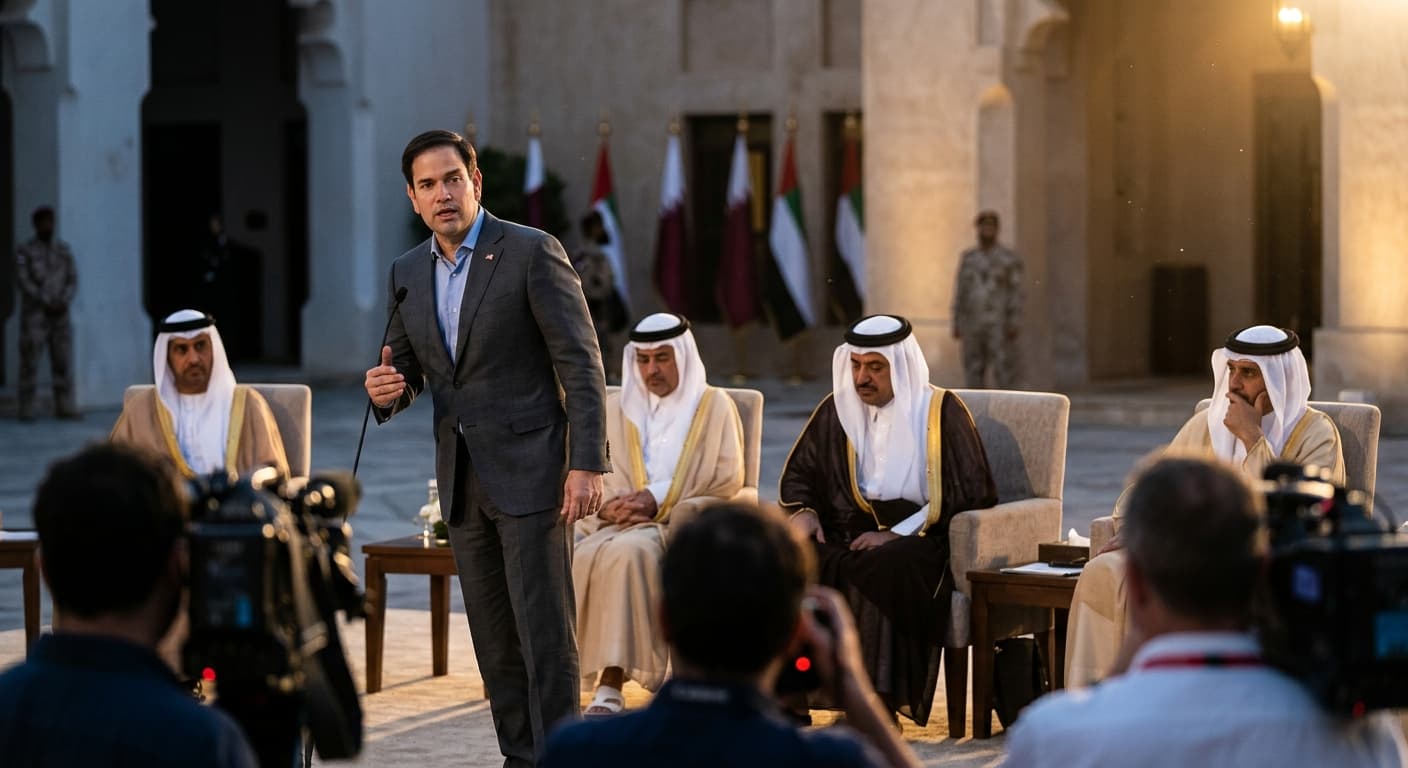
Rubio's Gulf Reassurance Tour Masks Lingering Iran Deal Doubts
US Secretary of State visits regional allies to defend Trump Iran agreement, but Gulf states remain wary of Tehran reconstruction fund and proxy militias.
Secretary of State Marco Rubio arrived in the Gulf on Tuesday for a three-day diplomatic blitz aimed at containing regional anxiety over the Trump administration's nascent agreement with Iran. The France 24 report captures the core tension: Rubio promised Gulf partners—primarily the
United Arab Emirates and
Kuwait—that Washington would "be completely aligned" with them and "not do anything that undermines the security of our allies." But his words reveal a deal structure that the region finds troublingly incomplete.
The framework Rubio is tasked with defending carries immediate red flags for Gulf states. The memorandum of understanding signed last week includes a proposed $300 billion reconstruction fund for Iran and sanctions relief—amounts that The Vibes reports have triggered concerns that Iran will leverage the capital to rebuild military capabilities damaged during the recent four-month conflict. The agreement notably omits provisions addressing Iran's ballistic missile program, the precise weapon that inflicted direct damage on the UAE and Kuwait during hostilities. That silence telegraphs what Rubio is now scrambling to manage: Gulf states feel exposed while their antagonist gains resources.
The blockade of the Strait of Hormuz—which Iran enforced during the war, disrupting roughly one-fifth of global oil and gas shipments—has also become a negotiating proxy. The Diplomatic Insight notes that Iranian officials have suggested introducing tolls on the transit route once the current 60-day arrangement expires. Rubio is insisting that
international law forbids such fees, but his repetition of that position signals that Gulf leaders are not yet convinced the US will enforce it.
Rubio has also tabled the proxy militia question—the most destabilizing gap in the accord. ANI News quotes him saying that "you can't have the end of hostilities and conflict in the region as long as Iranian proxies are launching missiles and drones from Iraq and are participating in terrorism." But the MOU itself does not explicitly address these networks. Rubio is attempting to reframe this as implicitly covered under a "complete end of hostilities" clause, a rhetorical move that suggests the provision is ambiguous enough that Gulf states will keep pressing for clarity in technical rounds now underway in Switzerland.
What's Actually on the Table
The Trump administration has begun a 60-day technical negotiation phase following Vice President JD Vance's talks in Switzerland over the weekend. That timeline matters: it sets a hard deadline for detail work before either side must decide whether to proceed or walk away. Rubio's regional tour is not principally diplomatic headway; it is damage control for an agreement that diverges sharply from Gulf expectations. The UAE suffered economic fallout as thousands of expatriate workers departed during the conflict. Kuwait and other GCC members want explicit long-term security guarantees—not reassurances that can be reinterpreted in Geneva.
What to Watch
The technical talks resume at month's end. Two decision points crystallize: First, whether the US concedes to explicit language on proxy militia constraints, ballistic missile limits, or Strait of Hormuz protections. Second, whether Iran agrees to IAEA nuclear facility inspections (which the administration has claimed but Iran has disputed). If Rubio returns from Bahrain's GCC gathering without Gulf states on record as "satisfied," the agreement's credibility with Congress and regional partners will erode further before the final settlement phase. That political floor matters as much as the contractual terms.
Discover more
Global Politics
Trump's Conflicting Messages on Iran War
Trump's mixed messages on Iran reflect a strategy of audience management, benefiting Tehran amid a complex geopolitical landscape.

International Relations
Pakistan's Key Role in US-Israel-Iran Meddle
Pakistan is seeking to mediate the US-Israel-Iran conflict, balancing high-stakes diplomacy against severe economic pressures and steep regional challenges.

Global Politics
US Seizes Iranian Ship, Tensions Surge
The US seizure of the Iranian ship Touska highlights a shift in control over the Strait of Hormuz, favoring Iran's strategic position.

Conflict & Security
Drone Warfare Killing Aid Workers at Unprec
Over 1,000 humanitarian workers killed in three years as cheap armed drones collapse legal protections. Gaza, Sudan, Ukraine, and DRC see deliberate targeting of aid convoys and hospitals with zero prosecutions.