Trump's Conflicting Messages on Iran War
Exploring Trump's strategy amid conflicting signals on Iran.
Model Diplomat8 min readMiddle East
Trump's Conflicting Messages on Iran War: Strategy or Improvisation?
Trump has whipsawed between peace and bombing threats for 130 days. On July 7, 2026, the pattern looks less like confusion than a controlled leak — and Iran is the beneficiary.
On the 130th day of the US-Israel war on Iran, President Donald Trump promised on July 5 that "neither side will shoot the other during the funeral proceedings" for the man he ordered killed on the war's opening day — and then, hours earlier, told an Axios reporter that Iranian officials at the ceremony could be eliminated with "one shot." That single 24-hour cycle captures the operating logic of Trump's war: the contradictions are the strategy, and the strategy is running out of room. This piece argues that Trump's mixed messaging on Iran is not improvisation but audience management — and that the beneficiary of the ambiguity is no longer the White House. It is Tehran.
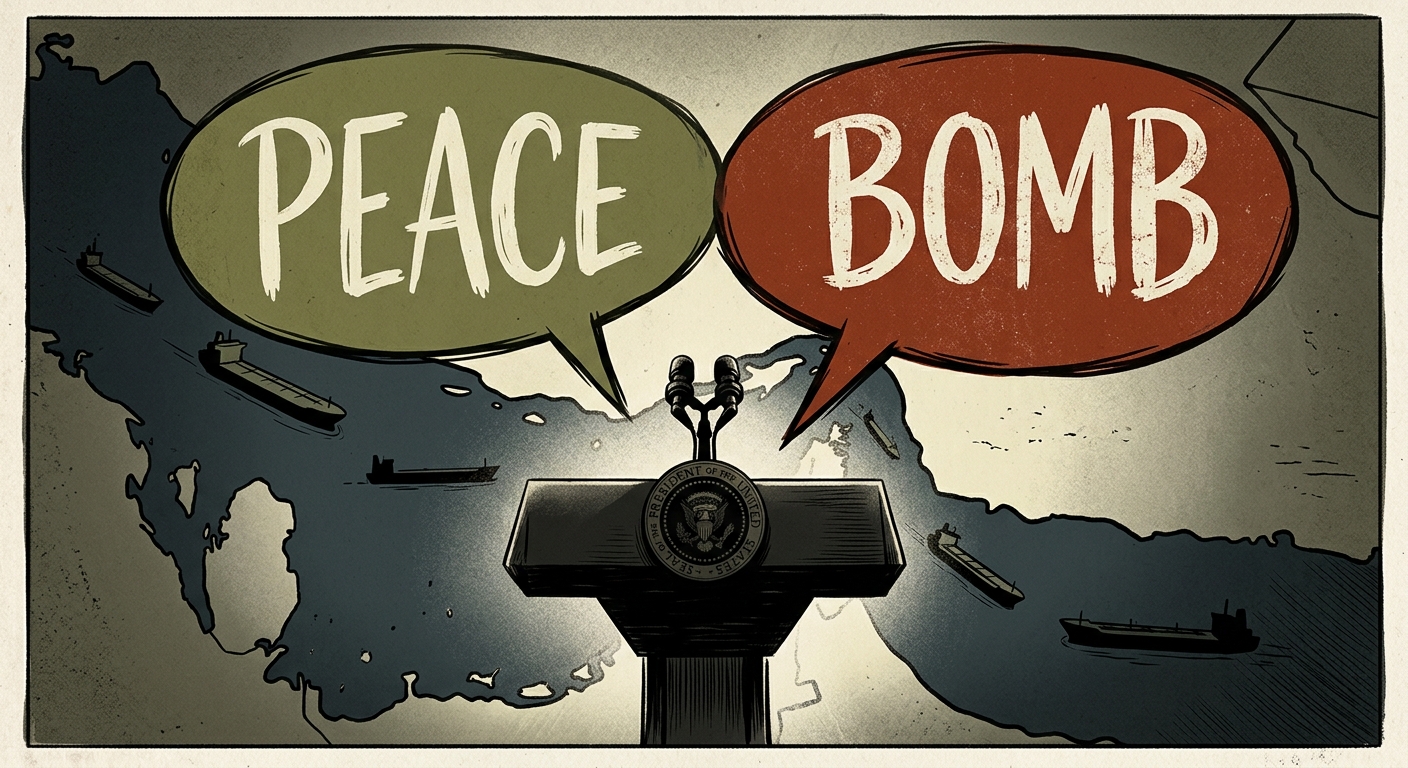
The pattern: peace by day, war by tweet
Since US and Israeli forces launched Operation Epic Fury on February 28, 2026, killing Supreme Leader Ayatollah Ali Khamenei and much of Iran's senior military command, Trump's public messaging has swung, sometimes hourly, between wind-down and escalation. The BBC catalogued a single Monday in June in which the president told reporters the operation was "very close to finishing" before adding, hours later, "we could go further. And we're going to go further," per its report on mixed messages from Trump. The Associated Press documented the same 24-hour arc across the Strait of Hormuz reopening — from Secretary of State Marco Rubio declaring the operation "concluded" to fresh bombing threats — in coverage carried by
WWLP.
The June 17 Memorandum of Understanding, signed by Trump and Iranian President Masoud Pezeshkian at the Palace of Versailles during the G7 Evian summit, was meant to end the argument. It has not. Per the BBC's account of the signing, the text commits both sides to a 60-day ceasefire, immediate reopening of the Strait of Hormuz with no transit charges, a $300 billion Iran reconstruction plan, and US termination of "all types of sanctions" — with the nuclear file punted into a 60-day negotiating window. Trump warned at the same event that the US would "bomb the hell" out of Iran if no final deal emerged.
Nine days after the signing, it nearly did. Following an attack on a cargo ship in the strait, Trump wrote on Truth Social — as the BBC quoted him — that "if that happens, the Islamic Republic of Iran will no longer exist," a threat carried in its
ceasefire breach coverage.
What the White House won't say out loud
Read alongside the MoU itself, the messaging is not random. It is choreographed for two audiences that want opposite things.
Audience one is the MAGA base, which broke for Trump in 2024 on an explicit anti-interventionist promise. The Council on Foreign Relations, tracking polling since Epic Fury began, found that 58 percent of Americans now oppose the war and just 35.7 percent support it — a widening gap since March. Even Republican approval of Trump's handling of the economy has fallen four points since February and his handling of inflation nine points. NPR's economic breakdown of the war's cost estimates the wartime gasoline surcharge is still adding
more than $360 million a day at the pump, with the average US household spending an additional $750 as of early June, per Moody's Analytics figures cited by
Al Jazeera.
Audience two is Tehran, which needs to believe Trump will re-escalate if the nuclear talks fail. Vice President JD Vance said on July 1 he could not "commit to anything" on whether the US would return to combat before the MoU deadline, per Al Jazeera's coverage of the Doha talks.
That is the operational logic of the ambiguity: telegraph peace to the base, threat to the adversary, and let each audience hear what it needs. The White House has, in effect, formalised this in its own talking-points memo, which frames the deal as ending "forever wars" while simultaneously insisting the "end of the fighting is not a hope. It is a precondition."
The audience-cost trap
Constructive ambiguity has a shelf life. Political scientist James Fearon's 1994 work on audience costs argues that leaders in democracies pay a compounding domestic price each time they walk back a publicly committed position. Writing for the Observer Research Foundation, analyst Rohan Venkat applies Fearon directly to the Iran standoff: "with midterm elections looming large, the domestic cost of conceding a defeat on Hormuz is enormous for Trump," per ORF's analysis. At the same time, the Iranian regime — governing through force after crushing the January protests — cannot be seen to surrender both its nuclear leverage and Hormuz.
The result is what Karim Sadjadpour of the Carnegie Endowment calls a Hail Mary. Sadjadpour told Carnegie's Emissary that the administration's real goal is a Kim Jong-un-style grand bargain — "$300 billion in Gulf investment, no more sanctions, no more isolation" versus renewed conflict — but that the Islamic Republic's revolutionary DNA makes rapprochement itself an existential threat. Suzanne Maloney, in the same conversation, judged the likelihood of meaningful, verifiable nuclear constraints in the 60-day window "almost nil."
The Council on Foreign Relations reached a similar verdict. Its post-MoU assessment concluded that Trump "has now concluded the conflict without a strategic victory — on terms that seem to favor Iran," noting that Tehran will retain enrichment capacity, a proxy network, and a de facto veto over Hormuz transit fees once the 60-day clock runs out.
Congress moved. Trump ignored it.
The mixed messaging masks a constitutional confrontation the administration is quietly losing. On May 14, 2026, the House deadlocked 212–212 on a War Powers Resolution demanding withdrawal from hostilities — three Republicans crossed the aisle, according to the House Clerk's roll call. On June 23, the Senate passed the same measure, H.Con.Res.86; per the
official statement from Senator Tim Kaine's office, it became the first war powers resolution to clear both chambers without requiring the president's signature. The text, catalogued on
Congress.gov, directs the president to remove US forces from hostilities against Iran absent explicit congressional authorization.
Trump has ignored it. The White House position, laid out in its MoU release, is that Operation Midnight Hammer and Operation Epic Fury delivered "decisive American strength" and that the MoU vindicates the campaign. Kaine, an Armed Services and Foreign Relations Committee member, called it a war launched "with no strategy, no endgame, no authorization from Congress."
That gap — between what the legislature has voted for and what the executive is doing — is precisely why the messaging matters. Ambiguity is Trump's only remaining answer to a Congress that has, on paper, revoked his war.
Who wins the ambiguity
Follow the money and the tankers. Since the MoU was signed on June 17, ship-tracking firm Kpler recorded 172 vessels crossing the Strait of Hormuz through June 27 — well below the pre-war average of 138 daily — with the majority using the Iranian-approved northern route through Iranian waters, per BBC Verify. Iran's Persian Gulf Strait Authority now issues transit permits. In practical terms, Tehran has converted a naval blockade it lost into a permitting regime it controls.
Oil markets have priced in the ambiguity. Brent crude closed at $72 on July 6, back below the $72.48 settlement price on February 27, the day before the strikes, according to Al Jazeera. But energy analyst Adi Imsirovic told Al Jazeera in a separate
assessment that "the oil market will never be the same, following this conflict" — a permanent risk premium the strait now carries because Iran demonstrated it could close it.
The Gulf International Forum's Madeline Stahle put the strategic verdict most plainly: the MoU is "an operational de-escalation framework with a limited strategic scope," achieving a halt in military action without altering the underlying balance of power, per her assessment. Iran's ballistic missile programme is untouched. Its proxies survive. Hezbollah, per CFR's read of the text, earned a reprieve because the White House lost the argument over whether the ceasefire binds Israel in Lebanon.
Meanwhile, Pakistan — the war's improbable mediator — has parlayed access into a $500 million crypto windfall for the Trump family's World Liberty Financial venture, per an Al Jazeera investigation published on July 3. Field Marshal Asim Munir, whom Vance publicly credited with brokering the framework, is now regularly referred to inside the administration as Trump's "favourite field marshal."
Diplomat View
The mixed messaging is not confusion. It is a controlled leak — a deliberate blurring calibrated for a MAGA base that wants out and an Iranian regime that must fear a return. The forecast: Trump will extend the 60-day MoU clock at least once past its August 16 expiry, because the alternative — restarting a war 58 percent of Americans oppose, three months before the November midterms — is politically radioactive. The Wall Street Journal has already reported, via Al Jazeera's summary, that Trump privately told advisers he prefers to give diplomacy a chance and would extend if needed.
What would revise the forecast: a mass-casualty Iranian strike on US personnel in the Gulf, a demonstrable IAEA finding of covert enrichment, or an Israeli operation in Lebanon that Netanyahu refuses to halt. Any of those hands the hawks — Hegseth, and increasingly Vance — the pretext to force Trump's hand. Absent them, the war ends not with a treaty but with a permanent ambiguity: a truce Iran can call victory, a deal Trump can call peace, and a Strait of Hormuz that has quietly become Tehran's toll road.
The audience-cost trap Fearon described is now Trump's operating environment. He can keep both audiences happy only so long as neither reads the fine print. On the current trajectory, one of them will.
What to watch
- August 16, 2026 — MoU 60-day clock expires. Watch for an extension announcement via Truth Social; the absence of one is the escalation signal.
- September 2026 — IAEA Board of Governors meets. Any Iran non-compliance finding hands Israel and US hawks the pretext to reopen the file.
- November 3, 2026 — US midterms. CFR polling suggests Iran is the one foreign-policy issue with the potential to move seats; a Democratic House flip would give Kaine and Schumer subpoena power over Epic Fury's authorization.
The Bottom Line
Trump's contradictions on Iran are not a communications failure — they are the load-bearing structure of a deal he cannot afford to explain to either audience honestly. The winner of the ambiguity is Iran, which traded Khamenei's life for regime survival, sanctions relief, and operational control of the world's most important oil chokepoint. The war ends, if it ends, not with victory but with a permanent grey zone — and every day the grey zone holds is a day Tehran, not Washington, is quietly setting the terms.
Discover more

Global Politics
US Seizes Iranian Ship, Tensions Surge
The US seizure of the Iranian ship Touska highlights a shift in control over the Strait of Hormuz, favoring Iran's strategic position.

Economics
Fed's Amex AML order puts correspondent banking on notice
Federal Reserve's Amex AML order requires board-level controls and a 90-day plan; OCC fined the bank $350 million over enterprise-wide deficiencies.

Conflict & Security
Guatemala: El Niño 2026–27 becomes regional security test
UNICEF: 25.8M children face El Niño risks in Latin America; Guatemala maps 188 municipalities for drought and food insecurity amid regional security test.

Economics
Fed's stress-test overhaul is a capital-smoothing exercise
Federal Reserve finalized stress-test overhaul: two-year averaging for bank capital buffers and public input, expected to halve volatility.