US Seizes Iranian Ship, Tensions Surge
Analyzing the implications of the Touska seizure in Hormuz
Model Diplomat8 min readPersian Gulf

US Seizure of Iranian Ship Touska: How Washington Lost Hormuz
The April 19, 2026 boarding of the MV Touska was the peak of US leverage in the Strait of Hormuz war. Two months later, Washington had already conceded the point.
The moment US Marines rappelled onto the 900-foot Iranian container ship Touska on April 19, 2026, looked like maximum American pressure. It was, in fact, the last day it held. Ten weeks later, the memorandum of understanding signed by Donald Trump at Versailles quietly accepts what the Touska seizure was meant to deny: that Iran, not the US Navy, will set the terms of transit through the Strait of Hormuz. The ship was the tactical win. The strait is the strategic loss. The unlikely winner is the Islamic Revolutionary Guard Corps, which walks away with a legal precedent for taxing 20% of the world's seaborne oil.
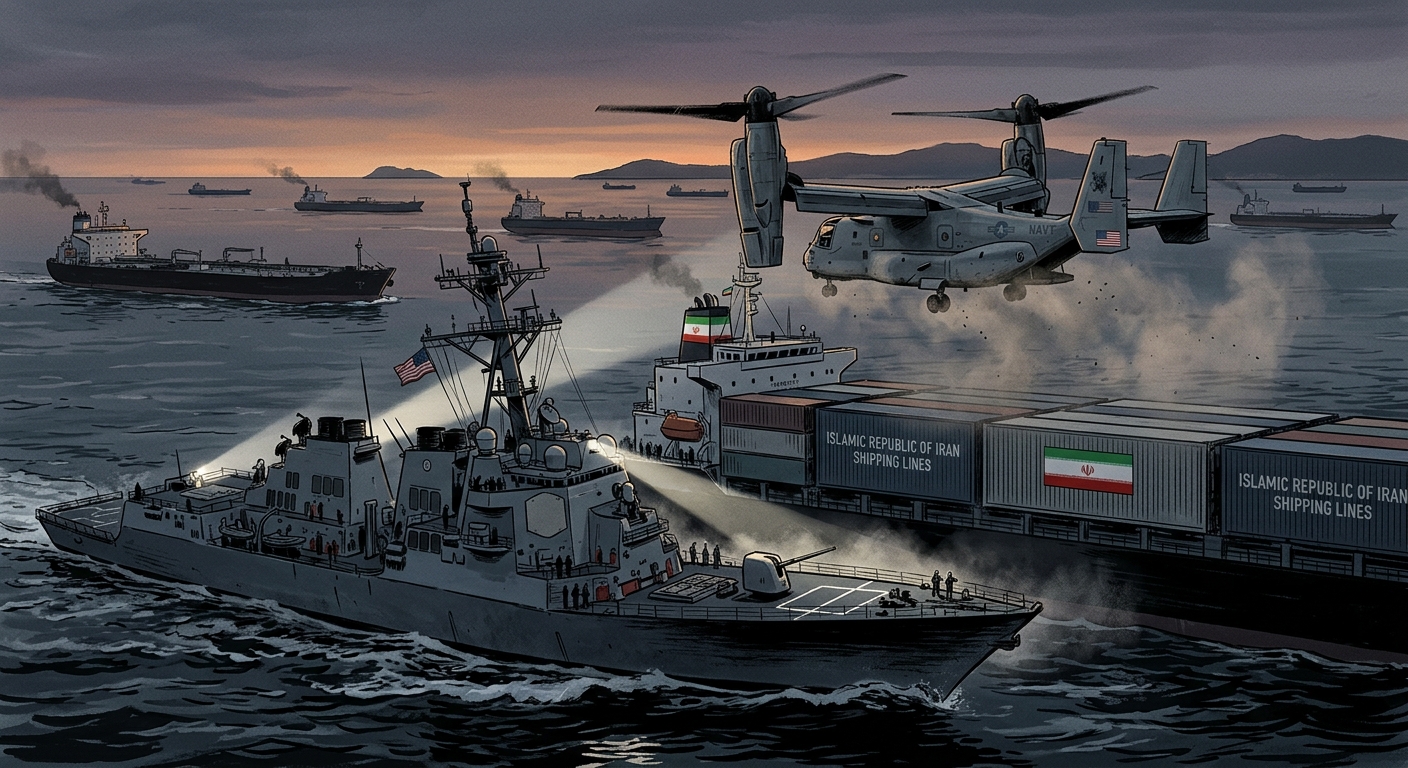
The seizure, on the record
At roughly midnight Iran time on April 19, the Arleigh Burke–class destroyer USS Spruance (DDG 111) fired its 5-inch MK 45 gun at the engine room of the Iranian-flagged Touska as the container ship crossed the northern Arabian Sea toward Bandar Abbas. According to the Al Jazeera reconstruction of the CENTCOM statement, the crew ignored warnings over a six-hour window before Spruance disabled the propulsion and Marines from the 31st Marine Expeditionary Unit rappelled from the amphibious assault ship USS Tripoli onto the deck.
Trump announced the operation on Truth Social within hours. "Our Navy ship stopped them right in their tracks by blowing a hole in the engineroom," he wrote, adding that the Touska was "under US Treasury Sanctions because of their prior history of illegal activity," per the BBC. That claim is verifiable: the vessel appears by IMO number on OFAC's Specially Designated Nationals list from the
November 2018 Iran sanctions publication, tied to the Islamic Republic of Iran Shipping Lines network that Treasury has been unwinding since 2008.
Iran's Khatam al-Anbiya joint command called it "armed piracy" and warned it would "soon respond and retaliate," according to state media reporting cited by NPR. Foreign Ministry spokesperson Esmaeil Baghaei cancelled Tehran's participation in the next round of Islamabad talks, which the Trump team — Steve Witkoff and Jared Kushner — was already boarding a plane for. The seizure was, in the narrow military sense, a clean operation. It was, in the diplomatic sense, an accelerant.
Why the Touska mattered — and why it didn't
The Touska was the first ship the US Navy took under the blockade Trump imposed on April 13, six days after the two-week Islamabad ceasefire began fraying. CENTCOM eventually deployed more than 12 warships and over 100 aircraft, and by April 29 said it had intercepted 42 commercial vessels and denied Iran the sale of 69 million barrels of oil, per BBC reporting on the blockade architecture. Brent crude jumped more than 4% on news of the Touska seizure, and by early May was trading above $114 a barrel as violence flared again — a level
Al Jazeera reported reflected market conviction that the strait would stay shut past whatever timeline Washington laid out.
Here is the analytical point that most of the wire coverage missed: the Touska seizure was the ceiling of US military leverage, not its opening bid. The US Navy demonstrated it could stop an Iranian-flagged ship at will in the Gulf of Oman. What it could not do was reopen the strait itself. Iran had mined the two central shipping lanes by early March and rerouted permitted traffic through its own territorial waters. As Brookings scholar Bruce Jones put it plainly in a June assessment of the deal, Iran had "withstood the US military barrage and come out with its capacity to threaten the straits essentially undiminished."
That asymmetry — the US can seize a ship; Iran can close the sea lane — dictated everything that followed.
The legal argument the seizure was supposed to win
Washington's boarding of the Touska rested on a specific claim: that the ship violated a lawful US wartime blockade under the law of naval warfare, itself layered on top of transit-passage rights codified in the 1982 UN Convention on the Law of the Sea. Iran's counter-position, spelled out in a Japan Institute of International Affairs legal briefing, is that neither state is a party to UNCLOS, that only "innocent passage" applies in the strait, and that a coastal state may condition or suspend such passage on security grounds.
The UN Security Council leaned toward Washington's reading. On March 11, 2026, it adopted Resolution 2817 by 13-0-2, condemning Iran's attacks on neighbours and reaffirming that "navigational rights and freedoms of merchant and commercial vessels, exercised in accordance with international law, must be respected." Tel Aviv's
Institute for National Security Studies reads 2817 as an institutional affirmation that transit passage is customary law binding even on non-parties like Iran. But a follow-on resolution to authorise defensive escorts through the strait was
vetoed on April 7 by Russia and China, with Colombia and Pakistan abstaining — a preview of how narrow the coalition backing US enforcement really was.
The Touska seizure was, in effect, Washington's answer to that veto: if the Council will not authorise coordinated enforcement, the US Navy will do it alone.
What the MoU actually concedes
Read the fine print of the 14-point memorandum Trump and Iranian President Masoud Pezeshkian signed on June 17 and the shape of the concession comes into focus.
"The Islamic Republic of Iran will conduct dialog with the Sultanate of Oman to define the future administration and maritime services in the Strait of Hormuz, in discussion with other Persian Gulf littoral states in line with the applicable international law and the sovereign rights of coastal states of the Strait of Hormuz."
That single sentence — Point 5 of the MoU — is the diplomatic legacy of the Touska. It legitimises the idea that Iran has "sovereign rights" over administration of an international strait. Point 4 requires the US to lift its blockade within 30 days. The "no charge" transit guarantee runs for only 60 days. Iran's parliament speaker and chief negotiator, Mohammad Bagher Ghalibaf, told reporters on signing day that the strait "will not return to pre-war conditions" and that Iran would "receive a fee for services," according to Al Jazeera's breakdown.
The mechanism is already built. Tehran established a Persian Gulf Strait Authority earlier in the war, modelled rhetorically on the Panama Canal Authority. Brookings analysts Samantha Gross and Ryan Beane report the PGSA is preparing tolls of up to $2 million per passage for very large crude carriers and has begun conditioning transit on political affiliation of the flag, crew, owner and destination. A June 2026
Bruegel analysis calculates that Gulf states would bear roughly 85% of the pass-through cost of such a toll — a de facto tax by Tehran on Riyadh, Abu Dhabi and Doha, collected by the IRGC.
The Center for a New American Security's Jonathan Odom is blunter, calling the arrangement an "illegal Tehran toll booth" and noting that the fragile ceasefire "does not appear to dismantle" it. AEI's Iran team has gone further, warning that acquiescence "would give Iran extraordinary leverage over the Persian Gulf" and let it "coerce Gulf states by threatening to bar their access." Read
their April brief alongside the MoU text and the gap is uncomfortable: the deal Trump signed at Versailles does not require Iran to renounce the toll regime; it only pauses it.
Who won, who lost
The clearest beneficiary of the Touska seizure, counterintuitively, is not the US Navy but the IRGC. It now has:
- A precedent. A signed US-Iran memorandum acknowledging Iran's "sovereign rights" in strait administration, jointly with Oman.
- A revenue stream. The PGSA's fee structure survives past day 60, with Ghalibaf openly saying it will resume.
- A strategic template. Iran demonstrated that mines, drones and small-boat swarms can neutralise the world's premier blue-water navy in a 21-nautical-mile chokepoint — a lesson every littoral autocrat is now studying.
The losers are more diffuse. Gulf Cooperation Council members pay the tolls. European refiners and Asian importers pay the risk premium; oil prices have stayed elevated even after the deal, with more than 250 tankers still stuck inside the Gulf as of early July per BBC ship-tracking analysis. And the US Navy's decades-long doctrine of freedom of navigation, which Brookings notes was rooted in Hugo Grotius's 1609 Mare Liberum, now carries an asterisk: it holds everywhere except where a well-armed coastal state disagrees.
The one clean American win is on paper. Point 8 of the MoU has Iran "reaffirm that it shall not procure or develop nuclear weapons" and commit to down-blending enriched uranium under IAEA supervision. Whether that survives the 60-day window is a separate question — and one on which Vice President JD Vance told reporters in Virginia Beach on July 1 that he "can't commit to anything," according to Al Jazeera coverage of the Doha talks.
What to watch next
- August 16, 2026 (approx.): The 60-day MoU window expires. If unextended, Iran's fee regime formally activates and the demining/US withdrawal schedule must be complete. Ghalibaf has already signalled fees resume; watch for the PGSA's published tariff schedule and for whether any major flag state (Marshall Islands, Liberia, Panama) instructs its registrants to comply.
- US Treasury general licences. The temporary OFAC waivers that let Iran sell oil in dollars during the ceasefire are time-limited. Renewal or expiry is the single biggest lever Washington retains before the deadline.
- Israel-Lebanon framework. Point 1 of the MoU commits to "immediate and permanent termination of military operations on all fronts, including in Lebanon." Any resumption of Israeli strikes — already flagged by Tehran as a violation — collapses the strait deal by default.
- China's Hormuz posture. Iran's ambassador to Beijing promised "special" treatment for "friendly countries," per
Al Jazeera on July 5. If Beijing formally accepts differentiated access, the Grotian order is over in practice.
Diplomat View
The bottom line is uncomfortable for Washington. The Touska seizure was a tactically flawless operation that solved nothing strategic. The US Navy can board an Iranian ship in the Arabian Sea; it cannot un-mine two shipping lanes without seizing Iranian coastal territory, and no one in the Trump cabinet is willing to do that. Faced with that gap, the administration accepted a memorandum that pauses — but does not reverse — Iranian control of the strait. The forecast that would revise this analysis: if Iran, under intra-regime pressure from a battered economy and $6 billion in promised unfrozen assets, agrees in the final deal to dismantle the Persian Gulf Strait Authority and accept a Malacca-style cooperative mechanism co-administered with Oman and the UAE, the concession is real. Absent that, expect the toll booth to open on schedule around August 16, expect Gulf capitals to pay it quietly, and expect the "war of blockades" — as BBC diplomatic correspondent Paul Adams has called it — to remain the default steady state. The Touska was not the beginning of American escalation. It was the last card Washington had to play, and it was played to force a settlement it did not particularly want. For
Global Politics watchers, that is the story worth remembering.
Discover more

US Politics
House GOP Rejects Limit on Trump's Iran War
The House narrowly rejected a resolution limiting Trump's military actions in Iran, exposing deep GOP divisions over war powers and presidential authority.

US Politics
GOP House Blocks Limits on Trump's Iran War
House Republicans narrowly defeated a resolution to limit Trump's war powers over Iran, intensifying the fight in Congress over presidential military authority.
Global Politics
House Rejects Iran War Powers Resolution
The House narrowly rejected a resolution to limit Trump's war powers in Iran, deepening political divides over the scope of U.S. military involvement abroad.

Economics
Fed's Amex AML order puts correspondent banking on notice
Federal Reserve's Amex AML order requires board-level controls and a 90-day plan; OCC fined the bank $350 million over enterprise-wide deficiencies.