West Africa Food Crisis: Three Shocks in 2026
Conflict, climate, and Hormuz closure drive a record hunger crisis
Model Diplomat4 min readAfrica
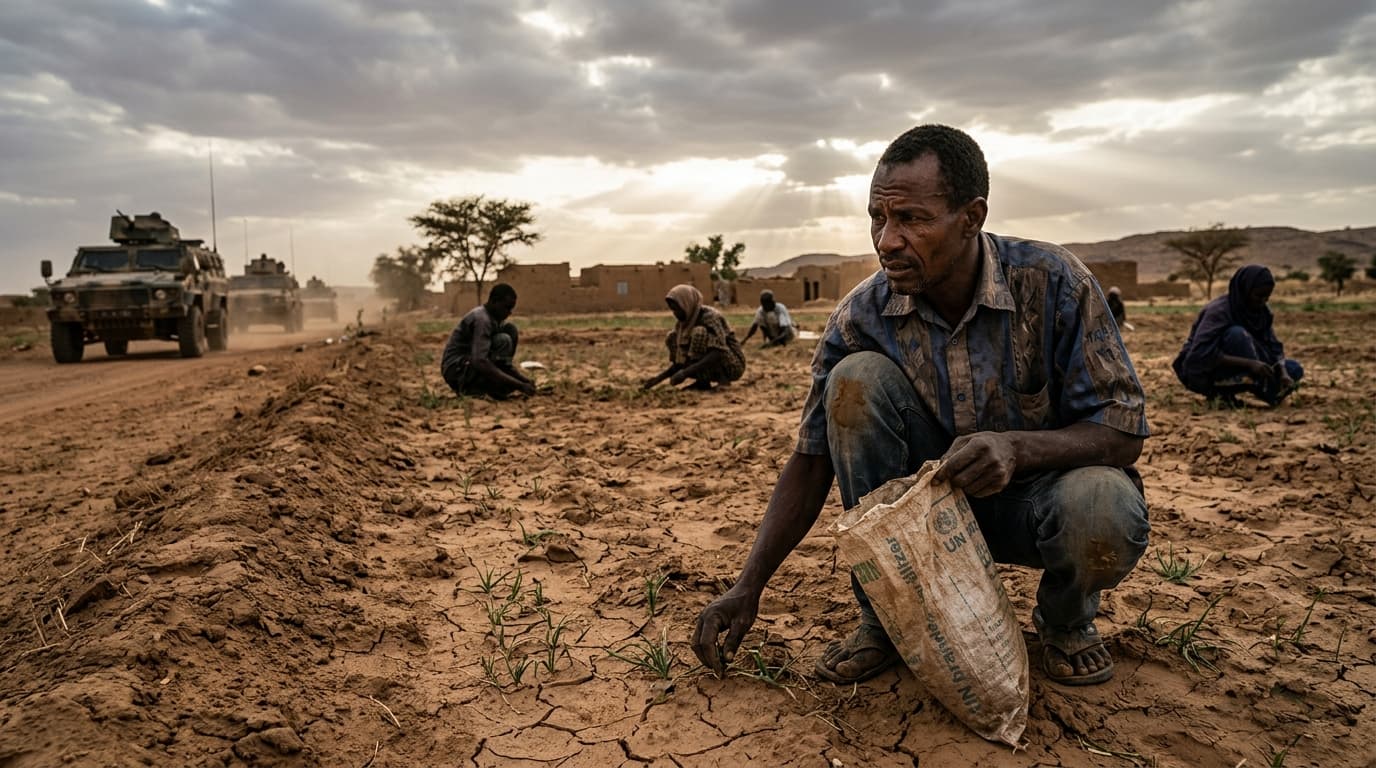
Shock One: Conflict Has Decoupled Food Production from Food Access
The FSNWG brief identifies conflict and insecurity as the primary driver, and the geographic concentration tells the story. The worst-affected populations cluster in three zones: the central Sahel (the tri-border area where Burkina Faso, Mali, and Niger meet), the Lake Chad Basin (northeastern Nigeria, Far North Cameroon, western Chad, and southeastern Niger), and increasingly, northern zones of coastal states — Benin, Côte d'Ivoire, and Togo — where insecurity has spilled southward from the Sahel.
In the Liptako-Gourma region alone, which spans parts of Mali, Niger, and Burkina Faso, the combined effects of conflict and climate stress have systematically dismantled agricultural livelihoods. The IMF notes that in Burkina Faso's Centre-Nord region, 30 percent of households have been displaced due to resource competition. Fatalities from security incidents across the West African Economic and Monetary Union (WAEMU) zone reached close to 14,000 in 2024.
The displacement numbers are staggering. Over 3.6 million people have been uprooted by violence across the central Sahel, according to UNICEF. In northeastern Nigeria alone, more than 2.3 million people remain internally displaced as of mid-2026, with Borno State host to nearly 1.7 million IDPs — more than a quarter of the state's total population, according to
IOM data cited in World Bank project documents. These are people who cannot farm, cannot access markets, and cannot rebuild stocks between harvests.
The FAO's representative in Nigeria, Kouacou Dominique Koffy, told the BBC: "Environ 52 millions de personnes souffrent d'insécurité alimentaire en Afrique de l'Ouest et les causes profondes sont les conflits, le changement climatique et les problèmes de gestion des sols."
What makes 2026 structurally different from earlier lean seasons is that conflict has now spread into areas previously considered agricultural surplus zones. In Nigeria's northwest and north-central states — Sokoto, Zamfara, Katsina, Kaduna — armed banditry has produced displacement patterns that rival the Boko Haram-affected northeast. The World Bank documented that between 2018/19 and 2023/24, partial crop losses in Nigeria more than tripled, and insecurity's contribution to total crop losses nearly doubled, reaching roughly one-fifth of national losses by 2023/24. In the northeast, the share of planted area that went entirely unharvested jumped from about 7 percent to nearly 27 percent.
The WFP's Nigeria country director, David Stevenson, captured the strategic dimension in late 2025: "The advance of insurgency presents a serious threat to stability in the north, with consequences reaching beyond Nigeria."
Shock Two: Climate Extremes Are Accelerating Faster than Adaptive Capacity
The FSNWG brief flags worsening pastoral conditions across the western and central Sahel driven by pasture and water shortages, bushfires, and insecurity-related restrictions on herd movement. The World Bank's May 2026 update notes that even with favorable rains boosting cereal production, pastoral conditions are deteriorating — a warning that the food security lens must extend beyond crops to livestock, which underpins livelihoods for more than 20 million people in the Sahel.
A 61 to 87 percent probability of El Niño emerging by mid-2026 and persisting into 2027, cited in the World Bank's June 2026 Food Security Update, introduces further risk. If realized, it could bring below-average rainfall to parts of the Sahel during the 2026/27 agricultural season, directly threatening the production gains that have, so far, kept the crisis from being far worse.
The climate-conflict feedback loop is now well documented. In northern Mali, some 2,600 people are expected to face catastrophic hunger (IPC Phase 5) — the highest classification before famine — according to UN agencies. These are not areas of crop failure. They are areas where conflict, displacement, and climate stress have converged to eliminate household coping capacity entirely.
Shock Three: Hormuz — the Distant Chokepoint that Hits the 2026 Planting Season
This is the FSNWG brief's most consequential warning, and the one that distinguishes July 2026 from every previous lean season projection.
The conflict in the Middle East, which escalated with US-Israeli strikes on Iran on February 28, 2026, has effectively closed the Strait of Hormuz. That chokepoint transits approximately 20 percent of global oil supplies, roughly one-third of global fertilizer trade, and 20 to 45 percent of key agrifood inputs, according to the FAO.
The fertilizer price impact has been immediate and severe. Urea prices surged above $850 per metric ton by April 2026 — an 80 percent increase since February and the highest level since April 2022, according to the World Bank. The Bank's April 2026 Commodity Markets Outlook projects fertilizer prices will rise 31 percent on average in 2026, reaching their worst affordability levels since 2022.
For West and Central Africa, the transmission mechanism is direct and unforgiving. The region imports roughly 80 percent of its fertilizer, according to analysis by Martin Fregene and Chakib Jenane in Al Jazeera. The FAO has estimated that even a 10 percent reduction in fertilizer availability could cut maize, rice, and wheat production by up to 25 percent in sub-Saharan Africa.
Critically, the timing is devastating. The FSNWG brief warns that the Middle East conflict is "increasing concerns about higher fuel, freight, and fertilizer costs" precisely as the region enters the 2026/27 planting season. Farmers making decisions now about input purchases face prices that have in some cases doubled. Those who cannot afford fertilizer will plant less, or plant without it — and the yield penalty will not become visible until the 2027 lean season, by which point the window for corrective action will have long passed.
The CSIS Global Food Security Program documented the mechanism: "Given the relative strength of the dollar, the currency in which fertilizers are traded, many African producers do not have the financial capacity to absorb price increases and could reduce use, further cutting yields and deepening food insecurity for those who rely on local markets."
Discover more

Global Politics
US Proposes Pakistan for Iran Talks Amid Ties
The US-Iran negotiations are now mediated by Pakistan, highlighting Islamabad's strategic role and the implications for regional diplomacy.

US Politics
House Ethics Committee Pushes Sexual Miscond.
The House Ethics Committee has shifted responsibility for sexual harassment settlement records to the Office of Congressional Workplace Rights, complicating disclosure efforts.

US Politics
White House Pressures Congress for Crypto Leg
The Trump administration's push for the CLARITY Act aims to reshape crypto regulation, impacting trillions in market value and the Trump family's wealth.

Conflict & Security
Drone Warfare Killing Aid Workers at Unprec
Over 1,000 humanitarian workers killed in three years as cheap armed drones collapse legal protections. Gaza, Sudan, Ukraine, and DRC see deliberate targeting of aid convoys and hospitals with zero prosecutions.

