House Ethics Committee Pushes Sexual Miscond.
Ethics Committee shifts sexual harassment records to OCWR
Model Diplomat7 min readUnited States
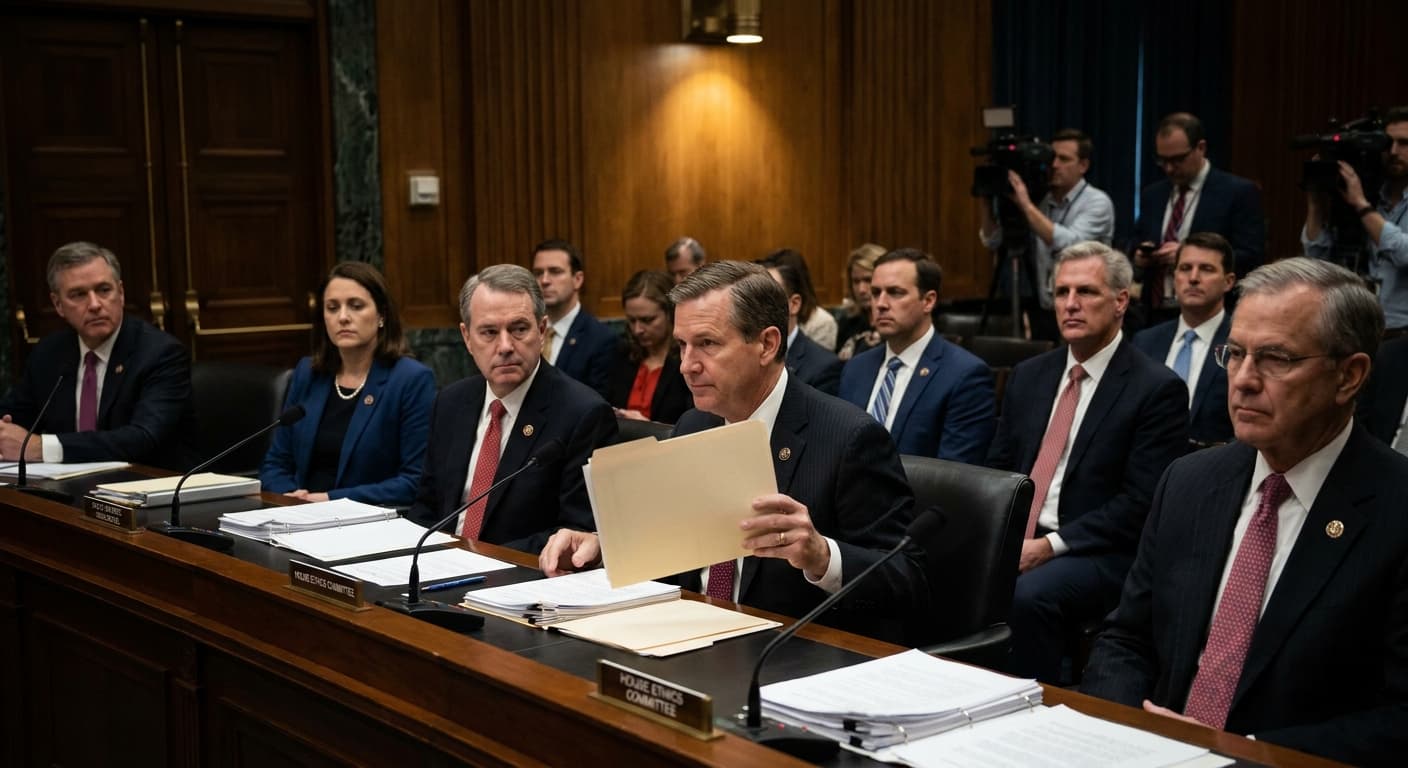
House Ethics Committee Pushes Sexual Misconduct Fight to OCWR
The House Ethics Committee says it has no role in sexual harassment settlements — a jurisdictional dodge that redirects the disclosure fight to the Office of Congressional Workplace Rights.
The House Ethics Committee, on July 2, 2026, publicly refused to take custody of the sexual harassment settlement records the House had just voted 424–0 to release — a jurisdictional dodge that quietly hands the political problem to a small legislative-branch agency, the Office of Congressional Workplace Rights, and all but guarantees the disclosure fight now spills into the fall. The committee's argument is narrow and correct on its face: since a 2018 reform, no member has been referred to it for reimbursing a taxpayer-funded harassment payout. What that answer leaves out is why: an OCWR subpoena in May turned up more than $300,000 paid on behalf of six former House members, and none of them were sitting when the referral trigger applied.
That is the story: the 2018 statute Congress passed to end the "hush fund" era created a referral mechanism with a design flaw wide enough to drive a resignation letter through. The Ethics Committee's July 2 statement, read against the record, is less a defense than a confession — and it puts Speaker Mike Johnson, OCWR Executive Director Susan Tsui Grundmann, and half a dozen members with active files on a collision course before the August recess.
The jurisdictional handoff
The committee's statement, posted April 20 and reaffirmed July 2, draws a bright line: "The Committee does not handle sexual harassment lawsuits or have any involvement in settlements of such claims." Under the Congressional Accountability Act Reform Act of 2018 — codified at
2 U.S.C. § 1415 — Ethics is only notified when a sitting member is personally required to reimburse the Treasury for a harassment award. Since December 2018, the committee says, that has happened exactly zero times.
Rep. Nancy Mace's May subpoena of OCWR punctures that clean number. According to The Hill, the documents show taxpayers "have paid over $300,000 in settlements on behalf of six former members of Congress or their offices." The reform statute's reimbursement trigger applies only to sitting members whose personal liability is separately established. Former members, or offices where liability is attributed to the "employing office" rather than the individual, sail past the referral mechanism. That is why the Ethics Committee can say — accurately — that it has been notified of nothing, while OCWR files show six cases.
On June 30, the House voted to close part of that gap. H.Res. 1399, sponsored by Rep. Thomas Massie (R-Ky.), passed on a unanimous voice-tally roll call directing both Ethics and OCWR to produce a "single consolidated list" of members who were the subject of investigations under House Rule XXIII or whose conduct resulted in a monetary settlement. The Ethics Committee's July 2 answer was, in effect: fine — but ask OCWR.
Why Ethics is walking away from the microphone
The committee has reasons beyond legalism to want distance. Its April 20 statement acknowledged 20 investigations into sitting members for sexual misconduct since 2017 — a figure it had never previously confirmed. The attached historical chart listed 28 matters in the committee's records overall, 15 of them publicly disclosed since 2017. That implies five sexual-misconduct probes since 2017 that were never announced. NOTUS has since reported that at least two involved Reps. Alma Adams (D-N.C.) and Jim Costa (D-Calif.), both closed without public findings — reporting summarized by
NewsNation.
That gap between "investigated" and "disclosed" is the wedge Mace has been driving since February. Her earlier resolution, H.Res. 1100, would have forced the release, within 60 days, of "all final reports, or in such cases where there is not a final report, the most recent draft report, conclusions, recommendations, exhibits, and attached or accompanying materials" for every clause 9 or clause 18 investigation — with victim identifiers redacted. On March 4, the House voted 357–65 to refer it back to the Ethics Committee, which is the parliamentary equivalent of a burial. NBC News reported at the time that the panel argued release "could re-traumatize victims and chill witness cooperation."
The July 2 statement leans on the same argument. "The greatest hurdle the Committee faces in evaluating allegations of sexual misconduct is in convincing the most vulnerable witnesses to share their stories," the committee wrote, adding that it "does not release transcripts of its interviews or share the source of allegations." That is a defensible institutional position. It is also one that keeps unfavorable material — including any inconvenient closed matters — off the record.
The resignations that broke the model
The committee's caution has been overtaken by the spring's political facts. Between April 13 and April 21, three House members resigned rather than see Ethics processes run to conclusion. Rep. Eric Swalwell (D-Calif.) quit on April 13, a day after suspending his gubernatorial campaign, as at least five women accused him of sexual misconduct ranging from harassment to rape; the Manhattan District Attorney's Office opened its own probe. Rep. Tony Gonzales (R-Texas)
followed on April 14, after admitting an affair with a staffer, Regina Santos-Aviles, who died by self-immolation in September 2025. Rep. Sheila Cherfilus-McCormick (D-Fla.)
resigned April 21, after the Ethics adjudicatory subcommittee found on March 26 that 25 of 26 counts against her had been proven by clear and convincing evidence in a disaster-relief campaign-finance case.
Each resignation stripped the Ethics Committee of jurisdiction. As NPR reported, the committee "loses jurisdiction once a lawmaker leaves office" — and lawmakers know it. Richard Painter, chief White House ethics lawyer under George W. Bush, told NPR the decision to resign was "a very good idea" for both men because enduring a full investigation would have been harder. It is also the mechanism by which the committee's disclosure record thins out: matters closed by resignation typically do not produce the "final report" H.Res. 1100 would have compelled.
The pipeline is not empty. Rep. Cory Mills (R-Fla.) is under an active investigative subcommittee established January 9, 2026, examining allegations that include an alleged 2024 assault at his D.C. residence — an arrest warrant the Metropolitan Police Department sought was, per the
censure resolution, refused by then-U.S. Attorney Ed Martin — plus revenge-porn threats that produced an October 2025 Florida restraining order. Rep. Chuck Edwards (R-N.C.) is now under Ethics review after Axios and NOTUS reported gifts and a handwritten note to a staffer.
What the primary documents show
The Ethics Committee's own reading of the 2018 statute is narrower than the statute itself. Public Law 115-397, Section 111, requires reimbursement — and thus automatic referral — only when "a violation described in subparagraph (C) [was] committed personally by an individual who, at the time of committing the violation, was a Member." For settlements, the trigger applies only where OCWR has already issued a formal notice of potential personal liability. Employing-office settlements, and settlements paid after a member has resigned or retired, fall outside. That is the drafting decision — made by a Congress that included many still-sitting members — that produced the July 2 disconnect.
Massie's H.Res. 1399 does not fix the statute. It only orders the two agencies to compile what they already have. The structural fix sits in H.R. 8300, the "Swalwell Act," which as introduced would prohibit any use of Treasury funds to pay workplace-misconduct settlements involving members or senior staff, impose personal liability, and mandate retroactive publication of every settlement paid since January 1, 1995. Its blockquote-worthy operative language:
No funds appropriated or otherwise made available from the U.S. Treasury may be used to pay any settlement, award, or judgment arising from a claim of workplace misconduct by a Member of Congress or a senior staff of the House of Representatives or the Senate.
That is the language leadership will have to decide whether to allow to the floor. Speaker Johnson has, per NewsNation, insisted the Ethics Committee should be allowed to finish its work before expulsion votes proceed — a position that satisfies neither Mace's disclosure caucus nor Rep. Anna Paulina Luna, who led the April expulsion push. The Senate has shown no appetite to move on any of it; H.R. 8300 has no Senate companion.
Diplomat View
The Ethics Committee's July 2 statement is the pivot point of this whole fight, not a footnote to it. By reasserting that settlements are OCWR's problem, the committee is doing two things at once: protecting a witness-confidentiality model it genuinely believes works, and quietly shifting the political cost of the next round of disclosures onto an executive-director-run agency with a $9 million budget and no political constituency. That handoff will hold through the summer — the Ethics Committee's investigations of Mills and Edwards proceed on their own track — but it will not hold through the fall. Expect OCWR's consolidated list, once produced under H.Res. 1399, to name former members whose successors are still in office, generating a second wave of political exposure the Ethics Committee cannot absorb even if it wanted to. The forecast revises if two conditions change: if Speaker Johnson allows H.R. 8300 or a stripped-down disclosure floor vote before the August recess, the balance of power moves back to the elected members; if OCWR resists the Massie directive on privacy grounds, as it did the Mace subpoena in part, the fight escalates into a subpoena-enforcement standoff that ends up in the D.C. Circuit. Watch OCWR, not Ethics.
What to watch next
- On or before August 29, 2026: OCWR's deadline to comply with H.Res. 1399 — the consolidated list of members subject to sexual harassment investigations or settlements.
- Fall 2026 markup: Whether House Administration schedules H.R. 8300 (the "Swalwell Act") or a competing leadership vehicle for markup before the continuing-resolution fight.
- Ethics Investigative Subcommittee on Rep. Cory Mills: Next procedural milestone expected in the fall; a Statement of Alleged Violations would be the first public inflection point.
- Rep. Chuck Edwards inquiry: Whether the committee publicly acknowledges the investigation, as it has for most 2017-era matters, or lets it close quietly — the tell for whether the April 20 "aggressive and robust approach" language has teeth.
Discover more
US Politics
Congress Targets AI Chatbot Access for Terror
The House passed the Generative AI Terrorism Risk Assessment Act, focusing on AI's role in terrorism and potential surveillance implications.
India
Congress Accuses Modi of Stalling Women's Law
Congress accuses Modi of stalling women's reservation law by linking it to delimitation, revealing a deeper electoral strategy.

Economics
Fed's Amex AML order puts correspondent banking on notice
Federal Reserve's Amex AML order requires board-level controls and a 90-day plan; OCC fined the bank $350 million over enterprise-wide deficiencies.

Conflict & Security
Guatemala: El Niño 2026–27 becomes regional security test
UNICEF: 25.8M children face El Niño risks in Latin America; Guatemala maps 188 municipalities for drought and food insecurity amid regional security test.