Ireland Tests ICJ Ruling With Settlement-Impo
Dáil passes bill banning settlement goods, citing ICJ opinion
Model Diplomat8 min readEurope
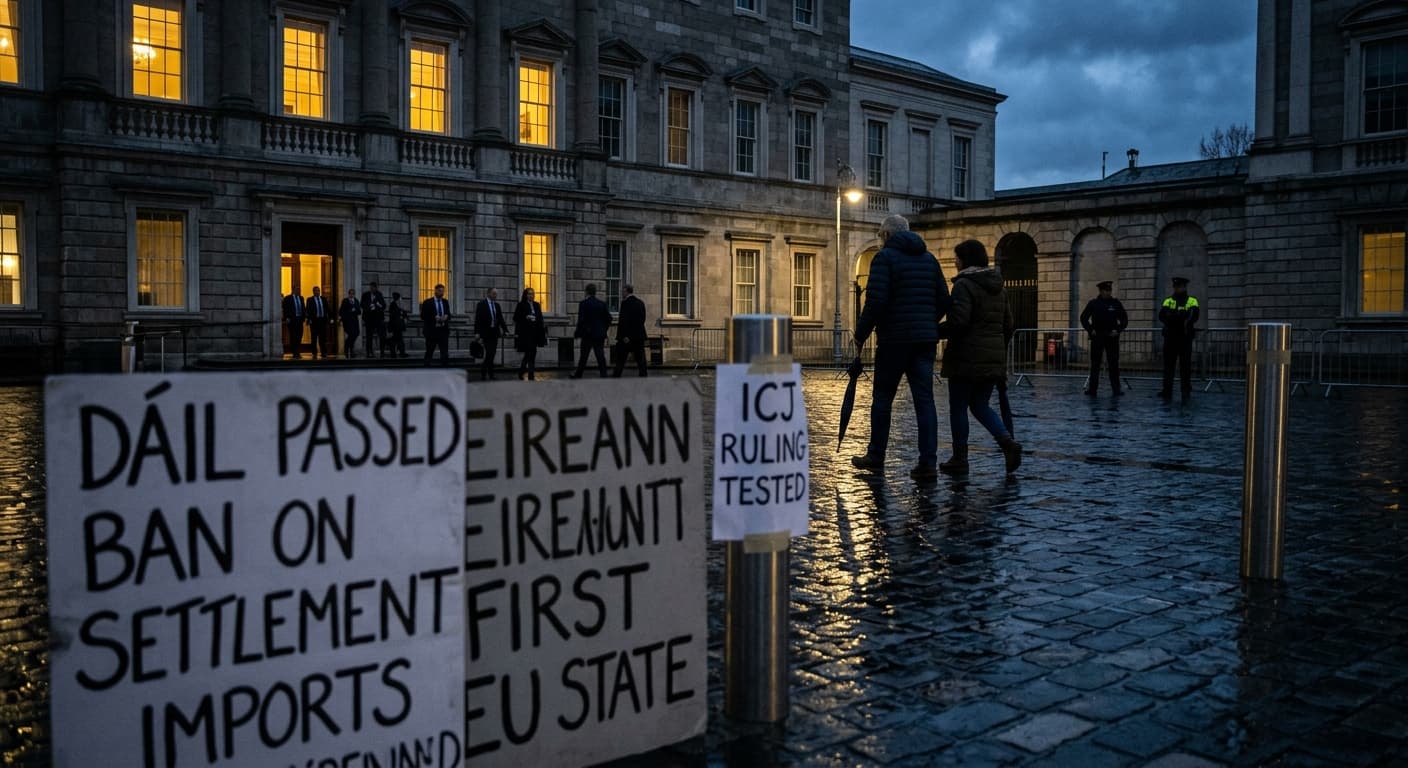
Ireland's Settlement-Import Ban Tests Whether EU States Can Enforce the ICJ's Occupation Ruling
Ireland's Dáil passed a bill banning imports of goods from Israeli settlements in the West Bank and East Jerusalem on July 7, 2026 — the first EU member-state law explicitly anchored in the ICJ's July 2024 advisory opinion that Israel's occupation is unlawful, and a test case for whether national trade restrictions can operationalize international-court rulings the bloc has been unable to act on collectively.
On July 7, 2026, Ireland's Dáil approved the Israeli Settlements (Prohibition of Importation of Goods) Bill, making it the first EU member state to legislate an explicit import ban on goods from Israeli settlements in the occupied Palestinian territories — West Bank and East Jerusalem — while leaving trade with Israel within its internationally recognized borders untouched. The bill now moves to the Seanad, where debate is expected the week of July 13, and Minister for Foreign Affairs Helen McEntee has pledged enactment before the summer recess. The immediate commercial impact is negligible: trade between Ireland and the settlements was worth less than €1 million between 2020 and 2024. The legal and political impact is not. Ireland is using national law to test whether the International Court of Justice's July 19, 2024 advisory opinion — which found Israel's occupation unlawful and told all states to abstain from trade that entrenches it — can be operationalized one member state at a time, circumventing a paralyzed EU.
The ICJ ruling and what it demands of third states
The ICJ's advisory opinion of July 19, 2024 found Israel's continued presence in the Occupied Palestinian Territory unlawful in its entirety, citing sustained violations of two peremptory norms: the Palestinian right to self-determination and the prohibition on acquiring territory by force. Crucially for trade policy, the Court did not confine its findings to Israel. It held that all states have an obligation "to abstain from entering into economic or trade dealings with Israel concerning the [OPT] … which may entrench its unlawful presence in the territory," and "to take steps to prevent trade or investment relations that assist in the maintenance of the illegal situation created by Israel" (ICJ Advisory Opinion, 19 July 2024;
Government of Ireland, 26 May 2026).
That language is the hinge on which Ireland's bill turns. McEntee framed the legislation explicitly as compliance: "The Bill will positively contribute towards Ireland's compliance with its international legal obligations as identified in the 2024 ICJ Advisory Opinion, including that states should take steps to prevent trade or investment relations that assist in the maintenance of the illegal situation created by Israel in the occupied Palestinian territory" (Government of Ireland, 26 May 2026). This is the first time an EU member state has enacted a trade measure that cites the ICJ opinion as its direct legal basis — converting an advisory, non-binding ruling into a domestic enforcement instrument.
Human Rights Watch has argued this framing is not optional. In a June 30, 2026 briefing, the organization wrote that "the only 'option' that complies with international and EU law is a ban," and that the Commission's claim that existing tariff differentiation satisfies the ICJ's obligations is "patently flawed" because preferential-tariff exclusion still permits settlement goods to enter the EU market (Human Rights Watch, 30 June 2026).
The EU's paralysis — and Ireland's workaround
The EU has been unable to act collectively. Under the EU's Common Commercial Policy (Article 207 TFEU), trade with third countries is an exclusive EU competence; in principle, only the EU can prohibit imports, not individual member states (European Parliament answer to written question E-002960/2021). A 2019 Commission reply to the Irish parliament stressed that "only the EU can decide to prohibit the importation of goods and services and not the Member States individually" and warned it "would take action to remove such measures" if it considered them disproportionate (
European Parliament, 2021).
That is the legal trap. But the political dynamic has shifted. Nine EU foreign ministers — Belgium, Finland, Ireland, Luxembourg, Poland, Portugal, Slovenia, Spain and Sweden — wrote to EU foreign policy chief Kaja Kallas in June 2025 pressing for bloc-wide proposals (Al Jazeera, 9 Feb 2026). Commission President Ursula von der Leyen proposed partial suspension of trade concessions with Israel in September 2025, but Germany and Italy have blocked the measure, which requires a qualified majority (
Amnesty International, May 2026;
European Commission, 17 Sept 2025). As of July 2026, no EU-wide ban is in force.
Ireland's calculation is that unilateral action builds momentum the Commission cannot ignore. McEntee said as much: "While we are moving ahead at the national level, it remains the Government's preference that collective action would be taken at EU level. This will have greater impact and I will continue to actively pursue this" (Government of Ireland, 26 May 2026). Dublin is, in effect, daring the Commission to either bring infringement proceedings against a member state invoking an ICJ ruling — a politically explosive move — or finally table a bloc-wide proposal. The Commission is expected to present "a list of options" to restrict settlement trade at the July 13 foreign ministers' gathering (
Human Rights Watch, 30 June 2026).
A widening band of national bans
Ireland is not alone, and the pattern reveals the fissure. Slovenia banned settlement-goods imports in August 2025. Spain followed with a royal decree in September 2025, enforced from January 1, 2026, banning both trade in and advertising of services from illegal settlements (Al Jazeera, 16 Feb 2026). The Netherlands agreed to a ban on May 22, 2026 (
NL Times, via HRW). Norway, outside the EU, announced plans in June 2026 to prohibit all trade with Israeli settlements, including real estate and services, with consultations open until September 19 (
Al Jazeera, 19 June 2026). Belgium is advancing legislation; Oxfam has urged it to make the ban effective (
Belga News Agency, via HRW).
The approaches differ in scope and legal basis. Spain used a decree under existing EU import rules, framing its ban as an "exceptional measure" (The National, 1 May 2026). Norway's proposal reaches into services, property, and corporate acquisitions. Ireland's bill, by contrast, is narrowly drawn: it prohibits the importation of goods from settlements and empowers customs officers to stop and seize restricted goods under section 14 of the Customs Act 2015 — but it does not cover services, and it does not ban exports to or investment in settlements (
Novara Media, 10 July 2026).
What the bill leaves out — and who noticed
The gap between ambition and scope is the bill's most contested feature. During the Dáil debate, People Before Profit–Solidarity TD Paul Murphy accused the center-right Fianna Fáil–Fine Gael coalition of having "absolutely gut" the legislation. "The occupied territories bill, which everyone understood to mean goods and services, is now being gutted to remove the majority of trade," he said. "We know that on average, 70% of trade is in services rather than goods and that 70% is now being removed" (Novara Media, 10 July 2026).
Amnesty International has made the same critique from the other direction. In July 2025, the organization's secretary general urged Ireland to "strengthen" the bill "to include banning all imports and exports of goods and services to and from Israeli settlements in illegally occupied Palestinian territory, as well as investments in them," calling the goods-only approach insufficient to meet ICJ obligations (Amnesty International, July 2025). The Irish government's choice to limit the bill to goods — and only imports, not exports — appears designed to minimize the risk of an EU legal challenge over Common Commercial Policy competence, while still claiming ICJ compliance. It is a deliberate trade-off: narrower scope for faster passage and lower legal exposure.
The corporate due diligence dimension
The bill also lands amid a fight over corporate accountability. The EU's Corporate Sustainability Due Diligence Directive (CSDDD), which entered into force in July 2024, requires large companies to identify and address human rights and environmental harms across their supply chains. A June 2025 expert legal opinion commissioned by EU lawmakers concluded that the ICJ advisory opinion must be read in conjunction with the UN Guiding Principles on Business and Human Rights, meaning companies trading with settlements face "enhanced due diligence" obligations and potential criminal liability where international crimes are implicated (University of Groningen expert opinion, June 2025).
But the CSDDD itself was gutted in December 2025, when the European Parliament approved amendments reducing the number of covered companies by 70% — from 3,363 corporate groups to 980 — and delaying binding application to July 2029 (Human Rights Watch, 16 Dec 2025). The core obligation to conduct due diligence across the whole supply chain survived, but the narrowing means fewer firms are covered and enforcement is fragmented across 27 member states. Ireland's bill, by imposing a hard import prohibition enforced at the customs border, does an end-run around due diligence's softer, risk-based logic: it does not ask companies to assess and mitigate; it tells them they may not import at all. For the narrow category of settlement goods reaching Ireland, a categorical ban is a sharper instrument than a due diligence regime that most firms no longer fall under.
The strategic logic
Ireland's move is less about the €1 million in settlement goods than about precedent. Dublin has long positioned itself as the EU's most vocal critic of Israeli conduct — it was the first EU state to use the phrase "de facto annexation" in 2021 (Al Jazeera, 26 May 2021). The 2026 bill is the legislative payoff. By acting unilaterally, Ireland creates a legal template other states can copy, pressures the Commission to harmonize rather than litigate, and demonstrates that the ICJ opinion is not a dead letter. The risk is fragmentation: a patchwork of national bans with divergent scopes and enforcement mechanisms could distort the single market and invite exactly the infringement proceedings the Commission warned about in 2021. The reward, from Dublin's perspective, is that the patchwork makes a bloc-wide ban the path of least resistance.
What to watch
- Seanad debate, week of July 13, 2026 — The upper house is expected to approve the bill, the final legislative hurdle before enactment. McEntee has pledged passage before the summer recess.
- EU Foreign Affairs Council, July 13, 2026 — The European Commission is expected to present options for bloc-wide restrictions on settlement trade. Whether it proposes a full ban, tariffs, or an export-licensing regime — and under which legal basis — will determine whether Ireland's bill becomes the floor or the ceiling.
- Germany and Italy's position — Both states have blocked suspension of the EU-Israel Association Agreement. A qualified majority on any settlement-trade measure runs through Rome and Berlin. Italy's recent, partial support for restricting settlement imports suggests it may be moving (
Amnesty International, May 2026).
The Bottom Line
Ireland's settlement-import ban is a €1-million trade measure with a million-vote geopolitical function: it converts the ICJ's non-binding advisory opinion into enforceable national law, daring the European Commission to either harmonize or sue a member state for complying with international law. The bill's narrow goods-only scope is a deliberate concession to EU competence rules — and its critics' strongest point — but the precedent it sets is that an EU state can legislate ICJ compliance unilaterally. Whether that precedent fragments the single market or forces a bloc-wide ban depends on what the Commission tables on July 13.
Discover more
US Politics
SNAP Food Assistance Faces Legal Challenges
In 2026, SNAP faces stricter eligibility rules and mounting legal challenges, threatening food assistance for the millions of Americans who rely on the program.
India
700 Activists Accuse PM Modi of MCC Breach
Over 700 activists allege PM Modi breached election code with a televised address attacking opposition parties just before state elections.

Global Politics
US Seizes Iranian Ship, Tensions Surge
The US seizure of the Iranian ship Touska highlights a shift in control over the Strait of Hormuz, favoring Iran's strategic position.

Economics
Fed's Amex AML order puts correspondent banking on notice
Federal Reserve's Amex AML order requires board-level controls and a 90-day plan; OCC fined the bank $350 million over enterprise-wide deficiencies.