U.S. Grants UAE License-Free AI Chip Access
U.S. reclassifies UAE to A:5, rewarding G42's China divestment and war sacrifices.
Model Diplomat8 min readMiddle East
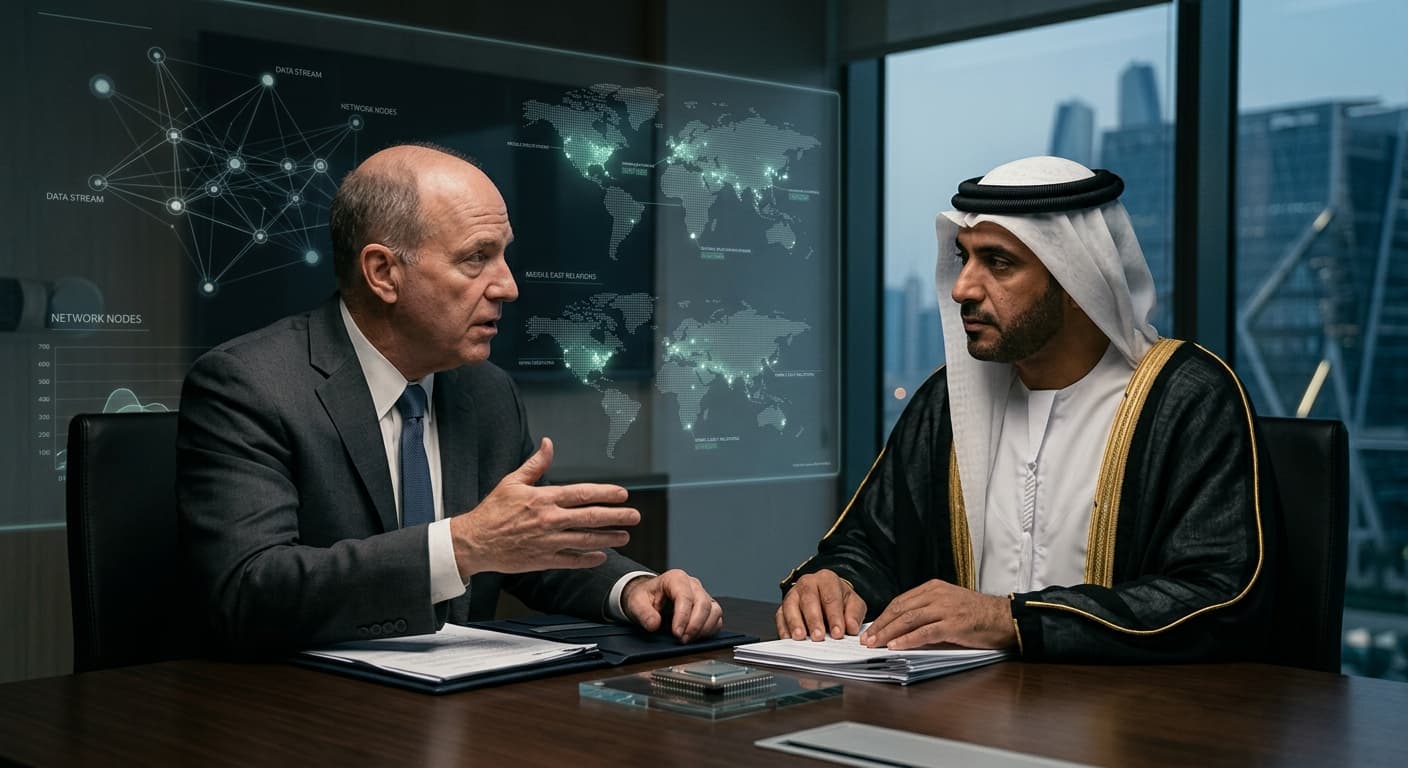
UAE Wins License-Free AI Chip Access as U.S. Trades Tech for Loyalty
The Commerce Department's July 10, 2026 reclassification of the UAE into Country Group A:5 grants G42, Core42, and five U.S. tech giants license-free access to advanced AI chips and defense technology — the payoff for G42's China divestment, a $1.4 trillion framework, and Emirati battlefield losses in Operation Epic Fury.
The U.S. Department of Commerce moved the United Arab Emirates out of restrictive EAR Country Groups D:3 and D:4 and into Country Group A:5 on July 10, 2026, granting approved Emirati entities including G42 and Core42, along with five named American companies, license-free access to advanced AI computing chips, servers, defense-related technologies, and commercial satellites under the Strategic Trade Authorization program, according to Quiver Quantitative. The rule, published in the Federal Register and citing the UAE's designation as a U.S. Major Defense Partner and its role in Operation Epic Fury, is no technical adjustment. It is the culmination of a deliberate 18-month strategy in which Washington traded its most sensitive technology for Emirati strategic alignment, converting the
UAE from a China-diversion risk into a forward outpost of American AI infrastructure. The wager: G42's partial China divestment and Emirati battlefield losses are worth more than the non-proliferation logic that governed U.S. export policy for a decade.
From Tier 2 to A:5: How the UAE Escaped the Back Row
The architecture the UAE just escaped was built in the final days of the Biden administration. On January 15, 2025, the Bureau of Industry and Security published the Framework for Artificial Intelligence Diffusion, a global licensing regime that sorted the world into three tiers, according to the Congressional Research Service. Tier 1, comprising 18 close allies including the United Kingdom, Japan, and Australia, faced no licensing. Tier 3, covering China, Russia, and North Korea, faced a presumption of denial. The UAE landed in Tier 2, a catch-all of roughly 150 countries subject to per-company, per-country computing-power caps and a data-center Validated End User program. Gulf powers with deep U.S. military ties were furious at being grouped alongside geopolitical swing states, as the
Council on Foreign Relations documented.
The Trump administration killed the rule on May 13, 2025, days before it would have taken effect, citing its burden on U.S. industry and diplomatic relationships, per the U.S. Government Accountability Office. The GAO later determined that Commerce's press-release rescission itself constituted a "rule" subject to the Congressional Review Act — a finding that underscored how aggressively the administration moved to clear the regulatory path. By January 2026, Commerce had codified the shift from a "presumption of denial" to "case-by-case review," as the
Center for American Progress reported, effectively lowering the barrier for high-end transfers to the UAE.
Wednesday's A:5 reclassification goes further still: it removes the licensing requirement for entire categories of controlled items. License Exception STA, codified at 15 CFR §740.20, authorizes exports, reexports, and in-country transfers for items controlled for national security, nuclear nonproliferation, regional stability, and other reasons to destinations in Country Group A:5 — a club that includes NATO allies and close security partners. The UAE now sits in that group. NVIDIA, Broadcom, Oracle, Amazon, Apple, Meta, and Microsoft are listed as eligible for license-free exports to qualifying UAE operations, per the Quiver Quantitative report. For NVIDIA, whose Blackwell-class GPUs remain banned for direct export to China, the UAE becomes a legitimate channel for massive frontier-compute deployment outside U.S. borders.
The Price of Admission: G42's China Divestment and the Security Bargain
The reclassification did not happen in a vacuum. It is the payoff for a sequence of strategic concessions that began in 2024 and accelerated through 2025-2026.
G42, the UAE's flagship AI company chaired by National Security Advisor Sheikh Tahnoon bin Zayed, was until recently a Washington worry. In January 2024, the House Select Committee on the Chinese Communist Party sent a letter to the Commerce Department requesting an investigation into G42's ties to sanctioned Chinese entities including Huawei, Beijing Genomics Institute, Tencent, and ByteDance, citing "credible evidence" that G42's CEO Peng Xiao operated "an expansive network of UAE- and PRC-based companies that develop dual-use technologies and materially support PRC military-civil fusion," according to the Select Committee letter. The committee urged BIS to consider adding G42 and subsidiaries including DarkMatter and G42 Shanghai Investment Co. to the Entity List.
G42 responded by severing ties with Huawei in December 2023, divesting its ByteDance stake in February 2024, and securing a $1.5 billion Microsoft investment in April 2024 that came with binding conditions: military-grade encryption, audits by U.S. Defense Department contractors, prohibitions on using the chips or Microsoft services for surveillance, and a requirement to seek Microsoft's permission before sharing technology with other governments or militaries, as the Center for Strategic and International Studies detailed. But the divestment was never complete: G42 maintained connections with BGI, Sinopharm, and Tencent even after the Microsoft deal, according to Israel's
Institute for National Security Studies. Washington's skepticism, as CSIS noted, never fully dissipated.
What changed the calculus was scale and loyalty. In May 2025, the U.S. and UAE announced a framework under which the UAE would purchase 500,000 advanced NVIDIA chips annually from 2025 to 2027, part of a $1.4 trillion economic and technology framework, as AGBI and
The Startup Scene reported. The first batch arrived in late May 2026, announced by UAE Ambassador Yousef Al Otaiba. Of the 500,000 annual chips, roughly 100,000 — 20 percent — were earmarked for G42 itself, per the Center for American Progress analysis, the same entity the Select Committee had urged be blacklisted two years earlier.
The scale matters. The Carnegie Endowment estimated that a deal allowing more than 400,000 H100-equivalent chips over two years would put a Gulf company on track to build frontier-scale data centers, and that more than one million H100-equivalents by 2027 — the figure reportedly contemplated for G42 — "could be enough to build the world's largest AI training cluster," as Carnegie assessed. License-free access removes the last procedural friction between that scale and deployment.
Operation Epic Fury: The Battlefield Ledger
The rule's explicit citation of Operation Epic Fury is not boilerplate. The U.S.-Israel war against Iran, launched February 28, 2026, transformed the UAE from a hedging Gulf state into a frontline belligerent — and gave Washington a ledger of Emirati sacrifices to reward.
Iran targeted all GCC states between February 28 and May 17, 2026, firing more than 6,700 drones and missiles, according to the Congressional Research Service. The UAE absorbed the heaviest strikes: by March 9, Tehran had launched 1,440 drones, eight cruise missiles, and 253 ballistic missiles at Emirati territory, according to the
Hudson Institute. The UAE achieved a 90 percent interception rate, using AH-64E Apache gunships against Shahed drones. The war fundamentally shifted Abu Dhabi's approach to Iran from rapprochement to outright hostility. In May 2026, the UAE withdrew from OPEC — an extraordinary break with its Gulf neighbors — and for the first time permitted Israeli troops to operate an Iron Dome missile defense system on Emirati soil, per CRS. The Trump administration invoked emergency provisions of the Arms Export Control Act to expedite over $30 billion in munitions and air and missile defense equipment to Israel, Jordan, Kuwait, Qatar, and the UAE, bypassing congressional review.
The A:5 reclassification is the technology-policy analogue of those emergency arms sales. The UAE bled for the U.S.-led coalition; the A:5 designation is the receipt. The rule's framing — Major Defense Partner, Operation Epic Fury — makes the transaction explicit. It also makes it harder to reverse: having formally elevated the UAE into the same export-control tier as NATO allies, walking it back would require acknowledging that the security bargain failed.
The China-Diversion Risk Has Been Monetized, Not Eliminated
The core vulnerability that animated the original controls — that Emirati access to frontier chips could serve as a conduit to China — has not disappeared. It has been reframed as manageable through the Microsoft-G42 governance architecture and the threat of future license cutoffs, a leverage point Carnegie emphasized because "AI chips last only three to five years before they need to be replaced."
But the governance architecture has a sovereignty-shaped hole at its center. As the International Institute for Strategic Studies observed, the UAE has accepted U.S. conditions on G42's technology relationships while simultaneously investing in France's Mistral and experimenting with Chinese Alibaba-derived model architectures. Gulf AI strategy is "an effort to manage different types of dependencies" — not to eliminate them. The IISS warned that if Washington extends conditions from the hardware layer to the model layer — requiring that U.S.-sold chips cannot run Chinese open-source models — it would "transform the sovereignty equation" and potentially accelerate Gulf diversification toward non-American hardware.
The diversion risk is also political, not just technical. House Democrats, led by Rep. Sydney Kamlager-Dove, sent a letter requesting an investigation into whether Sheikh Tahnoon's 49 percent stake in President Trump's crypto venture, World Liberty Financial — purchased months before the chip-sale approval — constituted a financial conflict of interest that "compromised U.S. export controls and national security decision-making," according to the congressional letter. The Center for American Progress separately detailed a $50 million investment by Sheikh Tahnoon in a Trump family cryptocurrency venture and noted that the administration's loosening of export controls followed "less than two weeks after this deal." Whether these financial links influenced the policy is unproven; that they coincide with the largest unilateral loosening of AI chip controls in the export-control regime's history is a matter of record.
The broader strategic logic, as CFR argued, is that the U.S. has pivoted from a Cold War non-proliferation model — restricting diffusion to prevent new entrants — to a diffusion model in which "the diffusion of U.S. technology — and an effort to box out Chinese technology — is of paramount importance." The UAE is the test case. The Pax Silica framework, a State Department-led coalition of countries securing access to AI inputs, counts the UAE, Israel, and Qatar among its twelve signatories, as the Atlantic Council noted. The bet is that American chips, once embedded in Gulf infrastructure, create switching costs that make defection to Chinese alternatives prohibitively expensive.
Diplomat View
The A:5 reclassification is a grand-strategy wager disguised as a regulatory filing. Washington is betting that embedding the full American AI stack — NVIDIA hardware, Microsoft cloud, Oracle data centers — inside Emirati territory generates more leverage than hoarding it, and that the G42 governance architecture plus the threat of future license cutoffs is sufficient to prevent diversion to China. The bet is defensible if three conditions hold: G42's remaining ties to BGI, Sinopharm, and Tencent stay dormant; the UAE's post-OPEC, post-rapprochement hostility to Iran proves durable; and the Trump administration's personal-financial entanglements with Sheikh Tahnoon do not generate a political backlash that forces a reversal. The first condition is the weakest link — it has never been independently verified, and the A:5 designation removes the case-by-case licensing reviews that were the primary enforcement mechanism. If a single verified diversion incident surfaces — a G42-affiliated entity running U.S. chips for a Chinese military-civil fusion project — the political pressure to reclassify the UAE back into D:3 will be immediate and bipartisan. The forecast revision trigger is concrete: watch for any Entity List action against G42 subsidiaries, any congressional hearing on the World Liberty Financial ties, and any UAE move to re-expand cooperation with Huawei or Tencent.
What to watch:
- Q3 2026: House Select Committee and Kamlager-Dove investigation into the World Liberty Financial–G42 nexus; any findings could trigger legislative riders on the next NDAA to restrict UAE chip access.
- September 2026: First anniversary of Operation Epic Fury ceasefire — UAE may seek formal U.S. security assurances (executive-order pledges like those given to Qatar and Saudi Arabia) in exchange for sustained AI cooperation.
- Late 2026: BIS Entity List update cycle — any addition of G42 affiliates would signal that the governance bargain is fraying.
Discover more
US Politics
SNAP Food Assistance Faces Legal Challenges
In 2026, SNAP faces stricter eligibility rules and mounting legal challenges, threatening food assistance for the millions of Americans who rely on the program.
US Politics
House Ethics Committee Pushes Sexual Miscond.
The House Ethics Committee has shifted responsibility for sexual harassment settlement records to the Office of Congressional Workplace Rights, complicating disclosure efforts.
India
700 Activists Accuse PM Modi of MCC Breach
Over 700 activists allege PM Modi breached election code with a televised address attacking opposition parties just before state elections.
Economics
Fed's Amex AML order puts correspondent banking on notice
Federal Reserve's Amex AML order requires board-level controls and a 90-day plan; OCC fined the bank $350 million over enterprise-wide deficiencies.