Xi's September White House Visit Tests Truce
Trump and Xi meet to discuss US-China trade relations.
Model Diplomat7 min readNorth America
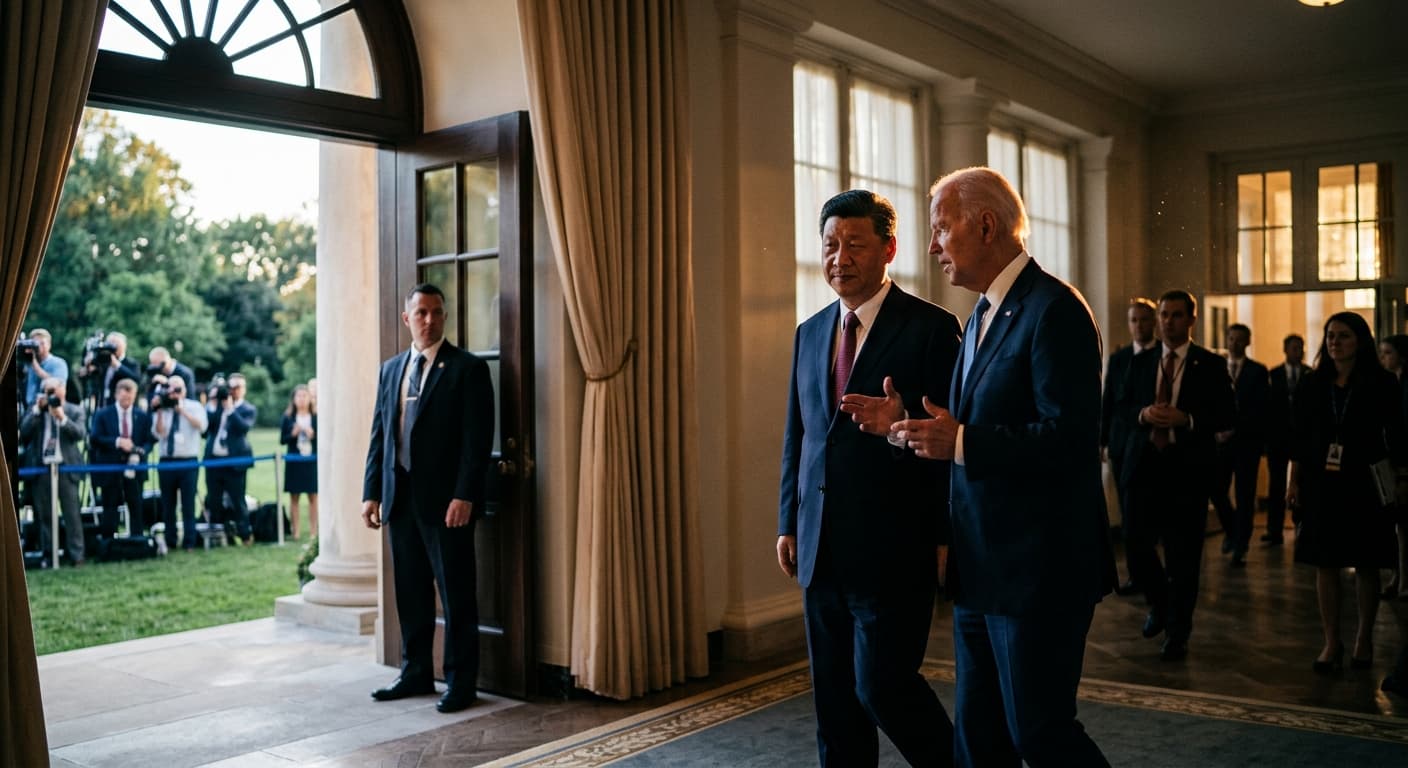
Xi's September White House Visit Tests Managed-Trade Truce
Trump will host Xi Jinping on Sept. 24, 2026 — a summit that will decide whether the US–China truce hardens into "managed trade" or collapses over Taiwan, chips and the South China Sea.
President Donald Trump said on July 6 that he expects to host Chinese President Xi Jinping at the White House around September 24, 2026, aligning the visit with the UN General Assembly and giving both leaders a global stage to convert an eight-month tariff truce into something structural. The angle worth watching: this summit is not really about trade in the old sense. It is about locking in a new US-China operating system — "managed trade" run by a bilateral Board of Trade — while three unresolved flashpoints (Taiwan arms, Scarborough Shoal, and Japan's Taiwan doctrine) sit under the table primed to detonate. The leader who walks out of Washington with fewer of those fuses lit wins the decade.
The deal architecture Xi is bringing to Washington
The Trump–Xi relationship now runs on documents, not tweets. After Trump's May 14–15 state visit to Beijing — the first by a US president since 2017 — the two sides announced a US-China Board of Trade and a parallel Board of Investment to govern the economic relationship. According to the White House fact sheet, the Board of Trade "will allow the United States Government and the Government of China to manage bilateral trade across non-sensitive goods."
That phrasing matters. In a June 2 Federal Register notice inviting public comment through July 10, the US Trade Representative described the new phase bluntly: "the U.S.-China trade relationship entered a new phase. This new phase, appropriately, requires a new approach: managed trade." USTR envisions each side identifying non-sensitive product baskets and modifying non-MFN tariffs on an equal-value basis — a return, in effect, to the negotiated-quota logic of the 1980s US-Japan semiconductor accord, dressed in 2026 clothes.
The President's 2026 Trade Policy Agenda formalizes "Manage Trade with China for Reciprocity and Balance" as one of six pillars, and describes the Busan deal as "the first step in that direction." September 24 is the second step.
What each side has already pocketed
The Beijing summit produced deliverables, if you squint. Per a White House readout summarised by Al Jazeera, China committed to buying "at least" $17 billion in US agricultural goods annually through 2028 — on top of the 25-million-tonne annual soybean pledge inherited from Busan. Trump also claimed a 200-plane Boeing order, a number
Al Jazeera noted was "much lower than expected" and unconfirmed by Beijing.
Xi extracted more than the optics suggest. Under a Trump reversal completed in December 2025, Nvidia's H200 — its second-most-advanced AI processor — can now be sold to "approved customers" in China, per the BBC, with a 15% revenue cut to the US Treasury. The Council on Foreign Relations warned in a
January 2026 analysis that the volume cap could green-light "around 1 million H200s" annually, "enough to create the largest AI data center in the world" and to increase Chinese AI compute installed in 2026 by 250%.
And Beijing has kept its rare-earth chokehold. China's one-year pause on the October 2025 export controls is exactly that — a pause. When it lapses, Beijing's leverage returns automatically. That is not an accident of drafting; it is the architecture.
The Foreign Affairs analyst Jude Blanchette and colleagues put it plainly in a March 2026 essay: the truce is "no more than a gentleman's agreement, held together by the two leaders' acceptance of the constraints of economic interdependence." A single shock — "a military incident in the Taiwan Strait, another balloon incident, accusations of Chinese interference in US elections" — could crack it.
The Indo-Pacific fuse under the table
Xi arrives in Washington with a warning already delivered. In Beijing, according to Al Jazeera, he told Trump directly that the "Taiwan question" is "the most important issue in US-China relations" and that mishandling it could bring "clashes and even conflicts." Nine days later, acting Navy Secretary Hung Cao confirmed to a Senate Appropriations subcommittee that the $14 billion Taiwan arms package Congress cleared in January was on hold — officially to conserve munitions for the Iran war, effectively as a bargaining chip Trump has said he "may or may not" approve.
Congress has boxed itself into the deal. The Taiwan Relations Act obliges the US to provide Taiwan defensive articles; withholding the package indefinitely to sweeten a China summit is unprecedented in the modern era. Taiwan's President Lai Ching-te told the Taipei Foreign Correspondents' Club in June that he hopes the sale is approved "as soon as possible," according to
Al Jazeera.
Meanwhile, the People's Liberation Army spent the last week of December 2025 rehearsing a blockade. "Justice Mission 2025" deployed 130 aircraft, 14 warships and long-range live-fire artillery around the island, per NPR, and — critically — was the first to publicly frame its goal as "all-dimensional deterrence outside the island chain." That is a message to Japan.
Japanese Prime Minister Sanae Takaichi triggered a still-simmering crisis on November 7, 2025, telling the Diet that a Chinese use of force against Taiwan "could" pose "a situation posing an existential threat" to Japan — the phrase that legally activates Tokyo's collective self-defense. Beijing summoned Japan's ambassador, issued a travel warning, and, per Al Jazeera, vowed to "crush" foreign interference after Tokyo announced Type-03 missile deployments on Yonaguni, 110 km from Taiwan.
To the south, the Philippines picture is worse. The Asia Maritime Transparency Initiative reported in July 2026 that Chinese Coast Guard presence at Scarborough Shoal is "beyond any previously observed CCG activity in the South China Sea since AMTI began" tracking. Beijing has sanctioned Philippine Defence Secretary Gilberto Teodoro, per
Al Jazeera, and unilaterally declared the shoal a "nature reserve." The 2016 arbitral ruling rejecting China's nine-dash line remains, in Beijing's practice, a dead letter.
Who benefits, who loses
The clear winner so far is Xi. He has secured a US president who publicly acknowledged in December 2025 that he does not believe China plans to invade Taiwan, per Al Jazeera; who paused a Taiwan arms package unprecedented in scale; and who reopened the AI chip pipeline his own first term shut. The
BBC noted after Busan that Xi "entered the meeting knowing he had a strong hand" thanks to rare-earth leverage and diversified trade partners.
The losers are more numerous. US soybean growers got a headline number that CSIS has documented as structurally hollow: even meeting the 12-MMT Busan pledge left 2025 US soybean exports to China at 18.2 million tonnes, a 32% drop from 2024, with Brazil having replaced the missing volume. The 2020 Phase One deal delivered only 83% of pledged purchases; the
CSIS follow-up on the $17 billion pledge is politely skeptical.
Taiwan loses if Trump uses the arms sale as a chip. Japan loses if Washington's "constructive, strategic and stable" framing with Beijing — the phrase both leaders adopted in Beijing per the BBC — quietly deprioritises Takaichi's forward-leaning Taiwan doctrine. Congressional China hawks lose control of AI export policy: the Carnegie Endowment's Peter Harrell told
NPR the 15% revenue-share arrangement may violate the 2018 statute prohibiting the Commerce Department from collecting fees for export licences.
North Korea is the wild card everyone is ignoring. Kim Jong Un tested a nuclear-warhead-compatible "special mission" ballistic missile on June 25, 2026, per Al Jazeera, and Trump has signaled openness to dropping denuclearisation as a precondition. If Trump adds a Kim meeting to his September calendar — as South Korean President Lee Jae Myung has quietly floated — Xi becomes the arbiter of a three-way Northeast Asian nuclear conversation, not a bystander to it.
What to watch
- July 10, 2026: USTR public-comment deadline on the Board of Trade design. The non-sensitive product list submitted by US industry will telegraph the September deliverables.
- August–September 2026: Whether Trump signs the $14 billion Taiwan arms package. Signing before Xi lands = leverage. Signing after = concession. Not signing = the tell.
- September 24, 2026: The White House summit itself. Watch for (a) a codified multi-year rare-earth commitment, (b) any language on Taiwan beyond the standard "one China" formula, and (c) whether Peng Liyuan's presence signals a genuine state visit or ceremonial photo op.
- November 2026: APEC in Shenzhen; December 2026: G20 in Miami. Two more Trump-Xi encounters are already penciled in, per
Al Jazeera. Managed trade needs managers who keep meeting.
Diplomat View
The September 24 summit will not "reset" US-China relations. It will do something more consequential and less reported: it will institutionalise a bilateral track that routes trade disputes through a Board of Trade rather than through tariff shocks — and, in doing so, quietly demote every US ally with an unresolved China problem. Japan's Taiwan doctrine, the Philippines' Scarborough claim, Taiwan's arms pipeline, South Korea's chip exposure — each becomes a variable Washington now trades against Beijing's cooperation, not a red line Washington defends.
The forecast: Xi leaves Washington with the rare-earth pause extended, the Board of Trade producing its first tariff-modification list before year-end, and the $14 billion Taiwan package still in bureaucratic amber. What would change this call: a live-fire incident in the Taiwan Strait or at Scarborough Shoal between now and September, a Chinese cyber operation attributed publicly by US intelligence, or a congressional revolt over the Nvidia revenue-share arrangement. Absent one of those, September 24 is Xi's summit. Trump provides the room.
The bottom line: Trump's decision to host Xi around the UNGA converts a fragile tariff truce into a managed-trade regime that gives Beijing what it wanted most — predictability and continued access to US technology — while shifting the risks of Indo-Pacific escalation onto US allies. If the White House meeting produces a codified Board of Trade tariff list and no movement on Taiwan arms, this will be remembered as the summit at which Washington stopped competing with China and started coordinating with it.
Discover more
US Politics
Virginia's Redistricting Referendum
Virginia's redistricting referendum is drawing a flood of dark money, shaping future elections and the fight for congressional control amid party stakes.
Global Politics
Trump's Conflicting Messages on Iran War
Trump's mixed messages on Iran reflect a strategy of audience management, benefiting Tehran amid a complex geopolitical landscape.
US Politics
House Ethics Committee Pushes Sexual Miscond.
The House Ethics Committee has shifted responsibility for sexual harassment settlement records to the Office of Congressional Workplace Rights, complicating disclosure efforts.

Conflict & Security
Drone Warfare Killing Aid Workers at Unprec
Over 1,000 humanitarian workers killed in three years as cheap armed drones collapse legal protections. Gaza, Sudan, Ukraine, and DRC see deliberate targeting of aid convoys and hospitals with zero prosecutions.