Zimbabwe's 2030 Gambit: Mnangagwa's Rule
How a constitutional amendment extends Mnangagwa's presidency.
Model Diplomat7 min readAfrica
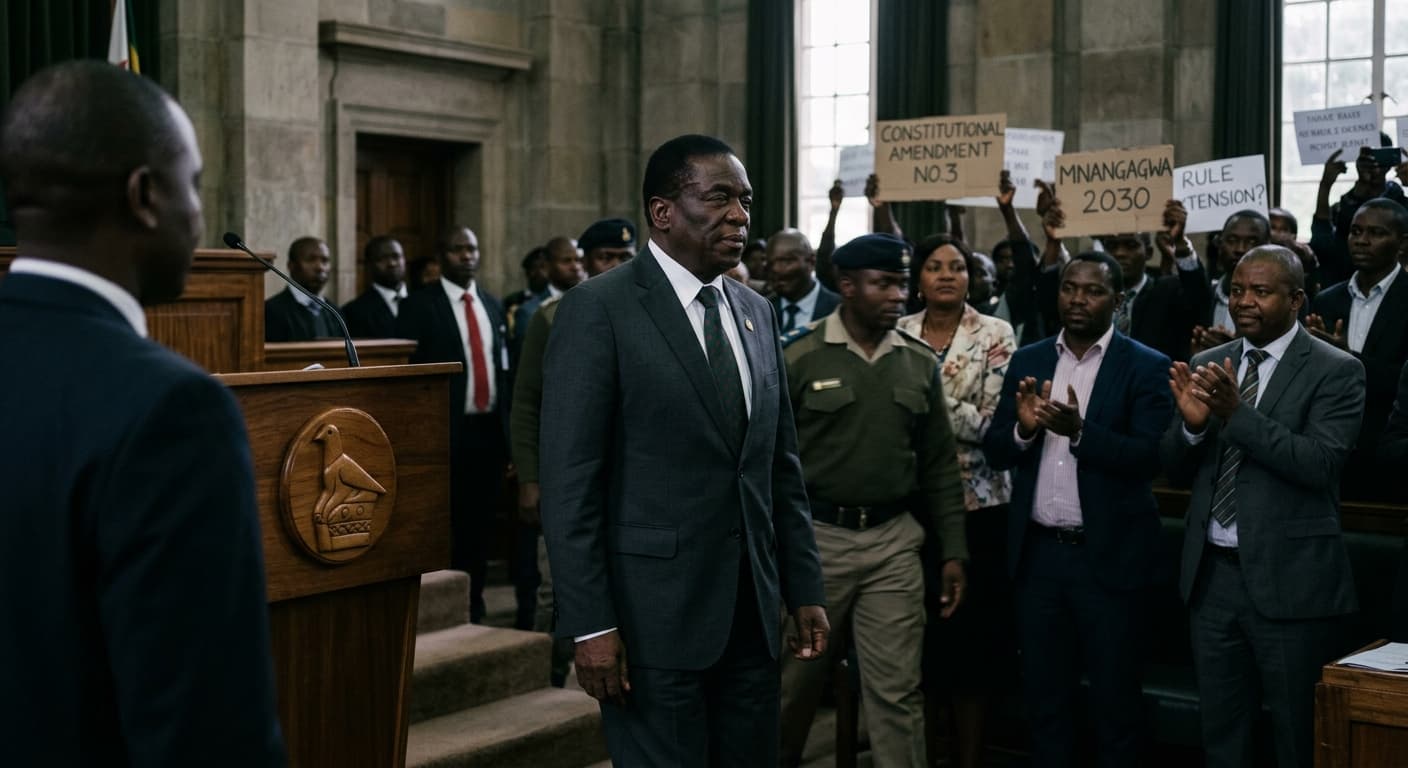
Zimbabwe's 2030 Gambit: How Mnangagwa Rewrote the Constitution Without Asking Voters
How Zimbabwe's Constitutional Amendment No. 3 extends Mnangagwa's rule to 2030, scraps direct elections, and tests SADC's tolerance for constitutional coups.
Zimbabwe's 83-year-old president signed Constitutional Amendment No. 3 into law on July 7, 2026, ending direct presidential elections held since 1990, delaying the 2028 vote by two years, and handing the choice of the next head of state to a ZANU-PF–dominated parliament — a legal engineering feat that, more than any Sahel coup, reveals how Southern Africa's post-liberation ruling parties now entrench themselves without firing a shot, and why the African Union's anti-coup architecture has no answer for them.
The mechanics were unambiguous. In the National Assembly, 216 lawmakers voted in favour and 42 against, according to the BBC, clearing the 187-vote two-thirds threshold. The Senate followed on June 24 with a 75–4 margin,
Al Jazeera reported. A day before the lower house vote, the Constitutional Court dismissed the last civil-society challenge on technical grounds. President Emmerson Mnangagwa, whose second and final term was set to expire in 2028, now sits until 2030, and his eventual successor will be picked not by 6.6 million registered voters but by a joint sitting of the two chambers his party already controls.
The referendum ZANU-PF refused to hold
The 2013 constitution, adopted in a referendum by 94% of voters, was designed to prevent exactly this move. Section 328 requires that any amendment "extending the length of time" a person may hold office be approved in a national referendum — and, crucially, that a sitting incumbent cannot benefit unless voters give a second, separate approval. Justice Minister Ziyambi Ziyambi told parliament on June 3 that the bill "does not give the president a term extension or a third term," Al Jazeera's Farai Matiashe reported. ZANU-PF's argument: because the two-term limit is nominally preserved, only the duration of each term has changed.
Constitutional lawyers dispute the reasoning. Former finance minister Tendai Biti and ex-education minister David Coltart have argued that any amendment with the effect of extending an incumbent's tenure triggers the double-referendum requirement. "If they can get away with two years, what stops them from getting away with 20?" Biti told the BBC. The Constitutional Court sidestepped the substance: it struck the challenges from the roll on procedural grounds and, in a subsequent ruling on July 1, dismissed the remaining petitions outright.
That legal choreography matters because it is now the template. Wellesley College political scientist Chipo Dendere and Oxford's Miles Tendi, writing at Brookings, noted that the amendments "were first proposed in early 2026, with the process being fast tracked to avoid a referendum." The opposition Citizens Coalition for Change, gutted by ZANU-PF–engineered recalls of its MPs since 2023, was unable to hold a blocking minority; several of its remaining members actually voted with the ruling party.
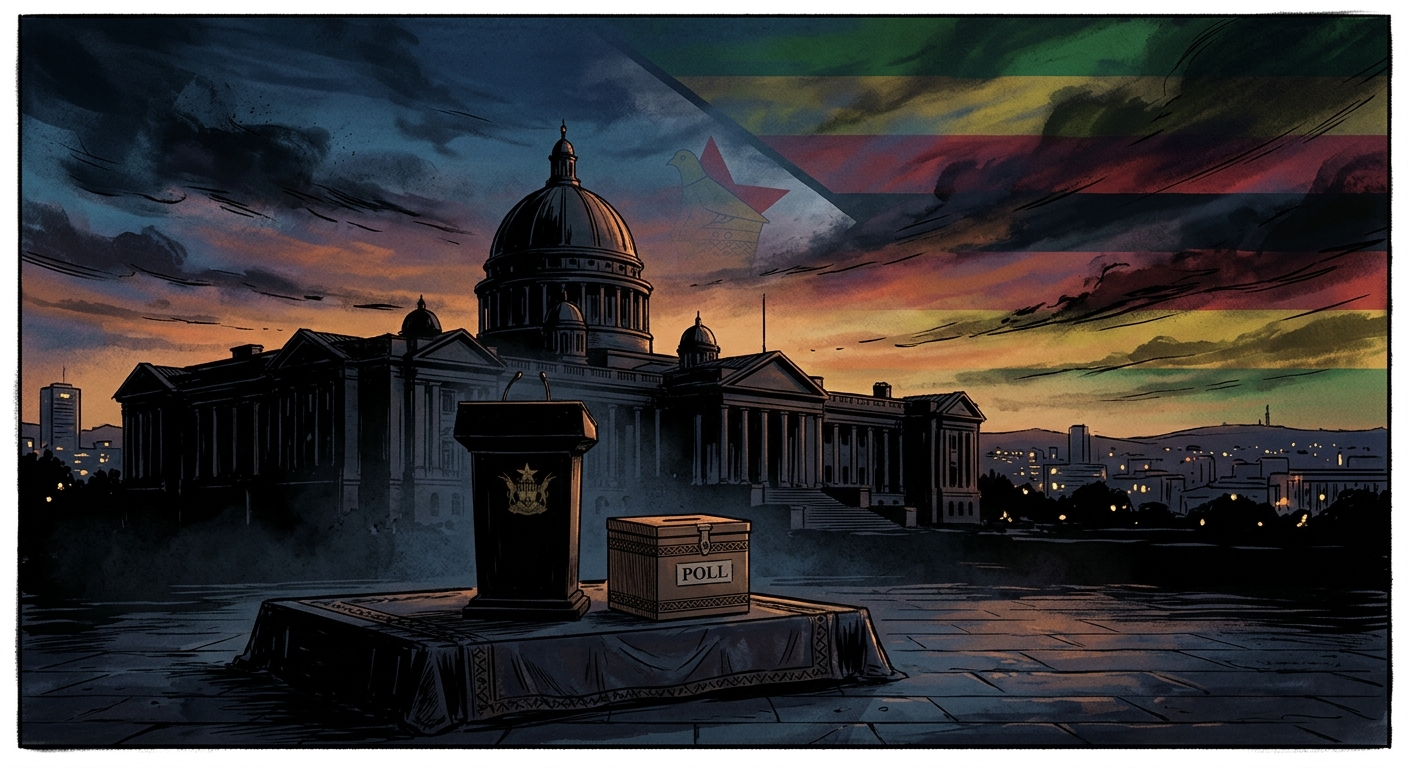
The regional pattern the AU cannot police
Between 2000 and 2023, one-third of African countries amended their constitutions to remove or reset term limits, the Institute for Security Studies documented. Cameroon in 2008, Djibouti in 2010, Côte d'Ivoire in 2016, Comoros in 2018, Guinea in 2020, Central African Republic in 2023 — and now Zimbabwe. In the past 12 months alone, Togo's Faure Gnassingbé used a May 2025 constitutional redesign to shift executive power to a prime minister role he now occupies indefinitely; Cameroon's 92-year-old Paul Biya won an eighth term after his main challenger was disqualified; and Uganda's Yoweri Museveni secured a seventh in January 2026,
Carnegie Endowment analysts noted.
The African Union's problem is architectural. Article 23 of the African Charter on Democracy, Elections and Governance lists "any amendment or revision of the constitution or legal instruments, which is an infringement on the principles of democratic change of government" as an unconstitutional change of government — grounds for suspension. Yet the AU has never invoked it against a term extension. ISS Africa argues that the AU has become "a chronicler rather than a referee," monitoring procedural benchmarks while incumbents rewrite the rules around them.
The Southern African Development Community, chaired by Mnangagwa himself through August 2025, is structurally incapable of censure. South Africa's ANC, Namibia's SWAPO, Angola's MPLA, Mozambique's Frelimo and Tanzania's CCM are all liberation-movement parties that see ZANU-PF as family. The 2017 military intervention that installed Mnangagwa produced a single, mild SADC communiqué. Nothing in the 2026 amendment will change that reflex.
The real fight is inside ZANU-PF
The Amendment is not really about the opposition, which has been legally and physically neutered. It is about Vice President Constantino Chiwenga — the former army general who led the 2017 coup against Robert Mugabe and, in the unwritten pact of that transition, expected the presidency in 2028.
That expectation is now dead. Blessed Geza, the war veteran and Chiwenga ally who used YouTube livestreams to condemn the extension push and call for protests, as Al Jazeera reported in October 2025, died in April 2026 under circumstances his supporters dispute. Mnangagwa retired army commander Lt. Gen. Anselem Sanyatwe, seen as Chiwenga-adjacent, and installed Emmanuel Matatu — the fourth army chief in eight years,
according to the BBC. Zimbabwe Defence Forces commander Philip Valerio Sibanda is now Mnangagwa's insurance policy.
This is the second-order effect that regional capitals should read most carefully. When ruling parties block internal succession by rewriting constitutions, they push contenders toward extra-constitutional exit ramps. The Sahel's coup wave — Mali 2020 and 2021, Guinea 2021, Burkina Faso 2022, Niger 2023, Gabon 2023 — followed years of exactly this kind of legal manipulation. Chiwenga controls no unit directly anymore, but he retains loyalists across the security services, and the 2030 timeline gives them four years to move.
Why creditors are watching, and China is not
Zimbabwe's economy is not, on paper, in crisis. The World Bank projected 6.6% GDP growth for 2025, driven by agricultural recovery and mining. In February 2026,
the IMF reached a staff-level agreement on a 10-month Staff-Monitored Program — the first serious step toward clearing arrears on roughly $21 billion in external debt and rejoining concessional finance. Inflation fell to 4.1% in January 2026.
That process is now at risk. The IMF and World Bank both anchor arrears clearance to governance benchmarks. A president who has just bypassed a constitutional referendum, shut down direct presidential elections, and consolidated control over judicial appointments — the amendment also creates a Judge President post and removes public interviews for senior judicial appointments — is a harder sell to the Paris Club creditors whose sign-off Zimbabwe needs.
The offset, as ever, is lithium. Zimbabwe holds Africa's largest reserves. Lithium export earnings more than doubled to $178.64 million in the first quarter of 2026 alone, Al Jazeera reported, citing Minerals Marketing Corporation of Zimbabwe data. Chinese firms — Sinomine, Zhejiang Huayou, Chengxin, Yahua — own the entire processing chain. Beijing does not attach governance conditions. The February 2026 ban on raw mineral exports, ostensibly to force local beneficiation, further locked Chinese capital into the country. Mnangagwa's calculation: the mining rents will fund the patronage network that keeps ZANU-PF cohesive until 2030, regardless of what the IMF says.
Washington is a wildcard. President Donald Trump imposed 18% tariffs on Zimbabwean exports in April 2025; Mnangagwa responded by scrapping tariffs on US goods and paying compensation to dispossessed white farmers, as the BBC documented. A House bill sponsored by Foreign Affairs chair Brian Mast would repeal the Zimbabwe Democracy and Economic Recovery Act (ZDERA) — the statute that instructs the US Treasury to vote against IMF loans to Harare — contingent on farmer compensation. If ZDERA falls, Mnangagwa gets the international financial rehabilitation he needs without political reform. That is the deal he is playing for.
Diplomat View
The consensus reading — "another African strongman clings on" — misses the strategic point. Zimbabwe is now the cleanest test case for whether SADC and the AU will treat a manufactured constitutional amendment as an unconstitutional change of government under Article 23 of the African Charter on Democracy. They will not. Expect a bland AU Peace and Security Council communiqué by end-July, no SADC statement of substance, and quiet acceptance from Pretoria, whose ANC leadership faces its own succession pressures. The falsifiable call: if the IMF Executive Board approves the Staff-Monitored Program at its scheduled meeting despite CAB 3, it confirms that the international governance-conditionality regime is now subordinate to critical-minerals access — and every liberation-era ruling party in the region will read the signal. The forecast reverses only if Chiwenga's faction moves, or if a Paris Club creditor breaks ranks to block arrears clearance on rule-of-law grounds. Neither is likely before 2027.
What to watch next
- IMF Executive Board decision on Zimbabwe's Staff-Monitored Program, expected in the second half of 2026 — the first hard test of whether governance conditionality still binds.
- SADC Summit, August 17, 2026 in Madagascar: silence on CAB 3 confirms the regional bloc will not police constitutional coups by its own founding parties.
- US Congress action on ZDERA repeal (H.R. Mast bill): if it advances, Mnangagwa gets financial rehabilitation without political concessions.
- ZANU-PF congress, October 2027: the next window for a Chiwenga-faction challenge before the 2030 vote calendar hardens.
The Bottom Line
Zimbabwe's Constitutional Amendment No. 3 is not a coup — it is the template that makes coups look crude. Mnangagwa has demonstrated that a liberation-era ruling party with a captive court, a fractured opposition, and Chinese mineral rents can rewrite term limits in five months, and neither SADC nor the AU has an enforcement mechanism that bites. If the IMF signs off on arrears clearance anyway, the message across Southern Africa will be unmistakable: the price of a legal autocracy in 2026 is a lithium contract and a compliant judiciary.
Discover more
US Politics
SNAP Food Assistance Faces Legal Challenges
In 2026, SNAP faces stricter eligibility rules and mounting legal challenges, threatening food assistance for the millions of Americans who rely on the program.

US Politics
Next Generation Republicans
A leaked survey shows 39% of Republicans under 30 do not identify as MAGA, revealing a split in the GOP's future leadership.
Global Politics
Trump's Conflicting Messages on Iran War
Trump's mixed messages on Iran reflect a strategy of audience management, benefiting Tehran amid a complex geopolitical landscape.

Conflict & Security
Drone Warfare Killing Aid Workers at Unprec
Over 1,000 humanitarian workers killed in three years as cheap armed drones collapse legal protections. Gaza, Sudan, Ukraine, and DRC see deliberate targeting of aid convoys and hospitals with zero prosecutions.