Next Generation Republicans
GOP's under-30 wing splits between factions.
Model Diplomat8 min readUnited States
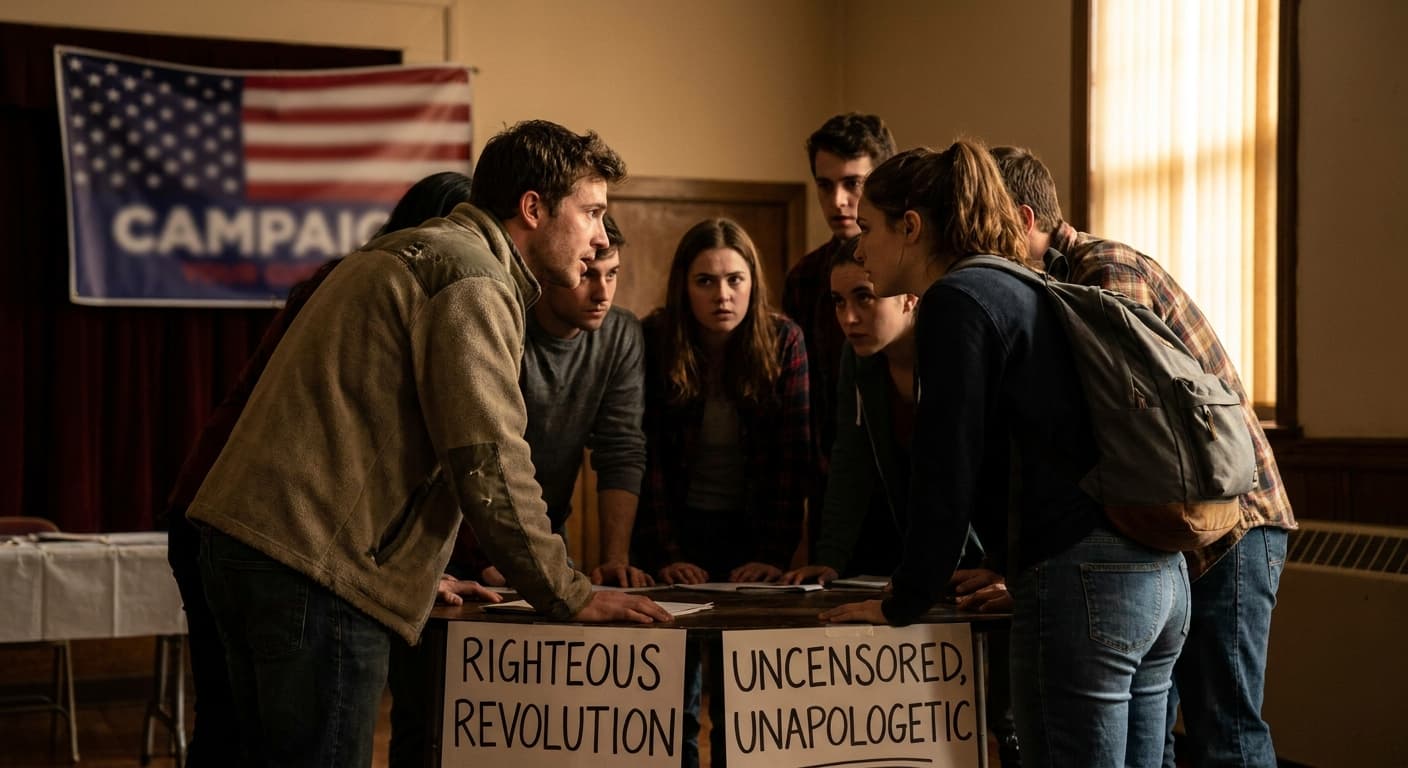
Next Generation Republicans: MAGA's Heirs Fight Over an Uncertain Inheritance
The GOP's under-30 wing splits between JD Vance's institutional bench and Nick Fuentes' online right — and 39% now say they are not MAGA at all.
The Republican succession fight has already begun, and it is not being run out of the White House. It is being run out of a Phoenix arena, a leaked group chat, and a Reagan Institute crosstab showing that 39% of Republicans under 30 do not identify as MAGA — a bloc that, at current margins, decides whether the coalition Donald Trump built survives him or shatters into something harder. The story of "next-generation Republicans" in 2026 is the story of two rival pipelines — an institutional bench organized around Vice President JD Vance and Turning Point USA, and an online right organized around Nick Fuentes — competing for the same inheritance, with Trump himself no longer the ceiling on how far the party can move.
The number that reframes the debate
For most of Trump's second term, the conventional read on young Republicans has been: MAGA is winning them, especially young men, especially online. The 2024 exit polls backed it. Trump carried 43% of voters under 30, per network exit surveys cited by TIME, and the podcast-and-manosphere strategy became gospel inside GOP consulting shops.
The June 2026 Ronald Reagan Institute Summer Survey punctures that story. Among all Republicans, 25% said they are not part of MAGA; among Republicans under 30, that figure jumps to 39%, according to TIME's reporting on the release. YouGov tracking cited in the same piece shows Trump's approval among all under-30 voters has collapsed roughly 50 points since he retook office, leaving him at a net negative of 45 in the cohort. Brookings'
William Galston puts the split in sharper terms: only 18% of MAGA Republicans think the economy is getting worse, versus 65% of non-MAGA Republicans — a gap that makes the party's own dissidents "virtually indistinguishable from independents."
The under-30 non-MAGA Republican is now the pivotal voter inside the coalition. That is the audience the succession race is actually chasing.
Vance's pipeline: the patient bench
The institutional answer to that audience is Vice President JD Vance, and the machinery moving him is not the RNC. It is Turning Point USA, the youth-organizing outfit Charlie Kirk built before his September 10, 2025 assassination on a Utah campus, an event NPR's Franco Ordoñez reported prompted Vance to fly Air Force Two out to retrieve Kirk's remains. Vance credits Kirk with introducing him to donors, staffing his Senate campaign, and lobbying Trump to pick him as running mate.
Three months after the killing, at the December 2025 AmericaFest in Phoenix, Kirk's widow Erika Kirk — now Turning Point's CEO — endorsed Vance for 2028, telling the crowd she wanted him "elected for 48 in the most resounding way possible," according to the Associated Press via NPR. The nod matters because Turning Point holds, in NPR's phrase, "a sizable hold on the MAGA youth movement" heading into a 2028 electorate in which under-45 voters will be a majority.
Vance is not campaigning alone. He has a farm system. Joe Mitchell, the former Iowa state representative Kirk seeded with early money, runs Run GenZ, which claims an 80% win rate placing conservatives under 30 into state legislative and county seats, per Mitchell's own account to NPR. Adam Pennings, the group's executive director, told NPR in September 2025 the strategy is deliberately patient: "We have young people who are in state House and state Senate and county commissioner seats waiting in the wings for when their congressman... steps down. Then they'll step up," Pennings told
NPR's Elena Moore. Only one young GOP congressional challenger — 28-year-old Mason Foley in Tennessee's 7th — has emerged in the cycle Moore has tracked; his pitch is that Trump "needs a new generation of conservative leaders to step up and help finish what he started."
Vance's ownership of this bench is why he swept the CPAC 2026 straw poll with 53% of roughly 1,600 delegates, per Al Jazeera, with Secretary of State Marco Rubio in second. It is also why the 2028 shadow primary is, at this point, structurally his to lose.
The other pipeline: Groypers, chats, and the ceiling that isn't
The rival pipeline does not run for anything. It runs a feed.
Nick Fuentes, the 27-year-old livestreamer profiled in the Financial Times as the anchor of the "Groyper" movement, spent years dismissed as fringe: Holocaust denial, praise of Hitler, the argument that Jim Crow was better for Black Americans, all catalogued by
NPR's Sarah McCammon. Tucker Carlson's two-hour-plus, friendly October 27, 2025 interview with Fuentes ended the fringe status. When Kevin Roberts, president of the Heritage Foundation, defended Carlson in a video invoking "the globalist class," senior Heritage staff and allied groups broke publicly with the think tank, per the same NPR report.
Fuentes' operating theory, laid out in the New Yorker reporting by Antonia Hitchens that Julian Zelizer summarized for Foreign Policy, is that Trump is the door and he is what comes through it: "Trump is the trailblazer, the person who opens the door for the rest of us. He opened the door to this next generation coming to take over." Zelizer's parallel is the Tea Party after Newt Gingrich — a generation that concluded its predecessors had been insufficiently radical and moved further right, not back to center.
The pipeline is not hypothetical. In October 2025, Politico published leaked Young Republican National Federation group chats from state chapters in New York, Kansas, Arizona, and Vermont. Al Jazeera documented messages including "gas them" jokes and open pro-Nazi references. The
BBC reported the New York State Young Republicans were disbanded. Trump's initial nominee for Office of Special Counsel, Paul Ingrassia, withdrew after his own racist text history surfaced,
NPR reported.
The decisive tell was Vance's response. On the Charlie Kirk Show, the vice president said: "kids do stupid things, especially young boys. They tell edgy, offensive jokes... I really don't want us to grow up in a country where a kid telling a stupid joke... is cause to ruin their lives," per Kansas News Service reporter Zane Irwin on NPR. Two months later at AmericaFest, Vance declined to set any red lines for the movement beyond "love America," the
Associated Press reported via NPR. Ben Shapiro, on the same stage, told the crowd Charlie Kirk had "despised" Fuentes and called Carlson's boost of him "an act of moral imbecility," per
NPR.
The heir is refusing to police the fringe. That is a choice, and it is the choice that will define what "next generation Republican" means by 2028.
What the young Republican actually believes
Underneath the succession theater, the substantive gap between under-30 Republicans and their party is narrower than critics claim on foreign policy — and wider on issues Trump has made central.
The Ronald Reagan Institute's summer polling, summarized by AEI's Marc Thiessen, found MAGA Republicans overall more internationalist than non-MAGA Republicans on nearly every question, with 90% of self-identified MAGA voters saying preventing an Iranian nuclear weapon was important to U.S. security, Thiessen wrote at AEI. TIME's read of the crosstabs found the under-30 MAGA cohort still hawkish but noticeably less so than older MAGA voters — 70% valuing NATO versus 62% of MAGA overall, but also 72% agreeing America should "put America First" by withdrawing from world affairs, versus 64% of MAGA overall.
The most useful primary data comes from the Carnegie Endowment's Gen Z foreign policy poll, fielded by YouGov between January 31 and February 11, 2025. Carnegie's American Statecraft Program found Gen Z Trump voters were 13 points more likely than Republicans overall to want the United States to "take an active part in world affairs," and 35% of Gen Z Trump voters said U.S. leadership on climate change was very important, versus 18% of Republicans overall. On military primacy, though, Gen Z Trump voters diverged from their elders: 67% called a leading U.S. military role "very important," compared to 82% of Republicans generally.
Read together, the picture is not isolationism. It is a demand for American engagement with a different tone — less military-first, more climate-aware, and less deferential to the party's foreign-policy establishment on either flank. That is the terrain both Vance and the Groypers are trying to occupy, and it does not naturally belong to either.
Where Democrats accidentally help the GOP
The generational-replacement math still favors Democrats — the classic Abrajano and Alvarez modeling projects Millennials and Gen Z combined at roughly half the electorate by 2032, with a Democratic-leaning swing of 5–7 points from replacement alone. But the Democratic side of the young-candidate story is running dog-eat-dog. NPR's
Elena Moore counted about twenty young Democratic congressional candidates; roughly half are primarying their own incumbents, including Nancy Pelosi. Democratic socialist Melat Kiros is
poised to become the first Gen Z woman in Congress after knocking off a 15-term Democrat in Colorado.
That is the environment in which Hayden Padgett, chair of the Young Republican National Federation, told NPR there is "just not the same level" of frustration inside his party — a claim Brookings' Galston suggests understates the quiet, non-MAGA GOP exit toward the sidelines. Republican young talent is not primarying incumbents. It is waiting.
Waiting is a strategy only if the party someone inherits is still recognizable to the voters they will need. That is the load-bearing assumption behind the Vance–Turning Point plan, and it is the one the Groyper wing is actively working to break.
Diplomat View
Watch Vance, not the polls. The under-30 GOP has already fractured — 39% non-MAGA per the Reagan Institute — and the question is whether the party's most plausible heir builds a coalition big enough to hold both halves, or lets the online right define the movement's floor by refusing to name a ceiling.
Our call: Vance wins the nomination and loses the boundary-setting fight, and by 2028 the "next generation Republican" label will describe two incompatible constituencies sharing one ballot line — a Turning Point–trained state legislator in Iowa and a Groyper-adjacent streamer with 500,000 followers, both claiming the Kirk inheritance. That is a governing coalition that can win a presidential election on Democratic dysfunction and lose a governing majority within 18 months.
What would change the forecast: (1) Vance drawing an explicit red line on Fuentes and the Groypers, which he pointedly declined to do at AmericaFest; (2) a Democratic recruit under 35 winning a marquee 2026 general election by more than five points on generational-change messaging; (3) a formal Turning Point break with Tucker Carlson before the 2027 straw-poll cycle. None of the three is currently priced in.
What to watch next
- November 3, 2026 — Midterms. Non-MAGA Republican turnout is the tell. Brookings' Kristen Soltis Anderson data shows only 49% of "party-first" Republicans "extremely motivated" to vote versus 62% of "Trump-first." A 5-point turnout gap in swing districts flips the House.
- December 2026 — AmericaFest. Whether Vance or Turning Point draws a Fuentes red line, or repeats the December 2025 refusal, sets the ceiling on 2028.
- February 2027 — CPAC straw poll. If Vance's 53% number holds against a live 2028 primary field, the Groyper wing loses its bid for electoral legitimacy. If it slips below 40%, the succession is genuinely open.
Discover more

US Politics
J.D. Vance's Iowa Visit
J.D. Vance's early Iowa visit signals a likely 2028 presidential bid, courting Republican voters and key allies like Zach Nunn in a pivotal caucus state.

US Politics
JD Vance Courts Iowa GOP for 2028 Run
Vice President JD Vance's visit to Iowa, alongside Rep. Zach Nunn, signals an early courtship of the GOP base and clear ambitions for a 2028 presidential bid.

US Politics
GOP Conservative Factions Clash Over Trump
House conservatives clash over Trump's voter ID ultimatum, sinking the FY2027 defense bill and exposing fractures in GOP unity.

US Politics
GOP Divided Over Trump's Tariff Policies
Republicans are divided over Trump's tariffs as a July 24 vote approaches, forcing senators to take a public stance before the midterms.