Iran Threatens Strait of Hormuz Shipping
Iran's threat turns Strait of Hormuz into a permit system.
Model Diplomat11 min readMiddle East
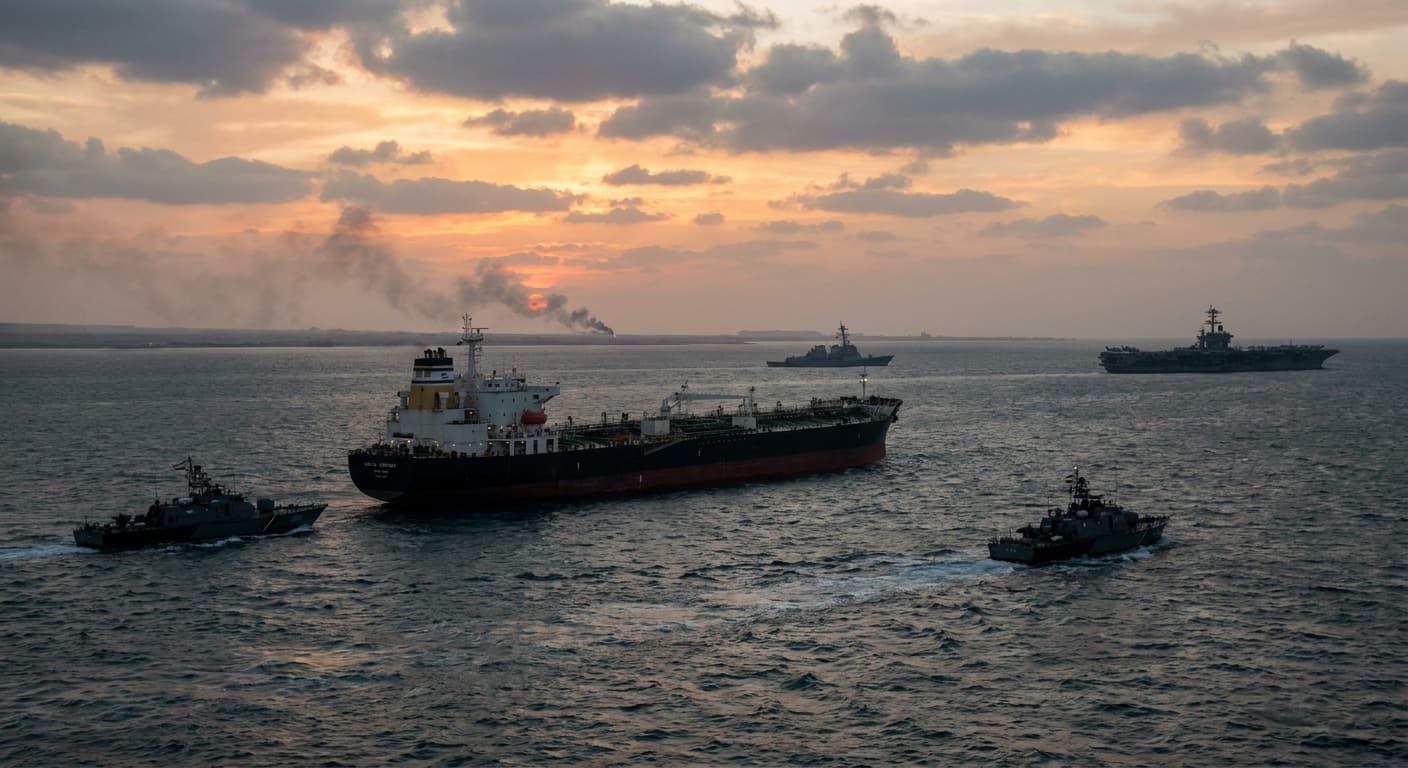
Iran's Hormuz Ultimatum Isn't a Blockade — It's a Toll Regime
Iran's July 2 threat of a "forceful response" against tankers off Tehran's approved routes turns the Strait of Hormuz into a permit system — and Beijing is the quiet winner.
Iran's joint military command warned on July 2, 2026 that every oil tanker in the Strait of Hormuz must sail its "approved" northern corridor or face a "forceful response," according to PBS News. Read against the June 17 US–Iran memorandum of understanding, Ayatollah Ali Khamenei's ongoing funeral, and Iran's newly created Persian Gulf Strait Authority, the ultimatum is not a threat to close the waterway — it is the operational rollout of a permit-and-fee regime that converts a global chokepoint into a politically conditioned tollbooth. The immediate beneficiary is not Tehran's treasury. It is China, which pays for Iranian oil in yuan and now sits on the only proven payment rail through the strait.
What Iran said, and what changed
The July 2 statement instructed vessels to use only the Iranian-designated corridor hugging Iran's coast around Larak Island, and denounced a rival southern corridor that Oman announced with the International Maritime Organization in late June. "Any crossing without authorisation is unacceptable and extremely dangerous," the Islamic Revolutionary Guard Corps said in a parallel warning reported by Al Jazeera. The IRGC's language matters: it is not asserting a right to close the strait, but a right to administer it.
The warning arrived four days after two commercial vessels were struck in the strait — attacks widely blamed on Iranian forces — and one day after indirect US–Iran technical talks concluded in Doha with what Qatar's foreign ministry called "positive progress." Mediators said the next round would resume only after the funeral processions for Khamenei, which end with his July 9 burial in Mashhad, according to Al Jazeera's account of the Doha outcome. US Vice President JD Vance, quoted in the same coverage, said he could not guarantee Washington would not return to combat before the memorandum's mid-August deadline — a warning that puts a shot-clock on the permit regime.
The escalation matters because it tests the load-bearing clause of the ceasefire. Point 5 of the memorandum, released in full by the BBC, commits Iran to make "best efforts for the safe passage of commercial vessels with no charge for 60 days" and to conduct dialogue with Oman "to define the future administration and maritime services in the Strait of Hormuz." Tehran reads that phrase as an acknowledgment of its sovereign administration; Washington reads it as a temporary pause before free transit resumes. The July 2 ultimatum is Iran's answer: administration first, transit second. Mostafa Khoshcheshm, a Tehran academic quoted by
Al Jazeera, put the Iranian position plainly: "According to the MoU, Iran is not going to charge service fees for 60 days, but afterwards, Iran is definitely going to do that."
The permit regime, not a blockade
The strait is not closed. It is metered. On July 2, MarineTraffic recorded 38 confirmed transits, down from 48 the day before and against a pre-war baseline of roughly 130 daily crossings, according to Al Jazeera's oil markets desk. BBC Verify's read of Kpler data showed 172 vessels had crossed since the June 17 deal, with more than 200 tankers still waiting inside the Gulf as of early July, per
the BBC. By the same tracking, more than 250 tankers and 440 cargo ships remained inside the Gulf awaiting exit — the backlog that gives Iran leverage.
The mechanics are now documented. Under the Persian Gulf Strait Authority (PGSA), which Iran stood up in May, ship operators must email the IRGC with vessel identity, cargo, crew nationalities, ownership and destination, according to reporting by NPR. The IRGC issues a clearance code by VHF radio; Iranian escorts then shepherd the ship along a corridor near Larak Island, per an account in
Al Jazeera drawing on Lloyd's List's shipboard sourcing. In the first two weeks the system was used, 26 vessels transited via the pre-approved IRGC route with their AIS trackers switched off — a compliance signature that gives the regime its operational fingerprint.
Iran suspended the associated fees for the 60-day negotiating window but has stated openly that "service charges" will follow. On May 21, Al Jazeera reported that Iran had already charged as much as $2 million per ship for wartime transits, and the PGSA has published a claim to "Iranian armed forces oversight" across more than 22,000 sq km — an area that reaches into the territorial waters of Oman and the UAE, according to
the BBC. UAE presidential adviser Anwar Gargash, quoted in the same report, called Iran's map "nothing but fragments of dreams." Fragments or not, the map is now the operational document Iranian VHF operators are enforcing.
The PGSA has itself been sanctioned by the US Office of Foreign Assets Control, which on June 26 warned that payments to Iranian government entities — cash, digital assets, "offsets" or in-kind — expose non-US shippers to secondary sanctions. The BBC reported the alert in detail. That created the pincer that defines the current market: pay Iran and risk US sanctions, or ignore Iran and risk missiles. US Central Command told commercial ships to turn around on 45 occasions since the April 13 blockade began, according to the same reporting; Iran's counter-blockade fired on at least 33 vessels in a single 24-hour window after the June 20 flare-up, according to
BBC Verify's mine-and-fees analysis.
The IRGC is the real counterparty
President Masoud Pezeshkian is negotiating in Doha. The IRGC is writing the rules in the strait. That gap widened this week because Iran's third Supreme Leader, 56-year-old Mojtaba Khamenei, has not appeared in public since Israeli strikes killed his father and injured him on February 28. He was absent from the lying-in-state, absent from the Tehran procession, and absent again from the Qom stop on July 7, according to BBC live coverage and reporting from
Al Jazeera documenting Iranian public unease at the vacuum. Israeli Defence Minister Israel Katz used the funeral to threaten the son directly, saying "any Iranian leader who will again try to pursue plans to destroy Israel will be killed as well," per
BBC reporting on the Tehran procession.
That vacuum matters. With the Supreme Leader physically absent and possibly incapacitated, day-to-day enforcement of the "approved routes" doctrine sits with IRGC naval command in Bandar Abbas — the same force that seized the Panama-flagged MSC Francesca and Liberia-flagged Epaminondas in April and has not released them, per a BBC on-the-ground report from Bandar Abbas. ACLED counted at least 96 US strikes in and around the city between February 28 and the April 8 ceasefire; the IRGC's response has been to embed its permit regime deeper into the ceasefire architecture rather than to disband it.
The UK and France read the moment the same way. In a joint statement on July 3, Prime Minister Keir Starmer and President Emmanuel Macron declared that "restoring safe transit for ships of all nations through the Strait is a matter of global concern" and said the two governments "stand ready to deploy the wider Multinational Military Mission to support freedom of navigation." Oman, they added, has "agreed to work with the United Kingdom and France to ensure that its sovereign territorial waters are safe for navigation." That is European muscle behind Oman's southern corridor — the corridor Iran denounced on July 2.
The legal fiction on both sides
The dispute rests on a treaty neither party has ratified. Neither Iran nor the United States is a party to the 1982 UN Convention on the Law of the Sea, whose Article 38 guarantees "transit passage" through international straits. Washington argues transit passage is customary international law binding on non-parties; Tehran argues UNCLOS's navigational provisions are a treaty right reserved for members, as James Kraska set out in his SSRN paper on the "legal vortex" in Hormuz. The
Cambridge legal-regime study traces the same argument through the 2007–2012 US–Iran flare-ups; the difference now is that Iran has stopped merely threatening the doctrine and started monetizing it.
That ambiguity is what Iran is monetizing. Because the strait's shipping lanes lie inside Iranian and Omani territorial waters — not the high seas — Tehran can frame its permit system as coastal administration, not toll-taking. Oman, whose southern corridor was defined with the IMO, has publicly rejected fees, with Foreign Minister Badr Albusaidi telling Al Jazeera that "future arrangements related to the strait do not involve imposing any transit fees." Iran has not made the same commitment. Foreign Minister Abbas Araghchi said on June 25 that Tehran and Muscat would "define the future administration and maritime services" jointly — a phrase that gives Iran a veto over the corridor Oman is trying to internationalize.
The Beijing dividend
The quiet winner is China. Beijing buys roughly 80% of Iran's oil, already settles those purchases in yuan, and — according to Lloyd's List reporting summarized by the Gulf Research Center in its analysis of Hormuz yuan payments — at least two Hormuz transit fees during the war were paid in renminbi, brokered by a Chinese maritime services intermediary. The report notes that Chinese payment-related equities rose on the news, and that analysts explicitly tied the transactions to expected "wider RMB internationalization." That is the currency dividend Beijing did not have on February 27.
That is the second-order effect Brookings warned about in June. In Chokepoints and coercion, Samantha Gross and Ryan Beane argue that Iran's screening form — which asks for flag, owner, manager and crew nationality — has turned Hormuz into a chokepoint where "access to a critical shipping route can be used to reward partners, disadvantage rivals, and create new forms of geopolitical leverage." A tanker linked to China, Russia, Pakistan or India moves. A tanker linked to Israel or a Western major waits. The Atlantic Council's
shadow-fleet study documents the same asymmetry: in the week Iran effectively closed Hormuz in March, three to six vessels a day still transited — "primarily shadow vessels transporting Iranian oil."
For Beijing the arithmetic is simple. Chinese state banks and mainstream shippers avoid direct sanctions exposure by routing Iranian cargoes through opaque intermediaries; a shadow fleet identified by Al Jazeera's investigative unit — 185 vessels making 202 voyages between March 1 and April 15 — proved the plumbing works even under a US blockade, with 25 crossings recorded in the first two days after the blockade took effect. Since the June 17 deal, at least 30 tankers have carried Iranian oil and petrochemicals out of the Gulf, per BBC Verify's read of Kpler data, and Iran has moved close to 50 million barrels to market since the blockade lifted, according to Sparta's Sam Yip, cited in
Al Jazeera's OPEC+ coverage.
The Persian Gulf Strait Authority — sanctioned by OFAC, guarded by the IRGC, paid in yuan — is functionally a Sino-Iranian settlement rail sitting on top of 27% of global seaborne oil trade. That is a strategic asset China did not have on February 27. It is also the clearest live example of what Brookings called "politically differentiated access" to a chokepoint, and the historical parallel it evokes — the Red Sea, where the Houthis have varied targeting by vessel affiliation — is the one Western capitals fear will now migrate east and become institutionalized rather than episodic.
What the tape and OPEC are telling you
Prices say the market has already discounted Iran's threats. Brent September futures traded at $72 a barrel on July 6, below the pre-war close of $72.48 on February 27, according to Al Jazeera's oil markets update. Prices are down more than 38% from their April 30 peak above $126. On July 6, OPEC+ agreed to raise August output by 188,000 barrels a day — a signal that Saudi Arabia, the UAE and Iraq are betting the strait stays open at reduced capacity, not that it closes. Saudi Arabia has more than doubled its shipping volume since June 17 compared with the prior three months combined, Sparta's Yip told Al Jazeera.
That confidence is thin. The Congressional Research Service, in its primer on Hormuz oil impacts, estimated that roughly 20 million barrels a day transited the strait in 2024 — 27% of maritime oil trade and 20% of world petroleum consumption — against just 2.6 million barrels a day of bypass pipeline capacity via Saudi Arabia's East–West line and the UAE's Abu Dhabi Crude Oil Pipeline. A sustained closure remains a tail risk the market cannot hedge; the July 2 ultimatum is designed to keep that tail risk priced in without triggering it. Dan Marks of the Royal United Services Institute, quoted in
Al Jazeera's analysis, captured the durability of the risk: "While the current Iranian regime remains in place and at odds with the United States and Israel, there will always be the possibility that tensions will flare and the strait will close."
Diplomat View
Iran is not preparing to close Hormuz. It is institutionalising the right to decide who transits and on what terms — and the July 2 ultimatum was the first stress test of that regime under the ceasefire. The forecast: absent a decisive US move before the memorandum's mid-August expiry, the PGSA permit system hardens into the de facto administration of the strait, with the IRGC as gatekeeper and yuan-denominated intermediaries as the payment layer. The winners are Beijing, Iran's shadow-fleet operators and the Gulf pipeline projects rerouting around Hormuz; the losers are Western P&I insurers, tanker operators exposed to OFAC secondary sanctions, Israeli-linked shipping, and Oman, whose southern corridor gets squeezed between Iranian threats and Anglo-French escort politics. This call would be wrong if three conditions revise: a public, verified sighting of Mojtaba Khamenei restoring civilian control over the IRGC; a US–Iran final deal that names the PGSA a sanctioned entity ships must avoid; or a UK–French escort mission actually deployed under the July 3 Starmer–Macron statement. Absent those, the ratchet only turns one way.
What to watch
- July 9, 2026: Khamenei's burial in Mashhad ends public mourning. The next US–Iran round in Doha is scheduled to follow immediately, per Qatar's foreign ministry.
- August 16, 2026: The 60-day negotiating window in Point 3 of the
MoU expires. Iran has said explicitly it will begin charging service fees the day after, unless a final deal preempts it.
- Ongoing: Whether the
UK–France joint statement translates into a deployed escort mission in Omani waters — the signal that Europe is willing to underwrite the southern corridor Iran denounced.
The Bottom Line
Iran's "forceful response" threat is not the prelude to closing the Strait of Hormuz — it is the enforcement mechanism for a permit regime that turns 27% of world seaborne oil into a politically conditioned service, priced in yuan, controlled by the IRGC, and shielded by the very ceasefire Washington signed on June 17. The story to watch is not whether Iran shuts the strait. It is whether the United States accepts, by August 16, a permanent Sino-Iranian tollbooth on the world's most important energy chokepoint.
Discover more
Global
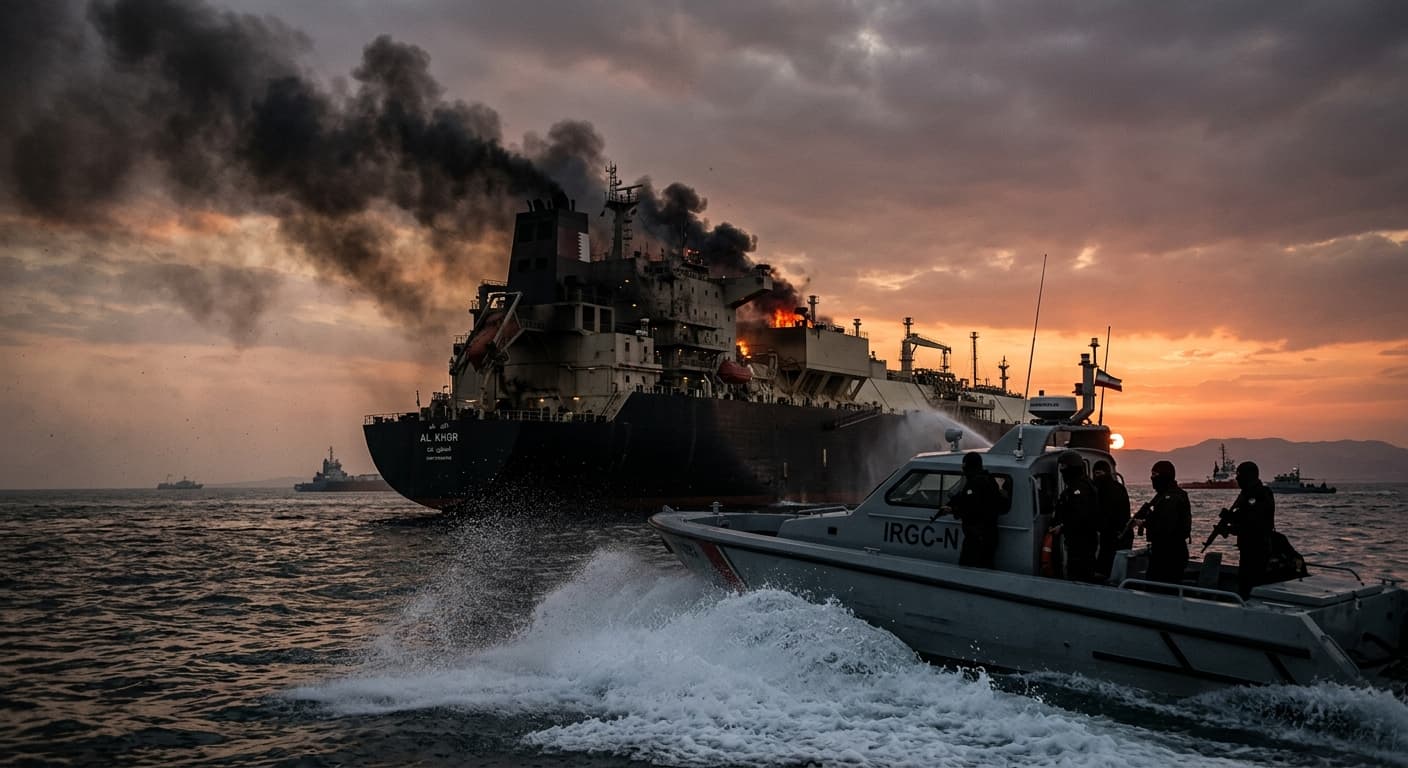
Qatari Tanker Strike Exposes Hormuz Tensions
A Qatari tanker was struck off Oman, revealing the fragility of the Hormuz ceasefire and Iran's influence over maritime security.
Global
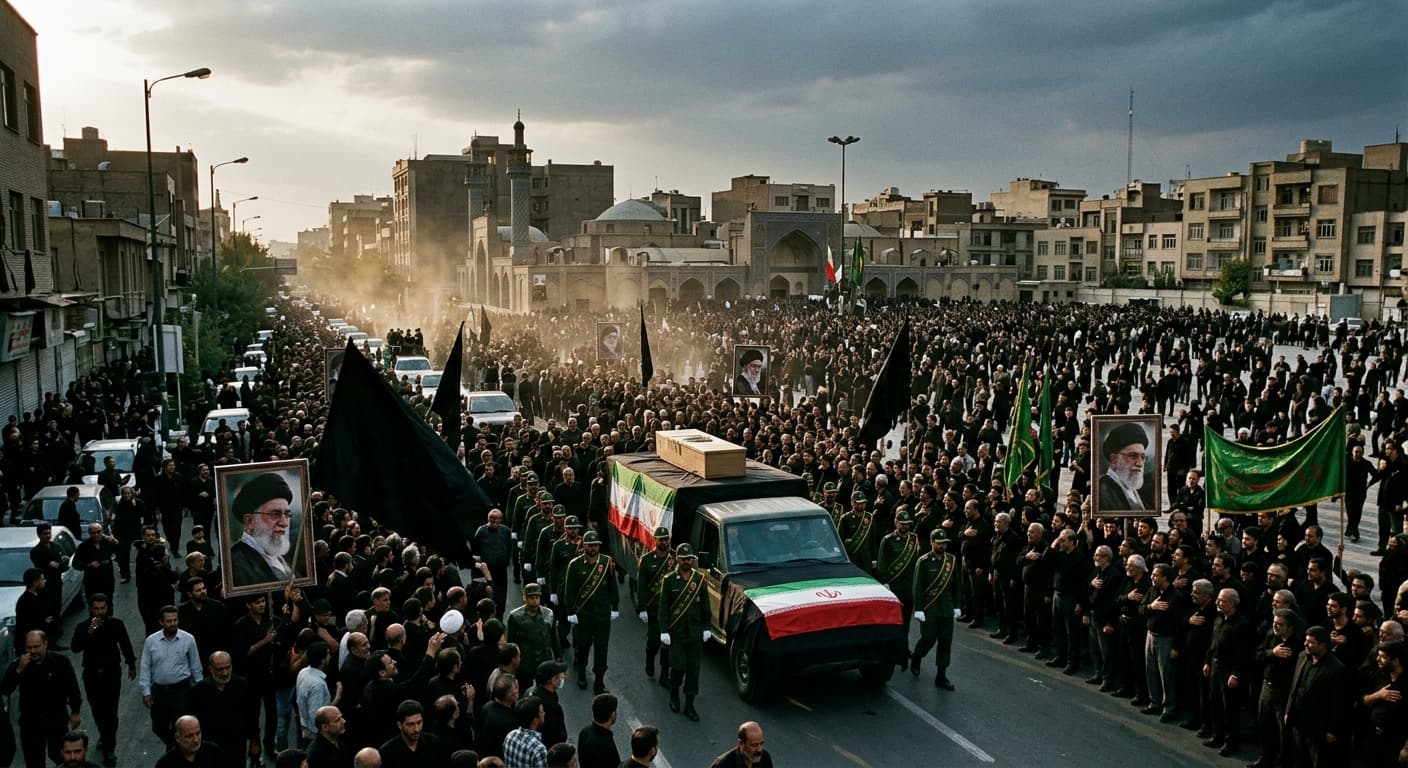
Khamenei's Funeral Signals Iran's Decline
The funeral of Ayatollah Khamenei highlights Iran's diminished influence in the Gulf, with regional powers now dictating terms.
Global
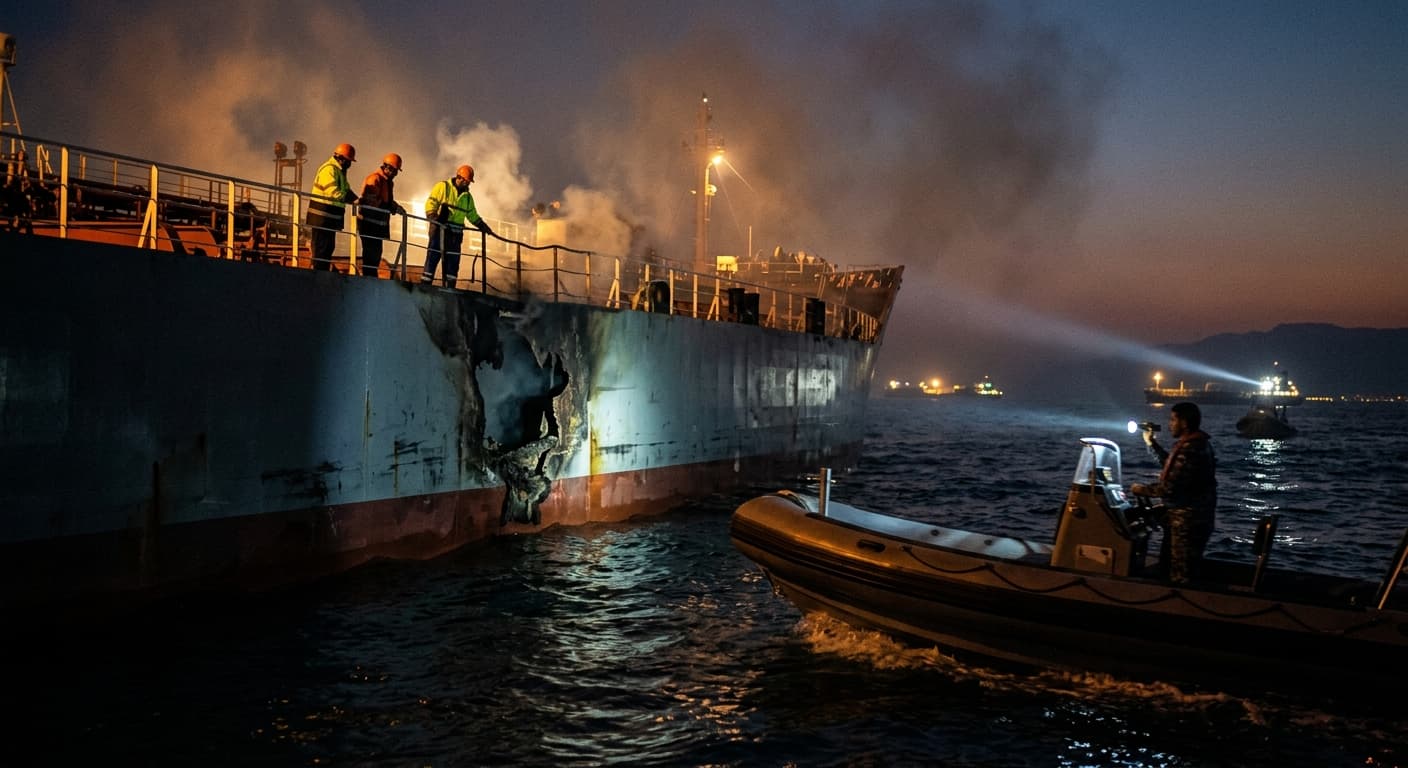
Iran's Hormuz Missile Strikes: A Toll Booth
Iran's missile attack on a Qatari-linked tanker highlights Tehran's strategy to control the Strait of Hormuz, impacting Gulf states and maritime law.

Tech Policy
Iran's Cavern Manticore Targets Israel's IT
Cavern Manticore, an Iran-linked hacking group, targets Israeli IT vendors, prompting a shift in Israel's cybersecurity policy and legislative efforts.