Wall Street Hits Record High Amid Iran Tense
Market rallies despite fragile Iran ceasefire and oil prices
Model Diplomat8 min readUnited States
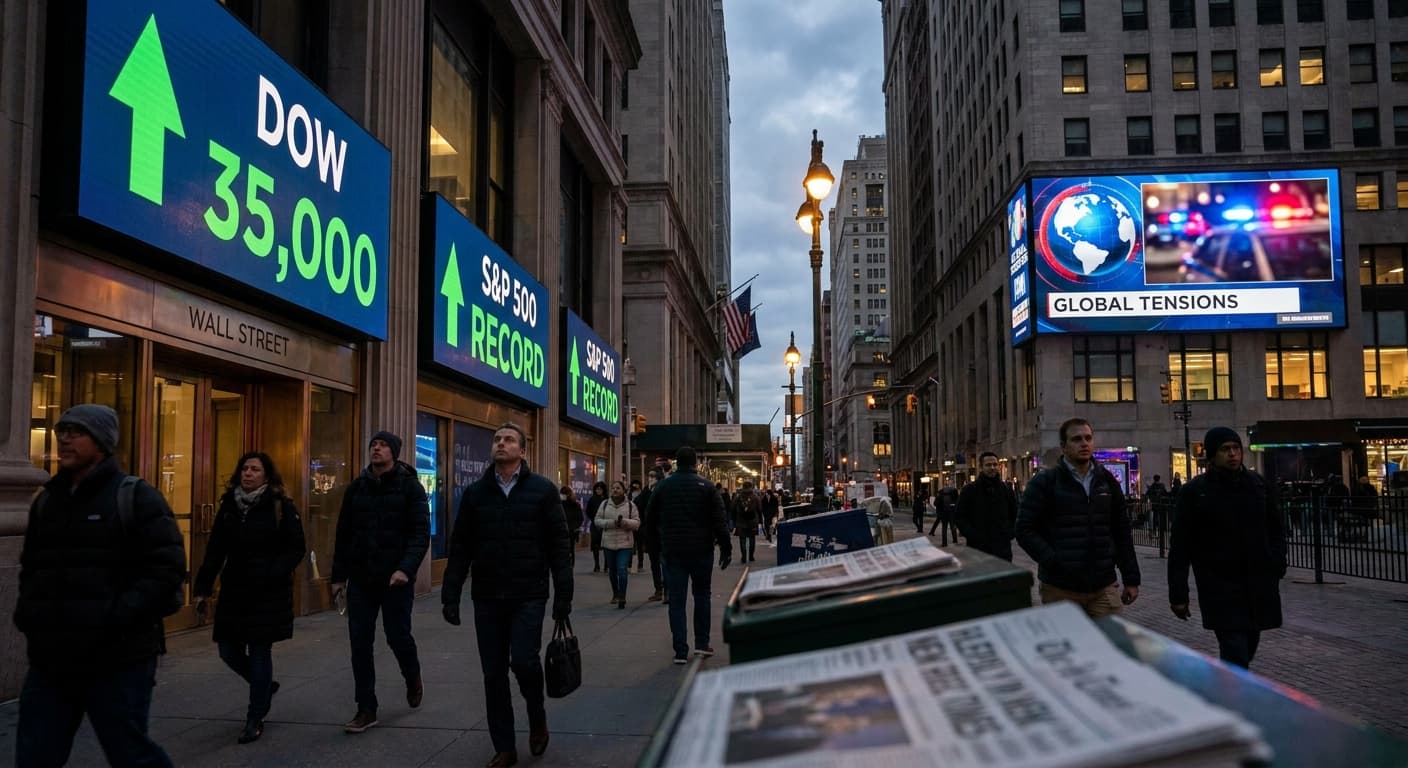
Wall Street Hits Record High as Iran Ceasefire Frays but Holds
Wall Street closed at record highs into July 7, 2026, as an Iran ceasefire and $71 oil overrode a fragile Hormuz truce and thin market breadth.
Wall Street's S&P 500 and Nasdaq Composite entered the July 4 holiday week at fresh record highs, even as attacks on Strait of Hormuz shipping and a stalled US–Iran nuclear track showed the June 17 ceasefire is anything but settled. The rally is real, but its foundations are narrower than the price action suggests: half the S&P 500's value now sits in just 26 stocks, according to S&P Dow Jones Indices, and the "peace premium" is being paid entirely by an AI-driven mega-cap rotation that would unravel fast if Hormuz closes again. This is not a market betting on peace. It is a market betting that Iran cannot afford to break it before OPEC+ finishes rebuilding the oil glut.
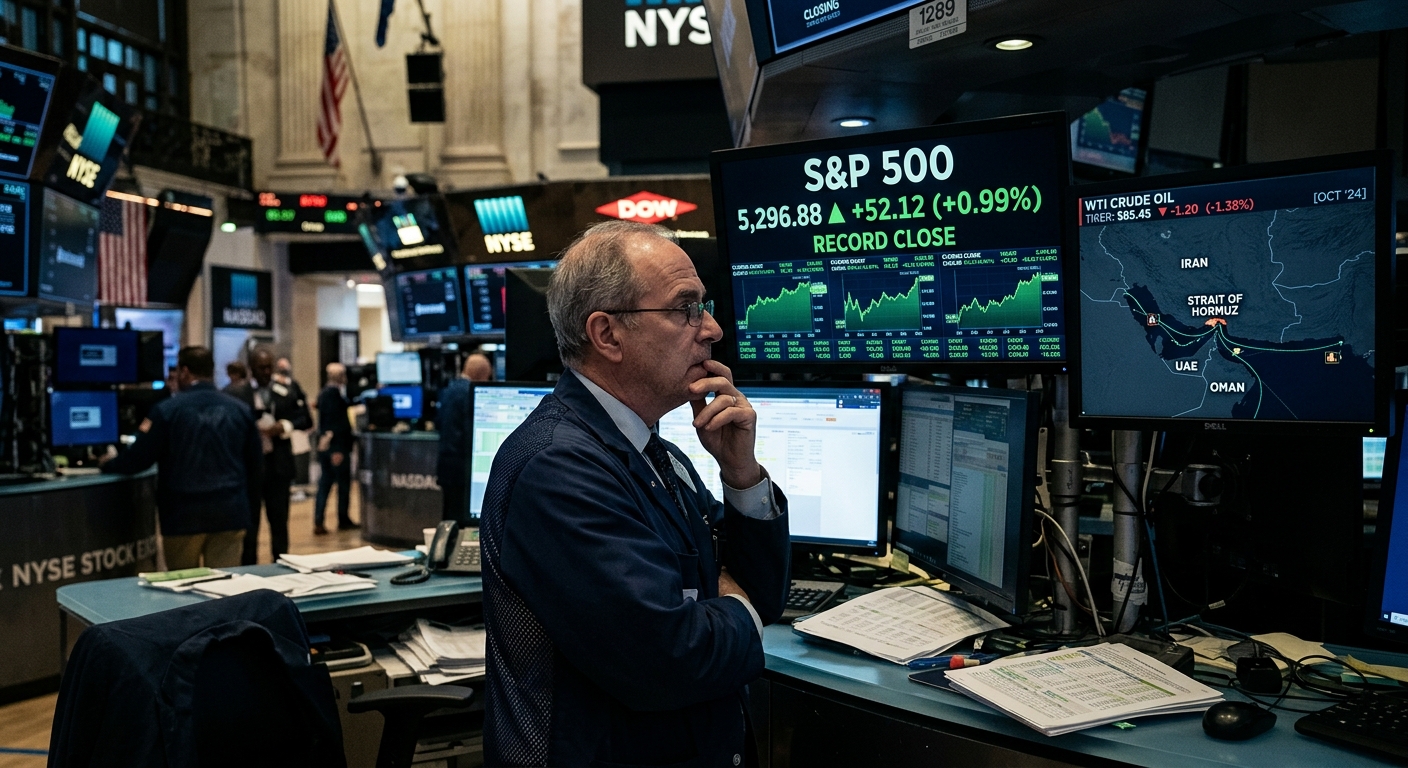
What actually happened
Brent crude fell below $71 a barrel on July 2, its lowest level since February 27 — the day before US and Israeli strikes killed Supreme Leader Ali Khamenei and touched off a four-month war that at its April 30 peak drove crude above $126. Al Jazeera reported that Brent has now fallen more than 38 percent from that peak, wiping out the entire wartime risk premium in the space of six weeks.
The trigger was the Islamabad Memorandum of Understanding, signed at the G7 in Evian-les-Bains on June 17 by Presidents Donald Trump and Masoud Pezeshkian. The BBC summarised the document's key provisions: reopening the Strait of Hormuz toll-free for 60 days, a $300 billion Iran reconstruction fund, US termination of "all types of sanctions," and — critically for markets — a 60-day negotiating window on Iran's nuclear programme, extendable by mutual consent.
Equities responded predictably. Al Jazeera's John Power reported the S&P 500 rose 1.7 percent on June 15 to within touching distance of its all-time high, with the Dow closing at a record and the Nasdaq up 3.1 percent — boosted by a 19.6 percent gain from SpaceX's post-IPO surge. On July 6,
OPEC+ agreed to raise output by another 188,000 barrels per day from August, the fifth consecutive monthly increase, cementing the case that the immediate supply shock is over.
The bet the market is actually making
The consensus explanation — "peace is breaking out, buy stocks" — misses the structural point. The ceasefire is visibly fraying. Trump himself called it "on life support" in May after a first truce collapsed. MarineTraffic data cited by Al Jazeera records at least 49 attacks on commercial vessels in the strait since the war began, most claimed by or blamed on Iranian forces. On June 26, the International Maritime Organization paused its evacuation of stranded ships after a cargo vessel was struck by an "unknown projectile." Traffic through the strait was 38 crossings on July 2 — up from the wartime nadir of seven per day, but still less than a third of the pre-war baseline of roughly 130.
Yet volatility barely twitches. That disconnect matters. The IMF's April 2026 Global Financial Stability Report warned that financial stability risks remain elevated on high debt and rollover risk, and that a Vix jump of roughly seven percentage points — comparable to the Fed's 2022 tightening shock — could trigger forced deleveraging by hedge funds now heavily exposed to emerging markets. The Fed's own Vice Chair Philip Jefferson
warned in a March 26 Dallas speech that "a sustained energy price shock… could have material implications" and that gasoline had already risen roughly a dollar a gallon since the war began.
What the market is actually pricing is not peace. It is the belief that even if Iran breaks the MoU, the combined slack — OPEC+ unwinding cuts, US strategic reserves, alternative pipelines through Saudi Arabia's East–West line and the UAE's Abu Dhabi Crude Oil Pipeline — now buffers a Hormuz disruption in a way it did not on February 28. US Energy Secretary Chris Wright told a forum on June 25, per Al Jazeera, that oil would keep flowing "even if the deal did not hold, and that Iran would not be able to close it again." That is the operative thesis under every equity high.
The narrow rally
The problem: this bet is being expressed in the most concentrated US equity market in living memory. The Financial Times' Alphaville reported, citing S&P Dow Jones Indices data, that just 26 stocks now account for half the entire value of the S&P 500 — down from 36 at end-2023 and, on the available data, the lowest number in the index's history. The top 10 alone represent 37.3 percent. Apollo's chief economist Torsten Sløk calls it a "diversification illusion": "The S&P 500… is in practice just Nvidia in drag."
Al Jazeera's 100-day audit of the war captured the mechanism cleanly: the S&P 500 fell 9.1 percent from its pre-war high through late March, then recovered to new records despite the ongoing conflict, "driven by a strong 'AI semis boom.'" Taiwan Semiconductor Manufacturing Company posted first-quarter net income of NT$572.8 billion ($18.1 billion), up 58 percent year-on-year; Taiwan's total merchandise exports hit a record $80.2 billion in March, with shipments to the US up 124 percent. The war did not stop the AI capex cycle. It arguably accelerated it, because nothing in a Middle East supply shock touches the demand curve for GPUs.
The Financial Times flagged on July 3 that surging Wall Street profit forecasts are now fuelling "earnings bubble" concerns — analysts have quietly ratcheted 2026 and 2027 estimates back toward pre-war trajectories on the assumption Hormuz normalises. NPR's
June 23 report on a mid-June tech selloff — the Nasdaq's worst single day in more than a year, 4 percent — showed how sharply the rotation can reverse when AI capex is questioned. That day's losses were fully retraced within a week once ceasefire optimism returned.
The Fed constraint
The rally is running against a central bank that cannot yet cut. The BBC reported that the Federal Reserve held rates in the 3.5–3.75 percent range at Jerome Powell's March meeting, with revised projections showing inflation ending 2026 at 2.7 percent — up from a 2.4 percent December projection — because of the "oil shock" and residual tariff pass-through. At the June 17 meeting,
under new chair Kevin Warsh, the Fed held again, with projections now hinting the next move could be a hike, not a cut. Governor Stephen Miran dissented in favour of easing.
Then came the June jobs report. The Economist's World in Brief noted the US economy added just 57,000 jobs in June, well below expectations, with unemployment ticking down to 4.2 percent only because participation slipped. The FT's response was blunter —
"the June jobs report was a blip — we hope." A softening labour market plus falling oil is precisely the mix that would let Warsh's Fed pivot back to cuts in September. That expectation, more than any single Iran headline, is what carried indices into record territory on July 6.
The Congressional Research Service's May 13 assessment of the ceasefire framed the trade Trump ultimately took: sustained Hormuz disruption risked "considerable global macroeconomic impacts" beyond energy, including fertiliser, helium and aluminium supply lines. In other words, the White House had a political incentive to sign at Evian even on soft terms — the alternative was a US recession heading into the midterms. Markets read that correctly.
Who wins, who loses
Al Jazeera's April survey of war beneficiaries identified the pattern early: AI infrastructure, weapons manufacturers, and — perversely — clean energy. The S&P Global Clean Energy Transition Index rose 70.92 percent year-on-year as Asian governments scrambled for hydrocarbon alternatives during the Hormuz shutdown. The losers are European industrials (the FTSE 100, DAX and CAC 40 spent months well below February levels), oil-importing emerging markets that burned through reserves defending currencies against a strong dollar, and any US household exposed to the $4.16-per-gallon gasoline peak documented in
NPR's April coverage.
The quiet winner is the US Treasury. The war drove a flight to dollars even as US assets were the direct exposure to the conflict — a reminder that in a fragmented global economy, the reserve currency premium widens when the reserve currency's military is doing the shooting.
Diplomat View
The market is not wrong to buy this ceasefire — it is wrong to buy it at these multiples. The 26-stock S&P 500 leaves no margin for a serious Hormuz relapse, and the June 17 MoU explicitly leaves the nuclear file and post-60-day transit fees unresolved. Iran's parliamentary speaker Mohammad Baqer Ghalibaf has already told state TV the strait "will not return to pre-war conditions" and that Tehran expects to charge shipping fees once the toll-free window lapses in mid-August. Doha's July 1 technical talks produced a "communication channel" — diplomat-speak for a hotline to manage the next incident, not a settlement.
Our call: the S&P 500 rally is durable through Q3 on Fed-cut expectations and OPEC+ supply. It is exposed to a specific, dateable risk — the August 16 expiry of the MoU's initial 60-day window, when either nuclear talks produce a follow-on agreement or the truce reverts to Trump's "life support" state. A single credible Hormuz incident in that window, priced against a market this concentrated, would produce a drawdown comparable to March's 9.1 percent — and this time without the Fed cavalry standing by. We revise this call if: (a) the Fed cuts in July on the jobs data, giving the market a policy cushion; (b) Iran and the US publicly agree an MoU extension before August 10; or (c) Brent breaks back above $85 on Hormuz incidents, at which point the "peace premium" collapses regardless of the political headline.
What to watch
- August 2, 2026 — OPEC+ ministerial review. A larger-than-expected quota increase would confirm the supply-glut thesis and cap oil below $75.
- Mid-August 2026 — expiry of the 60-day Islamabad MoU window on Hormuz transit fees and nuclear talks. This is the market's single largest binary risk.
- September 16–17, 2026 — FOMC meeting. First plausible window for a rate cut under Warsh; futures currently price roughly a coin-flip.
- Q2 earnings, mid-July — Nvidia, TSMC and hyperscaler guidance will decide whether the AI capex story that has carried this market through a shooting war can carry it through the ceasefire.
The Bottom Line
Wall Street's record close is not a peace dividend — it is a leveraged bet that Iran cannot afford to break the Islamabad MoU before OPEC+ and US shale rebuild the buffer that failed in February. With 26 stocks now representing half the S&P 500's value, that bet is being expressed in the narrowest market on record. If the ceasefire survives to Labor Day, the rally extends. If Hormuz closes again inside the August window, the same concentration that manufactured this record will manufacture the drawdown. *
Discover more

India
U.S. Missile Reserves Plummet in Iran War
US missile stockpiles are critically depleted by the Iran conflict, straining military readiness and forcing a rethink of global deterrence strategy and supply.

US Politics
Trump's Jones Act Waiver
Trump's waiver of the Jones Act exposes how the Iran conflict is driving up US fuel prices, easing shipping rules to ease pressure on domestic energy supplies.

Global Politics
US Minimizes Iran Conflict at IMF Meetings
US representatives at IMF meetings downplayed the Iran conflict's economic risks, diverging from global concerns over energy market and oil price shocks.

Global Politics
US-Israel Airstrikes on Iran
The February 2026 airstrikes on Iran did not destroy its uranium stockpile, raising concerns about nuclear proliferation and regional stability.