Kyiv’s Robot Army: Ukraine’s AI Warfare
Ukraine deploys AI drones to counter Russian forces.
Model Diplomat2 min readEurope
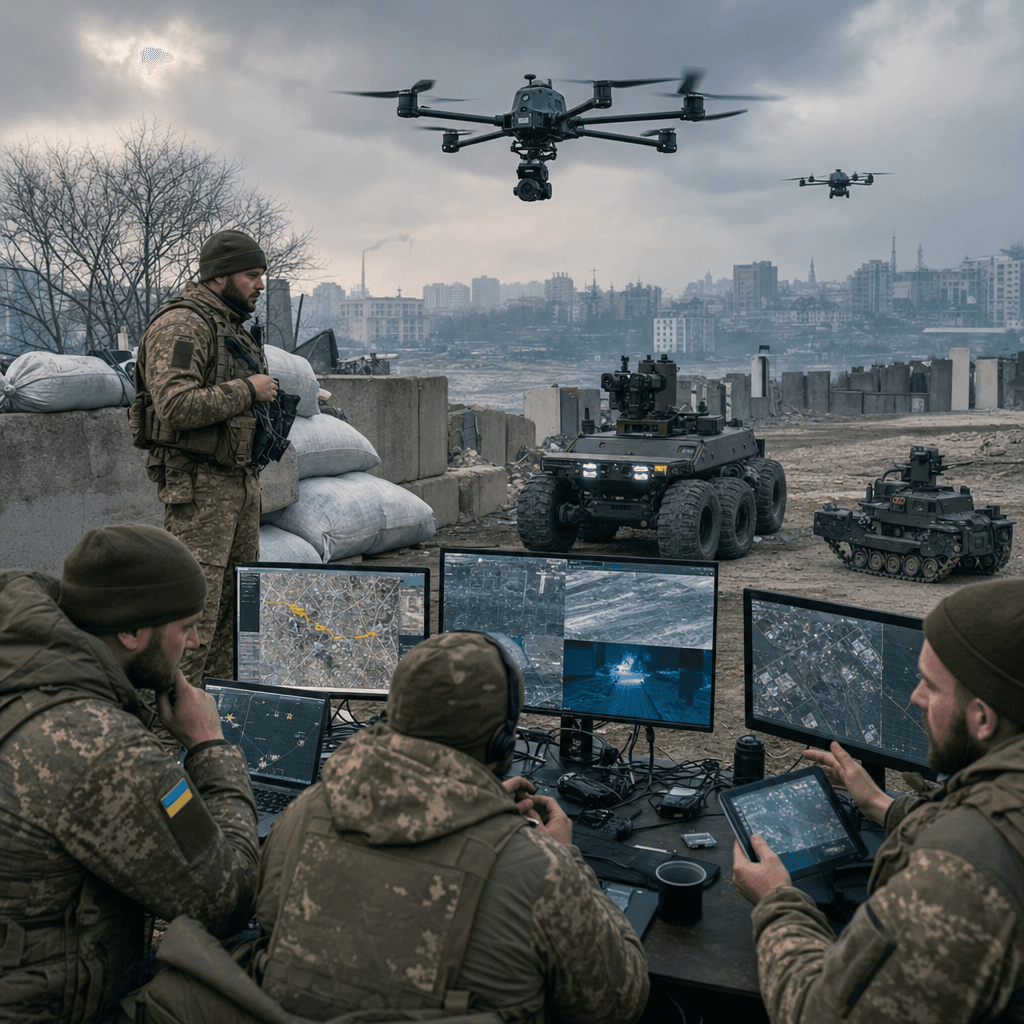
Kyiv’s Robot Army: Ukraine Accelerates Autonomous War to Blunt Russia’s Manpower Advantage
As Ukrainian infantry shortages grow, Kyiv is deploying AI-enabled drones and ground combat robots to cripple Russian supply lines and hold the front.
The Remote-Control Front
The asymmetric power dynamic in Ukraine is shifting from human endurance to technological adaptation. On May 30, 2026, CNN reported that Ukrainian veterans are now directing complex combat operations from remote bunkers, managing automated ground and aerial systems that have conducted over 22,000 operations since January. Facing a massive numerical disadvantage, Kyiv is using technological leverage to preserve its dwindling force pool. Severe manpower shortages are forcing Ukraine to pivot from human-heavy attrition to highly automated machine warfare, aiming to neutralize Russia's primary advantage of overwhelming troop numbers.
Substituting Steel for Blood
This automation strategy is being institutionalized across Ukraine’s armed forces. The military is no longer just using drones to augment traditional forces; it is actively replacing them. The elite Third Army Corps plans to replace 30 percent of its combat infantry with ground robotic systems by the end of 2026, according to command advisers cited by Euromaidan Press. Armed with machine guns, thermobaric rockets, and heavy explosives, these remotely operated ground vehicles are conducting high-risk trench clearances and casualty evacuations, keeping soldiers out of direct Russian artillery fire in this brutal
conflict.
Simultaneously, Kyiv has extended its technological reach into Russia's operational rear. According to reports from BBC News, Ukraine is now deploying AI-enabled "Hornet" drones trained on thousands of hours of target footage. Capable of navigating autonomously without GPS signals and linking to operators via Starlink, these loitering munitions are decimating Russian logistics. The Institute for the Study of War, highlighted in an analysis by
ABC News, confirmed that this intermediate-range strike campaign has turned the critical southern land bridge into a logistical highway to hell, starving front-line Russian columns of fuel, food, and ammunition.
What to Watch Next
For policymakers tracking global politics, the durability of Ukraine's technological edge is the central uncertainty. The next critical inflection point will be how rapidly Russian electronic-warfare units can adapt to jam or spoof the autonomous targeting algorithms of Ukraine’s AI drone fleet. Because battlefield cycles are short, Kyiv's current operational advantage will likely trigger a heavy Russian counter-investment in autonomous systems, turning the summer of 2026 into a race for algorithmic supremacy.
Discover more
US Politics
Congress Targets AI Chatbot Access for Terror
The House passed the Generative AI Terrorism Risk Assessment Act, focusing on AI's role in terrorism and potential surveillance implications.

Economics
Fed's Amex AML order puts correspondent banking on notice
Federal Reserve's Amex AML order requires board-level controls and a 90-day plan; OCC fined the bank $350 million over enterprise-wide deficiencies.

Conflict & Security
Guatemala: El Niño 2026–27 becomes regional security test
UNICEF: 25.8M children face El Niño risks in Latin America; Guatemala maps 188 municipalities for drought and food insecurity amid regional security test.

Economics
Fed's stress-test overhaul is a capital-smoothing exercise
Federal Reserve finalized stress-test overhaul: two-year averaging for bank capital buffers and public input, expected to halve volatility.