US Reinstates Iran Blockade, Splits Hormuz
US reinstates Iran blockade, splitting Hormuz into toll lanes
Model Diplomat10 min readMiddle East
US Reinstates Iran Blockade After 26-Day Ceasefire, Partitioning Hormuz
The US maritime blockade of Iran returned July 14 after a 26-day pause, ending the June 17 MoU and splitting the Strait of Hormuz into competing toll-controlled lanes — with a 60-day war-powers clock now ticking toward Congress.
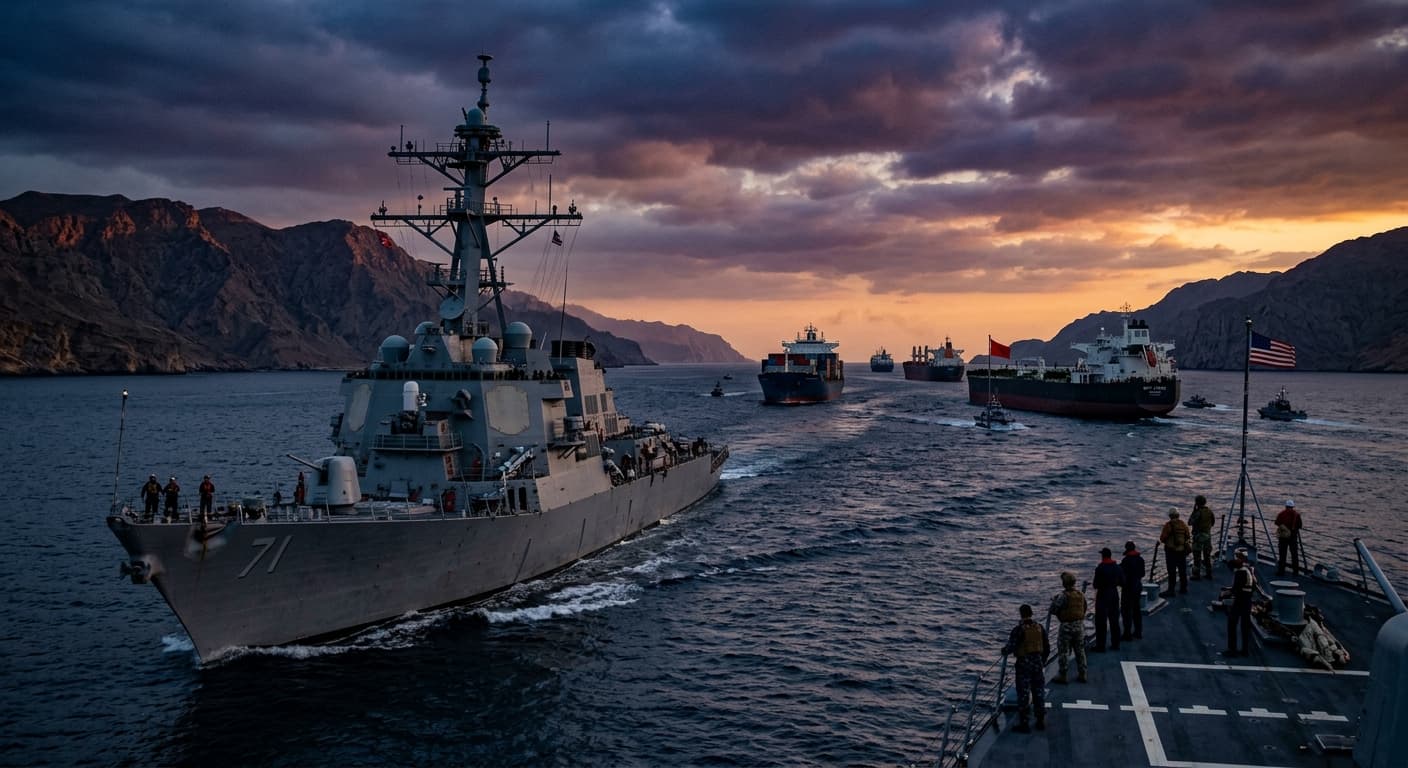
The United States reinstated its naval blockade of vessels transiting to and from Iranian ports at 4 p.m. Eastern time on July 14, 2026, 26 days after suspending the measure under a June 17 memorandum of understanding with Tehran, US Central Command announced on its official X account The Herald Business. The blockade, the second imposed this year, coincided with a fourth consecutive day of US airstrikes against Iranian military facilities, a campaign that has now killed at least seven Iranian troops, two seafarers, and wounded eight crew on two UAE-flagged tankers hit by Iranian cruise missiles
Al Jazeera. The strategic significance is not the blockade's return but what it has become: a de facto partition of the Strait of Hormuz into two competing, toll-governed corridors, one run by Washington along Oman's coast and one by Tehran along its own, with the MoU that briefly unified them now declared dead by both sides.
CENTCOM said more than 20 US Navy warships and hundreds of military aircraft were conducting operations across the Middle East, with at least 19 warships — including two aircraft carriers and amphibious assault ships carrying more than 1,000 Marines — deployed in the northern Arabian Sea The Herald Business. The blockade's first enforcement cycle, from April 13 to June 18, had redirected 100 commercial vessels and disabled four, according to CENTCOM statements
BBC. In the first 24 hours of the renewed blockade, CENTCOM said it had already redirected two commercial vessels and disabled a Curaçao-flagged oil tanker, the Belma, with a Hellfire missile after it ignored multiple warnings while transiting toward Kharg Island
NPR.
How a Ceasefire Died in 26 Days
The June 17 MoU was always fragile by design. It left the most contentious issues — Iran's nuclear program, frozen assets, and the future administration of the strait — for a 60-day negotiation window. On transit, it committed Iran to "best efforts" for toll-free passage while the US agreed to lift its blockade and temporarily ease sanctions on Iranian oil exports, according to a legal framework outlined by US Naval War College professor James Kraska in a June 18 Japan Institute of International Affairs briefing JIIA.
That compromise lasted barely a week. After the MoU, overall traffic in the strait rose to a peak of 72 ships on June 24, with a growing share using the US-recommended "Southern Highway" hugging Oman's coast BBC. Then on June 25 and 27, two ships in Omani waters were struck. Iran's Khatam al-Anbiya military command reiterated that "the only safe route" is one it determines along its own coast
BBC. On July 7, three ships using the Omani route were attacked — a Qatar-owned LNG tanker, a Saudi-owned crude oil tanker, and a Liberia-flagged crude tanker — triggering the current round of hostilities and effectively collapsing the ceasefire
BBC. Iran's Deputy Foreign Minister Kazem Gharibabadi formally declared the MoU "no longer valid" on July 15
Al Jazeera.
The trigger, on the surface, was a routing dispute. Beneath it was a contest over who gets to tax and police the world's most critical energy chokepoint — a question the MoU deliberately deferred and that 26 days of fighting has now answered with force.
Iran's top negotiator, Mohammed Bagher Ghalibaf, declared on July 15 that Iran's armed forces now have "complete freedom of action" against the "enemy's aggression" and that Iran is "in an essential and existential war with America" Al Jazeera. Trump, for his part, warned that US attacks would intensify if Iran's leaders did not return to negotiations, even threatening to "knock out" Iran's power plants and bridges — while declining to give a firm deadline
Al Jazeera. The rhetoric on both sides has shifted from ceasefire management to war posture.
The Toll-Booth Convergence
What is striking is how much Washington and Tehran now agree on, even as they exchange fire. Both sides have proposed charging fees for safe transit through the strait — the very mechanism the International Maritime Organization says has "no legal basis" under international law UN Press.
Trump announced on July 13 that the US would become "THE GUARDIAN OF THE HORMUZ STRAIT" and collect a 20% charge on all cargo shipped through the waterway BBC. He reversed the toll plan within 24 hours, replacing it with an offer of "trade and investment deals" with Gulf allies — but kept the blockade
BBC. Iran, meanwhile, has since March operated what the shipping journal Lloyd's List described as an IRGC "toll booth" system along its approved northern lanes, vetting vessels and collecting payments
Al Jazeera. On July 15, the IRGC warned that "the export of oil and gas from the region will be either for everyone or for no one"
Al Jazeera.
The Stimson Center's Joaquin Matamis frames the endgame bluntly: Iran seeks to institutionalize a "service charges" mechanism with Oman, and "returning to the pre-conflict status quo appears increasingly unlikely" Stimson Center. The real negotiation is no longer whether Hormuz will carry tolls, but who collects them — and what sovereignty over an international strait means once both belligerents have accepted that transit is no longer free.
This convergence has a historical parallel. The 1956 Suez Crisis ended with Egypt physical control of the canal but international guarantees on transit — a compromise that held for over a decade until the 1967 war closed the waterway entirely. The Hormuz dispute is tracking a similar arc: a fragile agreement over control and access, collapsing into armed confrontation, with the waterway itself becoming the battlefield.
Traffic Collapse and the Energy Shock
The numbers on the water tell the story. Before the war began on February 28, an average of 130 to 138 vessels transited the strait daily, according to the Joint Maritime Information Center and maritime intelligence firm Kpler BBC. After the initial US-Israeli strikes, traffic dropped 70%
CFR. The MoU brought a partial recovery to 72 ships on June 24. Then the July 7 attacks sent traffic plummeting again — just 23 vessels crossed on July 15, with zero ships using the Omani route that day
BBC.
Lloyd's List Intelligence reported that no vessel above 10,000 deadweight tons had transited the so-called Southern Highway with AIS switched on since July 7, with at least two ships believed to have crossed "dark" Al Jazeera. Windward tracked only five vessels crossing on July 15, compared with 45 on July 7
Al Jazeera. The strait is not formally closed — it is functionally deserted.
Oil markets have absorbed the disruption with surprising composure so far. Brent crude stood at $86.19 a barrel on July 15, up sharply from near $70 before the latest escalation but still well below the $100-plus peaks seen in March Al Jazeera. TD Securities' global head of commodity strategy Bart Melek told Al Jazeera that Brent could move "$10 to $15 higher into the summer, as inventories of oil and product wane, stressing supply chains"
Al Jazeera. The Congressional Research Service noted in a March 2026 report that "prohibiting all oil shipments through the Strait of Hormuz would materially affect global oil supply and could result in rapid price escalation for crude oil"
Congress.gov.
The biggest immediate loser is the refined products market. June Goh, senior oil market analyst at Sparta Commodities in Singapore, told Al Jazeera that diesel prices are "skyrocketing" beyond seasonal norms, driven by the loss of Middle East refinery output compounded by Russian refinery disruptions from Ukrainian drone attacks Al Jazeera. The IEA had already released 400 million barrels of emergency crude in March, its largest tranche ever, but strategic reserves cannot substitute for refined product flows.
Who Wins, Who Loses
Saudi Arabia is the quiet winner among Gulf producers. Its 1,200-kilometer East-West Pipeline, operated by Saudi Aramco, links Abqaiq in the east to the Red Sea port of Yanbu, bypassing Hormuz entirely at a capacity of 7 million barrels per day Al Jazeera. As long as the Bab al-Mandeb Strait at the Red Sea's southern entrance remains open, Saudi crude can reach Asian and European markets without entering the contested Gulf. No other Gulf producer has a comparable alternative.
The UAE, Kuwait, Qatar, and Bahrain are the immediate losers. Their energy exports are largely trapped behind the Hormuz bottleneck, and the UAE has already suffered direct casualties — one Indian crew member killed and eight wounded when Iranian cruise missiles struck two UAE tankers in Omani waters on July 14 BBC. Qatar Energy halted LNG production earlier in the war after its facilities were targeted by Iranian drones
CFR.
Iran itself is both belligerent and loser. The reimposed blockade again cuts off oil revenue, the lifeline of the regime, and the country's military infrastructure is being systematically degraded. But Iran retains the asymmetric advantage of geography: the strait's narrowest point is 21 nautical miles wide, with the entire waterway sitting within the overlapping territorial seas of Iran and Oman Al Jazeera. Iran can deny transit far more cheaply than the US can restore it.
The Legal Gray Zone
Under the UN Convention on the Law of the Sea, transit passage through international straits is non-suspendable, even during armed conflict, according to the San Remo Manual on International Law Applicable to Armed Conflicts at Sea Valdai Club. Neither the US nor Iran is a party to UNCLOS, though both acknowledge its provisions as customary international law — selectively
JIIA.
The IMO's Secretary-General Arsenio Dominguez has stated plainly: "There is no legal basis in international law to take any actions to block any strait used for international navigation" BBC. Yet the law of naval warfare, as ANU professor Donald Rothwell noted, treats the US, Israel, and Iran as "belligerents" — meaning the US "can legitimately impose a blockade under international law, specifically the law of naval warfare"
BBC. The blockade is legally defensible as an act of war; the tolls are not. Both sides are operating in the gap between those two frameworks.
UN Security Council Resolution 2817, adopted on March 11, 2026, condemned Iran's attacks on regional states and affirmed that "navigation rights and freedoms of merchant and commercial vessels, exercised in accordance with international law, must be respected" INSS. It did not authorize the US blockade — nor did it prohibit it. The Security Council's July 16 session heard Secretary-General António Guterres urge "Let ships pass. Let the global economy breathe"
UN Press. Neither belligerent is listening.
The 60-Day Clock
The war-powers calculus in Washington is now the decisive constraint on escalation. Trump formally notified Congress on July 11 that the US had resumed military strikes on Iran, starting from July 7 BBC. Under 50 U.S.C. § 1544(b), the President must terminate the use of armed forces within 60 calendar days of that report unless Congress declares war, enacts specific authorization, or extends the period — with a possible 30-day extension if the President certifies "unavoidable military necessity"
Cornell Law Institute.
That clock expires on approximately September 9, 2026 — or October 9 if the 30-day extension is invoked. With midterm elections approaching and Republican incumbents facing constituents concerned about rising gas prices, Congress has both the legal authority and the political incentive to force a vote. Historical precedent is not encouraging for the executive: every president since Nixon has operated under the War Powers Resolution's constraints, and courts have consistently held that Congress can cut off funding or pass a concurrent resolution to force withdrawal Cornell Law Institute.
The Second Front
The crisis could compound. A sudden military escalation in Yemen has shattered a fragile four-year truce, threatening to expand the conflict into the Red Sea and sever the Bab al-Mandeb Strait — the other critical energy artery Al Jazeera. If both Hormuz and Bab al-Mandeb were simultaneously shut, approximately 25% of the world's total oil and gas supply would be blocked, forcing ships around the Cape of Good Hope and adding 10 to 14 days to delivery schedules
Al Jazeera. Saudi Arabia's Yanbu bypass would be rendered useless if the Red Sea route closed.
Mohammad Cherkaoui, a professor of international conflict resolution, told Al Jazeera that "if the Bab al-Mandeb crisis erupts in parallel with the Hormuz crisis, we will face a pincer movement that blows away the stability and security of the Gulf" Al Jazeera. The IRGC has already warned the US to "expect the closure of other oil and gas export routes that serve the interests of the United States and its allies"
BBC.
Diplomat View
The MoU is dead, and no successor is on the table. Both sides have incentivized continued escalation: Trump needs a visibly "tough" posture ahead of the midterms and has calculated that the first blockade brought Iran to the table once before; Tehran's leadership, having declared an "existential war," cannot retreat without demonstrating costs imposed on the US and its Gulf partners. The toll-booth convergence, both belligerents proposing to charge for transit through a waterway international law says must remain free, is the most consequential development, because it means the next ceasefire, if one comes, will not restore the pre-war status quo. It will codify a partitioned strait with sanctioned lanes and fees, fundamentally reshaping the legal architecture of one of the world's most critical maritime corridors.
The forecast hinges on three variables: the September 9 war-powers deadline forcing congressional action, whether the Bab al-Mandeb remains open, and whether China and India, the largest buyers of Hormuz-bound crude, accept a toll regime or intervene diplomatically to restore free transit. If any of these moves, the current low-intensity war either de-escalates into a managed partition or escalates into the largest energy disruption since 1973.
The next ceasefire, if one comes, will not restore free transit through Hormuz. It will codify the toll.
Discover more

US Politics
Next Generation Republicans
A leaked survey shows 39% of Republicans under 30 do not identify as MAGA, revealing a split in the GOP's future leadership.
US Politics
SNAP Food Assistance Faces Legal Challenges
In 2026, SNAP faces stricter eligibility rules and mounting legal challenges, threatening food assistance for the millions of Americans who rely on the program.
US Politics
House Ethics Committee Pushes Sexual Miscond.
The House Ethics Committee has shifted responsibility for sexual harassment settlement records to the Office of Congressional Workplace Rights, complicating disclosure efforts.

Economics
Fed's Amex AML order puts correspondent banking on notice
Federal Reserve's Amex AML order requires board-level controls and a 90-day plan; OCC fined the bank $350 million over enterprise-wide deficiencies.