UAE Joins U.S. Export Control Inner Circle
BIS reclassifies UAE to A:5 with a 270-day sunset for G42 and Core42
Model Diplomat3 min readMiddle East
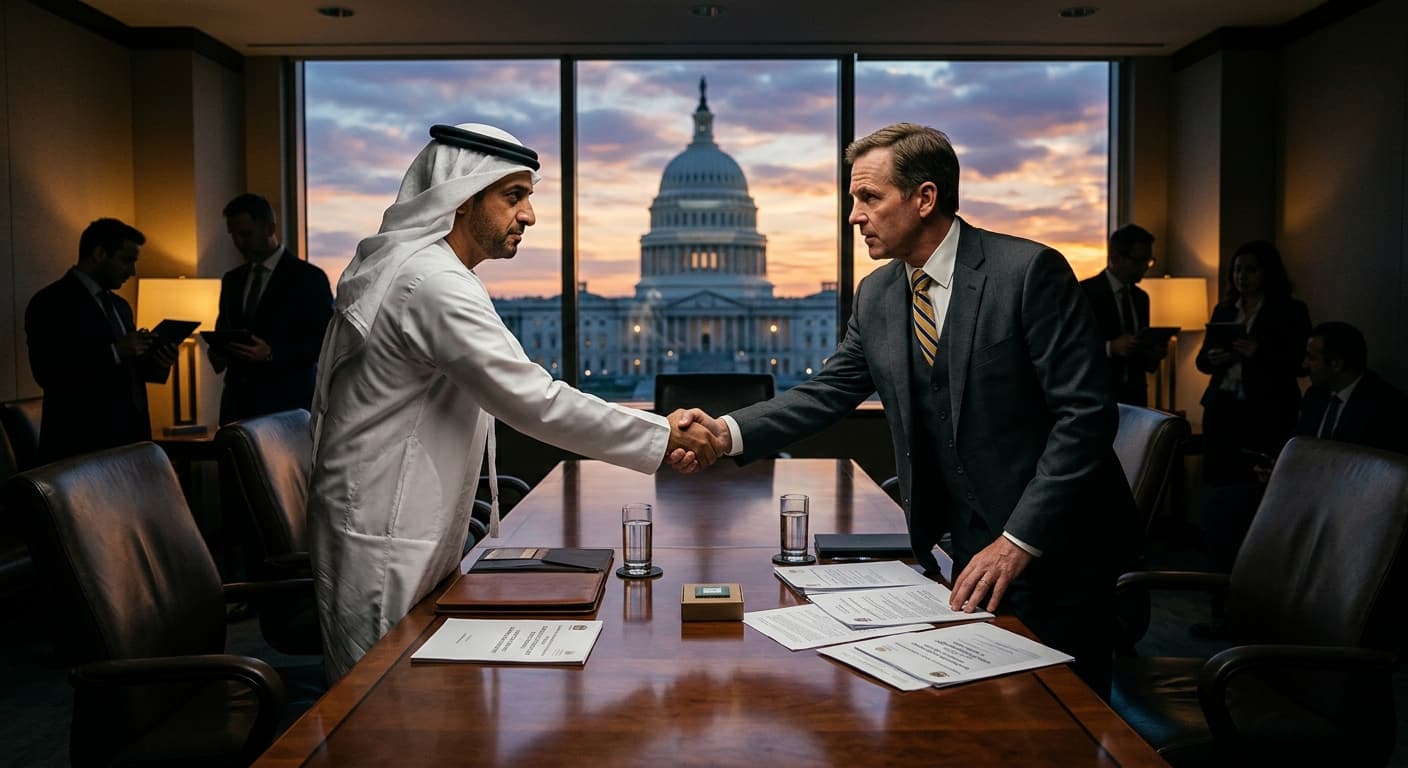
UAE Joins U.S. Inner Circle on Export Controls — With a 270-Day String Attached
The BIS final rule effective July 10, 2026, grants the UAE license-free access to advanced AI chips and defense technology, but a 270-day sunset clause for G42 and Core42 reveals the real play: pulling UAE's AI crown jewels into U.S. corporate jurisdiction.
The U.S. Bureau of Industry and Security removed the United Arab Emirates from Country Groups D:3 and D:4, the export-control categories covering chemical, biological, and missile technology restrictions, and reclassified the country into Country Group A:5, the tier reserved for America's closest export-control partners, effective July 10, 2026 (Global Trade & Sanctions Law). The rule, published in the Federal Register as 91 FR 43034 on July 14, 2026, grants the UAE government and a narrow list of approved commercial entities license-free access under License Exception Strategic Trade Authorization to items controlled for national security, chemical and biological weapons, nuclear nonproliferation, regional stability, crime control, and significant items reasons (
Federal Register). A companion Advanced Computing Items license exception authorizes license-free exports of AI chips and servers to the UAE — but only to parties listed in Supplement No. 8 to Part 740. The decisive detail is not the access granted but the clock started: STA eligibility for G42 and Core42, the UAE's two flagship AI firms, expires in 270 days (approximately April 6, 2027) unless they become U.S. companies. This is not a permanent concession. It is a structural pressure point designed to pull the UAE's AI crown jewels into U.S. corporate jurisdiction.
The Regulatory Architecture
The BIS press release dated July 10, 2026, frames the reclassification as recognition of the UAE's status as a U.S. Major Defense Partner and its support for "Operation Epic Fury" — a reference to recent military cooperation that BIS cites as justification for the upgrade (BIS Press Release). The rule eliminates EAR 744.3 end-use restrictions that previously required licenses for items used in the design, development, production, or maintenance of rocket systems, ballistic missiles, space launch vehicles, and unmanned aerial vehicles with a range of at least 300 kilometers destined for the UAE (
Global Trade & Sanctions Law). That removal alone represents a significant loosening of missile-technology controls for a country that was, until this month, in the same export-control tier as Iran and North Korea for chemical and biological weapons purposes.
Country Group A:5, as defined in Supplement No. 1 to Part 740 of the Export Administration Regulations, includes Wassenaar Arrangement participating states, Missile Technology Control Regime members, Australia Group countries, and Nuclear Suppliers Group members — effectively the core of the Western export-control architecture (Cornell Law Institute). The UAE is the first Gulf Arab state to join this group. Its admission is unilateral, not through membership in any of the multilateral regimes that populate A:5, but through a bilateral decision by the Trump administration to extend favorable treatment as a strategic reward.
The rule's Advanced Computing Items carve-out is the commercially consequential provision. It allows license-free exports of advanced semiconductor chips — including items classified under ECCNs 3A090 and 4A090, the categories covering the most powerful AI accelerators, to entities listed in Supplement No. 8. That supplement currently identifies Group 42 Holding Ltd (G42) and Core42 Technology Projects LLC (Core42) as the approved UAE commercial entities, alongside subsidiaries of certain U.S.-headquartered AI companies whose identities are specified in a separate paragraph of the supplement (Global Trade & Sanctions Law). The rule also states that license applications from MGX, the UAE state-backed investment vehicle and founding partner in the Stargate Project alongside OpenAI, SoftBank, and Oracle, will receive favorable review for semiconductor and server exports (
Global Trade & Sanctions Law). BIS is evaluating additional applications for approved-entity status on a case-by-case basis under 15 C.F.R. 748.3(c).
The 270-Day Lever
The sunset clause is the provision that transforms this rule from a gift into a mechanism. STA eligibility for G42 and Core42 will expire 270 days from July 10, 2026 — approximately April 6, 2027 — unless these companies become U.S. companies (Global Trade & Sanctions Law). The legal analysis from Squire
Discover more
US Politics
SNAP Food Assistance Faces Legal Challenges
In 2026, SNAP faces stricter eligibility rules and mounting legal challenges, threatening food assistance for the millions of Americans who rely on the program.
US Politics
House Ethics Committee Pushes Sexual Miscond.
The House Ethics Committee has shifted responsibility for sexual harassment settlement records to the Office of Congressional Workplace Rights, complicating disclosure efforts.
India
Congress Accuses Modi of Stalling Women's Law
Congress accuses Modi of stalling women's reservation law by linking it to delimitation, revealing a deeper electoral strategy.

Economics
Fed's Amex AML order puts correspondent banking on notice
Federal Reserve's Amex AML order requires board-level controls and a 90-day plan; OCC fined the bank $350 million over enterprise-wide deficiencies.