Trump's Hormuz Toll Reversal Masks a Bigger
Trump's reversal of a 20% cargo fee reveals the real deal is extracting Gulf investment, not reopening the waterway.
Model Diplomat10 min readMiddle East
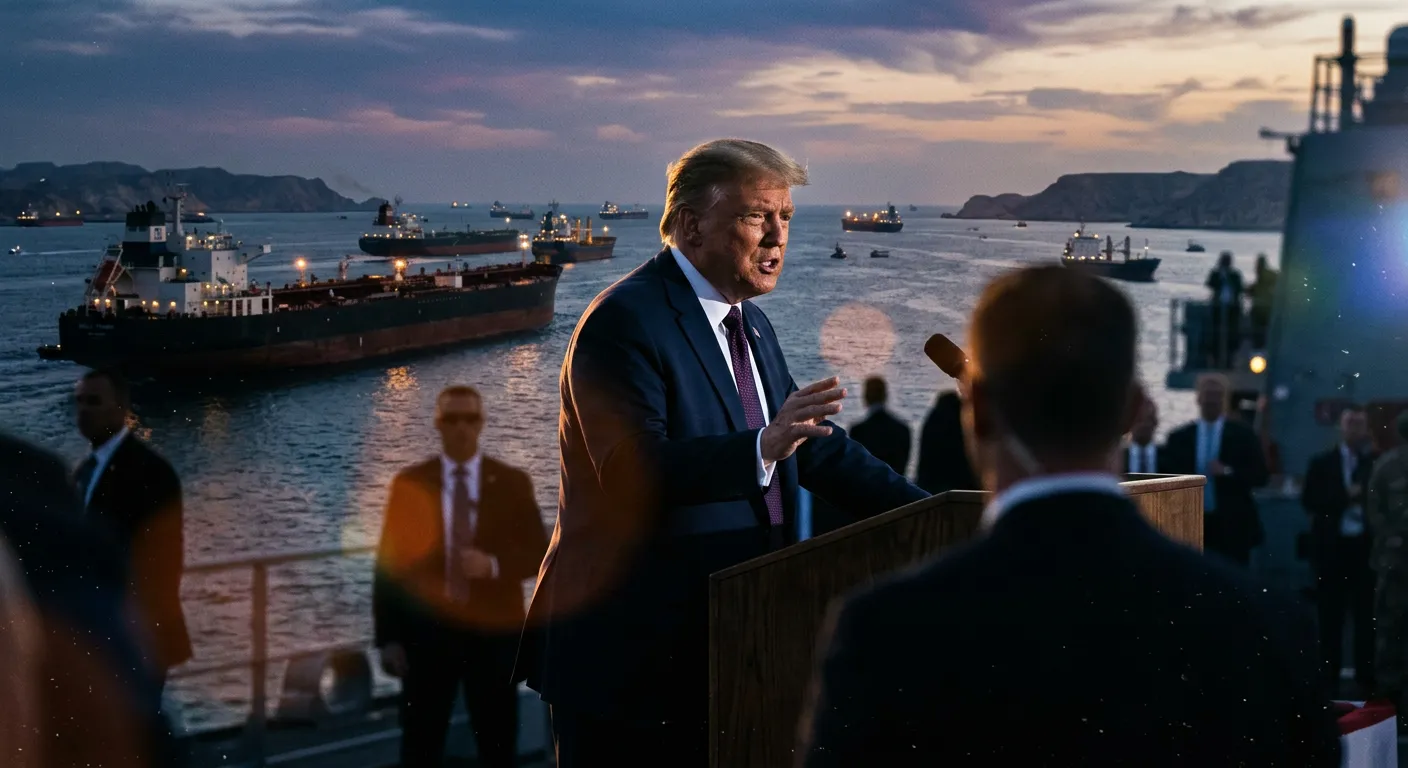
Trump's Hormuz Toll Reversal Masks a Bigger Play: Making Gulf States Pay for the Blockade
[Trump says strikes on Iran will continue as the Strait of Hormuz becomes the war's center of gravity — but his reversal of a 20% cargo fee reveals the real deal is extracting Gulf investment, not reopening the waterway.]
On July 14, 2026, President Donald Trump told Fox News that US air strikes on Iran would continue "until I say it's enough," and that within a week the targets would broaden to "power plants" and "bridges" unless Tehran returned to negotiations RFE/RL. The statement, delivered on the fourth consecutive day of strikes, confirmed what the unraveling of the June 17 Memorandum of Understanding had already signaled: the Strait of Hormuz is no longer a waterway to be reopened — it is a leverage asset Trump is running as a toll booth, with Gulf monarchies footing the bill. The decisive tell came hours earlier, when Trump scrapped a planned 20% cargo fee on ships transiting the strait and replaced it with something vaguer but more consequential: "Trade and Investment Deals that the various Gulf States will be making into the United States"
RFE/RL. The pivot was not a retreat. It was a transfer of who pays — from global shipping to Gulf capitals.
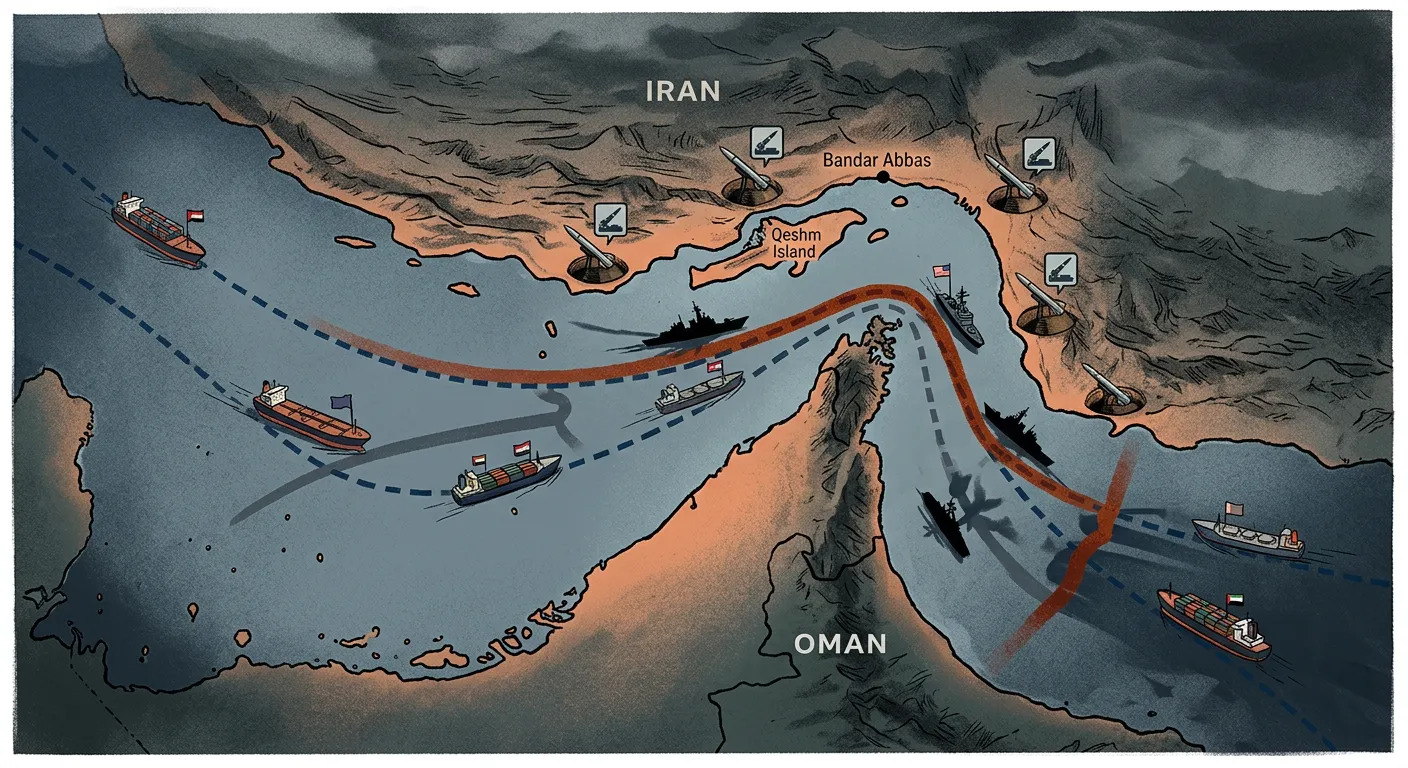
The blockade logic: choke the ports, own the strait
US Central Command reinstated its naval blockade of vessels "transiting to or from Iranian ports and coastal areas" at 4 p.m. Eastern Time on July 14, according to a CENTCOM statement, while insisting the US military "continues to support traffic flow through regional waters for all vessels not violating the blockade" Al Jazeera. This was the second US blockade of Iranian ports in four months — the first ran from April 13 to June 18 — and it followed a weekend in which Trump declared the US "the guardian of the Strait of Hormuz" and announced the 20% fee, only to reverse it 24 hours later after, in his own words, feedback "particularly from Gulf Arab countries"
NPR.
The reversal is the story. Until this week, Washington's position was categorical: no tolls on international waterways. Secretary of State Marco Rubio said as much in June, stating "no country is allowed to charge tolls or fees on an international waterway. That's existing international law" NPR. Trump's Monday proposal violated that principle; his Tuesday retreat restored it — but substituted a different extraction. The Gulf states, not shipping companies, will now pay for protection, through investment commitments Trump described as "MASSIVE" without providing details
RFE/RL. This converts a legal contest over freedom of navigation into a bilateral commercial arrangement — and places Saudi Arabia, the UAE, Qatar, and Kuwait in the position of funding the very blockade that is choking their own trade.
The beneficiary is unambiguous: the US Treasury. On the same day Trump reversed the toll, the Treasury's Office of Foreign Assets Control announced sanctions targeting more than 50 individuals, entities, and vessels linked to Mohammad Hossein Shamkhani, whom Treasury Secretary Scott Bessent called "one of its most profitable engines" of Iranian sanctions evasion US Department of the Treasury. The action, taken pursuant to Executive Order 13902, is the latest in a campaign that has sanctioned over 1,000 Iran-related persons, vessels, and aircraft since February 2025
US Department of the Treasury. The Shamkhani network — run by the son of Ali Shamkhani, a senior Iranian security official killed in the February 28 strikes — manages a multi-billion-dollar shipping empire transporting Iranian and Russian petroleum, primarily to Chinese buyers
US Department of the Treasury. Treasury's April 2026 action alone designated two dozen individuals and companies, including UAE-based Meritron, which had sought to purchase new vessels from South Korea worth tens of millions of dollars on the network's behalf
US Department of the Treasury. The sanctions and the blockade are complementary: one strangles Iran's legal trade, the other strangles its illicit trade.
The traffic collapse: a strait at virtual standstill
The stakes are visible in the shipping data. Daily transits through the Strait of Hormuz fell to 23 vessels on July 15, down from 147 the day before the war began on February 28 — an 84% collapse in traffic through a waterway that normally carries roughly 20% of global oil and gas BBC. The breakdown followed a route dispute at the heart of the MoU's failure. After the June 17 deal, the US-backed Joint Maritime Information Center recommended ships use a southern route through Omani waters; Iran insisted only its northern route was "safe." When Iran struck three vessels on the Omani route in early July — a Qatar-owned LNG tanker, a Saudi crude tanker, and a Liberia-flagged crude carrier — traffic on the Omani route ground to zero
BBC.
By July 16, CENTCOM reported it had disabled a Curaçao-flagged commercial vessel, the Belma, with a Hellfire missile after it "ignored multiple warnings" attempting to reach Kharg Island, Iran's main crude export terminal NPR. The strike on an unladen oil tanker in international waters marked a new threshold: the US is now firing on commercial shipping to enforce its blockade, not just on Iranian military targets. The Pentagon also reported a second wave of strikes that day, hitting command centers, air defense sites, and missile and drone capabilities in Bandar Abbas and on Greater Tunb Island
BBC. Brent crude, the global benchmark, rose more than 4% on July 13 and neared $85 a barrel, though it remained roughly a quarter below April's war peak
Al Jazeera
The Economist. The Economist noted that Brent's relative restraint — still below the April high despite a near-total traffic halt — reflects market expectations that the disruption is temporary, or that Saudi and Emirati spare capacity will absorb the gap. If those expectations break, the fuel crunch compounds fast.
The second-order effects are already registered. The International Maritime Organization reported at least two seafarers killed in the latest round of tanker strikes, and roughly 6,000 remain stranded aboard hundreds of vessels unable to exit the strait UN News. In June, the IMO managed to evacuate around 11,000 seafarers before pausing the operation on June 25 following a string of attacks
UN News. The disruption extends beyond oil: fertilizer shipments, food, and medicine transit the same waterway. UN Deputy High Commissioner Awa Dabo warned economists' assessments show "some of the world's most vulnerable economies could be thrown into chaos, increasing poverty and hunger for millions" unless the strait reopens
UN News.
Iran's counter-escalation: widening the map
Iran's response has been to expand the battlefield beyond the strait. The Islamic Revolutionary Guard Corps struck US military facilities in Jordan, Bahrain, and Kuwait with drones, and hit two supertankers in Omani waters, killing one crew member according to the UAE Al Jazeera. Jordanian state media reported its military intercepted eight drones with no casualties
BBC. Iran's top negotiator, Mohammad Bagher Ghalibaf, declared on July 15 that Iran was "in an essential and existential war with America" and that the MoU was void, giving Iran's armed forces "complete freedom of action"
Al Jazeera. The IRGC warned the US to "expect the closure of other oil and gas export routes that serve the interests of the United States and its allies" — a threat that, if acted upon, could extend disruption beyond Hormuz to the Bab el-Mandeb or Malacca straits
BBC.
Saudi Arabia's Foreign Ministry condemned Iran's attacks on Arab states and held Tehran "responsible for the consequences of continuing these cruel attacks" RFE/RL. The Gulf states are caught in both directions — struck by Iran, squeezed by a US blockade that requires their investment to sustain. Trump's "guardian" framing offers them protection; his fee reversal extracts payment for it. Qatar, which has served as mediator, condemned the tanker attacks, while Oman called on all parties to respect international law regarding navigation
Al Jazeera.
The historical parallel is the Tanker War of 1984–1988, when Iran and Iraq attacked each other's oil shipping in the Gulf, drawing US naval escorts under Operation Earnest Will. Then, as now, the contest was over who controlled the waterway and who paid for safe passage. The difference is scale: in the 1980s, roughly 400 ships were hit over four years; the current conflict has brought Hormuz traffic to a near-standstill in under five months. The 1987 reflagging of Kuwaiti tankers to fly the US flag was the mechanism by which Washington extended its protection; Trump's investment deals are the 2026 equivalent — a toll paid not in flags but in capital.
The legal fault line: two non-parties, one strait
The contest over Hormuz rests on a legal ambiguity that predates this war by decades. Neither the United States nor Iran is a party to the UN Convention on the Law of the Sea (UNCLOS), the multilateral treaty that governs maritime transit. Iran, which signed but never ratified, maintains that the regime of "innocent passage" — not the more liberal "transit passage" — applies in the strait, allowing it to regulate and restrict shipping in its territorial sea. The United States insists transit passage is customary international law, applicable regardless of treaty membership Alexander Lott, Ocean Development & International Law.
The scholarly consensus complicates both claims. As legal scholar James Kraska has argued, the United States "is not entirely correct in its claim that it enjoys unimpeded freedom of navigation through the strait as a feature of customary international law," and until it joins UNCLOS enjoys only the right of nonsuspendable innocent passage — which Iran may not close, but may regulate for safety and traffic separation SSRN. Iran, meanwhile, cannot claim a 12-nautical-mile territorial sea — another UNCLOS provision — while rejecting the transit-passage regime that accompanies it. The two positions are, as Kraska writes, "inseparable"
SSRN. This legal vortex is what makes the current escalation so combustible: both sides claim the law is on their side, and neither has a forum in which to adjudicate it. Trump's short-lived 20% fee was, in legal terms, the US adopting Iran's position — that the coastal state may charge for passage — then abandoning it when the cost shifted to Gulf governments rather than global shippers.
The UN has been blunt about the consequences. Secretary-General António Guterres said on July 12 he was "deeply concerned by the serious escalation and renewed military confrontations in the Gulf" and urged Iran and the US to "urgently resume negotiations," warning that "a return to full-scale hostilities would have catastrophic consequences — for the peoples of the region, for international peace and security, and for the global economy" UN Secretary-General statement. UN High Commissioner for Human Rights Volker Türk called the renewed hostilities "a huge setback for civilians in the region and beyond" and said attacks "must stop immediately"
UN News. The International Maritime Organization condemned strikes that killed at least two seafarers, saying "the cycle of escalation must end"
UN News.
The war powers clock Trump is trying to reset
The escalation also sits atop a constitutional fault line at home. Trump formally notified Congress on July 11 that the United States was "once again at war with Iran," starting a new 60-day period during which he could order strikes without seeking formal authorization RFE/RL. The administration's argument is that the June ceasefire "terminated" the original hostilities that began February 28, pausing the first 60-day clock — a reading contested by legal scholars and Democratic lawmakers
BBC. Professor Heather Brandon-Smith of Georgetown University Law said "a ceasefire is not a permanent end to the conflict" and would not stop the clock under the War Powers Resolution
BBC.
The notification is, in effect, an attempt to reset the war powers clock by restarting hostilities — a legal maneuver whose timing is no accident. The Pentagon has asked Congress for roughly $80 billion, most of it for the Iran war BBC. Democratic-led efforts to constrain Trump have repeatedly failed in the Senate, though a handful of Republicans have signaled they could defect if the war expands
Brookings. In April, Congress passed a war powers measure demanding Trump halt the war or seek authorization — the first concurrent resolution of its kind since 1973 — but it was largely symbolic, and a White House official noted that with the ceasefire in effect, "there are no hostilities from which to withdraw American forces"
BBC. That argument has now collapsed with the resumption of strikes.
The 2026 midterms loom over every calculation. Henry Olsen of the Ethics and Public Policy Center told Al Jazeera that the vast majority of Republican lawmakers "will want to avoid this vote by whatever means possible," particularly in the House, which is considered most at risk of a Democratic takeover Al Jazeera. Yet there is a dissenting voice within the administration itself: Vice President JD Vance, in an interview with podcaster Joe Rogan released July 15, said "those who reject negotiations with Iran offer no realistic solution beyond endless and ineffective bombing"
Al Jazeera. That sentence — from Trump's own running mate — is the sharpest internal signal that the escalation path is contested inside the White House, not just in Congress.
What to watch
- The week of July 20: Trump's stated deadline for strikes to broaden to Iranian power plants and bridges. If he follows through, the IRGC's threat to close "other export routes" becomes the next escalation rung.
- The 60-day war powers clock from July 11: Expires roughly September 9. Expect Democratic war powers resolutions in both chambers as the deadline approaches, and watch whether the Senate's Republican defectors grow beyond the current handful.
- Gulf state investment announcements: Any concrete commitments from Riyadh, Abu Dhabi, Doha, or Kuwait City would confirm Trump's toll-substitution strategy. Silence would signal the Gulf states are resisting being billed for a blockade that chokes their own exports.
- Oil price response to a power-plant strike: If Brent breaks above its April peak on Iranian infrastructure targeting, the domestic political cost of the war shifts, and the midterm calculus with it.
The Bottom Line
Trump's Hormuz policy is not about reopening the strait — it is about owning it, and making others pay for the privilege. The 20% fee reversal was not a climbdown but a refinement: charging shipping companies risked an international legal fight and a global consumer backlash; charging Gulf states directly converts the blockade into a protection racket with willing participants. The winners are the US Treasury, which tightens sanctions on Iran's shadow fleet while extracting Gulf capital, and Trump's deal-making brand. The losers are the Gulf monarchies, now financing their own containment; Iran's civilian population, caught between strikes and sanctions; and the 20,000 seafarers still stranded in a strait that has become a battlefield rather than a waterway.
Discover more

US Politics
SNAP Food Assistance Faces Legal Challenges
In 2026, SNAP faces stricter eligibility rules and mounting legal challenges, threatening food assistance for the millions of Americans who rely on the program.
India
700 Activists Accuse PM Modi of MCC Breach
Over 700 activists allege PM Modi breached election code with a televised address attacking opposition parties just before state elections.
India
Romanian Coalition Party Demands PM Resign
Romania's Social Democrats withdrew from coalition, joining far-right AUR to topple PM Bolojan, risking €10 billion in EU funds by August 2026.

Conflict & Security
Drone Warfare Killing Aid Workers at Unprec
Over 1,000 humanitarian workers killed in three years as cheap armed drones collapse legal protections. Gaza, Sudan, Ukraine, and DRC see deliberate targeting of aid convoys and hospitals with zero prosecutions.