Romanian Coalition Party Demands PM Resign
Social Democrats ally with far-right to topple PM Bolojan
Model Diplomat8 min readRomania
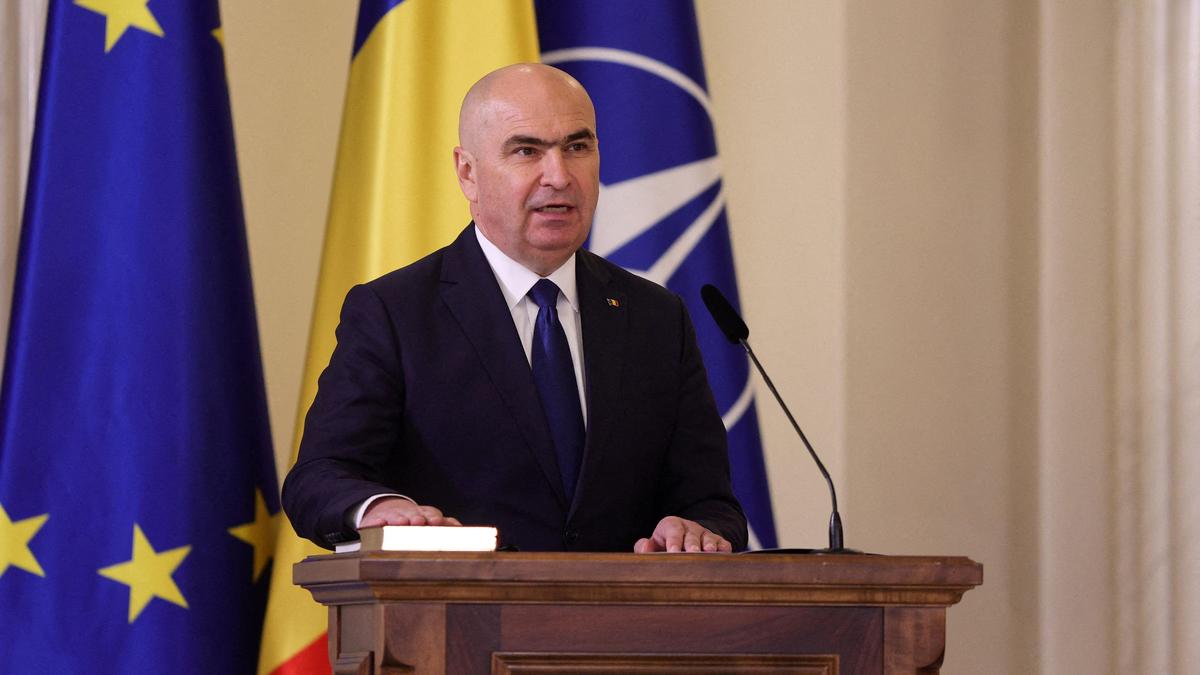
Romania's Ruling Party Demanded the PM Resign — Then Broke Him
Romania's Social Democrats withdrew from the Bolojan coalition on April 20, 2026 and, two weeks later, joined the far-right AUR to topple him 281–4. Here is what that costs Bucharest.
The decisive number is 281. On May 5, 2026, the Romanian parliament removed Prime Minister Ilie Bolojan by 281 votes to four — the largest margin for a no-confidence motion in the country's post-1989 history, according to the German Marshall Fund. The vote closed a sequence that began 15 days earlier, when the Social Democratic Party (PSD), the largest bloc in Bolojan's four-party coalition, demanded his resignation and, when refused, pulled its six ministers from cabinet. The thesis here is not that a government fell. It is that a governing party of the European mainstream broke the cordon sanitaire against a Eurosceptic far-right — and did so to protect patronage networks from an austerity plan the EU and IMF had all but written for it. The bill for that decision arrives on August 31, 2026, when roughly €10 billion in Recovery and Resilience Facility funds fall due, and Romania is the slowest-implementing member state in the bloc.
How the coalition broke
The PSD's leader, Sorin Grindeanu, put the resignation demand to an internal party ballot on April 20. According to Radio Romania International, 97.7% of the roughly 5,000 Social Democrats consulted voted to withdraw support for Bolojan. Three days later, six PSD ministers — labour, health, energy, agriculture, transport and justice — resigned along with Deputy Prime Minister Marian Neacșu and Secretary-General Ștefan-Radu Oprea, as the
OSW Centre for Eastern Studies documented in its post-mortem of the coalition. Bolojan refused to step down, appointed interim replacements from the PNL, USR and UDMR, and personally took the energy ministry.
That left him running a minority cabinet with 181 seats in a 464-member bicameral parliament. To dislodge him, the PSD's 130 MPs needed the Alliance for the Union of Romanians (AUR) — the same nationalist, Eurosceptic force whose 2024 presidential surge, later annulled over alleged Russian interference, had been the founding rationale for the grand coalition in the first place. On April 27 the PSD and AUR filed a joint motion. On May 5 it passed with 48 votes to spare over the 233 threshold, Al Jazeera reported. MPs from the PNL, USR and UDMR walked out rather than vote.
Bolojan's own framing, on the floor before the ballot, was blunt. "I assumed the position of prime minister, being aware that it comes with enormous pressure and that I would not receive applause from the citizens," he told parliament, per Al Jazeera. "But I chose to do what was urgent and necessary for our country. Can anyone say how Romania will function from tomorrow. Do you have a plan?"
The real dispute was fiscal — and that matters
The Social Democrats say Bolojan's austerity crushed their voters. He says his austerity was the price of investment-grade sovereign debt. The numbers side with him.
Romania's 2024 fiscal deficit reached 9.3% of GDP — the widest in the European Union — according to the World Bank, which approved a $650 million Development Policy Loan on March 30, 2026 explicitly to backstop the consolidation program. The IMF's 2025 Article IV consultation was equally direct: a VAT hike and other tax measures had "helped avoid a cutoff of structural EU funds and a sovereign credit rating downgrade to non investment status," the
IMF staff report noted, warning that Romania still sat one notch above speculative grade with a negative outlook from all three major agencies. During the presidential-election stress in May 2025, the leu had fallen almost 3% to above 5 RON per euro for the first time in history, the IMF observed.
Bolojan's ten months delivered results. The headline deficit fell from 9.3% of GDP in 2024 to 7.9% in 2025 — "the bloc's largest single-year correction," the German Marshall Fund noted, enough to talk Fitch out of a downgrade to junk in August 2025. What broke the coalition was the next tranche: a two-year freeze of public wages and pensions, VAT and excise increases, and roughly 13,000 planned job cuts in local administration — direct hits on the PSD's clientelist base, as an
OSW commentary on Romania's debt trajectory laid out. On June 3, 2026, the European Commission's in-depth review under the Macroeconomic Imbalance Procedure concluded Romania was still "continuing to experience excessive macroeconomic imbalances," while noting that "policy progress was significant in 2025" — a delicate two-hander published in
EUR-Lex.
That is the paradox at the centre of this crisis. The reforms were working; the party paying the political cost pulled the plug.
The €10 billion cliff
The clock on Romania's EU windfall runs out on August 31, 2026. That is the hard deadline for all milestones and targets under the Recovery and Resilience Facility, per the European Commission's closing guidelines. Any action taken after that date "cannot be taken into consideration in the assessment of payment requests," the Commission communication states in operative language. Final payment requests are due 30 September 2026, disbursements by year-end.
Romania is the worst-placed country in the bloc. As of end-January 2026, "slightly more than a third" of the country's NRRP measures had been assessed as completed, tying Hungary for last place, the European Parliament's Recovery and Resilience Dialogue briefing reported. A separate European Parliament fiscal-situation briefing put it in cash terms: Romania "risks losing up to EUR 10 billion in NRRP funds if milestones are not met by August 2026," on top of possible cohesion-fund suspensions under Article 126(8) TFEU, according to the
European Parliament. One flagged item is emblematic: a €231 million disbursement is blocked over Romania's failure to reform the "special pensions" regime for judges — a milestone the outgoing coalition could not force through.
That is what a caretaker government cannot deliver. Bolojan will remain interim PM with limited powers, and every day of formation delay eats into the NRRP window.
The new nominee — and what he changes
President Nicușor Dan first tried a technocrat. Eugen Tomac withdrew his mandate for lack of parliamentary support. On June 14, 2026, Dan nominated Adrian Vestea — a PNL man, president of the Brașov county council and a former development minister — to form a "political government," according to Al Jazeera. Vestea has 10 days from nomination to secure a parliamentary confidence vote.
Two things about that pick matter. First, Dan chose continuity: another Liberal, from Bolojan's own party, signalling that the reform track will not be abandoned. Second, Vestea is a provincial administrator, not a Bucharest fiscal hawk — a nod to the PSD, whose leadership had said it "would rejoin a pro-EU coalition under a different prime minister," per Al Jazeera's post-vote reporting. Grindeanu's line the night of the vote — "There is life after the no-confidence vote. We want to keep broadly this coalition" — reads as a re-entry ticket, not a rupture.
Who wins, who loses
The clearest winner is George Simion's AUR. Polling at 37–40% by mid-2026, more than double its December 2024 result, according to OSW, it now has proof that the mainstream will vote with it when convenient. The Atlantic Council's Bucharest dispatch was sharp on the second-order effect: "European institutions and political groups evaluate actions through observable behavior, not declared intent. The PSD is signaling that cooperation with the far right is possible under certain conditions. Once established, such precedents tend to expand," the
Atlantic Council argued.
The PSD is the ambiguous case. It kneecapped an unpopular reform program, but at the price of ideological credibility inside the Party of European Socialists, which criticised the tactical alignment with AUR. Its 20% poll rating is half AUR's. As Sciences Po's Cevipof put it, the coalition was "built less on programmatic coherence than on a shared fear of an electoral breakthrough by the far-right." That fear no longer disciplines the PSD.
The clearest loser is the ratings floor. Romania's investment grade rests on the fiscal path — and, as the IMF warned in its November 2025 statement, "a sovereign credit rating downgrade remains a risk as concerns persist regarding the execution of the planned fiscal consolidation." Bolojan personally polled at nearly 40% support for staying in office — twice his party's rating — the
Atlantic Council noted. Only 24% of Romanians said they trusted the government in the Cevipof barometer; 75% said democracy functions poorly. That is the electorate AUR is fishing in.
The historical parallel
This is Romania's third no-confidence removal in six years — Orban (2020, 261 votes), Cîțu (2021, 281), Bolojan (2026, 281). The pattern is not coincidence. Each time, an inside coalition partner — typically the party losing political rent to reform — has burned the cabinet and then negotiated the same coalition back into being under a different PM. What is new is the partner in the arithmetic. In 2020 and 2021 the wrecking vote came from mainstream parties. In 2026 it came, decisively, from a Eurosceptic force polling above every other party.
Diplomat View
Bolojan's fall does not, on its own, alter Romania's Western trajectory — the president is centrist, the incoming PM is his party colleague, and the deficit is coming down. The forecast to hold is that Vestea wins confidence by mid-July 2026, likely with tacit PSD abstention, and passes a stripped-down NRRP-critical package before August 31. In that scenario Romania recovers most of the €10bn recovery envelope, avoids a rating downgrade, and the crisis reads, in retrospect, as an internal PSD play to swap the prime minister.
The forecast breaks in two ways. One: Vestea fails his confidence vote and Dan burns his second nomination — the 60-day dissolution clock starts ticking, and a caretaker misses the August deadline. Two: the PSD conditions its support on unwinding pension and administrative reforms already logged as NRRP milestones, triggering EU payment suspensions under Article 10 of the RRF Regulation. Either outcome pushes Romania to non-investment grade, and AUR — already polling near 40% — inherits the wreckage before the 2028 election. The trip-wire to watch is not the confidence vote. It is the June 30 payment-request submissions and whether the Commission's forthcoming implementation assessment flags the pension milestone as unfulfilled.
What to watch next
- By mid-July 2026: Vestea's parliamentary confidence vote. Failure would exhaust Dan's usable nominations quickly and open the door to a technocratic caretaker straight into the NRRP deadline.
- August 31, 2026: Final RRF milestone deadline. Anything unfinished on that date cannot be counted toward payment.
- September 30, 2026: Last RRF payment requests due. This is when Romania's actual EU shortfall becomes a public number.
The Bottom Line
The Romanian coalition party that demanded the PM resign got what it wanted — and in the process signalled that Bucharest's mainstream will vote with a far-right, Eurosceptic bloc when patronage is on the line. The reforms Ilie Bolojan pushed through in ten months delivered the largest single-year deficit correction in the EU; the party that ran on protecting those voters pulled the plug six weeks before the €10 billion NRRP cliff. If Adrian Vestea cannot get a slimmed-down reform package through parliament before August 31, the ratings floor breaks — and George Simion's AUR, not the Social Democrats, inherits the next election.
Discover more

Global Politics
US Seizes Iranian Ship, Tensions Surge
The US seizure of the Iranian ship Touska highlights a shift in control over the Strait of Hormuz, favoring Iran's strategic position.

Economics
Fed's Amex AML order puts correspondent banking on notice
Federal Reserve's Amex AML order requires board-level controls and a 90-day plan; OCC fined the bank $350 million over enterprise-wide deficiencies.

Conflict & Security
Guatemala: El Niño 2026–27 becomes regional security test
UNICEF: 25.8M children face El Niño risks in Latin America; Guatemala maps 188 municipalities for drought and food insecurity amid regional security test.

Economics
Fed's stress-test overhaul is a capital-smoothing exercise
Federal Reserve finalized stress-test overhaul: two-year averaging for bank capital buffers and public input, expected to halve volatility.