Why Figuera, not Machado
Why Washington sidelines the popular opposition leader
Model Diplomat5 min readLatin America
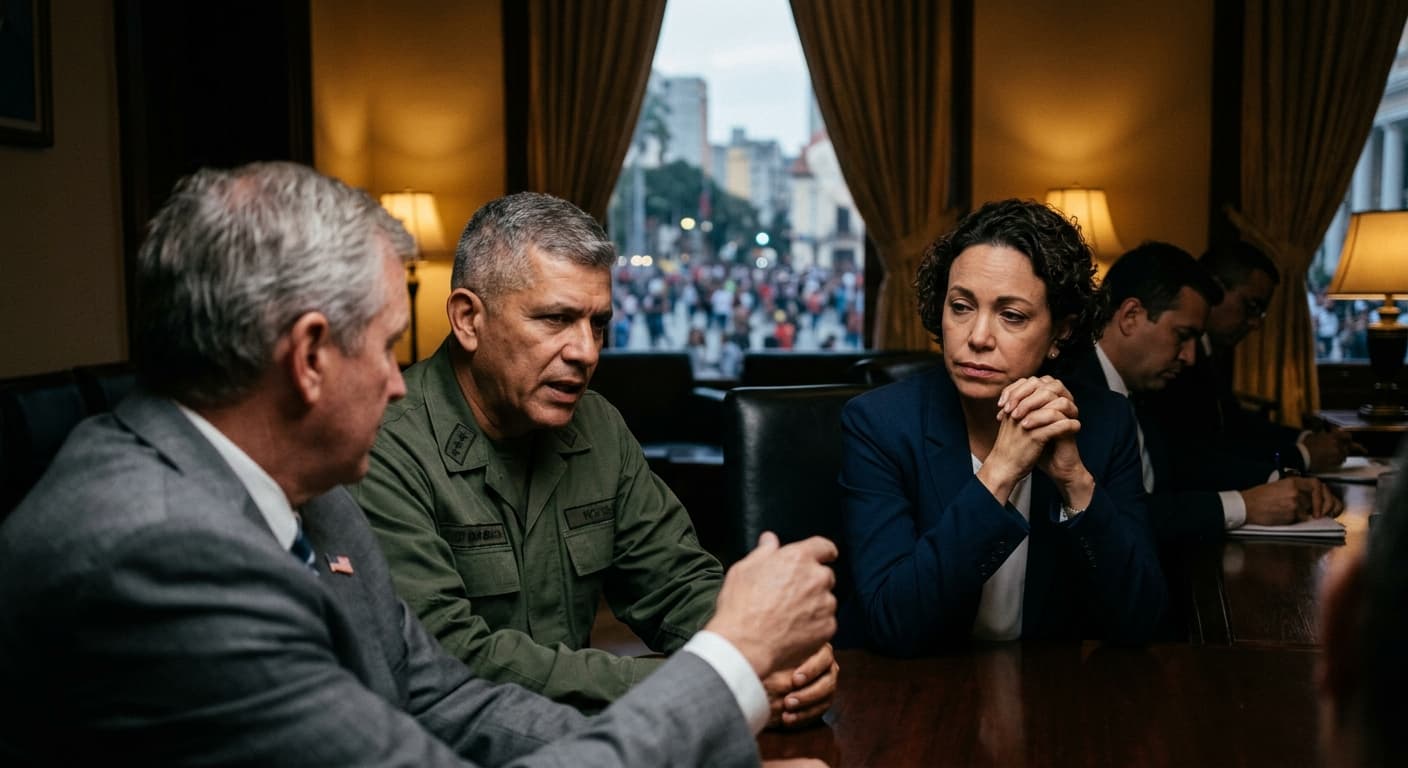
Why Figuera, not Machado
The choice of Figuera is not incidental. She is a 61-year-old physician and former lawmaker from Primero Justicia who has lived in Valencia, Spain since 2018, when she fled after intelligence services harassed her following the death in police custody of fellow opposition politician Fernando Albán BBC Mundo. She was appointed president of the 2015 National Assembly in January 2023, replacing Juan Guaidó, and spent her exile managing — from abroad — the opposition's claims to Venezuelan state assets frozen in U.S. and British courts
Al Jazeera.
Her profile suits Washington: institutionally legitimate to the degree the 2015 Assembly retains recognition, but politically lightweight and dependent on U.S. protection for her physical safety. She returned to Caracas June 18, 2026, telling reporters she traveled "on invitation from the State Department" BBC.
María Corina Machado is the opposite case. The 2025 Nobel Peace Prize laureate is the most popular politician in Venezuela. A February 2026 survey by Caracas-based pollster Meganálisis found she would take 82.4% of the vote against Delcy Rodríguez's 4.8% in a head-to-head race Foreign Affairs. Two-thirds of Venezuelans want a new presidential election, with 91% of those demanding it within a year, according to an Economist poll cited by the Journal of Democracy
Journal of Democracy.
Machado is not in the room. The organization speaking for her and for Edmundo González Urrutia — widely recognized as the actual winner of the July 2024 presidential election — called an urgent meeting with Democratic Unitary Platform parties for July 15 to "define a unified public position" on the Figuera–Rodríguez agenda UPI. Machado has called for transparent elections within no more than 10 months and questioned how a new electoral authority would be selected
UPI. She has also been blocked from returning to Venezuela, with interim authorities in Caracas briefly closing airspace to her plane in June
NPR.
The fragmentation strategy
Washington's preference for Figuera over Machado is not a diplomatic oversight. It is the deliberate outcome of a calculation the Trump administration made before the dust settled in Caracas. A classified U.S. intelligence assessment, reported by the Wall Street Journal in January, concluded that installing Machado could trigger dangerous instability, including a guerrilla war by elements of the security forces, and that Maduro-regime insiders including Delcy Rodríguez were better positioned to lead a temporary government BBC. The International Crisis Group had reached the same conclusion independently, warning that "the risks of violence in any post-Maduro scenario should not be downplayed"
BBC.
For Chavismo, the logic is straightforward. Former opposition negotiator Freddy Guevara, who sat across from Delcy and Jorge Rodríguez in the Norway-mediated talks of 2021, argues the regime's second pillar — after tactical flexibility — is fragmentation: it cannot defeat a unified opposition and a coherent U.S. policy simultaneously, so it works to divide both Journal of Democracy. Elevating Figuera and sidelining Machado achieves exactly that.
The fit between Washington's needs and the regime's strategy is what makes the August 1 framework durable — and what makes it dangerous for anyone who wants an actual election. The Council on Foreign Relations' Elliott Abrams observed that the U.S. decision to reopen diplomatic relations with the interim authorities lends "increased legitimacy to Maduro's heirs," giving them a functioning embassy in Washington to lobby for "less pressure and more time" CFR. James Story, a former U.S. ambassador to Venezuela, put it more bluntly: Delcy Rodríguez is "doing just enough to make it look as if they're complying" while waiting to see whether the 2026 U.S. midterms weaken Trump's leverage
NPR.
Structural reform or managed drift
The working group's agenda — CNE, electoral laws, party restitution — is the right agenda, on paper. The Chatham House April 2026 analysis concluded that Venezuela needs a political pact covering CNE reform, arbitration mechanisms, legal recognition of parties, and associated legal reforms, with the U.S. acting as guarantor — precisely the items Figuera listed Chatham House. A June 2026 follow-up from the same institute pressed for a formal negotiation and monitoring process with benchmarks, a timeline, and a public pact, warning that judicial reform "cannot wait"
Chatham House.
The gap is enforcement. The U.S. has tied oil revenue to the three-phase plan, but the benchmarks within the transition phase remain undefined. The constitution requires elections within 30 days of a president's "permanent" unavailability; the Maduro-stacked Supreme Court declared Maduro's absence "temporary" on January 3, 2026, and set no time limit BBC. The 180-day constitutional window for a vice-president to serve as acting president expired in July without a vote
BBC.

Carnegie's Moisés Naím and Francisco Rodríguez argued that the only way Venezuela can give investors a credible guarantee of stability is "a political agreement between the government and the opposition on the country's economic strategy" — and that such a deal requires Rodríguez to "reach out to all opposition factions, including the one led by Machado, which commands broad popular support but remains excluded from current negotiations" Foreign Affairs. The August 1 group does the opposite: it brings in a faction that controls frozen assets and Washington's recognition, and leaves out the faction that controls the voters.
The oil underneath the ballot
Venezuela holds the world's largest proven oil reserves. Production collapsed under sanctions and mismanagement. The post-Maduro energy deal, under which the U.S. markets Venezuelan crude and deposits proceeds in U.S.-controlled accounts, is the single largest source of revenue for the interim government and the lever Rubio keeps loaded Congressional Research Service. As long as that revenue flows through Washington, the incentive structure rewards compliance with U.S. security and energy goals — drug interdiction, expulsion of Iranian and Hezbollah operatives, refugee returns — and treats elections as a distant phase-three deliverable.
Foreign Affairs framed the paradox cleanly: "The same forces that could revive the economy — oil and mining revenues, private investment, and the returning capital and entrepreneurship of the diaspora — could also destabilize its political transition. If institutions remain weak and the gains of future economic growth are spread unevenly, then Venezuelans will lose faith in the new dispensation" Foreign Affairs.
What to watch
- August 1, 2026: Working group convenes in Caracas. Watch whether the 10 opposition seats include any Machado-aligned figures or are entirely drawn from the 2015 Assembly cohort.
- Machado's July 15 meeting with Unitary Platform parties: whether it produces a unified position or a formal split will signal whether the opposition fragments or holds.
- CNE reconstitution timeline: The constitution requires a six-month announcement window before any presidential vote; any election in 2026 would need a reformed electoral council named by roughly September.
- U.S. midterm elections, November 2026: Story's thesis — that Rodríguez is betting on a weakened Trump — will be tested. A Democratic Congress could constrain the oil-quarantine lever or condition sanctions relief on election benchmarks.
- Maduro trial docket: The next hearing in his Southern District of New York narco-terrorism case is a background pressure point; a conviction or plea could reshape Chavismo's incentive structure.
Discover more
US Politics
Virginia's Redistricting Referendum
Virginia's redistricting referendum is drawing a flood of dark money, shaping future elections and the fight for congressional control amid party stakes.

US Politics
SNAP Food Assistance Faces Legal Challenges
In 2026, SNAP faces stricter eligibility rules and mounting legal challenges, threatening food assistance for the millions of Americans who rely on the program.
India
Rajnath Singh's Durga Squad for 2026 Polls
Rajnath Singh's Durga Squad promised women's safety in Bengal but has since disappeared from the agenda, revealing BJP's true priorities.

Economics
Fed's Amex AML order puts correspondent banking on notice
Federal Reserve's Amex AML order requires board-level controls and a 90-day plan; OCC fined the bank $350 million over enterprise-wide deficiencies.