US Rewards UAE With License-Free AI Chips
Commerce reclassifies UAE to top export tier after Operation Epic Fury support
Model Diplomat9 min readMiddle East
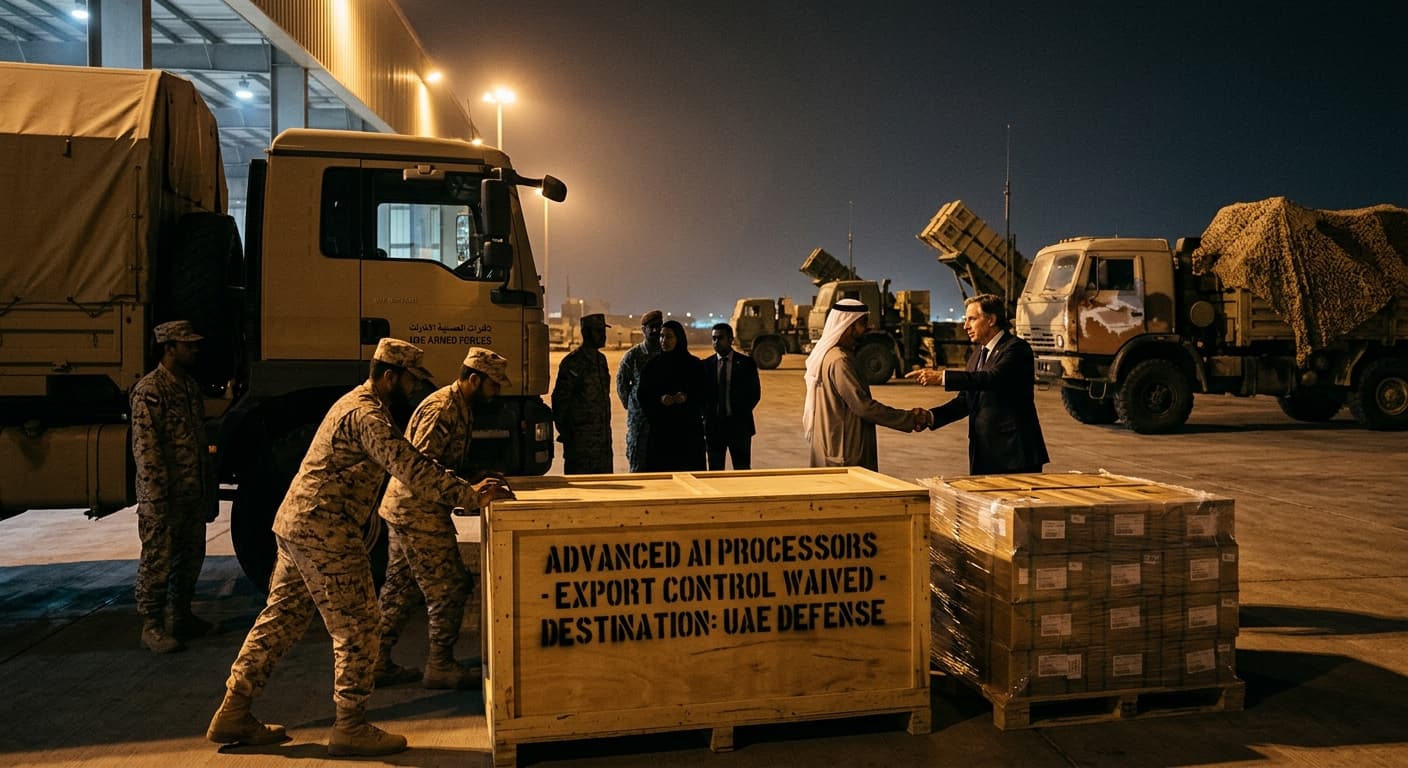
U.S. Trades License-Free AI Chips for UAE's Iran War Service — and the Export-Control Regime Is Now a Reward System
Commerce Department reclassifies the UAE into the highest U.S. export tier after Emirati forces absorbed 2,800 Iranian missiles and drones during Operation Epic Fury, giving Abu Dhabi unrestricted access to Nvidia's most advanced semiconductors — and converting a non-proliferation framework into a quid pro quo.

The United States has granted the United Arab Emirates license-free access to advanced artificial intelligence chips and other sensitive dual-use technologies, removing the licensing requirements that had constrained Abu Dhabi's AI ambitions for over a year. The U.S. Commerce Department confirmed the reclassification on July 16, 2026, placing the UAE into its highest export tier alongside European countries, South Korea, and India, according to
The Defense News. The decision, first reported by The Wall Street Journal, follows the UAE's military support during Operation Epic Fury — the U.S.-Israeli campaign against Iran that began February 28, 2026. The move converts what was a regulatory non-proliferation framework into a transactional reward system, where access to the most advanced semiconductors is now priced in military alignment rather than compliance with security standards.
What the Reclassification Unlocks
Under the new policy, the Commerce Department removed many licensing requirements for exports of advanced AI chips, military equipment, commercial satellites, and dual-use technologies to the UAE. The UAE becomes the only country in the Middle East to receive this level of unrestricted access to U.S. technology, The Defense News reported.
The immediate commercial beneficiaries are Abu Dhabi's state-backed AI companies, G42 and Core42, which can now purchase advanced semiconductors from U.S. manufacturers (principally Nvidia) without the case-by-case license reviews that previously delayed or blocked shipments. The reclassification also removes regulatory barriers for Amazon, Apple, Google, Meta, Microsoft, and OpenAI to proceed with large-scale AI data center projects in the UAE, including the Stargate UAE campus announced during Trump's May 2025 Gulf tour.
Commerce Department official Jeffrey Kessler described the regulatory change as "one of the most significant achievements of the administration," and said the UAE has implemented strong security measures to prevent sensitive American technology from being diverted or misused, The Defense News reported. UAE Ambassador to the United States Yousef Al Otaiba welcomed the decision as strengthening "decades of close cooperation" between the two countries.
The reclassification caps an 18-month arc. In September 2024, Microsoft's $1.5 billion investment in G42 came with a condition: G42 would strip Huawei equipment from its data centers and divest from Chinese technology firms, as CSIS documented. In May 2025, Trump announced the UAE would invest $1.4 trillion in U.S. AI over a decade,
Al Jazeera reported. The July 2026 reclassification is the regulatory infrastructure that makes those commitments operational.
The Currency of the Exchange
The timing is not coincidental. The reclassification follows the UAE's role in Operation Epic Fury, the U.S.-Israeli military campaign against Iran launched on February 28, 2026. During the operation, Emirati forces carried out dozens of airstrikes against Iranian targets, including a strike on a refinery on Iran's Lavan Island, and intercepted hundreds of Iranian missiles aimed at Gulf infrastructure, The Defense News reported.
The UAE absorbed more Iranian retaliation than any other Gulf state. Between February 28 and the April 8 ceasefire, the UAE was targeted by approximately 2,800 missiles and drones — more than any other Gulf state or Israel, Al Jazeera reported. Emirati air defenses engaged Iranian salvos from the first day of the war, and the UAE played a direct role in maintaining commercial shipping through the Strait of Hormuz, through which roughly 20 percent of the world's oil and liquefied natural gas passes in peacetime,
BBC reported.
The UAE also took hits that the United States did not. Iran struck the UAE's Fujairah oil port, setting a refinery ablaze and injuring Indian nationals, NPR reported. An Iranian cruise missile attack on two UAE-linked tankers in the Strait of Hormuz killed one Indian crew member and wounded eight others,
BBC reported. The UAE's eastern coast became a front line in a war it had not started.
In this light, the Commerce Department's reclassification reads less as a regulatory adjustment than as a settlement of accounts. The UAE paid for its license-free access in intercepted missiles, burnt refineries, and dead sailors — not in the compliance frameworks the Biden administration had originally demanded.
From Non-Proliferation to Transaction
The July 2026 decision is the culmination of a sharp reversal in U.S. AI export policy. In January 2025, the Biden-era Bureau of Industry and Security issued the Framework for Artificial Intelligence Diffusion, a three-tier global system. Tier 1 (the United States and 18 close allies including Australia, Japan, and the United Kingdom) faced no restrictions. Tier 3 (China, Russia, North Korea, and Iran) faced a presumption of denial. The UAE, along with some 150 other countries, landed in Tier 2, subject to licensing requirements and computing-power caps, the Congressional Research Service documented.
The Gulf states were furious. The Council on Foreign Relations noted that the tier-2 bucket placed Saudi Arabia and the UAE, states with deep military and economic ties to Washington, alongside geopolitical swing states and countries with minimal AI ambitions. The framework's critics, including leading AI developers and cloud providers, argued the caps would push tier-2 countries toward Chinese infrastructure,
Brookings observed.
On May 13, 2025, the Trump administration directed Commerce personnel not to enforce the AI Diffusion Rule, effectively rescinding it days before it would have taken binding effect, the U.S. Government Accountability Office determined. The GAO concluded that the Commerce Department's press release announcing the rescission was itself a "rule" subject to the Congressional Review Act — meaning the rescission should have been submitted to Congress, which it was not.
The July 2026 reclassification of the UAE completes the pivot. Where the Biden framework asked Gulf states to earn chip access through verified security compliance, the Trump approach asks them to earn it through alignment: military, financial, and political. The CSIS framed the stakes bluntly: "The United States diffuses AI technology into the Gulf to ensure sectoral dominance and broader influence, but creates dependence risks when infrastructure sits abroad."
The Corruption Question
The reclassification has drawn scrutiny from members of Congress who question whether the policy change represents an improper exchange of benefits. The most pointed criticism centers on a financial transaction that preceded it.
Before Trump's second inauguration, Sheikh Tahnoun bin Zayed Al Nahyan, the UAE's National Security Advisor and chairman of G42, directed a $500 million investment to acquire a 49 percent stake in World Liberty Financial, a cryptocurrency venture launched by the Trump family, The Defense News reported. Trump's 2025 financial disclosures, released in June 2026, showed he received more than $500 million from World Liberty Financial in token sales alone, part of $1.4 billion in reported crypto income,
Al Jazeera reported.
Senator Elizabeth Warren said the investment generated significant financial benefits for Trump shortly before the Commerce Department approved license-free technology exports to the UAE. Representative Sydney Kamlager-Dove has questioned whether the policy change could represent an improper exchange of financial and political benefits, The Defense News reported. The White House and the UAE have rejected any conflict-of-interest allegations.
The GAO's finding that the Commerce Department failed to submit its rescission of the AI Diffusion Rule to Congress under the Congressional Review Act adds a procedural dimension to the scrutiny. The rescission, and by extension the reclassification that followed, may lack the legal footing the administration claims, the GAO determined.
The Diversion Risk Nobody Resolved
Even supporters of the reclassification acknowledge a problem the regulatory change does not solve: the risk that advanced U.S. chips reaching the UAE could be diverted to China. U.S. intelligence agencies previously expressed concerns that G42 provided technology to China that could benefit the People's Liberation Army. G42 has denied those allegations, The Defense News reported.
The concern is not hypothetical. Chinese firms, including Huawei, were important vendors for G42 until the U.S. government forced the firm to divest its Chinese hardware as a condition of the Microsoft investment in 2024, CFR documented. The
CSIS noted that G42's divestment from Chinese technology — stripping Huawei equipment, implementing security measures — was the price of earlier, more restricted chip approvals.
License-free access removes a layer of case-by-case scrutiny that previously served as a checkpoint against diversion. The Commerce Department says the UAE has implemented security measures to prevent misuse, but the reclassification shifts the burden: instead of proving each shipment is safe, the U.S. now trusts the system. Some former U.S. officials have argued that hosting some of the world's largest AI data centers outside the United States could increase the risk of unauthorized access to sensitive technologies, The Defense News reported.
The Foreign Affairs critique goes further, arguing that the entire Gulf AI build-out was "a major miscalculation" given the region's persistent instability. The U.S. intervention in Iran, Foreign Affairs noted, has already presented China with an opening: Huawei is pitching Gulf clients on the perils of "single-region dependency."
Who Benefits, Who Watches
The reclassification has clear winners. G42 and Core42 gain frictionless access to Nvidia's most advanced semiconductors, accelerating the UAE's strategy to diversify beyond oil. The Wall Street Journal reported that G42 is taking steps toward becoming a U.S. company as part of its effort to strengthen technology cooperation, The Defense News noted. U.S. hyperscalers (Amazon, Google, Microsoft, OpenAI) gain regulatory clearance to build the data center complexes they have already pledged to construct. Nvidia gains a major customer with fewer transaction costs.
The losers are less visible but more consequential. Saudi Arabia, which received its own chip approvals in late 2025, remains in a more restrictive category than the UAE — a divergence that will not go unnoticed in Riyadh. Israel, a Tier 2 country under the now-defunct Biden framework and a closer U.S. intelligence partner than the UAE, has not received equivalent license-free access, RAND noted. India, which the Defense News report places in the same top tier as the UAE, earned its reclassification through a different currency — trade concessions and strategic alignment, not military service,
CFR observed.
The signal is unmistakable: the United States will trade its most sensitive dual-use technology for military alignment in a shooting war. Every government that wants advanced chips now knows the price.
Diplomat View
The reclassification of the UAE is not a technical adjustment. It is the formal articulation of a new doctrine: U.S. export controls on advanced AI are no longer a non-proliferation regime. They are a loyalty program. The Biden framework asked Gulf states to prove their security credentials. The Trump framework asks them to prove their military utility. The UAE paid in missiles absorbed and refineries burned, and it received license-free access to the most advanced semiconductors on Earth.
This is defensible on its own terms — the UAE took real risks and real damage in a U.S.-led war, and Washington rewards allies. But the precedent is destabilizing. It tells every capital with AI ambitions that the fastest route to unrestricted chip access is not compliance but combat. It tells Saudi Arabia that its late-2025 chip approvals were a down payment, not a settlement. It tells Israel that intelligence-sharing does not buy what kinetic support buys. And it tells Congress that the legal framework governing the most sensitive technology transfer of the decade was set aside without proper submission under the Congressional Review Act.
The forecast: the reclassification holds unless a federal court acts on the GAO's finding or Congress passes legislation restoring statutory licensing requirements — both are live possibilities. Saudi Arabia will press for equivalent status within months. The diversion risk to China does not disappear; it migrates from the licensing process to whatever security framework the UAE has promised but that remains largely undisclosed. The next decision point is not in Abu Dhabi. It is in Riyadh, where the question is no longer whether Saudi Arabia gets chips, but what it will have to do to get them without a license.
- GAO legal challenge: The GAO's determination that the AI Diffusion Rule rescission required Congressional Review Act submission is unresolved. A federal court could compel enforcement, which would reinstate Tier 2 licensing for the UAE.
- Congressional pushback: Senator Warren and Representative Kamlager-Dove's inquiries could escalate into hearings or legislation. Bills like H.R. 5885, which would require licensing and U.S. customer priority for chip exports to countries of concern, are pending in the 119th Congress.
- Saudi Arabia's next move: Riyadh will seek equivalent license-free status. The benchmark is set: military alignment in a U.S. operation. The open question is whether Saudi Arabia positions itself for a similar exchange, or whether Washington offers a different currency.
The bottom line: The UAE's license-free chip access is the clearest signal yet that advanced semiconductors have become a geopolitical currency, priced in military service rather than regulatory compliance. If the reclassification holds, it will redraw the map of who gets AI infrastructure — and the price every government will calculate to get it.
Discover more

US Politics
House Ethics Committee Pushes Sexual Miscond.
The House Ethics Committee has shifted responsibility for sexual harassment settlement records to the Office of Congressional Workplace Rights, complicating disclosure efforts.
India
CPI(M) Calls to Decouple Quota from Delimita
CPI(M) advocates for a 33% women's quota in Lok Sabha by 2029, removing the need for delimitation and census linkage.
India
700 Activists Accuse PM Modi of MCC Breach
Over 700 activists allege PM Modi breached election code with a televised address attacking opposition parties just before state elections.

Economics
Fed's Amex AML order puts correspondent banking on notice
Federal Reserve's Amex AML order requires board-level controls and a 90-day plan; OCC fined the bank $350 million over enterprise-wide deficiencies.