Trump's Trade Threat to Spain Explained
Analyzing Trump's trade order and its implications
Model Diplomat7 min readEurope
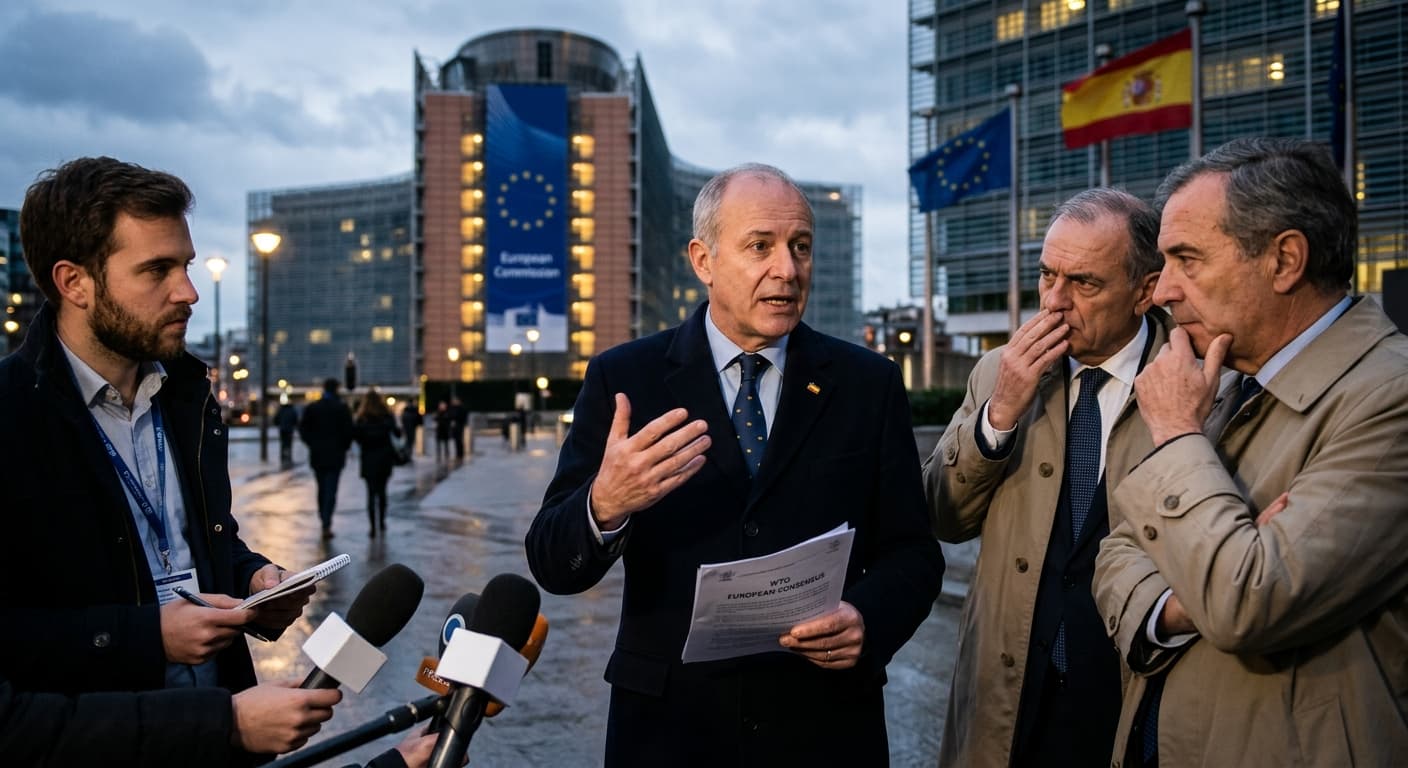
Trump's Spain Trade Halt: A Threat Without a Statute
Trump ordered Bessent to sever trade with Spain on July 8, 2026 — but the Supreme Court has already gutted the legal tool he needs, and Madrid knows it.
Donald Trump's order on July 8, 2026 for Treasury Secretary Scott Bessent to "cut off all trade… including visits" with Spain sent the IBEX 35 down 2.7% and rippled through the Stoxx 600 — but the more consequential fact is that the Supreme Court, in February, stripped him of the statute that would make such an embargo enforceable. The market is pricing in the shock. It has not yet priced in the ceiling. The real story is a president reaching for a lever the Court took away five months ago, and an EU that now has both a coercion statute and a domestic constituency willing to invoke it.
What happened, precisely
At the NATO summit in Ankara, Trump singled out Spain — not Denmark, not Canada, not Germany — as a "wasted cause" and "terrible partner in NATO," instructing Bessent on camera to sever commercial ties. According to Al Jazeera, a US official told Reuters that Treasury, Commerce and USTR would present Trump with "a menu of Spanish products that may be embargoed in the coming days," language that already softens "complete halt" into "partial embargo."
Markets took the maximalist reading. Spain's benchmark IBEX 35 fell 2.2% intraday to 19,122, its steepest one-day drop since early May, per MEXC News; the pan-European Stoxx 600 shed 1.7%. The Bankinter IBEX tracker fund, a clean proxy, closed −2.84% on July 8 at 256.24, according to
FT Markets — though by mid-session July 9 the parent index had recovered 1.27% as the "menu" language circulated.
Pedro Sánchez's rebuttal was pointed. In a ten-minute televised address on July 9, the Spanish prime minister framed the dispute as "no to war," not trade, and reminded viewers that Spain runs a trade deficit with the United States, per BBC News. Chancellor Friedrich Merz told Trump directly, in the same room, that Germany could not conclude "a separate trade agreement… but not with Spain." Emmanuel Macron and European Council President António Costa phoned Sánchez to convey EU "full solidarity."
The statute the President no longer has
Here is what the wires largely missed. Every plausible legal pathway to a unilateral, country-specific embargo runs through the International Emergency Economic Powers Act (IEEPA) — and IEEPA, as of February 20, 2026, no longer supports it.
In Learning Resources, Inc. v. Trump and Trump v. V.O.S. Selections, Inc., the Supreme Court held 7–2 that IEEPA's grant of authority to "regulate… importation" does not authorize the President to impose tariffs. Chief Justice Roberts, writing for the majority, was blunt in the opinion:
"The President asserts the extraordinary power to unilaterally impose tariffs of unlimited amount, duration, and scope… IEEPA's grant of authority to 'regulate . importation' falls short. IEEPA contains no reference to tariffs or duties… we hold that IEEPA does not authorize the President to impose tariffs."
The Congressional Research Service, in LSB11398, notes the ruling did not address Section 232 (national security) or Section 301 (unfair practices) — but neither of those fits a country-specific embargo of a NATO ally over base access. Section 232 requires a Commerce investigation; Section 301 requires a USTR determination of unfair trade practices. Neither can be improvised in a week from a NATO podium.
That leaves IEEPA's non-tariff authorities — the power to "prevent or prohibit" transactions, which the Court left intact for genuine sanctions cases (Iran, Russia, terrorist financing). Bessent and Trump could, in theory, block specific Spanish goods or freeze specific transactions by declaring a national emergency under 50 U.S.C. §§ 1701–1706. But at oral prompting from Trump in March, USTR Jamieson Greer refused to endorse the plan on camera — "We're going to talk about it with you" — a tell that the trade lawyers inside the administration know the ground is unstable.
Why Madrid is calm and Brussels is not bluffing
Sánchez's office called Trump's outburst "business as usual." That is not bravado; it is arithmetic. According to the Congressional Research Service, US-Spain trade in goods and services was worth $75 billion in 2025, with the United States running a $3 billion surplus. Spanish exports to the US amount to roughly 0.8% of Spain's GDP — a fraction of the EU average of 3%, per
BBC Mundo. Spanish direct investment in the US ($87.4 billion) exceeds US direct investment in Spain ($33.8 billion) by nearly three to one.
More important: Spain does not conduct its own trade policy. Article 207 of the Treaty on the Functioning of the European Union vests exclusive competence for the common commercial policy in Brussels. A US embargo on Spanish goods entering via Rotterdam, Antwerp or Hamburg would require customs enforcement at US ports of entry against goods bearing an EU origin — an administrative and diplomatic nightmare.
And Brussels has a purpose-built weapon. Regulation 2023/2675, the Anti-Coercion Instrument, entered into force in December 2023. It defines "economic coercion" as a third-country measure designed to interfere with the "legitimate sovereign choices of the Union or a Member State" — a definition Trump himself wrote into existence at Ankara by tying trade to Spain's refusal on Iran and the 5% defence target. Once the Council determines coercion exists (an 8–10 week process), the Commission can retaliate across "trade in goods, services, foreign direct investment, financial markets, public procurement, [and] trade-related aspects of intellectual property rights" per the
EUR-Lex text.
The ACI has never been triggered. It was designed for exactly this scenario.
Who wins, who loses, who is already hedging
The immediate loser is the US-EU trade framework signed in 2025. A CRS note reports the European Parliament has already frozen consideration of the deal, with USTR Greer complaining about EU "implementation delays." Singling out one member state gives the Parliament's sceptics a clean pretext to slow-walk indefinitely.
The immediate winner, ironically, is Beijing. Sánchez has made four consecutive annual visits to China — more than any major Western leader since Covid — and CSIS notes Xi used the April 2026 summit to declare that Spain and China stand on "the right side of history" against "the law of the jungle." That was a joint rebuke of Washington, delivered in Beijing, weeks before Trump's Ankara outburst. Spain's trade deficit with China hit roughly $35 billion in 2025, and Madrid is now openly courting inbound Chinese investment as insurance against transatlantic risk.
The second-order loser is NATO. Only five of 32 allies are projected to hit the 3.5% core-defence target in 2026, per Al Jazeera's summit reporting. Trump singled out Spain for punishment while Italy, Belgium and Croatia are similarly below target — a selectivity that other laggards will notice. If dissenting on Iran costs you your trade relationship, the alliance is no longer an alliance of sovereigns.
The quiet winner: Spanish exporters were already hedging. Jaime Fernández of Grupo Osborne told BBC News in May that his ham business would "reconsider how to accelerate growth in some other markets" at a 20% tariff. Olive-oil exporters have been quietly rerouting through Morocco and Andorra to arbitrage tariff differentials. The embargo, if it materialises, accelerates a diversification already in motion.
What to watch
- The "menu" from Treasury, Commerce and USTR — expected within days. If it targets pharmaceuticals, olive oil and jamón (Spain's iconic exports), it is symbolic. If it targets Airbus components produced at Spanish plants or the Navantia shipyards that build for the US Navy, it is real.
- A Section 232 or Section 301 initiation notice in the Federal Register. That is the earliest legal-form marker that this is more than rhetoric. Absent one, the embargo is a press release.
- The European Commission's first move under Regulation 2023/2675. A formal examination — even without a coercion determination — would put Washington on notice and give the Parliament cover to freeze the trade deal further.
- The euro-dollar cross. As of July 9 the IBEX had recovered most of the drop; if the euro sells off through 1.08 against the dollar, markets are pricing durable damage, not a headline.
Diplomat View
Our call: Trump's Spain embargo will not be implemented as ordered, but the political damage is already done and it is not recoverable inside this administration. The Supreme Court's February IEEPA ruling, the EU's Anti-Coercion Instrument, and Merz's on-the-record insistence that no EU trade deal can exclude Spain form a three-lock cage around the maximalist option. Expect a face-saving "menu" targeting two or three iconic Spanish goods — likely olive oil, cured meats, and one pharmaceutical line — dressed up as a Section 232 or 301 action, with a 90-day comment period that lets it die quietly.
We would revise this forecast if any of three things happens: the administration invokes IEEPA's transaction-blocking authority (not tariffs) to designate specific Spanish firms, which the Learning Resources ruling arguably permits; the Council of the EU fails to convene an ACI examination within 30 days, signalling German and Italian defection; or Sánchez's coalition collapses in Madrid, removing the Iran-hawk irritant from the equation. Absent those triggers, the market's July 9 rebound is the correct read: this is a diplomatic rupture priced as a trade shock.
The bottom line: Trump ordered a weapon he no longer legally possesses against a country whose trade policy is set 1,300 kilometres away in Brussels. The IBEX selloff is real; the embargo, as announced, is not. What is real is that Spain has been given a reason — and Brussels a template — to treat Washington as a coercive counterparty rather than an ally, and that reframing outlasts any menu Treasury publishes next week.
Discover more

US Politics
SNAP Food Assistance Faces Legal Challenges
In 2026, SNAP faces stricter eligibility rules and mounting legal challenges, threatening food assistance for the millions of Americans who rely on the program.

International Relations
Pakistan's Key Role in US-Israel-Iran Meddle
Pakistan is seeking to mediate the US-Israel-Iran conflict, balancing high-stakes diplomacy against severe economic pressures and steep regional challenges.

India
BJP's Misunderstanding of Women's Quota Needs
The BJP's linking of the Women Reservation Bill to delimitation risks delaying women's empowerment in India, misreading the aspirations of female voters.

Economics
Fed's Amex AML order puts correspondent banking on notice
Federal Reserve's Amex AML order requires board-level controls and a 90-day plan; OCC fined the bank $350 million over enterprise-wide deficiencies.