Trump Halts US Trade with Spain Over NATO
Analyzing the implications of Trump's trade order against Spain
Model Diplomat8 min readEurope
Trump orders halt to US trade with Spain: what the order can and cannot do
Trump's order to cut all US trade with Spain over NATO spending and Iran collides with a Supreme Court ruling, EU exclusive competence, and a $3bn US surplus he'd surrender.
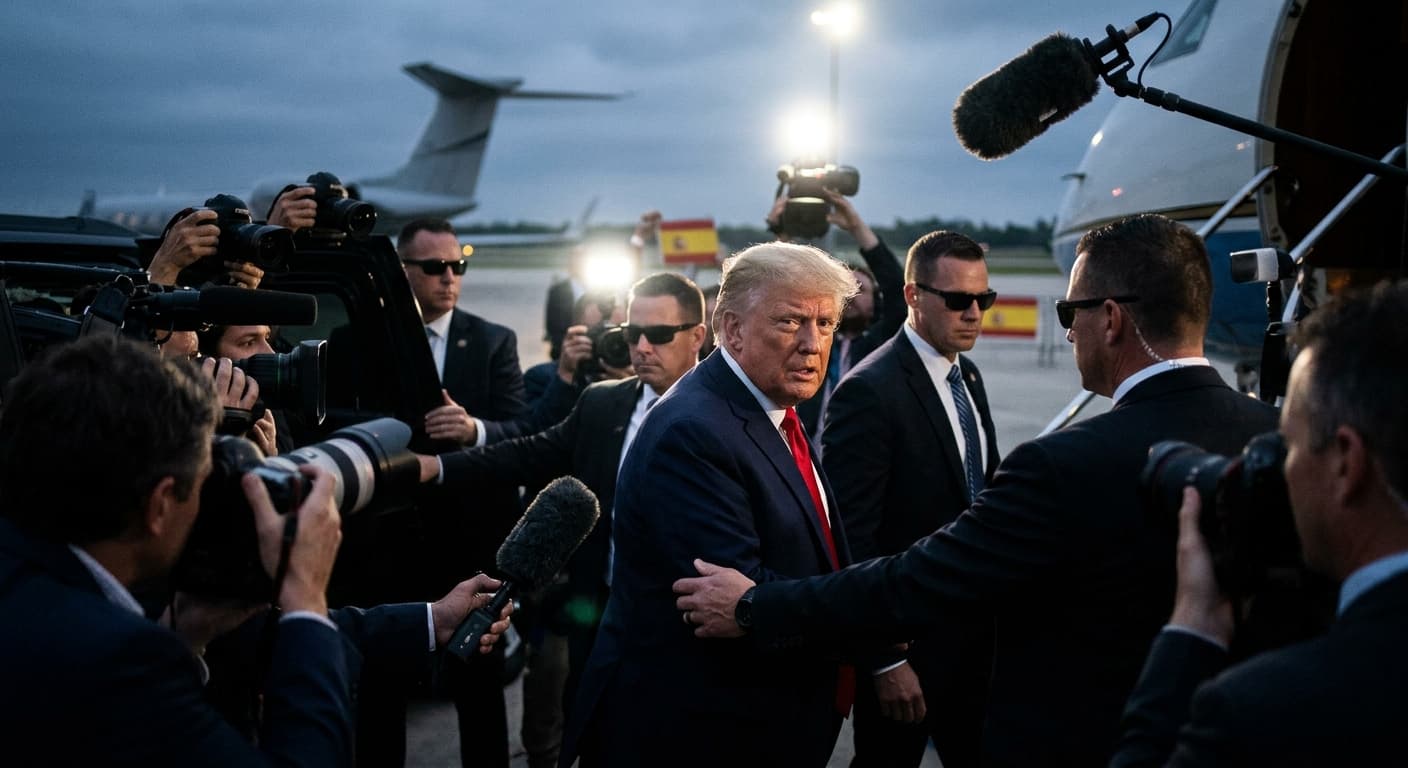
At a July 8, 2026 press conference in Ankara, US President Donald Trump instructed Treasury Secretary Scott Bessent to sever "all trade" with NATO ally Spain, calling Madrid a "wasted cause" over its refusal to endorse the alliance's 5% GDP defence target and its ban on US strikes against Iran from Spanish soil. The order is theatrical more than operational: four months earlier the US Supreme Court stripped Trump of the emergency tariff authority he used on China, Canada and Mexico, and EU exclusive trade competence blocks Washington from ring-fencing a single member state. The real leverage in play is not tariffs but the US force posture at Rota and Morón — and that is a card Trump has quietly refused to play.
The order, the words, the sequence
Speaking alongside NATO Secretary-General Mark Rutte, Trump was blunt. "Spain is a wasted cause. We don't want to do any trade business with Spain any more," he said, telling Bessent to "cut it off," according to Al Jazeera. He repeated the demand for allies to hit 5% of GDP on defence and singled out Spanish Prime Minister Pedro Sánchez for what he called mistreatment of Rutte. The
BBC reported Sánchez responded in a ten-minute televised address the next morning, restating opposition to "war" and to the "breakdown of international law" — a direct reference to the US-Israeli air campaign against Iran that began in late February 2026.
The immediate context is not new. In March 2026 Madrid refused US access to the jointly operated Rota naval base and Morón airbase for operations against Iran, forcing the Pentagon to relocate 15 aircraft, including refuellers, according to Al Jazeera's March 2 report. An internal Pentagon email leaked in April floated suspending Spain from NATO altogether — a step for which, as
the BBC's Katya Adler noted, the alliance's treaties contain no provision.
Why the "halt" is a threat, not a policy
Trump's order runs into three walls simultaneously — legal, treaty, and economic.
The first is domestic. On February 20, 2026, in Learning Resources, Inc. v. Trump, the Supreme Court held 7–2 that the International Emergency Economic Powers Act (IEEPA) — the 1977 statute Trump had invoked to impose his April 2025 "reciprocal" tariffs — "does not authorize the President to impose tariffs." The opinion by Chief Justice John Roberts stated that "all agree that the President enjoys no inherent authority to impose tariffs during peacetime." The Congressional Research Service, in its post-ruling
legal sidebar, confirmed the president's IEEPA authority to "regulate" imports does not extend to duties. That leaves Trump with Section 232 (national-security tariffs), Section 301 (unfair trade practices) and the residual IEEPA power to prohibit — not tax — transactions with a specific target. A blanket embargo on an EU member requires a national-emergency declaration and, per PIIE analyst Gary Hufbauer's
assessment, evidence of an "unusual and extraordinary threat" sourced abroad — a high bar against a NATO ally.
The second wall is European. Under Article 207 of the Treaty on the Functioning of the European Union, common commercial policy is an exclusive EU competence. Spain does not negotiate its own tariff schedules; the European Commission does. That is why German Chancellor Friedrich Merz told Trump in March, and repeated on the Ankara sidelines, that he could not conclude a trade deal covering Germany but not Spain. European Commission spokesperson Olof Gill reminded Washington on July 8 that the EU signed a joint trade statement with the US in 2025 and expected it to be honoured. Behind the scenes, the EU carries a live retaliation option:
Regulation (EU) 2023/2675, the Anti-Coercion Instrument, which allows Brussels to hit US services, IP, procurement and FDI if the Commission finds a third country is applying "measures affecting trade or investment" to influence a member state's "legitimate sovereign choices." Trump's order is textbook Article 2 coercion. Peterson Institute analyst Jacob Kirkegaard has called the instrument the
"EU bazooka" — untested, but engineered precisely for this scenario.
The third wall is arithmetic. Two-way US–Spain trade in goods and services ran near $75 billion in 2025, with the US posting a roughly $3 billion surplus — its fourth straight surplus year with Madrid, according to the Congressional Research Service's June 2026 country brief. Spanish direct investment in the US ($87.4 billion) is more than double the US stake in Spain, and Spanish affiliates employ about 86,500 people in the United States. An embargo would land hardest on US energy exporters (Spain is a major LNG buyer), US aerospace prime contractors, and Iberdrola-owned Avangrid utility customers in New England.
The angle: Trump is negotiating over bases, not bourbon
Read against the paper trail, the trade threat is a stalking horse for a base-posture negotiation.
Rota, on Spain's Atlantic coast, hosts the four US Aegis-equipped Arleigh Burke destroyers that anchor the European Phased Adaptive Approach for missile defence, per a 2015 State Department fact sheet and the 2023 amendment
deposited with State adding two more ships. Morón hosts the Special-Purpose Marine Air-Ground Task Force–Crisis Response–Africa, up to 2,200 personnel and 26 aircraft. Both are governed by the 1988 US–Spain Agreement on Defense Cooperation, renewed annually, and both require Spanish authorisation for each operational use — the legal chokehold Madrid tightened in March.
Former US ambassador to NATO Julianne Smith, now heading Clarion Strategies, told the BBC that punitive posture cuts "seem over-reactive in light of the fact that allies were never asked to assist the US" in Iran. That framing matters: it suggests the White House's own NATO caucus views trade coercion as the softer option, precisely because base drawdowns would degrade US operational reach into Africa and the Eastern Mediterranean at the exact moment the Strait of Hormuz remains contested. Trump has publicly announced a "phased withdrawal of warplanes, destroyers and submarines" from NATO countries, per Al Jazeera's summit preview, but has conspicuously not touched Rota's destroyers — the assets that most enrage Madrid domestically and that Washington least wants to move.
Who benefits, who pays
The immediate winner is Sánchez. A minority PSOE-led coalition wobbling on budget votes now has a national-unity issue delivered by Trump himself. Polling cited by the BBC shows most Spaniards already hold a "bad" or "very bad" view of Trump; French President Emmanuel Macron and European Council President António Costa called Sánchez the same day to convey "full solidarity." A wounded prime minister who spent June defending his 5% opt-out from centrist critics is now the EU's designated victim of American coercion.
The second-order winner is Brussels. Every threat like Trump's makes it easier for Commission President Ursula von der Leyen to build the qualified majority — 15 states, 65% of population — required to trigger the Anti-Coercion Instrument. France, Germany and Spain were already pushing for readiness, per PIIE; Ireland, worried about US tech retaliation, has been the drag. Ankara has probably just moved Dublin.
The loser is the transatlantic economic architecture. Bruegel's global trade tracker shows the EU has already offset most of its lost US market share through diversification to the UK, Türkiye and Asia in 2025; another public confrontation only accelerates the reshuffle. And on the US side, PIIE data on
2025 tariff outcomes shows US import prices rose faster than export volumes recovered — the fiscal case for another front is thin.
The quiet loser inside the alliance is Rutte. He was hired in 2024 specifically to manage Trump. Ankara was engineered as a victory lap on the 5% pledge. Instead, the secretary-general spent day two of his own summit sitting beside a US president who called a founding member a "terrible partner" and pivoted to demanding Greenland — which Denmark, another NATO state, again refused to sell. Al Jazeera's five takeaways note that only five allies are projected to hit 3.5% core defence spending in 2026; the Ankara declaration provides no enforcement mechanism.
The historical parallel that reframes it
The closest analogue is not Trump's 2018 steel tariffs. It is Richard Nixon's August 1971 emergency 10% import surcharge, imposed under the Trading with the Enemy Act, upheld in United States v. Yoshida International, and terminated after four months. Congress responded by writing Section 122 of the Trade Act of 1974, which caps any balance-of-payments surcharge at 15% for 150 days before Congress reclaims authority. As the Congressional Research Service notes, that 1974 cap remains the only clean statutory path for a peacetime, allies-included emergency trade action. It is not a path to a full embargo on Spain. It is a path to a temporary, capped surcharge — the kind of move that lets a president posture, extract concessions, and retreat.
What to watch next
- Federal Register within 14 days. Any real "halt" requires a National Emergencies Act proclamation citing Spain by name and a specific IEEPA finding of an "unusual and extraordinary threat." Absent that filing, Trump's Ankara order is rhetoric.
- European Commission College meeting, mid-July 2026. Watch for a Trade DG statement on whether the Ankara remarks meet the Article 2 threshold of Regulation 2023/2675. A pre-investigation "scoping" notice would signal escalation.
- Rota destroyer rotation. The next scheduled destroyer swap is a hard tell. If the Pentagon delays or reduces the four-ship complement, the trade threat is real leverage. If it proceeds normally, the threat is a bargaining chip.
- Spanish 2027 budget vote, autumn 2026. Sánchez has pledged 2.1% of GDP on defence; delivery — not rhetoric — will be scored in Washington and in the Ankara declaration's annual review.
Diplomat View
Trump's Ankara order is not a trade policy — it is a coercion signal aimed at Spanish base access and priced on the assumption that Madrid will fold before Washington has to. The evidence points the other way. With IEEPA tariff authority stripped by the Supreme Court, EU exclusive competence blocking bilateral action, a $3 billion US trade surplus at risk, and 195,000 Spanish-affiliate US jobs in play, the enforcement machinery for a genuine embargo does not exist. Sánchez has domestic incentives to hold firm; von der Leyen has institutional incentives to test the Anti-Coercion Instrument on the softest available target — a threat against one member state that violates the EU's constitutional trade order. Base forecast: Trump extracts a symbolic Spanish defence-spending sweetener before year-end and declares victory; a formal embargo does not happen. Revise the forecast if (1) the White House publishes a Federal Register national-emergency proclamation naming Spain, (2) Rota's destroyer rotation is cut, or (3) the Commission opens a formal ACI examination before Congress returns from August recess. Any one of those turns rhetoric into a genuine transatlantic crisis.
Key Takeaways
- Trump's July 8 order to halt US trade with Spain collides with the Supreme Court's February 2026 ruling gutting IEEPA tariff authority and with EU Article 207 exclusive competence.
- The US ran a ~$3 billion trade surplus with Spain in 2025 on ~$75 billion in two-way trade; an embargo would cost US exporters and hit 195,000 US jobs at Spanish affiliates.
- Real leverage sits at the Rota naval base and Morón airbase — assets Washington has not moved despite three months of escalation.
- The EU's untested Anti-Coercion Instrument (Regulation 2023/2675) is engineered for exactly this scenario; Trump's threat may finally trigger it.
- Sánchez's minority government is the immediate political beneficiary; NATO Secretary-General Mark Rutte the immediate loser.
Discover more

Conflict & Security
West Africa Food Crisis: Three Shocks in 2026
Conflict, climate extremes, and the Strait of Hormuz closure drive a severe food crisis in West and Central Africa, with fertilizer prices surging 80% and millions displaced.
Economics
US Tariffs on Brazil: A Political Play
US imposes 25% tariff on Brazil but exempts 66% of exports, targeting manufactured goods ahead of Brazil's October election. Analysis of the political calculus, exemptions, and Brazil's response options.
Tech Policy
US Restarts China Export Controls With 52-Ent
US Commerce Department adds 52 Chinese entities to Entity List and tightens controls on five-axis CNC machine tools, ending eight-month enforcement pause after Trump-Xi Busan truce.
Economics
Trump's 50% Tariff on Canada Ends USMCA's Tar
Trump invokes Section 338 of the Tariff Act of 1930 for the first time, imposing 50% tariffs on $20 billion of Canadian goods and ending the USMCA tariff shield.