Trump's 50% Tariff on Canada Ends USMCA's Tar
Trump invokes a 1930 law to hit Canada with 50% tariffs, ending the USMCA shield.
Model Diplomat12 min readNorth America
Trump's 50% Tariff on Canada Is Not About Hockey Sticks — It's About Dismantling the USMCA's Legal Shield
The White House invoked Section 338 of the Tariff Act of 1930 for the first time in nearly a century on July 20, 2026, imposing 50% tariffs on $20 billion of Canadian goods. The real target is not dairy or alcohol — it is the principle that trade agreements immunise partners from unilateral presidential tariffs.
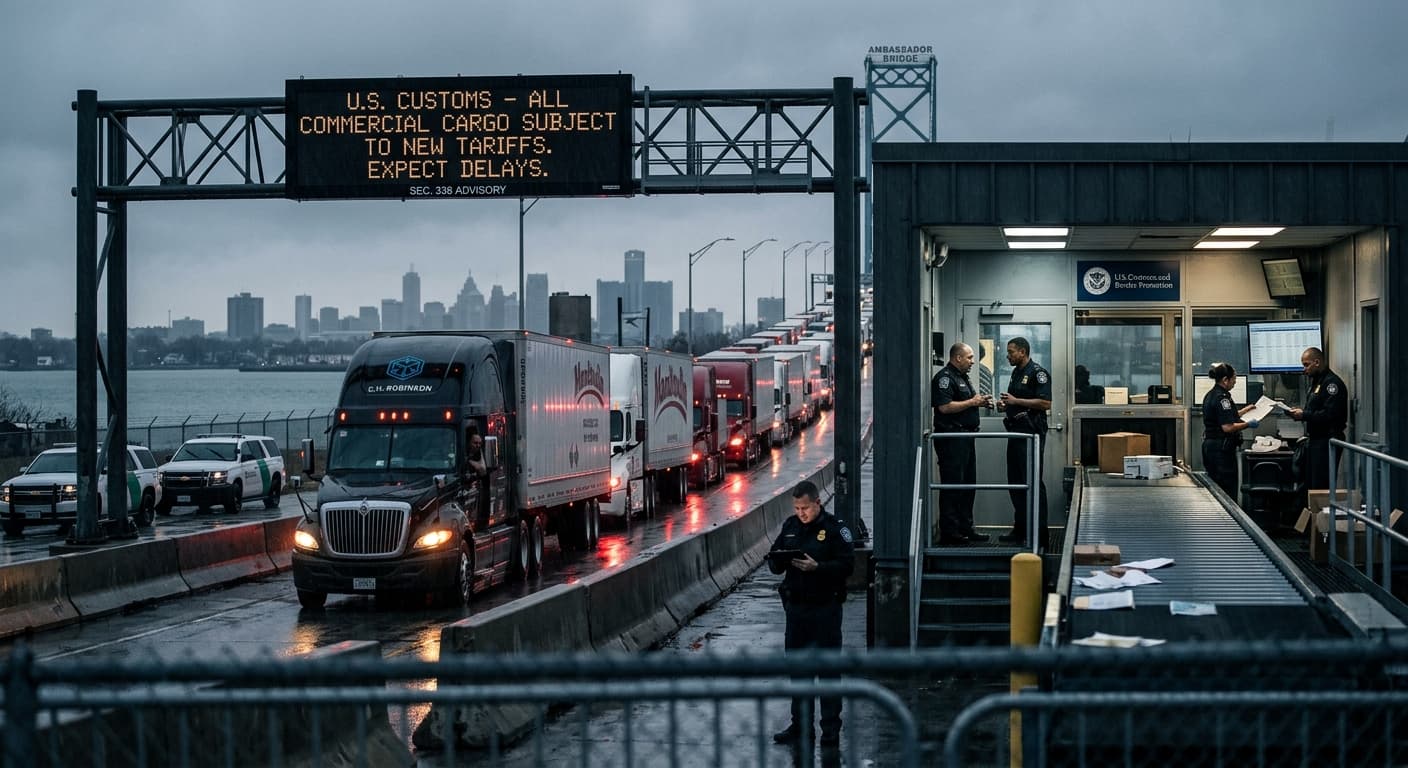
On Monday, July 20, President Donald Trump signed three proclamations under Section 338 of the Tariff Act of 1930, imposing a 50 percent surcharge on roughly $20 billion of Canadian imports — from wine and cement to hockey sticks and dairy. The tariffs take effect in 30 days, on August 19. But the most important number in the White House fact sheet is not the 50 percent rate or the $20 billion figure. It is the line confirming the tariffs apply "regardless of whether a good originates under the U.S.-Mexico-Canada Agreement."
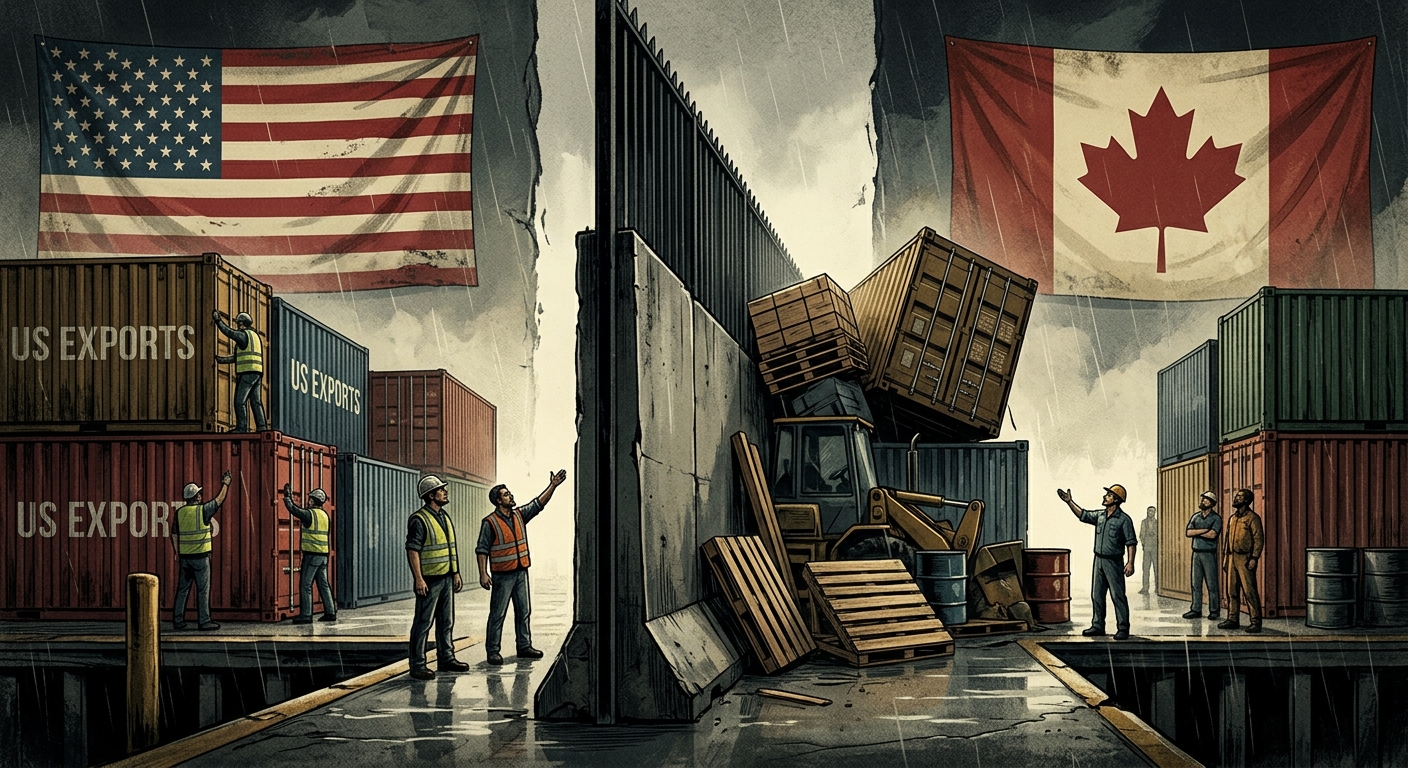
That clause marks the formal end of an 18-month understanding that USMCA-compliant goods would remain sheltered from Trump's tariff wars. The shield is gone. And the timing — two days before the Section 122 global tariffs expire on July 24, three weeks after the U.S. refused to renew the USMCA on July 1, and four months before the November midterm elections — makes clear this is not a trade dispute about cheese quotas. It is a coercive instrument designed to force Canada into USMCA renegotiations on Washington's terms before the electoral clock runs out.
The Legal Architecture: Why Section 338 Matters
The Trump administration has spent the past five months scrambling for legal authority since the Supreme Court ruled on February 20, 2026, that the president's use of the International Emergency Economic Powers Act (IEEPA) to impose sweeping global tariffs was unlawful. In Learning Resources, Inc. v. Trump, the Court held that IEEPA "does not authorize the President to impose tariffs," forcing the White House to rebuild its trade architecture from a patchwork of older, narrower statutes. Supreme Court of the United States
The first bridge was Section 122 of the Trade Act of 1974, which permitted a 10-to-15 percent global surcharge for 150 days. That authority expires this Friday, July 24. The administration has been racing to conclude Section 301 investigations — targeting forced labor and industrial overcapacity in up to 76 countries — before that deadline. U.S. Trade Representative Jamieson Greer told CNBC on Tuesday that "we expect to see some action soon" on a new wave of tariffs covering a majority of U.S. trade. Al Jazeera
Section 338 is the less-discussed tool in the arsenal — and potentially the most dangerous. The law, codified at 19 U.S.C. § 1338, permits the president to impose tariffs up to 50 percent against countries that "discriminate in fact" against U.S. commerce. It has sat dormant since its 1930 enactment. No president has ever used it. As legal scholars noted in amicus briefs filed during the IEEPA litigation, Section 338 "cannot plausibly serve as a general license for the President to impose tariffs" because reading it too broadly "would raise grave nondelegation concerns." Supreme Court Docket
But the administration is not using it as a general license — yet. It is using it surgically, against the one country other than China that retaliated against Trump's original tariffs. The legal theory is narrow: Canada discriminated, Section 338 authorises a proportional response, and the 50 percent ceiling permits a substantial deterrent. Whether courts sustain that reading will take years to resolve. In the meantime, the tariffs bite.
What the Tariffs Actually Hit — and What They Don't
The White House issued three separate proclamations — one each for motor vehicles, alcoholic beverages, and dairy — each with its own annex of covered products. The combined scope is broad but deliberately selective. The White House
The targeted goods represent roughly 5.2 percent of the $382 billion in goods the U.S. imported from Canada in 2025, according to U.S. Census Bureau data. Crucially, energy products, potash, critical minerals, and fish are carved out — along with goods already subject to Section 232 national security tariffs, such as steel, aluminum, and copper. The carve-outs are the tell: the administration wants maximum political leverage over Canadian provinces and industries without triggering an energy-price shock or fertiliser shortage that would hurt American farmers and consumers before the midterms.
The White House fact sheet marshals specific trade data to justify each proclamation. U.S. motor vehicle exports to Canada fell roughly 22 percent, or $5.6 billion, between April 2025 and March 2026 compared to the prior year. Alcoholic beverage exports cratered 81 percent, or $582 million, in the year through February 2026 — the result of provincial liquor boycotts that began in response to Trump's earlier tariffs and his repeated threats to make Canada the "51st state." On dairy, the administration cites Canada's more restrictive tariff-rate quotas on U.S. cheese relative to EU cheese.
In a statement accompanying the proclamations, USTR Greer framed the action bluntly: "Canada has taken US alcohol products off Canadian shelves, given better market access to dairy products from the European Union, and has put a cap on US vehicle exports to Canada from companies reshoring to the United States." The tariffs, he said, are intended to "hold Canada accountable for its retaliation and discrimination." USTR
The USMCA Game: Divide, Pressure, Conquer
The Section 338 tariffs did not arrive in isolation. They landed three weeks after the United States declined to renew the USMCA for a 16-year extension, triggering instead a decade of annual reviews under Article 34.7 — a sunset mechanism Trump himself negotiated in his first term. Brookings
What has followed is a bilateral, not trilateral, negotiation. The United States and Mexico have held three rounds of talks, with the third occurring this week in Mexico City. Canada has been kept out of the room. The pattern deliberately replicates the 2018 playbook: Washington strikes a deal with Mexico first, then uses tariffs to bludgeon Ottawa into joining at the last minute. In May 2018, Trump imposed 25 percent tariffs on Canadian steel and 10 percent on aluminum to force Canada into what became the USMCA. This time, the weapon is Section 338.
The CSIS noted in its analysis that "U.S. negotiations with Mexico regarding the USMCA have advanced speedily, while the United States and Canada have yet to formally initiate negotiations." The think tank assessed that the Section 338 duties are likely aimed at three objectives: "build leverage, push Canada to join USMCA review talks, and pressure Ottawa to concede to U.S. demands." CSIS
Prime Minister Mark Carney's response has been characteristically cautious. Speaking to reporters on Tuesday after a phone call with Trump — the two had watched the World Cup final together in New Jersey just a day before the tariff announcement — Carney said the leaders had agreed to "intensify discussions" and that "the first objective is to get a comprehensive agreement." But he also warned that "all options" remained on the table. Al Jazeera
Carney's Calculus: Run the Clock
Carney's playbook is increasingly legible. The former central banker — who campaigned last year on going "elbows up" for Canada — is betting that time works in Canada's favour.
Three factors support that bet. First, the midterm elections in November 2026 create acute vulnerability for Trump. His "Liberation Day" tariffs in April 2025 triggered a financial market meltdown, forcing a walk-back. A Fox News poll from November 2025 found 76 percent of U.S. voters viewed the economy negatively, and Pew Research reported in February 2026 that 60 percent of respondents disapproved of Trump's tariff increases. NPR Congressional Republicans have already shown willingness to break ranks: in February, the House voted 219–211 to pass a bill ending Canada tariffs, with several Republicans crossing party lines.
Al Jazeera
Second, the Section 122 expiry on July 24 creates a moment of maximum chaos for U.S. trade policy. If the administration cannot finalise its Section 301 replacement tariffs in time — and the CSIS has flagged that the legal pathway is far from certain — the entire global tariff architecture faces a gap. Adding a Canada fight to that calendar is poor sequencing for Washington.
Third, Canada's provincial liquor delistings — the boycott that most infuriates the White House — are not state actions easily reversed by executive agreement. As the CSIS noted in a separate analysis of the economic coercion campaign, "the boycotts are not an action by the state but by its people. Once consumers in a democratic society organize around a grievance, state-to-state economic statecraft cannot reliably dictate their behavior." Canadian land crossings into U.S. border communities remain roughly 20 percent below 2024 levels, even after earlier tariff relief. A Longwoods International survey in April 2026 found that 57 percent of Canadians said U.S. trade policies made them less likely to visit in the following year. CSIS
Carney has signaled he will not lift the provincial liquor bans without a broader deal addressing metals and auto tariffs. "Canada is not going to give any concessions that aren't in the context of a real negotiation," said Candace Laing, CEO of the Canadian Chamber of Commerce, whom Carney appointed to his new Canada-U.S. trade advisory committee. BBC
The Canadian dollar dipped to C$1.4083 per U.S. dollar on the news — a modest move that suggests markets are not yet pricing in full implementation. The 30-day window offers a genuine off-ramp.
The Wider Signal: No Agreement Is Safe
The most consequential aspect of the Section 338 tariffs is their precedent value — and the signal they send to the 60-plus trading partners bracing for new U.S. duties when Section 122 expires.
For 18 months, the USMCA's tariff shield was the one thing that made the administration's trade war manageable for North American supply chains. Steel, aluminum, copper, and lumber were hit with Section 232 tariffs. But the free-trade agreement itself provided a floor. Goods that met USMCA rules of origin crossed the border duty-free. That floor is now gone.
Scott Lincicome, vice president of general economics at the libertarian Cato Institute, warned that Section 338's application to a USMCA partner "could be applied to other U.S. trading partners, not just Canada, and inject 'massive uncertainty' into the global economy." NPR
The legal architecture of Section 338 is particularly troubling for U.S. partners because it requires less process than Section 301. Section 301 demands investigations, findings, and interagency review. Section 338 requires only a presidential finding of discrimination, a proclamation, and a 30-day waiting period. The tariff ceiling is 50 percent — higher than Section 122's 15 percent cap. And the statute permits the president to extend tariffs to third countries that benefit from the original country's discrimination, though Trump has not invoked that authority here.
In sum, what the White House unveiled Monday is a fast, potent, low-process tariff weapon — tested on Canada first, but calibrated for wider use.
The Winners and Losers
The immediate economic impact of the Section 338 tariffs is smaller than the political signal. At $20 billion, the covered goods represent a fraction of the roughly $900 billion in annual U.S.-Canada goods and services trade. The carve-outs for energy, potash, and Section 232 goods protect the most economically significant flows.
But the distributional effects are real — and uneven.
U.S. dairy producers stand to gain if Canadian cheese and cream become prohibitively expensive in the American market. U.S. wine and spirits producers, who have watched Canadian shelves close to them since early 2025, may recapture some pricing power — though the 81 percent decline in exports means there is little left to protect.
Canadian dairy farmers and alcohol exporters face the most direct damage. The dairy sector exported only C$391 million to the U.S. last year, according to Canadian government data, making the tariff more symbolic than catastrophic. The alcohol trade is larger — U.S. imports of Canadian beer, wine, and spirits totaled $1.9 billion in 2025, per U.S. trade data — but still manageable.
The larger losers are cross-border manufacturers and their workers. Kathleen Claussen, a trade law professor at Georgetown, told NPR the tariffs should be understood as "leverage in the USMCA negotiations because these are areas that have been irritants for the bilateral relationship." By piercing the USMCA shield, the administration has raised the cost of doing business across the border for every firm that relied on the agreement's certainty. NPR
U.S. consumers will pay some of the bill. Tariffs are taxes on imports, and those costs flow through to retail prices. Rep. Suzan DelBene, chair of the Democratic Congressional Campaign Committee, said the new duties "will raise prices on American families and likely lead to retaliation against the very industries Trump purportedly wants to protect." The midterm implications write themselves.
Ontario Premier Doug Ford, whose province is the heartland of Canada's integrated auto sector, called for a "dollar for dollar" Canadian response. Alberta Premier Danielle Smith warned the tariffs would hurt workers on both sides of the border. Saskatchewan Premier Scott Moe urged intensified talks, saying the bilateral relationship "is more important than any president or prime minister."
Key Takeaways
- The Trump administration imposed 50% tariffs on $20 billion of Canadian goods under Section 338 of the Tariff Act of 1930 — the provision's first-ever use — effective August 19 unless negotiations yield a deal.
- The tariffs apply regardless of USMCA origin, ending the 18-month convention that trade-agreement-compliant goods were exempt from Trump's tariff wars.
- Energy, potash, critical minerals, and goods under existing Section 232 tariffs are exempt — protecting the most economically significant trade flows from immediate disruption.
- The tariffs arrive three weeks after the U.S. declined to renew the USMCA, while bilateral U.S.-Mexico talks advance without Canada — replicating the 2018 divide-and-conquer playbook.
- The 30-day window before implementation is a genuine negotiating off-ramp, but the legal precedent — a fast, low-process tariff weapon tested on Canada — applies to every U.S. trading partner.
What to Watch
- July 24, 2026 — Section 122 global tariffs expire. Watch whether the administration announces replacement Section 301 tariffs or extends the deadline, and whether the scramble creates bandwidth for a Canada deal.
- Week of July 27, 2026 — U.S.-Mexico third round of bilateral USMCA talks concludes in Mexico City. An "agreement in principle" with Mexico would isolate Canada further and raise pressure on Carney.
- August 19, 2026 — Section 338 tariffs take effect. The key variable is whether the administration extends the 30-day deadline, as it has with previous tariff threats, or lets the duties land.
Diplomat View
The Section 338 tariffs are not primarily about dairy quotas, provincial liquor monopolies, or auto rules of origin. They are about establishing that the president can unilaterally tariff goods covered by a congressionally approved trade agreement — and that no partner, however integrated, is safe. This is the quiet demolition of the post-NAFTA settlement, one dormant statutory provision at a time.
Our forecast: Trump will not let these tariffs go into full effect on August 19. The political risk of a consumer-price shock four months before the midterms is too high, and the 30-day window is the standard Trump negotiating rhythm — threaten, delay, claim victory. What he extracts in the interim will determine whether this is remembered as a tactical bluff or the first shot in a genuinely new phase of North American trade relations. The most likely outcome is a deal that lifts the tariffs in exchange for Canadian concessions on dairy access and provincial liquor policies — timed to land before Labor Day, when midterm campaigns begin in earnest.
If Carney refuses to deal and August 19 arrives without an agreement, revise the forecast sharply downward. That scenario would mean Carney has calculated that the electoral damage to Trump outweighs the economic damage to Canada — and that he can hold the line through November. The last time a Canadian leader made that bet and won was never. But no Canadian leader has faced an American president who threatened annexation while imposing tariffs under a 1930 law nobody had ever used.
The bottom line: The prize in this fight is not $20 billion in Canadian exports. It is the precedent that trade agreements constrain presidential tariff power — and that precedent is now on life support.
Discover more
US Politics
House Ethics Committee Pushes Sexual Miscond.
The House Ethics Committee has shifted responsibility for sexual harassment settlement records to the Office of Congressional Workplace Rights, complicating disclosure efforts.

India
BJP's Delimitation Strategy
Congress leader K.C. Venugopal claims the BJP uses women's reservation to advance delimitation, raising fears over electoral fairness ahead of the 2029 polls.

India
Congress Advocates 33% Women’s Quota
Congress calls for a 33% women's reservation in the existing 543 Lok Sabha seats, countering Modi's plan to expand the house to 850 seats.

Economics
Fed's Amex AML order puts correspondent banking on notice
Federal Reserve's Amex AML order requires board-level controls and a 90-day plan; OCC fined the bank $350 million over enterprise-wide deficiencies.