Congress Advocates 33% Women’s Quota
Congress pushes for immediate women's reservation in Lok Sabha.
Model Diplomat8 min readIndia
Congress Pushes 33% Women's Quota in Existing 543 Lok Sabha Seats
Congress president Mallikarjun Kharge is demanding immediate 33% women's reservation in the current 543-seat Lok Sabha — decoupling gender quotas from Modi's stalled delimitation plan.
Two days after his government's Constitution (131st Amendment) Bill collapsed on the floor of the Lok Sabha 298–230, Prime Minister Narendra Modi went on national television on April 18, 2026 to apologise to India's women and to blame the opposition. Within twenty-four hours Congress president Mallikarjun Kharge answered with a proposition that reframes the entire fight: bring a fresh women's reservation bill to Parliament "tomorrow", inside the existing 543 seats, without waiting for a census or a redraw of constituencies. That demand is not really about gender — it is about killing Modi's plan to expand the Lok Sabha to 850 seats before the 2029 election, and Congress now holds the arithmetic to do it.
What actually happened on the floor
The Modi government convened a three-day special session on April 16, 2026 to move three linked bills: the Constitution (131st Amendment) Bill, a Delimitation Bill capping the Lok Sabha at 850 seats, and a companion Union Territories Laws (Amendment) Bill. The package would have activated the 33% women's quota — dormant since 2023 — but only after a fresh delimitation exercise based on the 2011 census, expanding the lower house from 543 to about 850 seats, as Al Jazeera reported on April 16.
On April 17, the 131st Amendment Bill failed. It required a two-thirds majority — roughly 352 votes with the house at strength — and Home Minister Amit Shah's reply mustered only 298 in favour against 230 opposed, according to BBC Hindi's account of the division. The NDA's own count is 293. The BJP walked in knowing the numbers were not there — and tabled the bill anyway.
Modi's Saturday broadcast converted the defeat into a moral indictment of the opposition. "Those who oppose this bill will pay the price for a long time to come," he said, according to BBC Hindi's transcript — apologising to "mothers and sisters" while charging that Congress, DMK, Trinamool and the Samajwadi Party had betrayed India's women. Amit Shah, on X, echoed the line: the opposition's stance was neither in women's interest nor the nation's.
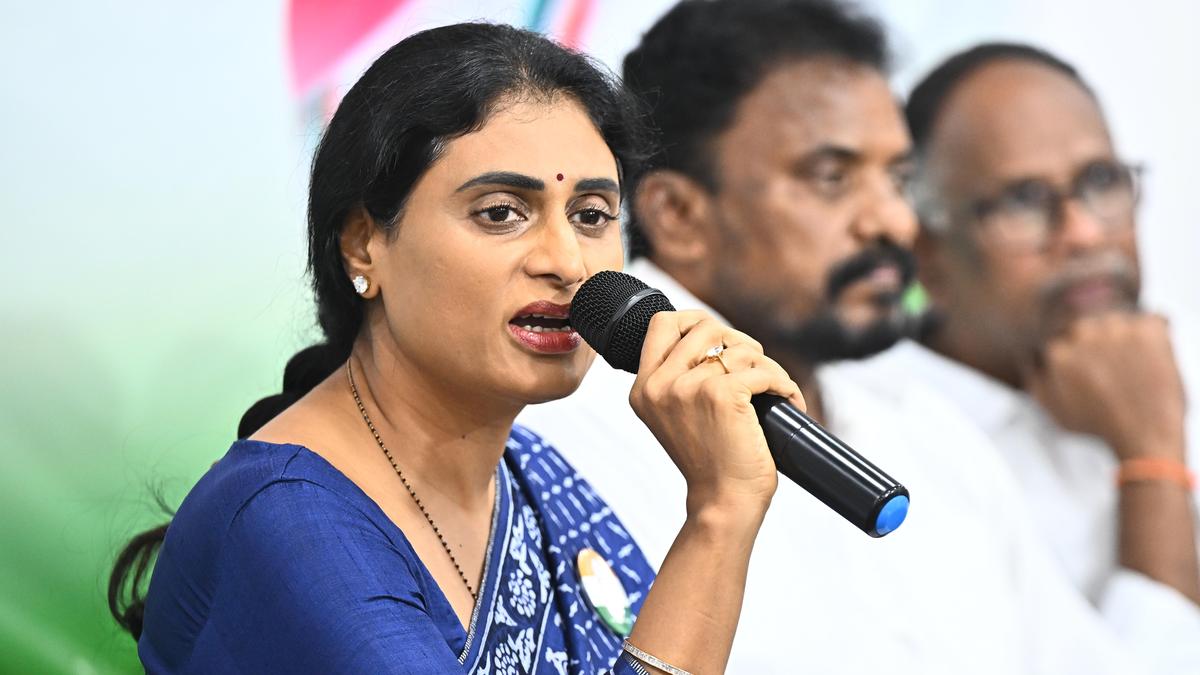
Kharge's response, delivered in New Delhi on April 19 and reported by The Tribune, collapsed the government's narrative in a sentence. Bring the bill back tomorrow, he said, drop the delimitation clause, and reserve one-third of the existing 543 seats. Congress general secretary Jairam Ramesh called Modi's broadcast "a distress address".
YS Sharmila, in Andhra Pradesh, put the same argument to a regional audience: the party is committed to 33%; the government is committed to gerrymandering.
The bill Congress can live with — and why Modi cannot
The Nari Shakti Vandan Adhiniyam, 2023 — the Constitution (One Hundred and Sixth Amendment) Act — was notified by the Government of India on 28 September 2023. Its operative clause — Articles 330A and 332A — ties the reservation to "an exercise of delimitation… undertaken for this purpose after the relevant figures for the first census taken after the commencement" of the Act,
as the Institute of South Asian Studies at NUS summarised days after passage. That single clause is the trapdoor. Until the delayed decennial census is complete and constituencies redrawn, the 33% quota is a promissory note.
The 131st Amendment tried to redeem the note — but on the government's terms. It proposed to lift the constitutional cap on the Lok Sabha from 550 to 850, use the 2011 census as the delimitation base, and rotate reserved seats after each cycle. The Home Ministry claims a uniform 50% expansion across states on paper, taking southern India's tally from 129 seats to roughly 195 while holding its share near 24%. In practice, as Arghya Sengupta of the Vidhi Centre for Legal Policy told the BBC, the bill "does not explicitly spell this out" — there is no proportional formula in the text, and no matching expansion of state assemblies.
Southern chief ministers read the silence the way it was meant. Tamil Nadu's M. K. Stalin called it a "massive historic injustice." Karnataka's Siddaramaiah demanded the quota be implemented inside the current 543 seats. The Communist Party of India (Marxist)'s John Brittas told the BBC the party supports 33% "based on the current strength of parliament" and wants the seat cap frozen "until population trends stabilise." Kharge's Friday demand is a coalition weld — it hands the DMK, the Left, Trinamool and the regional parties the exact language they have been asking for.
That is why Modi cannot accept it. Decoupled from delimitation, the women's quota loses its political value to the BJP: the party's electoral map project — moving the centre of parliamentary gravity into the Hindi belt where Modi's vote share is highest — dies with the amendment. The bill was the vehicle. Women were the passengers. The seat map was the destination.
The historical parallel that reframes everything
Congress is running the identical play Manmohan Singh's UPA ran on it in 2010 — in reverse. In March 2010 the Rajya Sabha passed a women's reservation constitutional amendment; the Lok Sabha, where UPA leaned on OBC allies like Lalu Prasad Yadav's RJD, never took it up. It lapsed with the 15th Lok Sabha. BJP spokesman Shehzad Poonawalla threw the sequence back at Sonia Gandhi during the current session, as BBC Hindi noted: "You had the chance… why didn't you bring it?"
Kharge's answer is procedural jiu-jitsu. By demanding the 33% quota within the existing 543 seats, Congress can vote for women's reservation while voting against the government's constitutional architecture — the same split UPA exploited in reverse fifteen years ago. The demand is designed to be refused. When Modi rejects it, the "delay" narrative flips: it is no longer the opposition that blocked women, but the BJP that refused a quota it could have had within a week.
The BJP's countermove — an all-party meeting on the Nari Shakti Vandan Adhiniyam rollout — was already faltering before the vote. The Hindu reported on April 20 that Congress had spurned repeated informal feelers and demanded a formal, written all-party discussion of implementation timelines. The party is refusing to be manoeuvred into a bipartisan photograph before it has extracted a policy concession.
The numbers that make the moral case
India's women's representation deficit is real and it is measurable. The Congressional Research Service's brief on India's 2024 national election records that women hold 14% of seats in the 18th Lok Sabha — a slight decline from the 17th. A
2025 study in the International Journal of Research and Innovation in Social Science puts the figure at 13.6% (74 of 543), with women accounting for only 9.5% of candidates fielded across all parties. India ranks around 143rd of 187 countries in the Inter-Parliamentary Union's league table on women's parliamentary representation,
per Observer Research Foundation analysis, behind Nepal (34%), Bangladesh (21%), Pakistan (20%) and Bhutan (17%).
That deficit gives Kharge the high ground. His party's own record is not clean — Congress fielded women in 14% of seats in 2024, well behind Trinamool's 38%. But the argument is asymmetric: the government has the law on the books, the majority in the Rajya Sabha, and 293 votes in the lower house. What it does not have is a two-thirds constitutional supermajority — and Congress is choosing to withhold that supermajority until delimitation is severed from the quota.
Who benefits, who loses
Winners. The four southern states — Tamil Nadu, Kerala, Karnataka and Telangana — gain the most from Kharge's framing. Their combined 129 Lok Sabha seats are unchanged if the quota is applied within 543. Under the 131st Amendment's 850-seat model, even the BJP's "pro-rata" assurance leaves the south's share frozen near 24% while the Hindi belt's absolute weight expands. Trinamool Congress, whose 38% women MP share is already the highest of any major party, benefits reputationally and loses nothing.
Losers. The BJP's electoral map project — years of quiet planning to translate demographic gains in the north into a durable parliamentary majority — is the biggest casualty. Senior journalist Sharad Gupta, quoted by BBC Hindi, read the government's calculation bluntly: the bill was tabled between the Bihar and West Bengal cycles precisely to weaponise a "BJP for women, opposition against" narrative. That narrative did not survive Kharge's counter-demand for 24 hours.
Also on the losing end: upper-caste, urban, party-connected women who would have been the first beneficiaries of the Nari Shakti Vandan Adhiniyam. AIMIM's Asaduddin Owaisi flagged this class effect during the 2023 debate, BBC reported, and it explains why OBC-based parties like the Samajwadi Party pressed again in April 2026 for a sub-quota for Muslims and OBC women within the reserved seats — a demand
Al Jazeera confirmed was rebuffed.
What to watch — the next catalysts
- Monsoon Session, July 2026. Whether the government tables a standalone women's reservation amendment inside the 543-seat frame. If it refuses, Congress will make the refusal a centrepiece of the West Bengal and Kerala campaigns.
- All-party meeting on Nari Shakti Vandan Adhiniyam rollout. The Home Ministry's written invitation is on the table; Congress's price is a public commitment to decouple the quota from delimitation. The test is whether Kharge attends without preconditions.
- Census results. The delayed decennial census,
Al Jazeera reported, launched enumeration in April 2026 and will take at least a year to complete. Every month it slips is a month the government cannot argue the quota is "imminent under existing law."
- West Bengal Assembly election, 2026. The BJP's core reason for tabling the bill mid-cycle was to court women voters in Bengal against Mamata Banerjee's TMC. That strategic rationale is now spent.
Diplomat View
Kharge's April 19 demand is the most consequential opposition move of the 18th Lok Sabha. It converts a policy defeat into a policy trap: by offering to pass 33% inside 543 seats, Congress dares the BJP to reveal that delimitation — not women — was ever the point. The forecast is that Modi will not accept, that the quota will remain inoperative through the 2029 election, and that "women's reservation" will function as a rhetorical weapon in every state contest between now and then rather than a lived reform.
That forecast would change under two conditions. First, if the BJP splits its own bill and passes the quota inside the current 543 seats as a discrete constitutional amendment — surrendering the delimitation gamble to reclaim the gender narrative. Second, if the census produces credible numbers before 2028, giving the government a way to argue that its original architecture is workable on a timetable voters can see. Absent either, India's most consequential democratic reform of the decade will remain, in Sonia Gandhi's 2023 formulation, an injustice extended one election at a time — as she asked in the Lok Sabha, "How many years will they have to wait — two, four, eight?" On present arithmetic, the honest answer is at least eight.
Discover more

Global Politics
US Seizes Iranian Ship, Tensions Surge
The US seizure of the Iranian ship Touska highlights a shift in control over the Strait of Hormuz, favoring Iran's strategic position.
US Politics
House Rejects Resolution on Trump's Iran Host
The House voted down a resolution to limit Trump's military actions in Iran, laying bare partisan divides and reigniting debate over presidential war powers.

US Politics
GOP House Blocks Limits on Trump's Iran War
House Republicans narrowly defeated a resolution to limit Trump's war powers over Iran, intensifying the fight in Congress over presidential military authority.

Economics
Fed's Amex AML order puts correspondent banking on notice
Federal Reserve's Amex AML order requires board-level controls and a 90-day plan; OCC fined the bank $350 million over enterprise-wide deficiencies.