US Restarts China Export Controls With 52-Ent
Ending eight-month freeze since Trump-Xi détente
Model Diplomat8 min readAsia
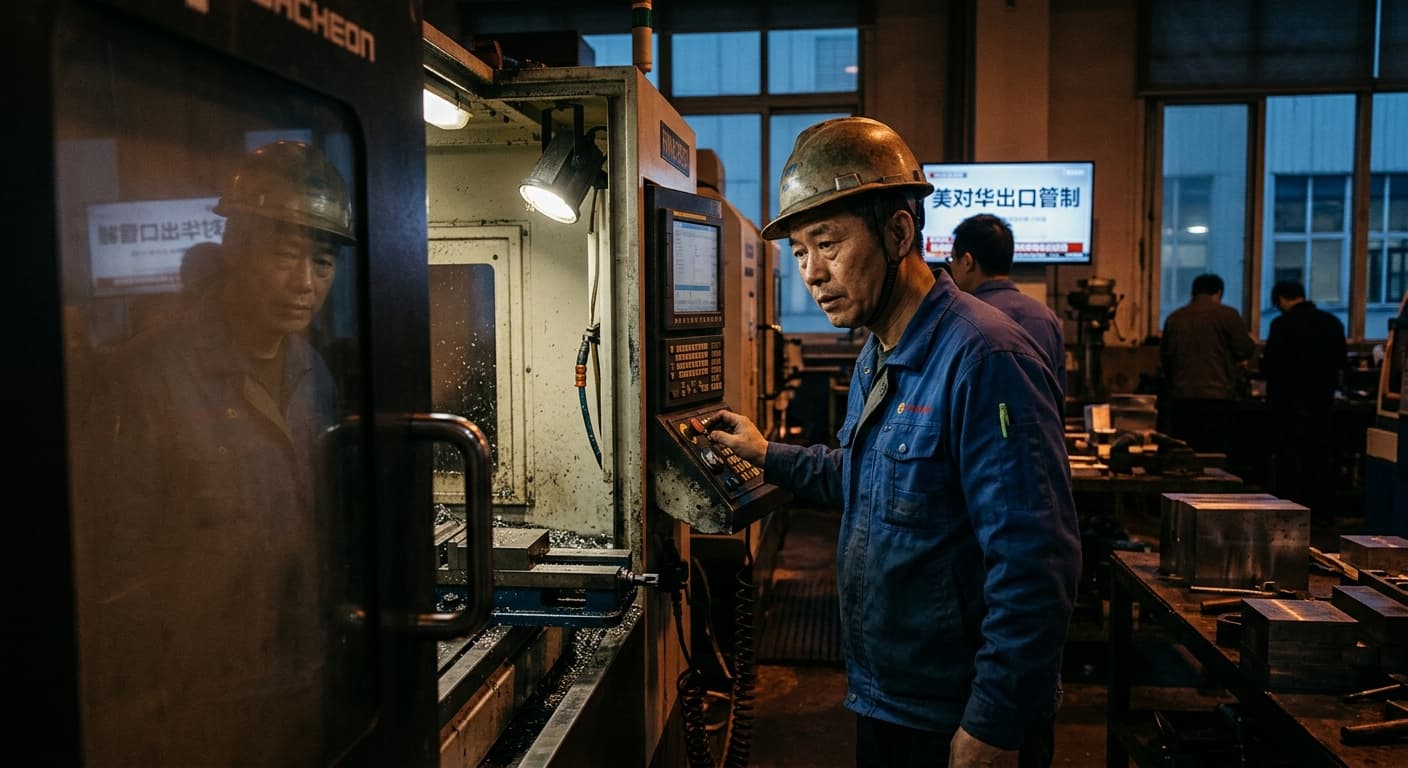
US Restarts China Export Controls With 52-Entity CNC Blacklist, Ending Eight-Month Freeze
On July 21, 2026, the Commerce Department added 52 Chinese entities to its trade blacklist and tightened controls on high-end CNC machine tools — the first Entity List additions since the Trump-Xi détente froze enforcement eight months ago.
The U.S. Department of Commerce's Bureau of Industry and Security issued an interim final rule on July 21, 2026, adding 52 Chinese entities to the Entity List and tightening export controls on five-axis CNC machine tools with nanometer-level interpolation, according to the Global Machine Tool Trade Research Center. The rule took effect on the day it was issued — a hallmark of BIS practice when it seeks to prevent stockpiling before the close of a public comment period, a procedure the Government Accountability Office confirmed BIS has used repeatedly since the original October 2022 semiconductor rules to "avoid stockpiling of controlled items and for other national security or foreign policy concerns"
GAO.
The immediate legal significance is clear: any exporter, distributor, or re-exporter dealing in high-precision CNC equipment must now screen transactions against 52 new names. But the strategic significance is that Washington has broken its eight-month enforcement freeze and, in doing so, widened the technological chokepoint from the chips China uses to the machine tools China needs to build its own chipmaking equipment. This is not a routine Entity List maintenance update — it is the first evidence that the post-Busan détente is degrading, and that the Trump administration is willing to resume unilateral controls even as leader-level diplomacy continues.
The Rule: What Is and Isn't Controlled
The listed entities include three precision machine tool manufacturers, seven automated production line integrators, and multiple R&D units focused on core CNC components. The controlled technology — high-end CNC machining centers and control systems featuring five-axis linkage and nanometer-level interpolation — sits at the intersection of several critical supply chains.
Five-axis CNC machines are not commodity equipment. They produce the complex, high-tolerance geometries required for aerospace structures, defense platforms, and — crucially — the precision stages, spindles, and motion-control subsystems embedded in semiconductor manufacturing equipment (SME). As Chris McGuire, senior fellow at the Council on Foreign Relations, testified to the House Foreign Affairs Committee in November 2025, "SME export controls are the single most decisive leverage point the United States has in the technology competition with China" because "advanced chips cannot be manufactured without U.S. and allied SME, and SME is uniquely hard for China to indigenize" CFR.
The rule also introduces downstream compliance pressure. The research center report notes that the restriction triggers "substitute procurement demand in the global supply chain for key control modules," meaning distributors and re-exporters in Europe and North America face a compliance bottleneck: they must now verify that any high-precision Chinese-origin equipment they handle does not route controlled components to listed entities. For supply-chain managers, the practical effect is an immediate expansion of due-diligence obligations — not just on end products but on the subcomponents embedded within them.
The Eight-Month Freeze and Its Unraveling
To understand why this action is consequential, consider what preceded it. Between October 2025 and June 2026, BIS did not add a single entity to the Entity List — the longest such gap since 2008, as CSIS documented on June 29. From 2018 through 2024, BIS averaged a new addition every 35 days. The freeze was not accidental: it was a direct consequence of the one-year trade truce that President Donald Trump and Chinese President Xi Jinping negotiated on the sidelines of the APEC summit in Busan, South Korea, on October 30, 2025, as reported by
Al Jazeera.
The Busan agreement suspended the most aggressive measures on both sides: Washington paused the September 2025 "affiliates rule" — which would have extended Entity List restrictions to any company 50% or more owned by a listed entity, capturing an estimated 20,000 Chinese firms — and Beijing in turn suspended its extraterritorial rare-earth export controls modeled on the U.S. Foreign Direct Product Rule. Critically, Commerce also "paused export control actions affecting China" across the board CSIS. For eight months, that pause held.
The July 21 rule breaks it. The fact that it does so by targeting CNC machine tools — a category the CSIS arms-race analysis noted had previously seen "export licenses for machine tools and aviation equipment that had been issued previously were also suspended" during the 2025 spiral — is telling. It suggests the administration is reopening enforcement on precisely the industrial-technology categories that had been frozen, while keeping the broader semiconductor-chip détente intact for now.
Who Gains, Who Loses
The winners are not subtle. U.S. and allied CNC machine-tool manufacturers — companies such as Haas Automation, DMG Mori, and Makino — gain protection from a Chinese industrial ecosystem that has been rapidly ascending the value chain. Chinese firms like Shanghai Top Numerical Control Technology, a company focused on "aerospace intelligent manufacturing equipment, compact general-purpose five-axis machine tools, and large-size carbon fiber composite five-axis machine tools," as detailed in Financial Times market data, represent exactly the kind of competitor Washington wants to constrain. Other major Chinese CNC players — including Neway CNC Equipment Suzhou (revenue CNY 3.04 billion) and Ningbo Haitian Precision Machinery (revenue CNY 3.44 billion) — have built substantial domestic-market positions that export controls now seek to wall off from advanced foreign components
FT.
The losers extend beyond the 52 named entities. A 2024 Congressional Research Service report noted that BIS expanded controls in December 2024 to add "140 PRC and PRC-tied entities to the EL," including Chinese "tool manufacturers, semiconductor fabs, and investment companies involved in advancing the [Chinese] government's military modernization" CRS. The CNC rule extends this logic into precision manufacturing, creating compliance risk for any distributor or integrator whose supply chain touches listed entities. European equipment distributors — who face narrower compliance paths under the new rule — are particularly exposed, since much high-precision CNC equipment flows through layered distribution structures with ambiguous end-user documentation.
There is a second-order loser as well: re-exporters in third countries that have served as transshipment conduits. As Chris Miller and Jordan Schneider warned in an AEI analysis, "Western and Japanese metalworking machines have been found in Russian defense factories churning out armaments used against Ukrainian cities." The CNC rule does not yet deploy geolocation or software-based enforcement — the kind Miller and Schneider advocate — but it tightens the paper-trail requirements that make detection possible, and raises the cost of circumvention for intermediaries who might otherwise claim ignorance.
The Logic of the Widening Aperture
The rule reflects a strategic judgment that has been building in Washington for at least two years: semiconductor controls alone are insufficient if China can build the machine tools that produce its own semiconductor manufacturing equipment. This is the upstream-of-upstream logic that McGuire articulated in his testimony: if the United States "control[s] SME, the United States will retain control over all advanced technology supply chains upstream from SME: advanced chips, AI data centers, AI models, quantum computers, advanced robotics, and other emerging areas" CFR.
The BIS action also responds to a gap in the multilateral control architecture. Japan and the Netherlands — whose companies (Tokyo Electron, ASML) dominate the advanced lithography and deposition equipment markets — have not imposed comparable controls on the machine tools that feed SME production. As a result, even as Chinese fabs faced restrictions on importing finished SME from the Netherlands and Japan, they could legally acquire precision CNC equipment from non-U.S. suppliers and use it to build indigenous SME. The July 21 rule closes that gap for U.S.-origin technology, and the Entity List designation creates extraterritorial licensing requirements — a template the administration could later expand under the Foreign Direct Product Rule if allied alignment proves insufficient.
The timing also matters. The Busan truce is scheduled for review in October 2026 — less than three months from now. By resuming Entity List additions in a category adjacent to, but distinct from, the core semiconductor dispute, the administration preserves the formal ceasefire while signaling that enforcement will not wait. This is calibrated escalation: enough to show resolve, not enough to trigger Beijing's rare-earth retaliation.
What to Watch Next
The immediate questions are operational. The rule is an interim final rule, meaning BIS can enforce it immediately while still accepting public comments — the standard procedure the GAO confirmed BIS has used since the October 2022 semiconductor rules GAO. Companies exposed to high-precision CNC supply chains should monitor the Federal Register for the formal publication, which will contain the full list of 52 entities and the specific ECCN designations covering the controlled equipment categories.
Politically, the rule tests Beijing's tolerance. The CSIS arms-race analysis noted that during the 2025 spiral, "Chinese export controls on critical minerals as an instrument of retaliation, negotiation, and market control demonstrates its willingness to weaponize dependencies" CSIS. Whether Beijing treats CNC controls as a bridge too far — or as sufficiently narrow to avoid a tit-for-tat — will shape the bilateral trade atmosphere heading into the October 2026 truce review and the November APEC summit in Shenzhen.
For the semiconductor supply chain, the rule is a leading indicator: if BIS is willing to target the machine tools that make chipmaking equipment, the logical next step is to broaden allied coordination to cover those same tools — potentially through the Netherlands and Japan, whose precision-engineering sectors remain the global standard. A failure to coordinate would leave U.S. firms carrying the commercial burden of controls while allied competitors fill the gap, a dynamic the CRS flagged in its 2024 analysis CRS.
Diplomat View
The July 21 rule is more than a list update. It is the first concrete signal that the eight-month post-Busan enforcement freeze is over, and that the Trump administration is willing to resume unilateral export controls even as leader-level diplomacy continues. The choice of CNC machine tools as the reopening category is deliberate: it widens the technological chokepoint from semiconductors to the industrial base that produces semiconductor manufacturing equipment, without directly breaching the chip-specific terms of the Busan truce.
The forecast through October 2026: additional Entity List additions are likely, but will cluster in adjacent industrial-technology categories — precision metrology, advanced materials processing, motion-control systems — rather than in the politically sensitive AI-chip space. A full resumption of semiconductor Entity List additions is conditional on the collapse of the Busan framework, which remains possible but not imminent. If Beijing retaliates with rare-earth controls before October, expect the administration to respond with a broader package that includes semiconductor equipment restrictions. If Beijing absorbs the CNC rule without escalation, Washington will read that as a green light for further incremental tightening — and the aperture will keep widening.
Discover more

US Politics
House Ethics Committee Pushes Sexual Miscond.
The House Ethics Committee has shifted responsibility for sexual harassment settlement records to the Office of Congressional Workplace Rights, complicating disclosure efforts.

India
Congress Accuses Modi of Stalling Women's Law
Congress accuses Modi of stalling women's reservation law by linking it to delimitation, revealing a deeper electoral strategy.

India
BJP's Misunderstanding of Women's Quota Needs
The BJP's linking of the Women Reservation Bill to delimitation risks delaying women's empowerment in India, misreading the aspirations of female voters.

Economics
Fed's Amex AML order puts correspondent banking on notice
Federal Reserve's Amex AML order requires board-level controls and a 90-day plan; OCC fined the bank $350 million over enterprise-wide deficiencies.