US Tariffs on Brazil: A Political Play
Exemptions covering 66% of exports reveal a trade war Washington cannot fully wage
Model Diplomat8 min readAmericas
The US Just Raised Tariffs on Brazil to 25%. Two-Thirds of Brazilian Exports Are Exempt. What's Actually Happening Here?
The 25% US tariff on Brazilian goods takes effect today. But exemptions covering roughly 66% of exports reveal a trade war Washington cannot fully wage — and a political calculation aimed squarely at Brazil's October election.
The tariff that took effect on July 22, 2026 carries a headline rate of 25% and covers thousands of Brazilian products — sugar, apparel, paper, machinery, electrical equipment, ethanol, granite, gold, tires, and steel. Announced by USTR Jamieson Greer on July 15 after a yearlong Section 301 investigation, it marks the first completed tariff action under the Trump administration's post-IEEPA trade strategy — the legal fallback after the Supreme Court struck down the White House's sweeping global tariffs in February 2026. Al Jazeera
But the headline rate is not the real story. The real story is in the exemptions.
The USTR's final action spares roughly 66% of Brazilian exports to the United States, according to analysis by Monica de Bolle of the Peterson Institute for International Economics (PIIE). BBC News Brasil The exemption annex covers approximately 400 tariff subheadings — including coffee, orange juice, beef, cocoa, iron and manganese ore, chemical wood pulp, crude and refined petroleum, civil aircraft, and pig iron. An additional 13% of exports escape because they are already covered by separate Section 232 duties on steel, aluminum, copper, autos, and lumber. Special provision imports account for the remaining slice. The products actually facing the full 25% are concentrated in machinery, electrical equipment, apparel, shoes, sugar, and ethanol — sectors where Brazil's manufactured-goods exporters, not its commodity giants, compete.
PIIE
The result: Brazil's effective average tariff rate rises from 1.19% at the end of the Biden administration to 14.42% today, per the Swiss-based Global Trade Alert. BBC News Brasil Brazil now ranks second globally among countries facing the highest US tariff burdens — behind only China. A single country has absorbed the largest tariff increase of any US trading partner since Trump's return.
The Political Calculus: Why Brazil, and Why Now
The economic logic is thin. The United States runs a $14.4 billion trade surplus with Brazil, which more than doubled from $7.7 billion in 2024. Al Jazeera US exports to Brazil have continued growing along their pre-2025 trendline even as Brazilian imports to the US declined — meaning the trade imbalance has tilted further in America's favor during the tariff war.
Atlantic Council
The politics, by contrast, are unambiguous.
The Section 301 investigation was initiated in July 2025, the same month Trump imposed a 50% tariff on Brazilian goods while publicly demanding Brazil end the "witch hunt" against former President Jair Bolsonaro, a Trump ally facing trial for an alleged coup attempt. BBC News That 50% tariff was imposed under IEEPA — the legal authority the Supreme Court later invalidated. The Section 301 investigation, which took a full year of procedures, consultations, and public hearings, supplied the legally durable replacement.
Congressional Research Service
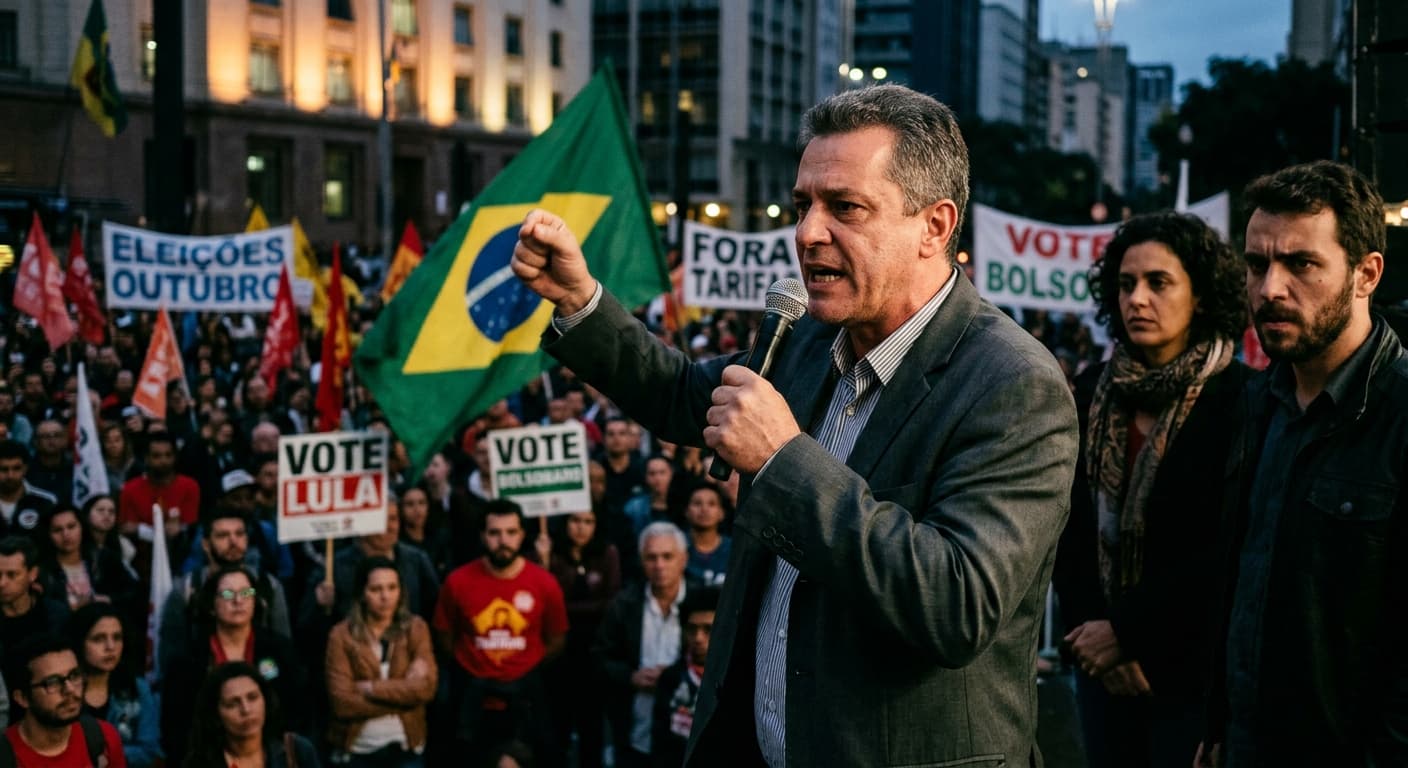
Now, with Brazil's presidential election three months away in October 2026, the tariffs land squarely in the middle of a campaign pitting incumbent Luiz Inácio Lula da Silva against Flavio Bolsonaro, the former president's son. Al Jazeera A Quaest poll found 47% of Brazilians agree with Lula's claim that the Bolsonaro family encouraged Washington to impose tariffs, while 35% believe Flavio Bolsonaro's counter-narrative that he tried to stop them. Secretary of State Marco Rubio publicly blamed Lula for the failure of negotiations, posting that the Brazilian president "has put his own ego ahead of making a deal for the welfare of the Brazilian people, and these tariffs are the price for that."
Al Jazeera
Brazil's Foreign Minister Mauro Vieira called Rubio's comments "unacceptable and offensive." The coordinated government response, led by Finance Minister Dario Durigan, was blunt: "We will continue without lowering our heads, without bending to foreign interests... We will continue protecting the Pix, protecting our geological sovereignty, and protecting our democracy against undue international interference." BBC News Brasil
Who Loses: Brazil's Manufactured-Goods Exporters
The exemptions tell a clear story about whose interests Washington was unwilling to harm. Brazil supplies over 50% of US pig iron consumption — exempt. Embraer is one of the world's top builders of commercial jets — aircraft and parts are exempt. Coffee prices are already up 12% year-over-year for US consumers — coffee is exempt, down to unflavored instant. Beef prices are up 11% — exempt. Al Jazeera The administration exempted goods that "could cause economy-wide disruptions" or "cannot be adequately produced or sourced domestically."
PIIE
The sectors that face the tariff are those without a domestic US political constituency powerful enough to demand exemption — or with a rival US industry that benefits from protection.
Shoes are the clearest case. Brazil is the largest footwear producer outside Asia and Europe. The US is the primary export market for Brazilian shoemakers. Abicalçados, the industry association, joined CNI, Fiesp, and Abimaq in warning the tariff "compromises the competitiveness of Brazilian products in their principal manufactured-goods market" and threatens investments and jobs. PEGN Professor Rodrigo Zeidan of NYU Shanghai noted that the hardest-hit firms are those producing specialized machinery, parts, and equipment — products far harder to redirect to alternative buyers than homogeneous commodities.
BBC News Brasil
The ethanol sector faces a specific, targeted penalty. The USTR investigation cited Brazil's 2017 decision to end balanced tariff treatment for ethanol and its failure to offer reciprocal market access since. But Brazil's ethanol tariff structure is set by Mercosur, the South American customs union — Brazil cannot legally grant the US unilateral concessions even if it wanted to. PIIE
The tariff also hits sugar, apparel, electrical machinery, granite, gold, and tires — a mix of industrial and consumer goods that employ significant numbers of Brazilian workers in sectors with limited short-term export diversification options.
What Brazil Can Do: The Reciprocity Law and the WTO Path
Brazil's response toolkit has three components, and the government has signaled it will use all three — carefully.
First, the Economic Reciprocity Law. Passed unanimously by Congress in April 2025 and regulated by presidential decree in July of the same year, it authorizes the government to impose counter-tariffs, suspend trade concessions or treaty obligations, and — in the most potent provision — suspend intellectual property obligations affecting sectors such as agriculture, pharmaceuticals, and technology. BBC News Brasil The law's text stresses that retaliation should "minimize the impact on economic activity and avoid excessive administrative costs" — a built-in brake on escalation. On July 20, the MDIC began a series of meetings with industry associations to assess impacts and structure support for affected companies.
PEGN
Second, the WTO. Brazil filed a consultation request with the World Trade Organization in August 2025 challenging the IEEPA-based tariffs, and has now indicated it will expand the case to cover the Section 301 actions. The US accepted consultations while reserving the position that national security matters are "not susceptible to review or capable of resolution by WTO dispute settlement." WTO documents The WTO path is slow — panels take years — but provides diplomatic cover and legal precedent.
Third, trade diversification. The numbers are already moving. Since the first US tariffs in 2025, China now absorbs roughly 37% of Brazil's total exports. Shipments to India are up more than 50%. The US share of Brazil's trade is at a record low. PIIE Apex, Brazil's trade promotion agency, has announced a R$130 million plan to further diversify export destinations.
PEGN
The Next Shoe: July 24
The 25% tariff is not the last word. Two further developments loom at the end of this week.
On July 24, a separate Section 301 investigation into forced-labor import policies concludes. USTR has proposed an additional 12.5% tariff on economies it found fail to enforce a ban on goods made with forced labor — and Brazil is among the 60 economies investigated. Congressional Research Service — IF11346 Stacked on top of the 25% tariff taking effect today, this would produce a combined 37.5% barrier — a figure remarkably close to the 50% IEEPA tariff the Supreme Court struck down.
PIIE
Also on July 24, the Section 122 10% global tariff imposed after the Supreme Court ruling is set to expire. Between July 22 and July 26, the effective rate on Brazilian goods reaches 18.17%, per Global Trade Alert — a four-day peak before the Section 122 rate drops. BBC News Brasil
Brazil's government, meanwhile, has announced the Plano Brasil Soberano as a domestic mitigation package, prioritizing credit access for small and medium exporters most exposed to the US market. PEGN
Diplomat View
The US-Brazil tariff escalation is not about trade balances — the US runs a growing surplus with Brazil. It is not about market access — the exemptions prove Washington will not harm its own consumers or strategic supply chains. It is about demonstrating that political alignment with Washington has a price, and disalignment has a higher one, three months before Brazilians vote.
The exemptions are the tell. The Trump administration protected American coffee drinkers, Gulf Coast refiners running on Brazilian crude, Embraer's US airline customers, and steel mills dependent on Brazilian pig iron. It left Brazilian shoemakers, garment workers, sugar producers, and machinery manufacturers — concentrated in electoral states like São Paulo and Rio Grande do Sul — to absorb the cost. The political signal is precise.
Brazil's room for maneuver is limited but real. The Reciprocity Law's IP suspension clause is the sharpest tool — it threatens pharmaceutical and technology patents that generate reliable income for US firms. Whether Brasília deploys it depends on whether the forced-labor tariff hits on July 24. A calibrated, limited retaliation is the most likely scenario — enough to demonstrate resolve without triggering the kind of escalation that would push the combined tariff toward 50%.
What to Watch
- July 24, 2026 — Two triggers on the same day: the forced-labor Section 301 determination (potential 12.5% add-on) and the expiration of the Section 122 10% base tariff. The net effective rate after both actions will signal whether Washington intends to escalate or stabilize.
- August 2026 — CAMEX, Brazil's foreign trade chamber, is expected to complete its 30-day analysis of reciprocity options. The scope of any retaliation — narrow or broad, tariffs or IP — will set the trajectory for the remainder of the year.
- October 2026 — Brazil's presidential election. If Lula converts the tariff into nationalist electoral advantage, the political logic of Trump's pressure campaign collapses. If Flavio Bolsonaro gains ground arguing Lula has isolated Brazil from its largest manufactured-goods market, the tariffs will have achieved their intended effect.
The Bottom Line
The bottom line: The 25% US tariff on Brazil is a political instrument dressed in trade-law clothing — and the exemptions prove it. Two-thirds of Brazilian exports are protected because Washington cannot afford to disrupt its own supply chains or consumer prices. The remaining third — shoes, ethanol, machinery, sugar — will bear the full cost, concentrated on Brazilian manufacturing workers whose hardship is meant to register at the ballot box in October. If the forced-labor tariff lands on July 24, the combined barrier will approach the punitive levels the Supreme Court already struck down once, and Brazil will face a choice between symbolic retaliation and a wider trade war it cannot win but may decide it cannot avoid.
Discover more

US Politics
House Ethics Committee Pushes Sexual Miscond.
The House Ethics Committee has shifted responsibility for sexual harassment settlement records to the Office of Congressional Workplace Rights, complicating disclosure efforts.

International Relations
Pakistan's Key Role in US-Israel-Iran Meddle
Pakistan is seeking to mediate the US-Israel-Iran conflict, balancing high-stakes diplomacy against severe economic pressures and steep regional challenges.

US Politics
SNAP Food Assistance Faces Legal Challenges
In 2026, SNAP faces stricter eligibility rules and mounting legal challenges, threatening food assistance for the millions of Americans who rely on the program.

Economics
Fed's Amex AML order puts correspondent banking on notice
Federal Reserve's Amex AML order requires board-level controls and a 90-day plan; OCC fined the bank $350 million over enterprise-wide deficiencies.