Tech Cold War: Trump-Xi Summit Fallout
The tech war escalates despite a summit truce.
Model Diplomat8 min readGlobal
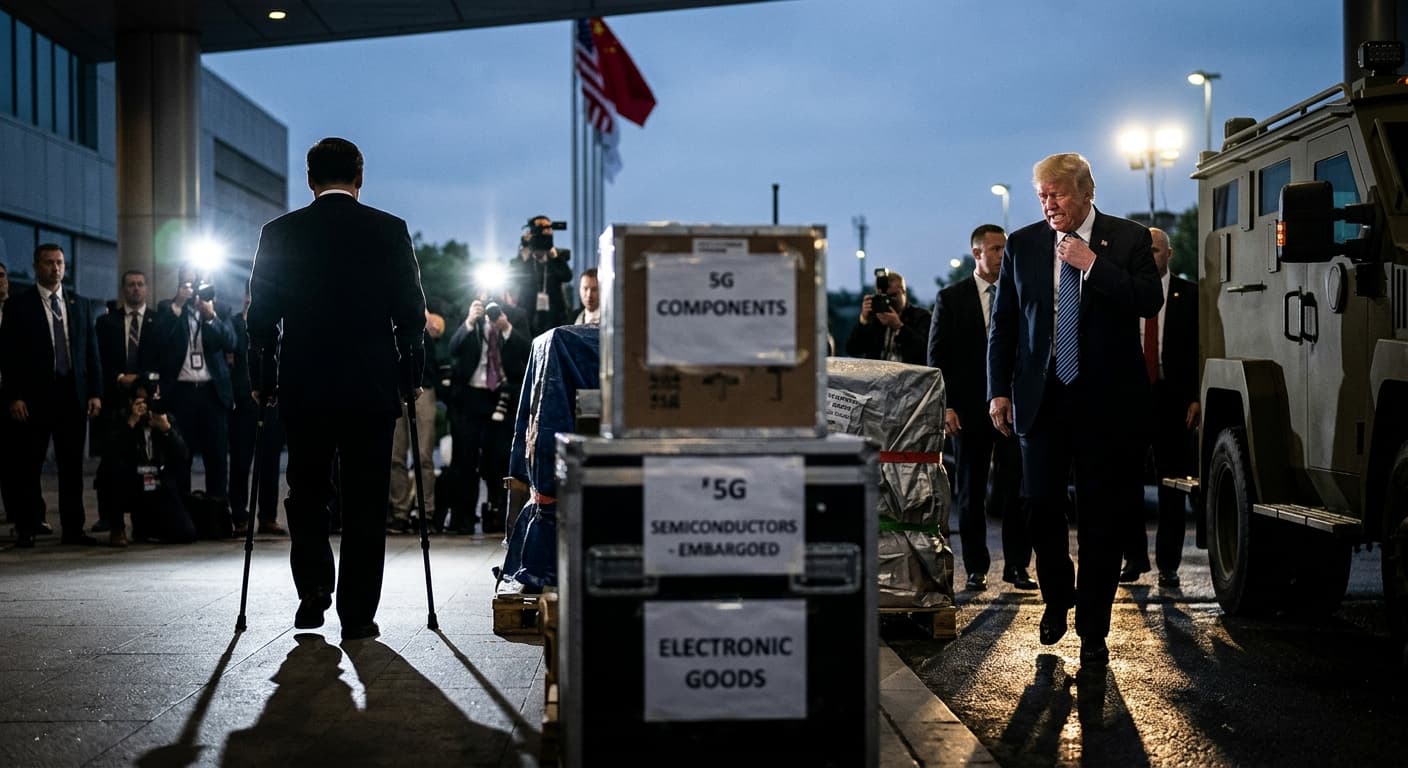
After Trump-Xi: The Tech Cold War the Leaders Couldn't Freeze
The Trump-Xi summit paused tariffs but not the tech war — semiconductor controls, AI model restrictions, cross-border antitrust and cyber attribution keep escalating.
Fifty-five days after Donald Trump left Zhongnanhai on May 15, 2026 with a handshake and a "constructive strategic stability" communique, the technology layer of the U.S.-China relationship has produced at least four distinct escalations that neither government has bothered to reconcile with the summit rhetoric. The truce Trump and Xi Jinping extended in Beijing was real, but narrow — a leaders-level ceasefire that sits above a floor of export controls, antitrust probes, model-weight restrictions and cyber operations that keeps giving way beneath it. The story after the summit is that Washington and Beijing have institutionalized their tech war to the point where their presidents can no longer freeze it, even when they publicly agree to try.
The clearest evidence sits in the calendar. On June 1, 2026, the U.S. Commerce Department issued guidance that its AI-chip ban covers Chinese firms operating outside China, closing a subsidiary loophole two weeks after the summit. On June 12, Commerce restricted Anthropic's frontier models Fable 5 and Mythos 5 under the Export Administration Regulations, forcing the company to
disable them worldwide pending license review — the first time model weights have been treated as controlled dual-use technology on a company-specific basis. On June 22, Beijing put 10 U.S. firms including rare-earth miner MP Materials on its export-control list and barred 46 U.S. defense-linked companies from government procurement, per
Al Jazeera. And Chinese customs, per
CSIS, quietly told importers in January 2026 that Nvidia H200 chips — the very chips Trump had personally cleared for export in December 2025 — were "not permitted" to enter China.
The summit that avoided the actual dispute
Read the two readouts side by side and the omission is the point. The U.S. side led with soybeans, 200 Boeing planes, 400 GE aerospace engines, and a Board of Trade; China led with Taiwan and the new "constructive strategic stability" phraseology, per Brookings' Patricia Kim. Neither mentioned semiconductors or AI. U.S. Trade Representative Jamieson Greer told Bloomberg TV, as
Al Jazeera reported, that chip export controls were "not a major topic of discussion." The BBC's
live coverage confirmed no announcement on AI or advanced semiconductors, despite Jensen Huang joining Trump on Air Force One from Anchorage and a delegation that included Tim Cook and Elon Musk.
The optics were built for a leaders-level truce, not a policy convergence. CSIS analysts Lauryn Williams and Kuhu Badgi note that Xi's team tabled a bilateral AI dialogue in the Chinese readout with no time frame — and no matching statement ever appeared from Washington. Asked afterward whether he raised cybersecurity with Xi, Trump said "I did. He talked about attacks that we did in China. You know, what they do, we do too." That is a sitting U.S. president publicly conceding cyber parity while his own intelligence community, in successive Annual Threat Assessments, still frames China as "the most active and persistent cyber threat actor" targeting U.S. infrastructure, per the
CSIS worldwide-threats readout.
The Foreign Affairs post-mortem catches the structural point: Chinese analysts once loathed the word "competition"; now they tolerate guardrails around it as long as those guardrails do not force real concessions. Beijing "used this to box us in and try to preclude the United States from taking further competitive actions," Ryan Hass and Jonathan Czin argue in the Brookings transcript, "things that we see as necessary for our own self-defense, whether that's export controls or Taiwan arms sales."
The chip loophole is closing on both sides
The bureaucratic gears reveal the truer trajectory. The Congressional Research Service, in its report on U.S. export controls and China, documents a decade of ratcheting: Foreign Direct Product Rule expansions, Entity List additions — 140 Chinese firms in December 2024 alone — and end-use controls on high-bandwidth memory and advanced packaging. The Trump administration reversed the Biden "AI Diffusion" framework in May 2025, then in December 2025 personally cleared Nvidia's H200 for Chinese buyers. Brookings' John Villasenor has
called that decision the end of the U.S. chip industry in China, because Beijing turned around and told domestic AI firms not to buy the chips.
That is the second-order effect the summit narrative obscures: China no longer wants the American chip it fought for the right to buy. The signal was the September 2025 antitrust action, when SAMR — days after Trump added 23 Chinese firms to the trade blacklist — issued a preliminary ruling that Nvidia had violated China's anti-monopoly law, per BBC. Chinese customs then instructed agents in January 2026 that H200s were "not permitted" to enter, and Chinese regulators told domestic tech firms to halt orders and buy Huawei Ascend or Alibaba's newly announced accelerator instead, per
BBC. A handful of licensed imports proceeded only so Beijing could benchmark the H200 against domestic silicon. The Trump administration's 25% tariff on H200 shipments — routed through Taiwan for tariff collection then re-exported to China, per
CSIS — turned the export control into a revenue mechanism, which some analysts flag as a fee-for-license arrangement of dubious legality.
On the U.S. side, the Senate NDAA passed on October 9, 2025 with the bipartisan GAIN AI Act amendment, which would give U.S. customers a right of first refusal before Nvidia or AMD can secure a China export license — resurrecting the core mechanic of the diffusion rule the same administration rescinded five months earlier. The Trump administration opposes it; a China-hawk coalition on both sides of the aisle is pushing it through. If the House concurs on the FY2026 conference report, the White House faces a veto choice on a bill it otherwise supports.
The named beneficiary of this stalemate is Huawei. The named loser is Nvidia: Villasenor reports U.S. chipmakers now hold zero market share in Chinese AI accelerators, down from dominance three years ago. Nvidia's China revenue share has fallen from roughly 15% to 13% and is now heading toward the floor of a market that Jensen Huang told podcasters in September 2025 China is "nanoseconds behind" on chip design, per BBC. The deeper Brookings insight from
the DeepSeek episode is that scarcity is fostering Chinese algorithmic efficiency the U.S. was not forced to develop.
The other three fronts nobody discussed
AI regulation was the summit's biggest invisible file. Commerce's June 12, 2026 letter to Anthropic — restricting Fable 5 and Mythos 5 to any foreign person under the EAR — is the first company-specific enforcement of AI model-weight controls, and CSIS notes Commerce cannot legally reinstate the broader diffusion rule for a single firm without new rulemaking. European politicians promptly cited the move as evidence of the need for sovereign European AI, an outcome that undercuts U.S. exportable model influence at the exact moment Chinese models — Zhipu, DeepSeek and Alibaba's Qwen family — are closing what CFR estimates is a seven-month U.S. lead.
Cross-border antitrust has become the mirror image of export controls. SAMR's Nvidia probe (opened December 2024, escalated September 2025) sits alongside a live Qualcomm investigation opened in response to Trump-era tariffs — Chinese antimonopoly law allows fines of 1% to 10% of prior-year annual sales, per
Al Jazeera. The June 22 Chinese Commerce Ministry order, which Cameron Johnson of Tidal Wave Solutions told Al Jazeera "mirrors U.S. semiconductor export controls" in its extraterritorial reach, applies to "foreign institutions and individuals worldwide" transferring Chinese dual-use goods. That is Beijing operationalizing the same Foreign Direct Product logic Washington pioneered — a mirror-image FDP rule now running against U.S. defense contractors including subsidiaries of Lockheed Martin, Boeing, General Atomics and General Dynamics.
Cyber operations were the front the summit most conspicuously buried. Volt Typhoon has, per CFR's cyber-operations tracker, maintained pre-positioned access to U.S. critical infrastructure since at least 2023. Salt Typhoon compromised at least eight U.S. telecom firms, stealing metadata on senior officials and both major-party presidential tickets, per
Al Jazeera. CSIS's
peer-competitor assessment notes that two years after the initial Salt Typhoon disclosure, the United States "cannot confidently assert that the actors have been booted out." Trump's on-camera concession of cyber parity was, in CSIS's reading, "a notable public concession for a sitting president" — and one that came without any reciprocal Chinese acknowledgment. Meanwhile, CISA staffing is being trimmed even as Senator Angus King and others press the administration on the rising threat, per the
Annual Threat Assessment hearing readout.
The historical parallel
The right analog for what came out of Beijing is not Nixon-in-China; it is the 1972-1979 U.S.-Soviet detente, where leaders-level agreements on strategic frameworks coexisted with an intelligence-community and defense-industrial competition that never paused. The equivalent of SALT here is the "constructive strategic stability" phrase and the Trade and Investment Boards, described by CFR's Ian Bremmer as vehicles for "non-strategic, non-sensitive" trade. The equivalent of Team B is CSIS and the China-hawk caucus around the GAIN AI Act, systematically documenting the gap between summit optics and technical reality. Detente lasted seven years before Afghanistan blew it up; the current version is calendared to be tested at four separate Trump-Xi engagements in 2026 alone, per CSIS's
state-of-play tracker.
What to watch next
- September 24, 2026: Xi visits the White House on the sidelines of UNGA, per Trump's May 14 state-dinner invitation. This is the first true test of whether the boards produce anything binding.
- July-August 2026: FY2026 NDAA conference report. If GAIN AI Act survives, Trump faces a veto choice that pits his personal chip-liberalization policy against a bipartisan congressional majority.
- November 2026: APEC leaders' meeting in Shenzhen. Watch whether Beijing lifts or extends the January 2026 targeted rare-earth controls on Japan, where CSIS reports Chinese exports of controlled products fell 43% and rare-earth shipments fell 78% in the first two months.
The Bottom Line
The Trump-Xi summit produced a genuine trade truce and a genuine tech ceasefire — but only at the presidential level, and only for as long as neither side's regulators move. They have already moved four times in the seven weeks since. What matters after Beijing is not the "constructive strategic stability" phraseology but the fact that both governments have built export-control, antitrust and cyber machinery that runs on autopilot, indifferent to leaders' handshakes. The forecast that would revise this thesis: a written, dated, sector-specific standstill agreement on chips and AI, signed by both commerce ministries, before Xi lands in Washington on September 24, 2026. Absent that, the tech war will keep escalating while the leaders keep meeting.
Discover more
US Politics
SNAP Food Assistance Faces Legal Challenges
In 2026, SNAP faces stricter eligibility rules and mounting legal challenges, threatening food assistance for the millions of Americans who rely on the program.
India
Congress Accuses Modi of Stalling Women's Law
Congress accuses Modi of stalling women's reservation law by linking it to delimitation, revealing a deeper electoral strategy.
Global Politics
Xi Jinping Calls China-Russia Ties 'Precious'
Xi Jinping's description of China-Russia ties as 'precious' reflects a strategic imbalance, with Beijing dictating terms in the partnership.
Economics
Fed's Amex AML order puts correspondent banking on notice
Federal Reserve's Amex AML order requires board-level controls and a 90-day plan; OCC fined the bank $350 million over enterprise-wide deficiencies.