Xi Jinping Calls China-Russia Ties 'Precious'
Exploring the implications of Xi's remarks on China-Russia relations.
Model Diplomat7 min readAsia
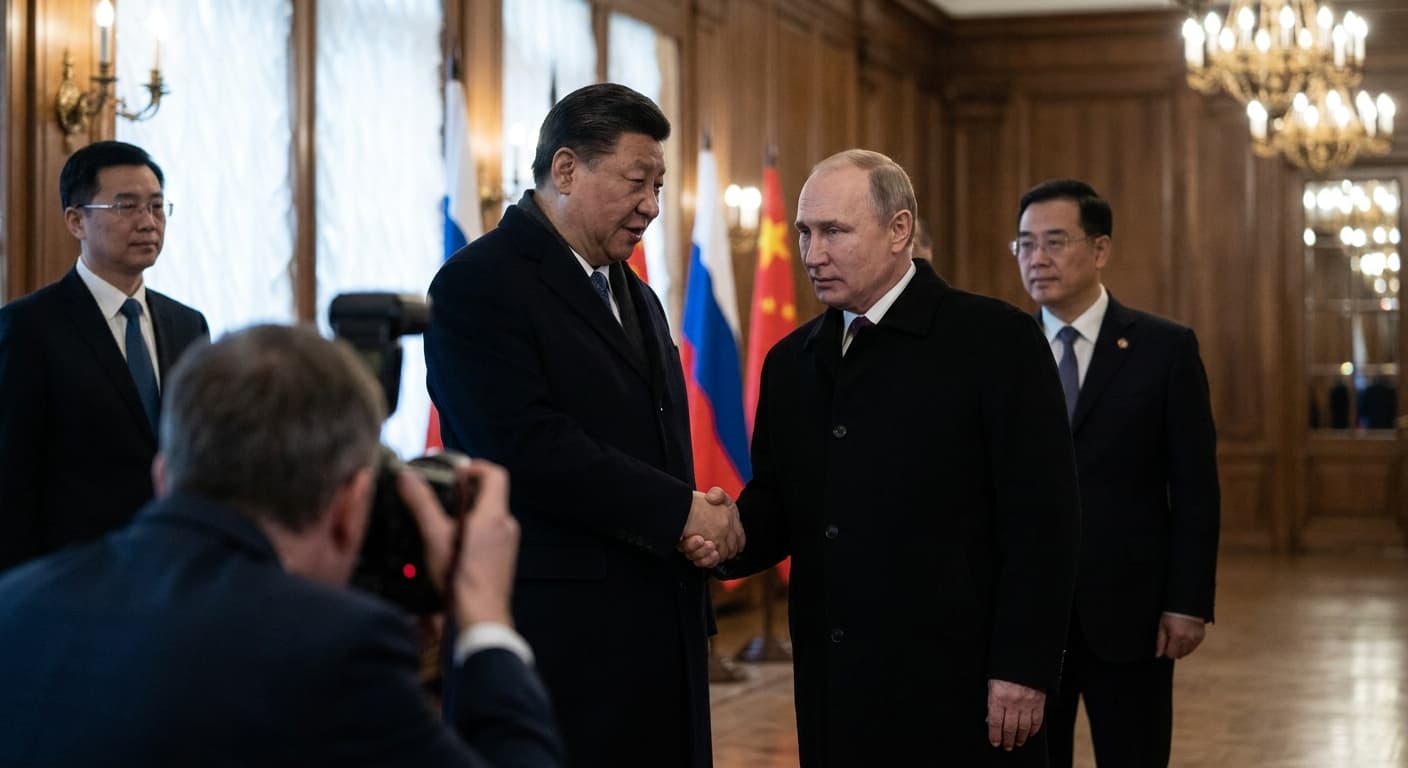
Xi Calls China-Russia Ties 'Precious' — What Beijing Really Meant
Xi Jinping's "precious" line to Lavrov reads like sentiment. It is closer to a price tag: Beijing setting the terms of an increasingly uneven partnership.
When Chinese President Xi Jinping told Russian Foreign Minister Sergey Lavrov in the Great Hall of the People on April 15, 2026, that the "stability and certainty" of China–Russia relations were "particularly precious," the phrase was reported as warmth. It is closer to a receipt. Five weeks later, Xi hosted Vladimir Putin and signed 42 documents — but not the Power of Siberia 2 gas contract Moscow needed. The word "precious" is doing the work "no limits" once did: signalling solidarity while Beijing quietly widens the leverage gap. The China–Russia partnership has never been closer, and never more asymmetric — and July 2026's joint naval drills are how Beijing keeps it that way without paying Moscow's asking price.
The setting: chaos as Beijing's talking point
The "precious" formulation was not a stray adjective. According to the Chinese foreign ministry's official readout, Xi told Lavrov that "facing an international landscape intertwined with change and chaos, the stability and certainty of China–Russia relations are especially precious, and the strong vitality and exemplary significance of the Treaty of Good-Neighborliness and Friendly Cooperation stand out more prominently." The readout also framed 2026 as a double anniversary — 30 years of the strategic partnership, 25 years of the 2001 treaty.
The context matters. Lavrov landed in Beijing on April 14, 2026, as the U.S.–Israel war on Iran was choking the Strait of Hormuz, through which China sources roughly a third of its oil, Al Jazeera reported. Lavrov used a post-meeting press conference to offer that Moscow could "compensate" for China's energy shortfalls. That is not the language of a peer. It is a supplier bidding for a customer's attention.
Foreign Minister Wang Yi, in his own meeting with Lavrov on April 14, offered the pairing's most revealing formula: China–Russia relations, he said, remain "unshaken by fleeting clouds," with cooperation "stronger through repeated trials." The two sides signed a 2026 foreign-ministry consultation plan and coordinated on the Ukraine war, the Iran conflict, and the Asia-Pacific.
The nut graf: why "precious" is not "no limits"
The rhetorical downgrade is the story. Since 2022's "friendship without limits" declaration, both sides have quietly avoided repeating the phrase, as India's Observer Research Foundation noted after Putin's May visit: using "no limits" would imply Chinese endorsement of the war in Ukraine, which Beijing does not want to give. "Precious" — 宝贵 in the Chinese readout — is warmer than "strategic partner" but colder than "ally." It flatters Moscow while committing Beijing to nothing new.
That distinction matters because the underlying balance has shifted sharply. Russia is now China's largest single supplier of crude oil, at 17.5% of imports in 2025 according to the South China Morning Post, and roughly 30% of Russia's foreign trade is now settled in yuan, per the
Mercator Institute for China Studies. But bilateral trade fell 6.9% in 2025 as oil prices sank, and Russia remains only about 4% of China's total trade — meaning Beijing can absorb pain from Moscow's disruptions far more easily than the reverse.
Carnegie's Alexander Gabuev put it bluntly to the BBC: "Russia is fully in China's pocket, and China can dictate the terms."
The receipt: what Putin didn't get in May
The Power of Siberia 2 pipeline is the tell. During Putin's May 19–20 visit, Al Jazeera reported that roughly 40 intergovernmental and corporate documents were signed, and the Kremlin claimed an "understanding" had been reached on the pipeline's route through Mongolia. But no contract was signed. In a scathing post-summit analysis, Carnegie's Tatiana Mitrova
wrote that "the more documents are signed at summits between Putin and his Chinese counterpart Xi Jinping, the more obvious it is that no significant breakthroughs have been made." Beijing, she argued, had judged that even the Hormuz blockade did not sufficiently strengthen Russia's hand to justify the 30-year take-or-pay terms Moscow wanted.
The reason is structural. China has spent the last decade building out LNG terminals, nuclear plants, hydro capacity and renewables at industrial scale; Beijing has not needed to draw down its 1.3–1.4 billion-barrel strategic oil reserves even during the Hormuz shock, according to Bruegel. The window for Russia to sell 50 billion cubic meters of gas per year to China on Gazprom's preferred terms is closing, not opening.
Who actually benefits from "precious"
The paradox of Xi's word choice is that it locks in the appearance of parity while cementing the reality of imbalance. Three parties benefit, in descending order:
Xi. Beijing gets a reliable oil supplier at a discount averaging 7.7% between April 2022 and February 2026 — worth about $18.3 billion in savings, per MERICS — plus a UN Security Council partner, an anti-U.S. rhetorical chorus, and a Eurasian land bridge that hedges against maritime chokepoints Washington could close. Xi pays for it with photo ops and non-binding language.
Putin. Moscow gets a market that took 108 million tonnes of Russian crude in 2024, according to MERICS — and a yuan-denominated trade system that has, per the Kremlin, insulated bilateral commerce "from external influence." What it does not get is a formal alliance, a Power of Siberia 2 contract on Russian terms, or Chinese diplomatic recognition of any territory seized in Ukraine.
The losers are the "wedge" strategists in Washington. President Donald Trump's team, according to Brookings analysts Fiona Hill and Patricia Kim on the July 7, 2026 Beijing Brief podcast, have been unable to drive daylight between Beijing and Moscow despite courting Putin over a Ukraine deal and hosting Xi in South Korea and Beijing. As the Council on Foreign Relations'
Hal Brands recently argued, sanctions on Russia have reoriented Moscow's economy toward China; freezing Russian reserves accelerated de-dollarisation; export controls on China pushed Beijing to lean on Russian energy. The tools designed to split the axis have thickened it.
The July 2026 signal: hardware, not just rhetoric
Words are cheap; steel is not. On July 5, 2026, China and Russia announced another round of the "Joint Sea" exercises, Al Jazeera reported — the fifteenth iteration of a drill series that began in 2012 and has expanded from close-in coastal exercises to submarine warfare, anti-missile defense and joint patrols in the Pacific. Last year's Joint Sea-2025 was staged near Vladivostok in the Sea of Japan; Japan's Ministry of Defense warned in its 2025 white paper that Sino-Russian military cooperation now poses "serious security concerns."
The drills are the closest thing to a formal alliance the two powers permit themselves. As the Center for Strategic and International Studies' ChinaPower project documents, exercises have grown in geographic scope, force complexity and command integration — all without a mutual-defense clause. That is exactly what Beijing prefers: interoperability without obligation.
What Xi actually told Lavrov, in his own words
The primary text is worth quoting in full. From the Chinese foreign ministry readout:
"Facing the great changes of a century, China and Russia should engage in closer and more effective strategic coordination, firmly defend the legitimate interests of both countries, safeguard the unity of the Global South, and demonstrate the responsibility of major countries and permanent members of the UN Security Council. The two sides should maintain strategic resolve, trust each other, support each other, develop together, and do their own things well."
Note what is not there: no reference to Ukraine, no reference to Iran by name, no promise of any specific new economic package, no commitment on Power of Siberia 2, no security guarantee. This is a script for a partnership that Beijing wants preserved but not upgraded.
Diplomat View
Xi's "precious" line is not the ceiling of the China–Russia relationship. It is the equilibrium Beijing prefers: warm enough to keep Moscow anchored, cool enough to avoid alliance liabilities, and vague enough to preserve the option of a deal with Washington if one materialises. The forecast: the partnership will keep deepening on China's terms, not Russia's, through the end of the 15th Five-Year Plan window in 2030. Watch three revision triggers. First, if Beijing signs a binding Power of Siberia 2 offtake before the Kyrgyzstan SCO summit later this year, the balance has tilted more toward Moscow than this analysis assumes. Second, if the U.S. brokers even a partial Ukraine ceasefire and Trump pivots to sanctions relief for Russia, Putin will have marginally more leverage over Xi than he does today. Third, if China begins to formally recognise Russian territorial claims in Ukraine — it has not — the partnership has crossed from "precious" to "no limits" for real. Absent any of those, the direction of travel is clear: Russia becomes more dependent, and Beijing pockets the discount.
What to watch next
- Kyrgyzstan SCO summit (H2 2026): Wang Yi told Lavrov both sides would use it to implement the Tianjin summit's Global Governance Initiative. The final communiqué will show how far the "Global South unity" line extends.
- Joint Sea 2026 exercises (summer/autumn): location and force composition will indicate whether the drills are drifting further into the Western Pacific — a direct signal to Tokyo and Washington.
- Power of Siberia 2 contract: Russian officials from Deputy PM Alexander Novak claim progress; Peskov concedes no timeline. Any signing before year-end would revise the current asymmetry.
- Trump–Xi follow-up (post-October): the U.S. president's next contact with Xi will test whether Washington's tariff-and-tariff pressure model can extract concessions on Russia. So far, per Brookings, it has not.
The Bottom Line
The bottom line: Xi called the relationship "precious" precisely because it is now priceless in one direction and cheap in the other — China gets discounted oil, a yuan-denominated hinterland, a UN Security Council partner and a Eurasian buffer, while Russia gets rhetoric and a market. The next data point that would change this forecast is a signed Power of Siberia 2 contract on Gazprom's terms. Until then, the "precious" partnership is exactly what Beijing wants it to be: strong enough to worry Washington, weak enough to disappoint Moscow, and entirely under Xi's control.
Discover more

Global Politics
China's New Strategy for Taiwan and Japan
China softened its stance on Taiwan and Japan, eyeing the 2028 election and regional stability as Middle East turmoil reshapes its geopolitical calculations.

US Politics
Global Economic Challenges
Inflation, rising interest rates, and surging defense spending are straining the global economy, complicating IMF and World Bank efforts to sustain recovery.

Global Politics
Duchess of Sussex's Australia Visit
The Duchess of Sussex's Australia visit spotlights shifting soft power in the Asia Pacific, centering youth mental health and cross-cultural influence.

Economics
Fed's Amex AML order puts correspondent banking on notice
Federal Reserve's Amex AML order requires board-level controls and a 90-day plan; OCC fined the bank $350 million over enterprise-wide deficiencies.