South Korea-Mongolia CEPA: Tariff Wins
New trade agreement offers mixed benefits for minerals and consumer goods.
Model Diplomat5 min readAsia
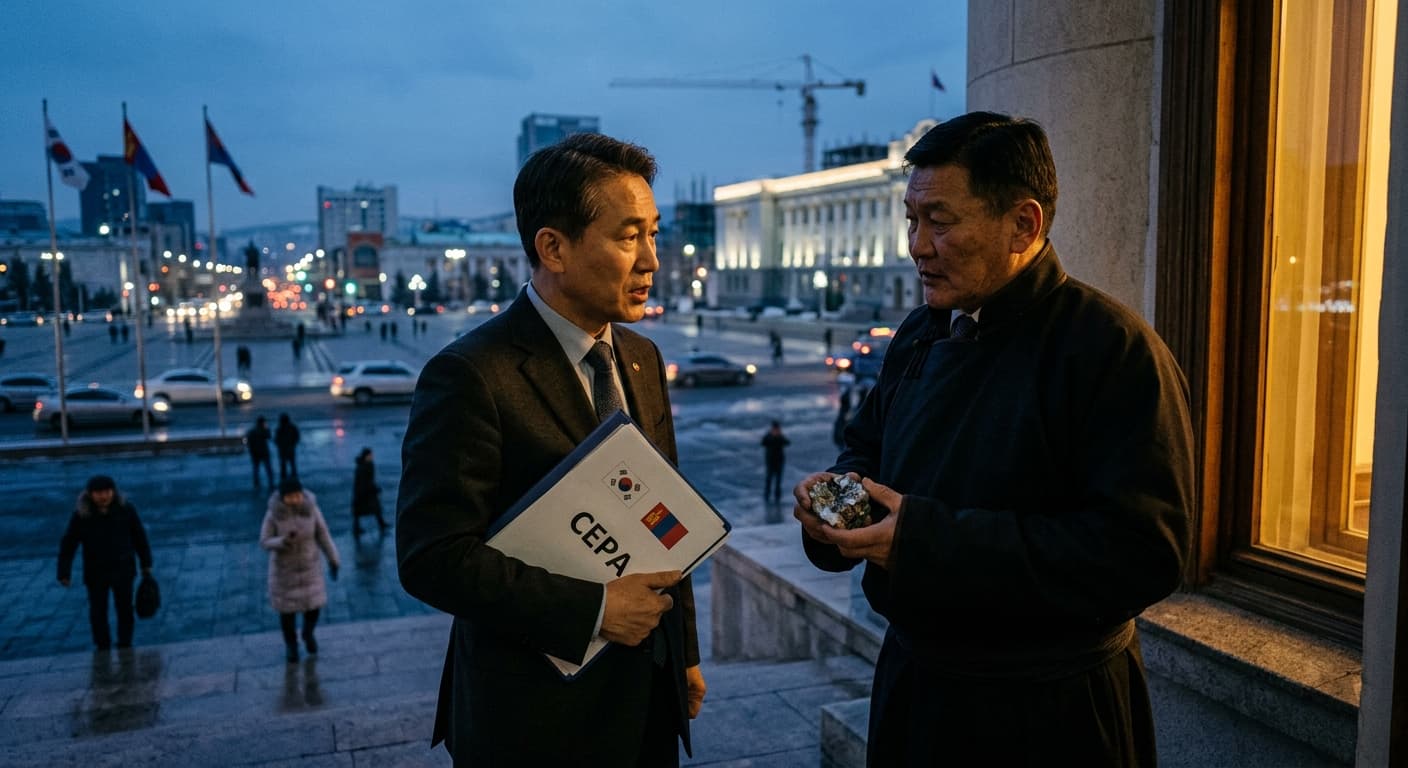
South Korea and Mongolia reached an agreement in principle on a Comprehensive Economic Partnership Agreement on July 9, during President Lee Jae Myung's state visit to Ulaanbaatar — a deal that offers Seoul real tariff wins on cosmetics and ramyun but only symbolic progress on the critical-minerals problem it actually needs to solve. The CEPA is one prong of a much broader diplomatic push. Since taking office in mid-2025, Lee has held summits with Xi Jinping in Beijing in January 2026, Takaichi in Nara, Modi in New Delhi in April 2026, and Trump in Gyeongju in October 2025. Under the Trump deal — the "Korea Strategic Trade and Investment" package — Seoul committed $350 billion in U.S. investment including $7.4 billion via Korea Zinc for critical-minerals processing capacity in Tennessee, according to a joint fact sheet from The White House. Seoul also chairs the Forum on Resource Geostrategic Engagement (FORGE), the successor to the Minerals Security Partnership, until June 2026, per
CSIS. Mongolia is now a target country for that architecture — which makes the CEPA's mineral chapter the drafting fight that matters most.
The Chinese transit problem no CEPA can fix
Here is where the enthusiasm gets a reality check. Mongolia is landlocked. Its two neighbours — Russia and China — are its only two transit options. According to a UN OHRLLS report by Jamie Macleod, China accounted for over 90% of Mongolian exports in 2023, and 88% of Mongolia's minerals leave the country unprocessed, per an
ISPI analysis by Bulgan Batdorj. The Gashuunsukhait–Ganqimaodu crossing into Inner Mongolia handles more than 55% of copper concentrate and over 50% of coal exports — a single node in a single neighbouring country.
The KIEP itself concedes the constraint bluntly in a manuscript by Song Baek-hoon and colleagues: "exports to Korea currently depend entirely on transportation through China by land and sea," according to KIEP research. Even where Ulaanbaatar wants to diversify to "third neighbours," its geography dictates otherwise. The 2023 U.S.–Mongolia "Open Skies" agreement offered air cargo as an alternative — useful for small volumes of processed rare earths, useless for bulk copper concentrate.
The infrastructure gap compounds the political one. A 2023 assessment by the German Federal Institute for Geosciences and Natural Resources concluded that Mongolia's rare-earth deposits are all at an early exploration stage and would face significant cost disadvantages versus Chinese and Burmese ore, per the European Parliament briefing by Gisela Grieger. China alone controls roughly 90% of global rare-earth processing capacity, according to CSIS. Digging Mongolian ore does not solve Korea's midstream problem; it just moves the choke point one step upstream.
Japan signed its Economic Partnership Agreement with Mongolia in 2016 — a decade before Korea — and elevated ties to a Special Strategic Partnership in 2022; it is Ulaanbaatar's largest bilateral aid donor with explicit commitments on copper, REEs and processing capacity, according to a CSIS blog by Amelia Lee Zhi Yi and Sneha Nair. Japan sourced 66% of its REEs from China in 2025, down from 93% in 2009 — proof that diversification moves a needle only over 15 years. Korea's CEPA enters that same slow race a decade behind.
Who actually benefits
The consumer-goods win is real; the mineral win is symbolic. Korean cosmetics conglomerates — LG H&H, Amorepacific — and food exporters like Nongshim (ramyun) and Ottogi (seasoned laver) get immediate, quantifiable tariff relief in a fast-growing 3.5-million-person consumer market. Mongolia was already the top single export destination for Korean floor and shoe polishes in 2024 at $649,000, World Bank WITS data show — the CEPA scales that. Retail giants Lotte and Shinsegae signed MOUs on distribution,
The Herald Business reported.
On the mineral side, the practical winners are process-development players — KOMIR, KIGAM, KIAT and Korea Zinc — who gain preferential legal standing and the political cover to pursue joint exploration and processing joint ventures. But the pace will be measured in years, not quarters. As a KIEP working paper by Wonseok Choi argues, Korea's MOU-heavy critical-minerals diplomacy still lacks enforceable disciplines on export restrictions, investor protection, and technical-workforce mobility — the "three pillars" needed to turn political declarations into supply-chain resilience. Whether the CEPA text ultimately contains a minerals chapter with enforceable disciplines is the drafting fight that determines whether this deal is remembered as a supply-chain milestone or a photo-op.
Beijing is the quiet loser, but only marginally. China buys the vast majority of Mongolian minerals, provides transit, and controls midstream processing. A Korean CEPA does not dent that structural position; at most it introduces a fractional demand competitor at the mine gate. Russia is functionally indifferent — the CEPA does not touch the Power of Siberia 2 pipeline, which would still run through Mongolia to China. As the ISPI analysis notes, Ulaanbaatar's "third neighbour" diplomacy operates within, not against, its neighbour-dependence.
Forward look
- Working-level CEPA text. Korean and Mongolian negotiators must close chapters on rules of origin, an investment framework, and — critically — a minerals-specific annex. A signing target in Q4 2026 or H1 2027 is the baseline; anything slower signals the mineral chapter is contested.
- Erdenes Critical Minerals JSC. Mongolia in 2025 rebranded Mongolrostsvetmet as Erdenes Critical Minerals with an expanded mandate for REE exploration and extraction, per ISPI. The next equity or offtake tender by Erdenes is the concrete test of whether Korean firms — versus Chinese, Japanese or Western — can win project-level access.
- FORGE handover. Korea's chairmanship of the Forum on Resource Geostrategic Engagement expires in June 2026. Whether Seoul uses its final weeks to sponsor Mongolia's formal accession, or a Korea–Mongolia sectoral working group under FORGE, will indicate how far the CEPA feeds the broader minerals bloc.
- Alternative-transit pilots. Any concrete progress on air-cargo routing of processed rare earths, or on a Mongolia–Russia–Vladivostok mineral corridor bypassing China, would be the first material dent in the transit problem. Neither option has a funded project or a government commitment behind it as of July 2026.
Discover more

US Politics
SNAP Food Assistance Faces Legal Challenges
In 2026, SNAP faces stricter eligibility rules and mounting legal challenges, threatening food assistance for the millions of Americans who rely on the program.
Global Politics
Trump's Conflicting Messages on Iran War
Trump's mixed messages on Iran reflect a strategy of audience management, benefiting Tehran amid a complex geopolitical landscape.

US Politics
House Ethics Committee Pushes Sexual Miscond.
The House Ethics Committee has shifted responsibility for sexual harassment settlement records to the Office of Congressional Workplace Rights, complicating disclosure efforts.

Economics
Fed's Amex AML order puts correspondent banking on notice
Federal Reserve's Amex AML order requires board-level controls and a 90-day plan; OCC fined the bank $350 million over enterprise-wide deficiencies.