Quad's $20B Bet on Critical Minerals
Aiming to break China's grip on rare-earth refining
Model Diplomat8 min readAsia-Pacific
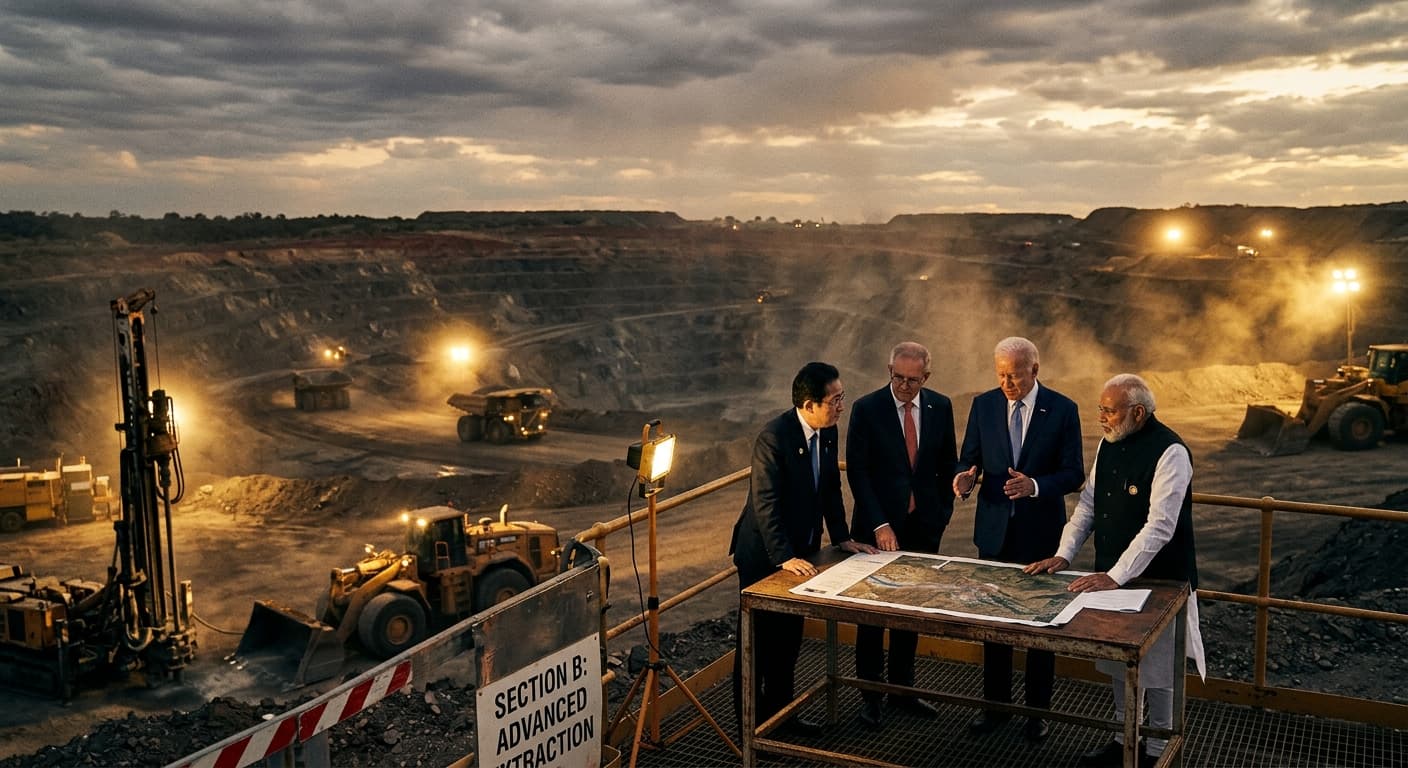
Quad's $20B Critical Minerals Bet Aims at China's Chokehold
The Quad's May 2026 framework mobilises $20 billion to break China's 90% grip on rare-earth refining. A new USSC playbook shows why execution — not capital — is the binding constraint.
The United States, Japan, Australia and India have 16 months to prove that a $20 billion joint bet on critical minerals can move faster than China's expiring export-licence regime — and a policy blueprint published July 8, 2026 by the University of Sydney's United States Studies Centre argues the binding constraint is not capital but coordination. The Quad Critical Minerals Initiative Framework, signed by foreign ministers in New Delhi on May 26, 2026, is the clearest attempt yet by the world's four biggest non-Chinese economies to build a parallel processing industry before Beijing's second wave of rare-earth export controls — suspended only until November 10, 2026 — becomes the permanent architecture of the clean-energy economy. The winner from that bet, if it lands, is unlikely to be American. It is Australian refiners and Japanese magnet-makers, funded largely by US public balance sheets, selling into Indian demand.
The chokepoint that forced the deal
China mines about 69% of the world's rare-earth ore, refines roughly 90% of it, and produces 93% of the neodymium-iron-boron permanent magnets that go into every electric motor, guided missile and wind turbine, according to the Swedish Institute of International Affairs. For heavy rare earths — the dysprosium and terbium that keep magnets stable at high temperatures — the
Center for Strategic and International Studies puts China's processing share at 99%. Chinese firms control not just capacity but the technology: Beijing banned the export of rare-earth processing and refining know-how in December 2023, according to a
Congressional Research Service filing.
That dominance stopped being theoretical on April 4, 2025, when Beijing imposed licensing requirements on seven heavy rare earths in retaliation for President Trump's "Liberation Day" tariffs. A second wave on October 9, 2025 extended controls extraterritorially to any foreign-made magnet containing 0.1% or more of Chinese-sourced material, according to the European Parliamentary Research Service. Ford halted Explorer production that spring for lack of magnets,
CSIS noted. Gallium prices in Europe rose 365%. Antimony spiked 437%. The Uppsala data set describing those spikes captures why Quad ministers moved from communiqués to capital deployment inside seven months.
Beijing suspended the second wave on November 7, 2025 as part of a trade truce, but suspension is not repeal. Licences remain opaque and slow, and Chatham House warned in October 2025 that the new rules require licences even for the technical expertise used to process ores — a control regime with no precedent, aimed at freezing rival supply chains before they can be built, according to Chatham House.
What the framework actually does
Read closely, the framework is not a fund. It is a permission structure. It authorises four governments to co-invest in projects with a "Quad nexus" — meaning any project located in, owned by, or supplying a Quad country — and to coordinate "price mechanisms" against non-market practices. The official State Department text commits partners to mobilise "up to $20 billion in government and private sector support" through export credit agencies, development finance institutions, guarantees, loans, equity, subsidies and offtake agreements — essentially the full industrial-policy toolkit.
That last phrase — "price mechanisms" — is the operative one. It gives the Quad legal cover to build the price-floor architecture that US Vice President JD Vance previewed on February 4, 2026, when he told a Washington summit that the United States would underwrite prices to stop Chinese oversupply from bankrupting Western miners, according to Al Jazeera. The Pentagon has already run this playbook once: in July 2025 the Department of Defense took a $400 million equity stake in MP Materials and guaranteed Mountain Pass a floor of $110 per kilogram of neodymium-praseodymium for ten years,
BBC News reported.
On February 2, 2026 the White House layered on Project Vault — a $12 billion Strategic Critical Minerals Reserve funded by the largest loan in the 92-year history of the US Export-Import Bank, CSIS confirmed. The Peterson Institute has warned that voluntary participation could hollow out the risk pool and that stockpiles of processed materials will, in the near term, still depend on Chinese suppliers, according to
PIIE. That is the paradox the Quad framework must solve: no reserve is credible without processing capacity, and no processing capacity is bankable without price floors and offtake.
Where each partner actually adds value
The USSC report frames the CMI as a comparative-advantage play, and the geography is unforgiving. Australia has the ore and, increasingly, the mid-stream. The federal government has loaned Iluka Resources A$1.65 billion to build the Eneabba refinery in Western Australia, which the company says will supply "a significant proportion of Western demand for rare earths by 2030," according to BBC News. Lynas — the only company producing separated rare-earth oxides at commercial scale outside China — added commercial dysprosium output in May 2025 and had its Malaysian licence renewed for ten years in March 2026, though under stricter waste conditions,
Asia Pacific Foundation of Canada reported.
The United States brings capital and demand but very little mine-to-magnet capacity: MP Materials is on track for 1,000 metric tons of NdFeB magnets in 2025 — under 1% of what China produced in 2018 alone, CSIS noted. Japan brings offtake finance and magnet know-how, honed since its own 2010 shock when Beijing throttled exports over the Senkaku dispute. India brings the world's third-largest rare-earth reserves — an estimated 6.9 million tonnes — but almost no separation capacity, and imported 93% of its rare-earth magnets from China in FY2024-25, according to the
Vivekananda International Foundation. New Delhi approved a ₹16,300 crore National Critical Mineral Mission on January 29, 2025,
Press Information Bureau confirmed, and used its 2026-27 budget to create dedicated rare-earth corridors in Odisha, Kerala, Andhra Pradesh and Tamil Nadu,
Al Jazeera reported.
The historical parallel — and why this time is different
The 2010 Senkaku episode is the analogue. When Beijing cut rare-earth exports to Japan over a fishing-boat collision, prices spiked as much as 26-fold and Japan responded by financing Lynas's original Malaysian plant. That model — Japanese offtake, Australian ore, Malaysian labour — is what the Quad is trying to industrialise 15 years later, but at a scale two orders of magnitude larger. What's different is the extraterritoriality: the October 2025 licence regime reaches downstream products made anywhere on earth. Chatham House warns this means the West must build not just alternative mines but entire alternative processing networks beyond Chinese ownership and control.
The other break with 2010 is the coordination problem. The USSC's April 2026 companion brief called the collective effort a "wicked" problem, noting that even among ten like-minded countries meeting in Australia that month, "coordinating minerals policies" remained "out of reach," according to the United States Studies Centre. Its proposed remedy — a Quad "mineral fusion centre" modelled on Indo-Pacific maritime domain-awareness hubs in India, Singapore and Vanuatu — is the kind of low-cost, high-leverage institution the July 8, 2026 report says must underpin the $20 billion commitment. Without shared intelligence on where Chinese subsidies are distorting which price signals, government money will fund projects that go bankrupt the day Beijing lifts its next restriction.
Who wins, who loses
The dollar flows suggest the political economy. Washington is the primary financier — Project Vault, MP Materials, the DFC and EXIM — but the productive capacity is being built in Australia, Malaysia and, on paper, India. The Observer Research Foundation captures the trade-off bluntly: for the United States, locking India into a Quad-nexus supply chain is "a long-term strategic move…to prevent it from gaining significant market share and being able to exercise market dominance in the same way the Chinese have done." That is a candid admission that friendshoring is also market-share management.
The losers are more diffuse. European manufacturers, absent from the Quad architecture, face the same Chinese chokehold with none of the coordinated price support; the European Parliamentary Research Service has already flagged the vulnerability. Chinese state-linked firms lose optionality: Shenghe Resources, which had been MP Materials' largest non-US shareholder and sole offtaker, was displaced when Washington took its equity stake, according to
BBC News. And Southeast Asian countries — the Philippines, Indonesia, Vietnam — that had hoped to slot into Chinese-financed processing hubs must now choose sides or accept second-tier status behind the Quad-nexus definition.
The most fragile relationship is US-India. Trump's 2025 tariff pressure and the "growing closeness with Pakistan" have opened what Milan Vaishnav of the Carnegie Endowment called a "serious trust deficit," Al Jazeera reported ahead of Secretary Rubio's May 2026 New Delhi visit. The Quad Leaders' Summit that India was to host in 2025 never happened. If the CMI does not deliver visible Indian upside — corridors funded, offtake secured, refineries commissioned — before the January 2027 outcomes report, the framework will read like a US industrial-policy vehicle wearing a Quad label.
Diplomat View
The Quad Critical Minerals Initiative Framework is a serious instrument, but it is not yet a working supply chain. The $20 billion figure is a ceiling of intent, not a fund; the real work is regulatory alignment, offtake stitching and price floors that can survive a Chinese decision to flood the market the moment Western capacity comes online. Our forecast: expect the Quad to deliver two or three flagship projects — likely Iluka's Eneabba refinery, MP Materials' heavy-REE expansion, and a Japan-financed Indian magnet plant — but to miss the mine-to-magnet timeline the Pentagon set for 2027. The forecast changes if two conditions are met: first, the USSC-proposed mineral fusion centre is stood up before the October 2026 workshop and starts publishing coordinated supply-risk assessments; second, Washington and New Delhi resolve the tariff overhang enough to hold a Quad Leaders' Summit before year-end. Absent both, the initiative will resemble the Minerals Security Partnership — sound principles, thin outcomes.
What to watch next
- October 2026 — USSC's second Quad Track-1.5 workshop and expected release of a coordination architecture (fusion centre, buyer's club).
- November 10, 2026 — Chinese suspension of the second-wave rare-earth export controls expires; renewal or expansion would test Quad resolve.
- January 2027 — Final USSC outcomes report to the US State Department, and Pentagon deadline for a complete "mine-to-magnet" REE supply chain.
The Bottom Line
The Quad's $20 billion critical-minerals framework is not primarily about ore — it is about whether four democracies can build a parallel industrial architecture faster than Beijing can adjust its export-control dial. The framework's success will be judged not on capital pledged but on refineries commissioned, offtake locked, and price floors held when Chinese supply returns. If it works, the model that emerges — American capital, Australian metal, Japanese engineering, Indian demand — will be the template for every strategic-materials contest of the next decade.
Discover more

US Politics
SNAP Food Assistance Faces Legal Challenges
In 2026, SNAP faces stricter eligibility rules and mounting legal challenges, threatening food assistance for the millions of Americans who rely on the program.
US Politics
House Ethics Committee Pushes Sexual Miscond.
The House Ethics Committee has shifted responsibility for sexual harassment settlement records to the Office of Congressional Workplace Rights, complicating disclosure efforts.
India
700 Activists Accuse PM Modi of MCC Breach
Over 700 activists allege PM Modi breached election code with a televised address attacking opposition parties just before state elections.

Conflict & Security
Drone Warfare Killing Aid Workers at Unprec
Over 1,000 humanitarian workers killed in three years as cheap armed drones collapse legal protections. Gaza, Sudan, Ukraine, and DRC see deliberate targeting of aid convoys and hospitals with zero prosecutions.