Modi's Jakarta Pacts Redraw Southeast Asia's
India and Indonesia's agreements reshape regional security dynamics.
Model Diplomat8 min readSoutheast Asia
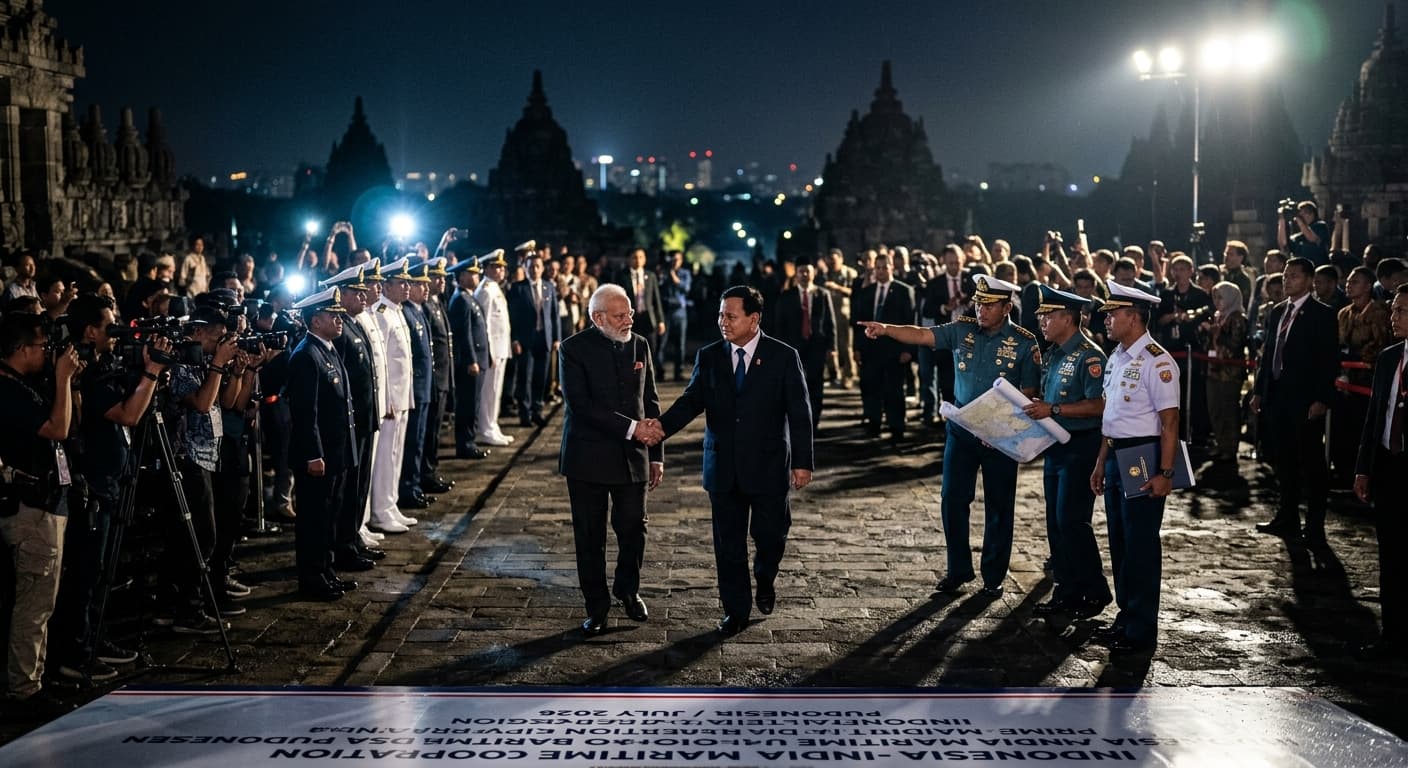
Modi's Jakarta Pacts Redraw Southeast Asia's Security Map
India and Indonesia signed 20 agreements on July 6–8, 2026 — the BrahMOS expansion, Sabang port and rare-earth deals reshape the Malacca chokepoint and dilute China's leverage over ASEAN's biggest economy.
Prime Minister Narendra Modi's state visit to Jakarta from July 6–8, 2026 produced 20 bilateral agreements, but only three of them matter for regional power: an expanded BrahMOS supersonic missile deal, a joint-development pact for the deep-water port at Sabang, and a critical-minerals MoU that hands Indian firms a stake in Indonesia's nickel and rare-earth chain. Taken together they convert a long-underperforming "comprehensive strategic partnership" into something more consequential — a coordinated Indian-Indonesian grip on the northwestern approach to the Malacca Strait and a first serious dent in China's monopoly over Indonesia's downstream minerals sector. The joint statement issued by India's Ministry of External Affairs on July 8 formalises the shift; Beijing's Southeast Asian periphery just got narrower.
What was actually signed
The India-Indonesia Joint Statement published by India's Ministry of External Affairs runs across defence, maritime security, digital economy, critical minerals, health, tourism and cultural restoration — including Indian assistance for the Prambanan Hindu temple complex. President Prabowo Subianto conferred on Modi the Bintang Republik Indonesia Adipurna, Indonesia's highest civilian honour, according to reporting by
Open magazine.
The defence deliverables are the load-bearing ones. Indonesia will expand its use of the Indian-Russian BrahMOS supersonic cruise missile — a system for which the Observer Research Foundation reported Jakarta was negotiating a US$450 million contract, making Indonesia the third BrahMOS customer in Southeast Asia after the Philippines' 2022 US$374 million deal and Vietnam's reported US$700 million package. Indonesia will also integrate India's indigenous Astra Beyond-Visual-Range Air-to-Air Missile onto its Sukhoi Su-30 fleet, according to
The Indian News. And the two sides signed a joint-development framework for the port of Sabang in Aceh — an idea first floated during Modi's 2018 visit but which, as Manohar Parrikar IDSA analyst Abhay Kumar Singh notes in a 2026
monograph on India's Act East Policy, has spent eight years mired in implementation delays.

Why Sabang is the pivot, not the ports headline
Sabang, at the northern tip of Sumatra, sits roughly 90–100 nautical miles from India's Great Nicobar Island and directly astride the northwestern mouth of the Malacca Strait — the maritime chokepoint through which China imports the bulk of its Middle Eastern oil. The Institute of Peace and Conflict Studies has described the port as better suited to strategic than commercial use: deep enough for submarines, small enough that heavy container traffic is uneconomic, close enough to India's Andaman Command that it functions as a natural forward operating node for the Indian Navy in the Andaman Sea.
The 2026 agreement moves Sabang from aspirational to contractual. According to the Manohar Parrikar IDSA, Indonesia's earlier hesitations were rooted in domestic sensitivities about foreign military footprints; the joint-development framing — Indian investment in the port complex plus an economic zone — preserves Indonesian sovereignty while giving India the logistics access it has sought since 2018. A Global Times editorial cited by IPCS warned years ago of "disastrous consequences" if India developed Sabang into a strategic base. The euphemism is now moot.
The BrahMOS piece amplifies this. As ORF's analysis of the missile's Southeast Asian diffusion argues, the export of BrahMOS to Manila, Hanoi and now Jakarta lets three claimant or near-claimant states in the South China Sea deploy their own anti-access/area-denial capability against Chinese naval movements. The Carnegie Endowment's Rajeswari Pillai Rajagopalan has framed the logic bluntly: supplying anti-ship missiles to Southeast Asian claimants "helps ensure that smaller countries can also employ their own A2AD strategies against China," per an earlier
ORF assessment. Indonesia is not a South China Sea claimant, but its Natuna EEZ has been the site of repeated Chinese Coast Guard incursions since 2019, documented at length by the
ISEAS-Yusof Ishak Institute.
The critical-minerals angle everyone else missed
The under-covered deliverable is the minerals MoU. Indonesia produces roughly half the world's mined nickel and, since Jakarta's 2020 export ban on unprocessed ore, its downstream refining capacity has been built almost entirely with Chinese capital. That concentration is what the new Indian framework attacks. Under the MoU, India — which is subsidising 50 GWh of domestic battery-cell manufacturing under its Production Linked Incentive scheme — gains a preferential lane into Indonesian nickel and joint investment in rare-earth magnet plants on Indonesian soil, according to an ORF analysis of the emerging India-Indonesia EV value chain.
For Prabowo, this is not sentimentality. It is portfolio hedging. As Clingendael and CSIS Indonesia argued in an April 2026 joint policy brief, Prabowo is running a strategy of "institutional diversification" — full BRICS membership since January 2025, OECD accession in parallel, a new UK strategic partnership signed on
21 January 2026, and a reciprocal trade agreement with the Trump administration
confirmed on 19 February 2026. India is the piece that lets Jakarta rebalance a nickel sector that has become uncomfortably dependent on a single financier.
Trade: the number that has to move
The economic architecture is real but the trade base is still thin. According to the Indian MEA's bilateral brief, two-way merchandise trade reached US$29.40 billion in 2023–24 — impressive, but skewed heavily toward Indonesian coal and palm oil going west. Gateway House's Rajiv Bhatia, a former Indian ambassador in Jakarta, argues the target is
US$50 billion in the near term; NUS-ISAS suggests the two economies could plausibly aim at
US$80–100 billion by 2030 if the ASEAN-India Trade in Goods Agreement is upgraded and services trade is unlocked.
The July 2026 package includes the plumbing for that: an India-Indonesia Joint Economic and Financial Dialogue, an ION digital-commerce network modelled on India's Open Network for Digital Commerce, and exploratory work on UPI cross-border payments. India will also assist Indonesia in developing Electronic Voting Machines for the country's 2029 general election — a technology transfer that binds Indonesia's electoral infrastructure to Indian systems for at least a decade, and one with no precedent in the region.
Who gains, who loses
The clear beneficiary is Prabowo's active-non-alignment doctrine. In an assessment for the Australian Institute of International Affairs, analyst Akhmad Hanan describes Indonesia's current posture as multi-alignment as strategy — trading with BRICS, acceding to the OECD, doing a Trump deal, buying Indian missiles, keeping the Russian Su-35 option open. India's offer is uniquely suited to this menu: strategic weight without treaty entanglements, capital without Chinese-scale conditionality, and a shared Bandung-era diplomatic vocabulary.
The clearest losers are two. China loses the near-monopoly on Indonesia's nickel downstream and gains a fresh BrahMOS battery within striking range of shipping through Malacca. Russia loses market share in a defence relationship it had begun rebuilding — Prabowo signed a strategic partnership declaration with Vladimir Putin in June 2025, per an ORF assessment, but the Astra integration onto Indonesian Su-30s substitutes Indian for Russian air-to-air missile stocks on a Russian-built platform. That is a small but pointed reversal.
The United States is a quiet net winner. Washington's Indo-Pacific strategy has for a decade sought exactly this outcome: a Southeast Asian anchor building its own deterrent capability, tied to a like-minded regional partner, without an American security guarantee that would trigger domestic political blowback in Jakarta. The Trump administration's February 2026 reciprocal trade deal with Indonesia sits comfortably alongside a stronger India-Indonesia axis.
The caveats that matter
Two. First, execution is the historical failure mode. As IDSA's May 2026 monograph on India's Act East Policy documents plainly, the 2018 Sabang commitment produced years of delay, and India's connectivity projects across ASEAN — Kaladan, the Trilateral Highway — have been plagued by cost overruns and missed deadlines. Twenty MoUs signed in three days is a diplomatic achievement; converting even half into on-the-ground assets by 2029 would be a stretch by any measure.
Second, Indonesia is hedging in every direction simultaneously. The RSIS documented in January 2025 that Prabowo's earlier joint statement with Xi Jinping tacitly recognised "overlapping claims" in the South China Sea — a formulation Jakarta's foreign ministry then had to walk back. The BrahMOS-and-Sabang package is real, but it does not commit Indonesia to align with India in any Chinese crisis. It gives Jakarta options; it does not choose sides.
What to watch next
- Q4 2026: The follow-on Indonesian defence ministerial delegation to New Delhi is expected to finalise BrahMOS contract technicalities and confirm the Astra-Su-30 integration schedule. Watch for the signed missile contract value and delivery timeline.
- 2027: First substantive works package on Sabang under the joint-development agreement. Any move toward reciprocal berthing rights or a logistics-support agreement of the type India signed with France would be the signal that the port is functionally, if not formally, a dual-use facility.
- 2029: Indonesian general election. If Indian-supplied EVMs are deployed at scale, the technology dependency locks in for at least one further electoral cycle.
- ASEAN-India Maritime Year (2026): India has been positioning to formally join the Malacca Strait Patrol. A Modi-Prabowo announcement in that direction — likely at the East Asia Summit later in 2026 — would confirm the shift from bilateral to plurilateral maritime coordination.
Diplomat View
The Jakarta package is the moment India-Indonesia stops being a civilisational photo-op and starts being a functional Indo-Pacific coalition. Our call: within 24 months, Sabang will host Indian naval logistics visits on a routine cadence, BrahMOS batteries will be operational on Indonesian coasts, and India will hold at least a 15–20% equity stake in downstream Indonesian nickel or rare-earth processing. What would falsify this forecast: a second Prabowo joint declaration with Beijing on South China Sea "joint development," an Indonesian pull-back on Sabang works, or the collapse of the Astra-Su-30 integration on technical grounds. The deeper wager here is Prabowo's — that active non-alignment can be practised at scale, with India as one of four or five simultaneous partners, without any single relationship demanding exclusivity. If it works, India inherits the ASEAN partner it has courted since 1991. If it does not, the 2026 pacts will read like every India-Indonesia joint statement since 2005 — ambitious on paper, thin on delivery. The next 18 months decide which.
The Bottom Line
India and Indonesia's July 2026 pacts are the first concrete step toward a two-power condominium over the northwestern Malacca approaches and a genuine dent in China's grip on Indonesian nickel. The BrahMOS-Sabang-minerals troika is what matters; the other 17 agreements are scaffolding. If execution holds, the Indo-Pacific gets a Southeast Asian anchor built by regional powers, not imported guarantees — and that is the geometry Prabowo has been signalling since taking office.
Discover more
India
Women's Reservation Bill 2026: A Political Sh
India's Lok Sabha rejected the Women's Reservation Bill, exposing a political maneuver to redraw electoral maps favoring the north over the south.

US Politics
SNAP Food Assistance Faces Legal Challenges
In 2026, SNAP faces stricter eligibility rules and mounting legal challenges, threatening food assistance for the millions of Americans who rely on the program.

India
Delhi CM Rekha Gupta Blasts Opposition's Delm
Delhi CM Rekha Gupta's remarks on women's quota defeat reveal BJP's strategy for the 2029 Lok Sabha elections, focusing on delimitation.

Conflict & Security
Drone Warfare Killing Aid Workers at Unprec
Over 1,000 humanitarian workers killed in three years as cheap armed drones collapse legal protections. Gaza, Sudan, Ukraine, and DRC see deliberate targeting of aid convoys and hospitals with zero prosecutions.