Korea, Mongolia Sign 21 MOUs on Rare Earths
Seoul and Ulaanbaatar deepen ties with critical minerals focus.
Model Diplomat4 min readAsia
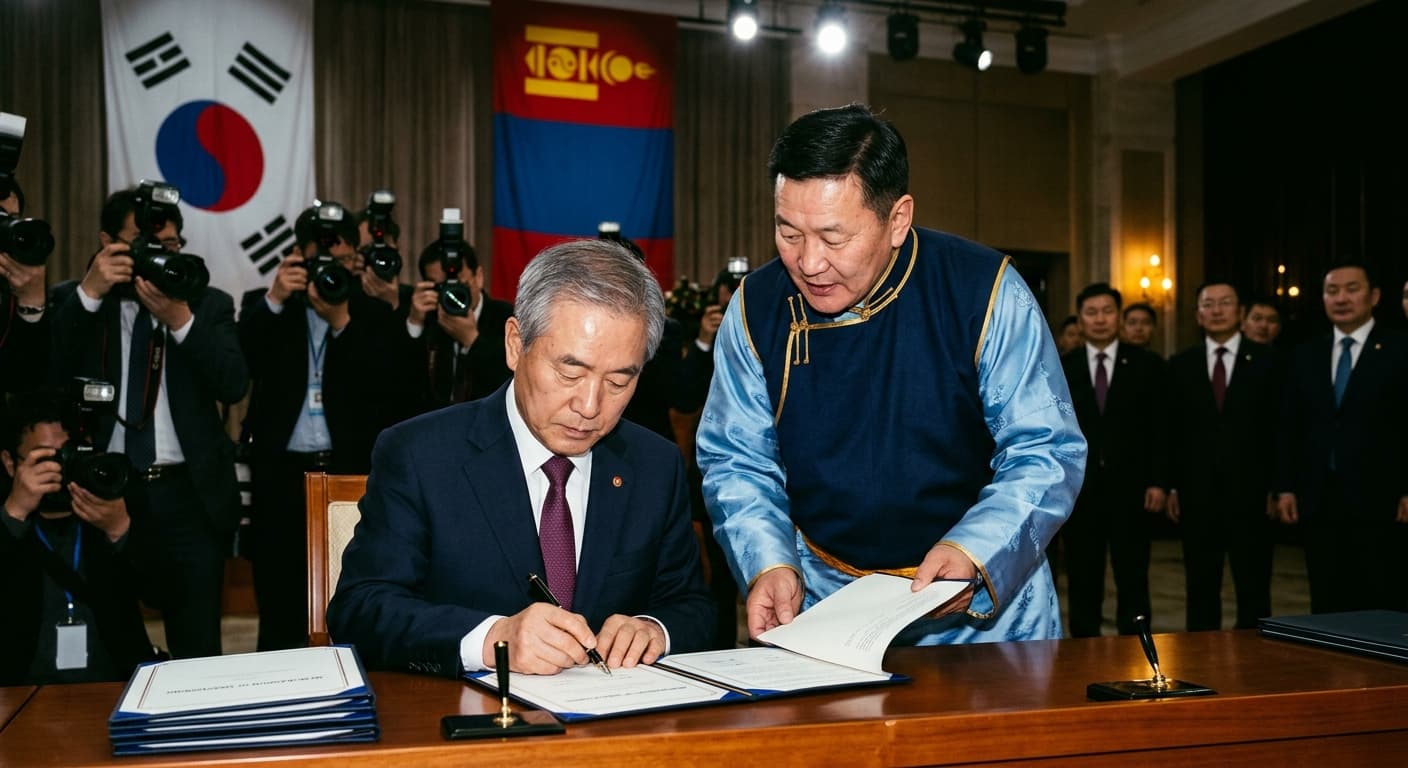
Korea, Mongolia Ink 21 MOUs, Bet on Rare Earths Beyond China
Seoul and Ulaanbaatar declared a "Golden Era" partnership on July 9, 2026, with critical minerals, a phased denuclearization pitch, and a $1 billion trade target by 2030.
South Korean President Lee Jae Myung landed in Ulaanbaatar on July 9, 2026, and by the end of the day had signed 21 memorandums of understanding, an "agreement in principle" on a bilateral economic partnership, and a joint declaration titled "The Golden Era of Korea-Mongolia Relations." The strategic weight of the package lies less in the number of documents than in what it attempts to price out of Seoul's supply chain: China. The summit is a bet that Mongolia can become the friend-shored bypass for Korean industry's 95% dependence on Chinese rare earths, and a back-channel to Pyongyang, in a single visit. The wager is defensible on paper. The chokepoint that makes it work — Mongolia's railways still run through China — is the same chokepoint that has quietly killed every previous version of this idea. Whether Lee's visit changes that calculus, or merely adds a 22nd document to the pile, is the only question that matters.
The deal, in specifics
Lee's summit with President Ukhnaagiin Khurelsukh on July 9 was the first state visit by a South Korean head of state to Mongolia in 15 years — the last was Roh Moo-hyun in 2011. According to The Korea Times, the two governments set a target of $1 billion in bilateral trade by 2030 and committed in principle to a Korea-Mongolia Comprehensive Economic Partnership Agreement (CEPA) — Mongolia's third preferential trade deal after Japan (2016) and the Asia-Pacific Trade Agreement, per a
European Parliamentary Research Service briefing.
The 21 MOUs cover a second national cancer center in Ulaanbaatar, forest restoration, digital central banking, mutual driver's-license recognition, and cooperation on Mongolia's planned new administrative capital. A separate energy MOU signed by Climate, Energy and Environment Minister Kim Sung-whan and his Mongolian counterpart Badrakh Naidalaa targets renewables, heat-pump district heating, and workforce training, The Korea Herald reported.
The load-bearing item is the critical-minerals pillar. Speaking in Ulaanbaatar, Lee said the two countries should "create a business model that involves participation throughout the entire supply chain of critical minerals, from exploration to refining and the training of personnel for value-added industries," according to Aju Press. That is a deliberate escalation from the 2023 Korea-Mongolia Rare Metals Cooperation Committee, which the EPRS briefing noted had been framed cautiously "primarily as part of South Korea's official development assistance" to avoid antagonising Beijing.
Why Seoul is moving now: the China chokepoint
The timing is not accidental. On April 4, 2025, Beijing imposed licensing controls on seven medium and heavy rare earth elements — samarium, gadolinium, terbium, dysprosium, lutetium, scandium and yttrium — and on October 9, 2025, expanded the list to five more (holmium, erbium, thulium, europium, ytterbium) plus extraterritorial licensing for any product containing more than 0.1% Chinese-origin rare earth content, according to a European Parliamentary Research Service note. Beijing suspended the second wave until November 10, 2026, a one-year deadline that now hovers over every Northeast Asian capital.
The market impact has been asymmetric. A study by the Swedish Institute of International Affairs found that after the April 2025 controls, Chinese exports of dysprosium oxide only resumed in August 2025, with shipments "limited to South Korea and Japan," while spot prices in Europe surged 289% above Chinese levels, according to the UI report. Seoul got its licenses. It also got the message: access to its own supply chain is now conditional on Beijing's mood. South Korea sources roughly 95% of its rare-earth imports from China, alongside 78% of niobium, 84% of magnesium, 93% of indium and 98% of gallium, an Observer Research Foundation analysis published in April 2026 concluded. The Ministry of Trade, Industry and Energy's stated goal is to cut critical-minerals dependence on China from 80% in 2023 to 50% by 2030 across 10 strategic minerals. That number is aspirational unless Mongolia does most of the substitution.
Why Mongolia, and why Mongolia is hard
Mongolia holds an estimated $1–3 trillion in untapped mineral reserves — copper, fluorspar, coal and rare earth elements among them — per a CSIS analysis published this year. In May 2024, the Mongolian Critical Minerals Association designated 11 minerals as critical — including copper, fluorspar, graphite, rare earths, cobalt, lithium, platinum-group metals and tungsten — and in February 2025 Ulaanbaatar renamed its state mining champion "Erdenes Critical Minerals" and gave it a mandate covering "research, exploration, extraction and utilization of rare earth elements," according to
ISPI. Mongolia's "Third Neighbour Policy," in place since the 1990s, is now explicitly organised around monetising this endowment through Japan, the United States, the European Union, South Korea and the United Kingdom — anyone that is not Beijing or Moscow. Lee's visit is the latest proof that Seoul has decided to take that offer seriously. The harder proof will come when the first ore shipment has to cross the Trans-Mongolian Railway into China on its way to Incheon.
Discover more

US Politics
SNAP Food Assistance Faces Legal Challenges
In 2026, SNAP faces stricter eligibility rules and mounting legal challenges, threatening food assistance for the millions of Americans who rely on the program.
Global Politics
Trump's Conflicting Messages on Iran War
Trump's mixed messages on Iran reflect a strategy of audience management, benefiting Tehran amid a complex geopolitical landscape.

US Politics
House Ethics Committee Pushes Sexual Miscond.
The House Ethics Committee has shifted responsibility for sexual harassment settlement records to the Office of Congressional Workplace Rights, complicating disclosure efforts.

Economics
Fed's Amex AML order puts correspondent banking on notice
Federal Reserve's Amex AML order requires board-level controls and a 90-day plan; OCC fined the bank $350 million over enterprise-wide deficiencies.