Korea-Mongolia CEPA: Rare-Earth Strategy
A trade pact aimed at securing critical minerals.
Model Diplomat9 min readAsia
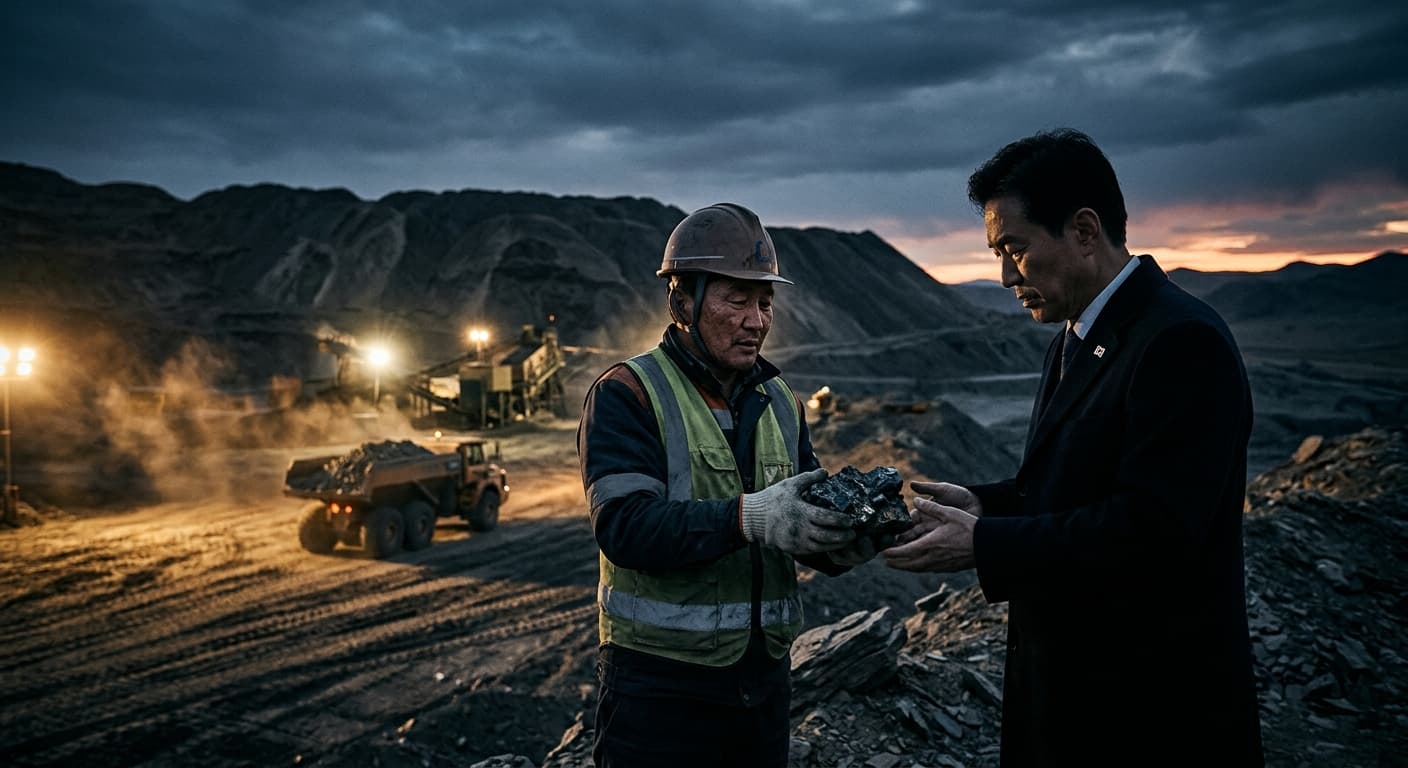
Korea-Mongolia CEPA: The Rare-Earth Bet Behind a Ramyeon Deal
South Korea and Mongolia reached an agreement in principle on a Comprehensive Economic Partnership Agreement on July 9, 2026 — a critical-minerals play dressed as a trade pact.
South Korea and Mongolia announced an agreement in principle on a Comprehensive Economic Partnership Agreement (CEPA) on July 9, 2026, during President Lee Jae-myung's state visit to Ulaanbaatar — a deal that eliminates Korea's 2–5% tariffs on Mongolian copper and rare earths in exchange for market access for cosmetics, instant noodles and seasoned seaweed. The headline reads like a consumer-goods giveaway. The substance is a wager: Seoul is buying itself a non-Chinese back door into rare earths at the moment Beijing has weaponised the export licence — and doing so by copying, almost line for line, the 2015 Japan-Mongolia playbook that Tokyo used to cut its Chinese rare-earth dependence from 93% to 66% in a decade.
That is the story. The CEPA will not, on its own, break China's grip on the critical-minerals value chain. It cannot: Mongolia is landlocked, and virtually every tonne of ore it ships to Korea today transits Chinese rail. What the deal does is give Korean industrial policy a treaty-grade anchor in Ulaanbaatar — the piece Seoul's MOU-heavy resource diplomacy has been missing, and the piece Chinese export controls have just made unavoidable.
What was actually signed
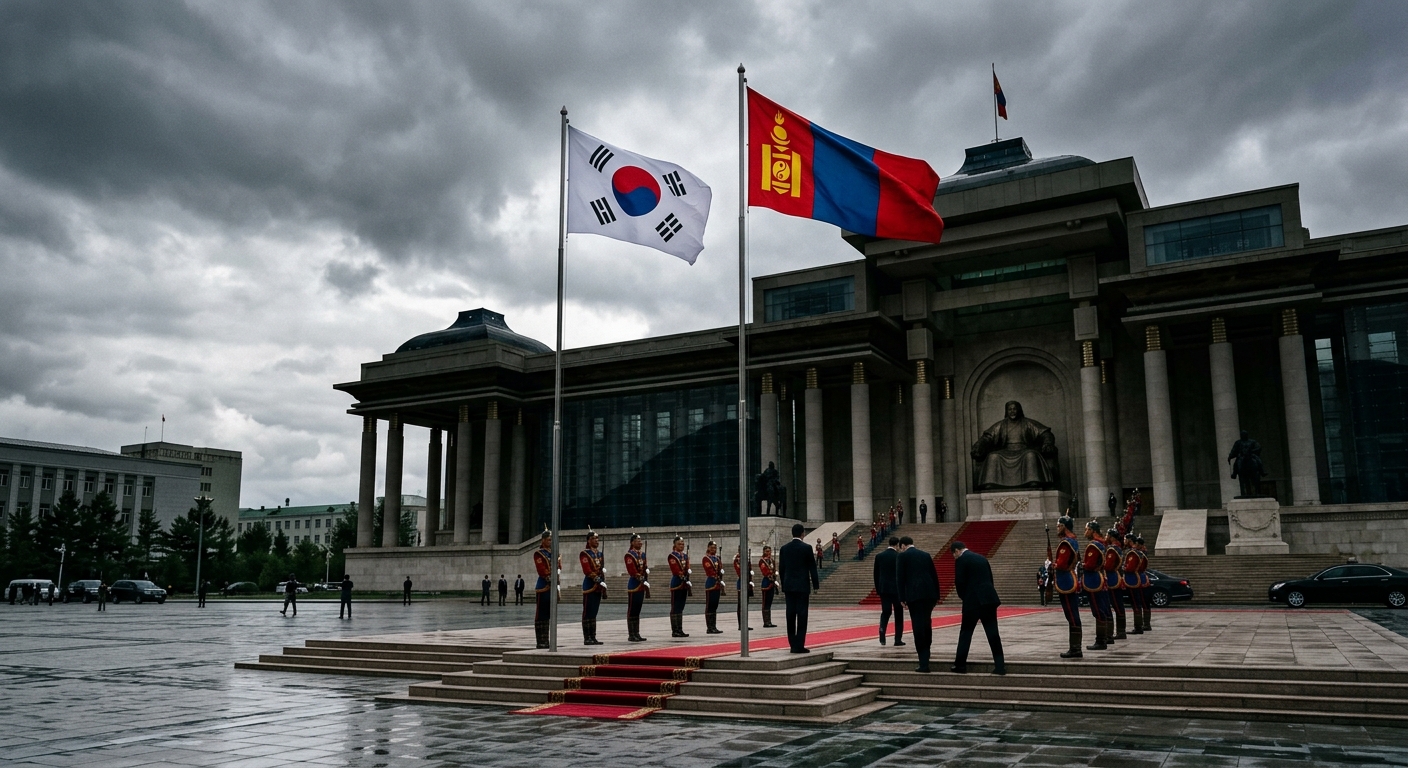
Lee and Mongolian President Ukhnaa Khurelsukh formalised the CEPA breakthrough at the government palace in Ulaanbaatar, with both sides declaring the negotiation "substantively concluded" pending technical clean-up at working level, according to Yonhap News Agency. Korea's Ministry of Trade, Industry and Energy said the two governments had closed the goods market-access chapter and rules-of-origin schedules, opening more than 90% of bilateral trade lines. Negotiations had been running since December 2023, meaning this is a two-and-a-half-year push closed in a single summit day — fast by Korean FTA standards.
The tariff architecture is asymmetric by design. Korea will scrap 2–5% duties on Mongolian copper concentrate, molybdenum and rare-earth-bearing ores. Mongolia will phase out tariffs on Korean cosmetics, ramyeon and gim — the categories where K-consumer brands already dominate a small but fast-growing market. In 2024, Korea was the leading exporter of non-alcoholic beverages to Mongolia at $9.7 million and of coffee extracts and concentrates at $5.7 million, according to World Bank WITS trade data. Korean firms also dominated Mongolia's diesel-truck import market at just over $25 million in 2024,
WITS records show — a foothold the CEPA locks in against Japanese and Chinese competition. Those flows expand; they were never the point.
The point sits in two ancillary documents. Lee and Khurelsukh signed a memorandum of understanding on energy-transition and renewables cooperation, giving Korean firms a route into Mongolian generation permitting, Yonhap reported. And Lee explicitly proposed a "full-chain" mineral cooperation model — from exploration through refining and workforce training — that mirrors the industrial-policy language of Seoul's 2023 Critical Minerals Strategy, according to
Aju Press. That framing is the tell: Seoul is not buying ore; it is trying to buy a value chain.
Why Seoul is doing this now
South Korea's critical-minerals problem is acute and getting worse. Korea imports 95% of its rare earths, 78% of niobium, 84% of magnesium, 93% of indium and 98% of gallium from China, according to Observer Research Foundation research synthesising MOTIE data. The country's overall net-import reliance on critical minerals exceeds 99.7%, per Korea Institute of Geoscience and Mineral Resources figures cited by
CSIS. MOTIE has set a formal target: cut Chinese import dependence for 10 designated strategic minerals from about 80% today to 50% by 2030.
Beijing has made that target existential rather than aspirational. Since April 2025, China has imposed a permanent export-control regime on seven medium and heavy rare-earth elements — including dysprosium and terbium — with dysprosium oxide exports collapsing to zero in May 2025, according to RUSI's June 2026 assessment of rare-earth supply chains. Chinese customs data reviewed in the same report show total rare-earth exports across the value chain hit a record 62,585 tonnes in 2025 — a 12.9% year-on-year jump — even as controlled heavy-rare-earth flows collapsed. The lesson for Seoul: China will keep selling finished magnets to keep foreign OEMs hooked while choking off the oxides that would let Korea build its own magnet industry.
The problem is that MOUs do not survive contact with an export licence. The Korea Institute for International Economic Policy argued in a February 2026 policy brief that Korea's cooperation architecture — the 2023 Rare Metals MOU with Mongolia among them — is "primarily declaratory or facilitative, lacking enforceable rules on investment protection and export restrictions." KIEP recommends that Seoul evolve toward "enforceable critical minerals agreements" with three pillars: disciplines on export restrictions modelled on GATT Article XI, investment protection with dispute-prevention safeguards, and technical-workforce mobility for engineers moving between mines and Korean refineries.
A CEPA is precisely that vehicle. It is a legally binding instrument with an investment chapter, rules of origin, and — critically — the standing dispute settlement that MOUs lack. Whether the working-level clean-up delivers KIEP's three pillars will determine whether this becomes Asia's first genuine minerals-plus FTA, or just another Japan-style tariff deal with mineral seasoning.
The Japan parallel — and where Korea diverges
Mongolia's CEPA with Korea is only its second bilateral trade pact. The first, an Economic Partnership Agreement with Japan, entered into force in June 2016 and eliminated tariffs on 96% of traded goods, according to the European Parliamentary Research Service. Japan's payoff has been quiet but real: Sumitomo Corporation entered the Tavan Tolgoi coal complex, JOGMEC took equity stakes in overseas mining projects, and Japan cut its Chinese share of rare-earth imports from 93% in 2009 to 66% by 2025,
per CSIS analysis.
Korea is arriving a decade late but into a harsher environment. Three variables will decide whether Seoul does better or worse than Tokyo.
First, chokepoints. Approximately 88% of Mongolian minerals leave the country unprocessed, and the vast majority are bound for China, CSIS notes. The
Congressional Research Service reports that China takes 89% of Mongolia's exports and Russia supplies over 90% of its energy imports. The
ISPI analysis by Bulgan Batdorj shows Chinese entities hold 159 mining licences in Mongolia versus 11 for Korean firms and just 4 for Australians — the licence-holder distribution alone tells you who controls the pipeline into which Korean refiners are now buying. A new 19.5 km cross-border rail line, Gashuunsukhait-Gantsmod, is about to deepen that dependence for coking coal, per the same ISPI research.
Second, mid-stream capacity. Korea has built domestic refining and cathode-processing capacity that Japan chose to place offshore in Malaysia. If Korean firms — POSCO, LX International, LS Cable — can persuade Erdenes Critical Minerals, the state enterprise Mongolia renamed in February 2025 to hold the country's rare-earth mandate, to route ore to processing hubs in Pohang or Gwangyang, the value-add stays in Korea. The Mongolian mining sector already accounts for 30% of GDP, 79% of foreign direct investment and 94% of exports, per ISPI — giving Ulaanbaatar every incentive to trade access for downstream jobs. That is where the CEPA's rules-of-origin schedule will matter most.
Third, geopolitical framing. The Deberdt–Park review in Mineral Economics (March 2026) argues that Seoul's strategy is measurably distinct from Washington's — Korea "recognizes the immense capacities of China and intends to maintain part of its sourcing from its neighbor while diversifying," according to the study. The Mongolia deal is therefore a hedge, not a rupture. That is a Lee Jae-myung signature: keep Beijing's raw material flows running while building an insurance policy in the steppe.
Winners, losers, and second-order effects
Name the beneficiaries plainly. Korean cosmetics majors — Amorepacific, LG H&H — and the ramyeon duopoly of Nongshim and Ottogi get tariff-free entry into a market where their K-brand premium already commands price power. POSCO International and LX International, both quietly building critical-minerals portfolios, get a treaty-grade legal shell for stakes in Mongolian assets. Korea Mine Rehabilitation and Mineral Resources Corporation (KOMIR) and the Korea Institute of Geoscience and Mineral Resources gain a formal counterpart in Erdenes Critical Minerals. Consumer-goods retailers — Lotte, Shinsegae — get first-mover access to a distribution market Yonhap explicitly identifies as a CEPA growth vector.
The losers are less obvious. Japanese trading houses, which have enjoyed a decade of privileged access under the 2016 EPA, now face a Korean competitor holding equivalent tariff parity plus a more integrated refining offer. Chinese processors of Mongolian raw material lose their monopoly on downstream value capture — modestly at first, meaningfully if Korean investment scales. And Mongolia's own bargaining leverage with Beijing improves: every additional buyer with a signed treaty raises the political cost of Chinese coercion of the sort documented by the European Parliamentary Research Service, which lists Mongolia among countries targeted by Chinese economic pressure.
The second-order effect worth watching is trilateral. The first US-Mongolia-Korea Critical Minerals Dialogue met in Ulaanbaatar in 2023, as CSIS documented, and RAND has recommended embedding Mongolia in the trilateral US-Japan-Korea supply-chain architecture,
in a 2024 study. A binding Korea-Mongolia CEPA gives that trilateral something concrete to plug into — Washington and Tokyo can layer financing (DFC, JBIC, JOGMEC) on top of a Korean treaty framework rather than negotiating from scratch.
Two structural constraints, however, will not yield to a treaty. Mongolia's rare-earth deposits are all at early exploration stage, and a 2023 German Federal Institute for Geosciences and Natural Resources assessment cited by the European Parliament briefing concluded that commercial rare-earth extraction in Mongolia is unlikely in the short-to-medium term without huge infrastructure investment. And with China taking 89% of Mongolia's exports today,
per CRS, the pipeline problem cannot be legislated away from Ulaanbaatar. Someone — Korea, Japan, the United States, the EU — has to build alternative rail, road or processing capacity. The CEPA is a permission slip, not a solution.
What to watch next
- Working-level closure and text release. Both governments said technical items would wrap through follow-on talks. The published text — especially the investment chapter and any minerals-specific annex — will determine whether KIEP's three pillars survived.
- National Assembly ratification. Under Article 60 of Korea's constitution, treaties affecting the national economy require parliamentary consent. Timing likely stretches into 2027.
- First anchor project. Watch for a POSCO or LX International equity move on a Mongolian copper or rare-earth asset within 12 months — the signal that the treaty framework has activated capital.
- Mongolia's Minerals Security Partnership entry. Mongolia has been circling MSP membership; a Korean CEPA strengthens the case, and Seoul chairs the MSP.
Diplomat View
The Korea-Mongolia CEPA is the first Korean trade agreement written explicitly around China risk rather than around export-growth. That is what makes it worth reading twice. Our call: if the final text embeds KIEP's export-restriction disciplines and a genuine investment chapter, this becomes the template for Korea's next generation of minerals-plus FTAs — with Kazakhstan, Uzbekistan, and eventually parts of Africa. If it does not, it will be remembered as a cosmetics deal that let Beijing keep the choke collar on Korean magnets.
The forecast changes if either of two conditions is triggered: (1) a Korean industrial major announces a mid-stream refining joint venture with Erdenes Critical Minerals inside 18 months, which would validate the value-chain thesis; or (2) China responds with targeted export licence delays on gallium, germanium or heavy rare earths bound for Korea, which would confirm Beijing views the CEPA as a strategic threat and accelerate every diversification timeline Seoul has set. Absent either, this remains a good treaty in search of a supply chain.
The Bottom Line
The Korea-Mongolia CEPA is not a trade deal about ramyeon and cosmetics — it is Seoul's first legally binding attempt to build a rare-earth supply chain that does not begin in China. Whether it works depends less on the tariff schedule than on whether Korean industrial capital moves into Mongolian processing within 18 months, and whether Beijing decides to punish Seoul for trying.
Discover more
US Politics
SNAP Food Assistance Faces Legal Challenges
In 2026, SNAP faces stricter eligibility rules and mounting legal challenges, threatening food assistance for the millions of Americans who rely on the program.
Global Politics
Trump's Conflicting Messages on Iran War
Trump's mixed messages on Iran reflect a strategy of audience management, benefiting Tehran amid a complex geopolitical landscape.

US Politics
House Ethics Committee Pushes Sexual Miscond.
The House Ethics Committee has shifted responsibility for sexual harassment settlement records to the Office of Congressional Workplace Rights, complicating disclosure efforts.

Conflict & Security
Drone Warfare Killing Aid Workers at Unprec
Over 1,000 humanitarian workers killed in three years as cheap armed drones collapse legal protections. Gaza, Sudan, Ukraine, and DRC see deliberate targeting of aid convoys and hospitals with zero prosecutions.