Khamenei Funeral Locks In Iran's Hormuz Barg
Tehran's six-day funeral reshapes Gulf diplomacy.
Model Diplomat8 min readMiddle East
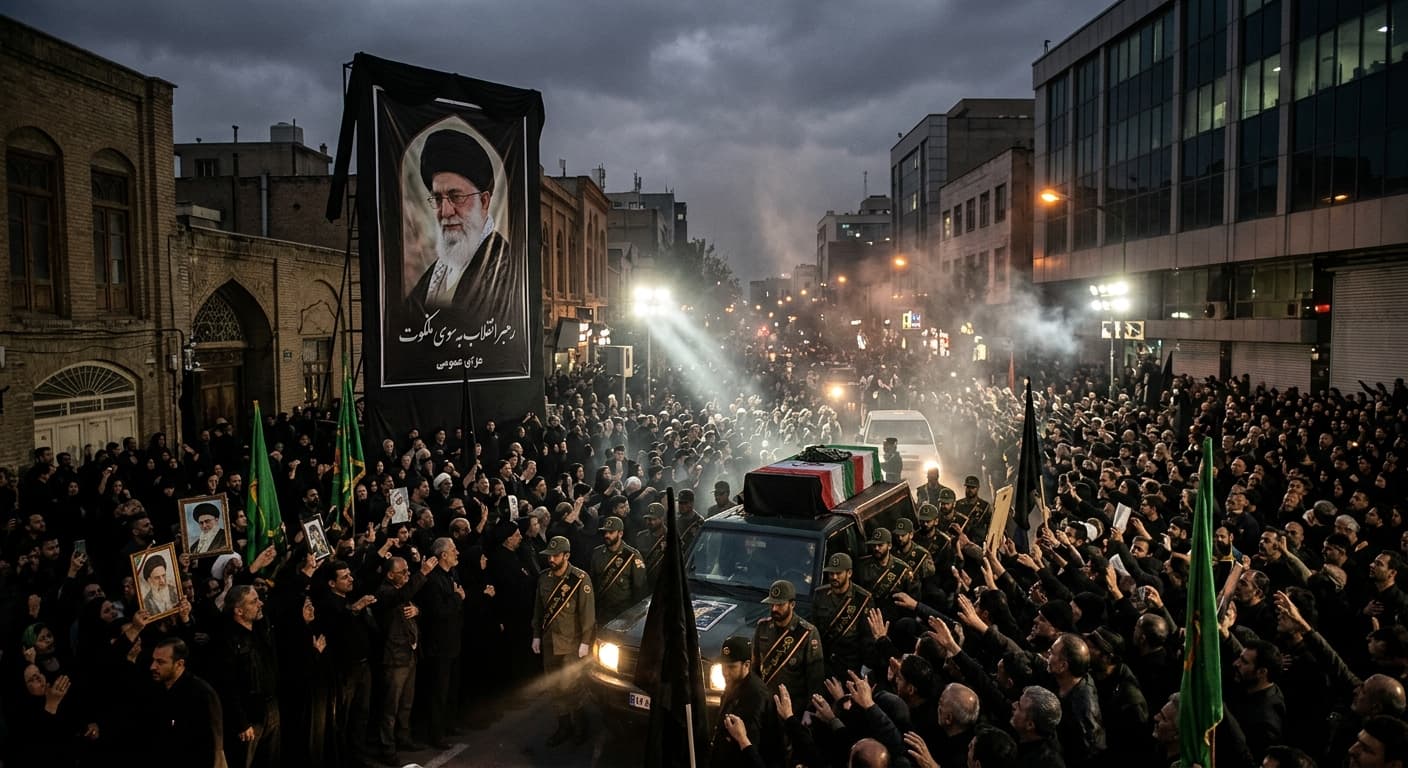
Khamenei Funeral Locks In Iran's Hormuz Bargain With the Gulf
How Tehran is using its six-day funeral for Ali Khamenei to convert wartime control of the Strait of Hormuz into a permanent seat at the table — and reset Gulf diplomacy on its terms.
The mass rites for Ali Khamenei that began in Tehran on July 3, 2026, are not a farewell. They are a demand. Four months after a joint US–Israeli strike killed the supreme leader on February 28, and three weeks after Washington and Tehran signed a memorandum of understanding to pause the war, the Islamic Republic is using millions of mourners and a Tehran-to-Mashhad procession to hard-code a new regional bargain: recognition of Iranian primacy over the Strait of Hormuz — where about a fifth of global seaborne oil and LNG moves — in exchange for lasting de-escalation. The nuclear file is being demoted; geography is being promoted. That is the shift Gulf capitals, oil markets and the White House now have to price in.
What the funeral is actually signalling
The choreography is the message. Iranian authorities expect 12–20 million attendees across a six-day route through Tehran, Qom, the Iraqi shrine cities of Najaf and Karbala, and the July 9 burial at the Imam Reza Shrine in Mashhad, per the BBC. Delegations from Russia, Pakistan, Turkey, Saudi Arabia, Qatar and Oman attended the Tehran service; former Russian president Dmitry Medvedev and Pakistan's prime minister Shehbaz Sharif were in the front rows, according to the
BBC. Reuters, in the analysis that framed the day for wire subscribers, called the crowds a rebuke to the assumption that the strikes had broken the Islamic Republic, and quoted regional officials describing Hormuz as Tehran's "diamond" — an asset to be monetised, not surrendered (
Investing.com/Reuters).
The most conspicuous absentee tells its own story. Mojtaba Khamenei, 56, confirmed as the new supreme leader by the Assembly of Experts on March 8, has not been seen in public since he was wounded in the strike that killed his father, his wife and a one-year-old granddaughter. He skipped the Tehran service and communicates only in writing, Al Jazeera reported from the procession. Israeli Defence Minister Israel Katz used the day of the cortège to warn, in Hebrew, that Iran's next leader is also a target.
That silence is the point. As the Gulf International Forum's Madeline Stahle argues, Mojtaba functions as a "figurehead" while wartime authority has migrated to the IRGC, which has "tightened its grip over wartime decision-making" and now organises the system rather than merely protecting it (Gulf International Forum). The funeral is the clerical face; the strait is the Guards' collateral.
The Hormuz doctrine, made concrete
Iran's post-war strategy is not improvisation. On April 19, IRGC veteran and parliament national-security chair Ebrahim Azizi told the BBC Tehran would "never" cede control of the strait and was drafting legislation, under Article 110 of the constitution, giving the armed forces authority over passage. On May 4 the IRGC published a map extending a maritime enforcement zone deep into UAE waters, from Qeshm to Umm al-Quwain and from Mount Mobarak to Fujairah, per
Al Jazeera. Tehran then created a Persian Gulf Strait Authority to license transits, and its national insurance company opened a policy vessels must apply for — a bureaucracy that has not been dismantled under the ceasefire, Brookings' Kari Heerman notes in a
Brookings briefing.
The June 17 MoU, brokered by Qatar and Pakistan, papered over the disagreement rather than resolving it. Iran suspended planned transit fees for 60 days and Washington waived a set of sanctions to let Iranian crude sell in dollars, according to Al Jazeera. But Iran's chief negotiator, parliament speaker Mohammad Bagher Ghalibaf, has said publicly that Hormuz "will never return" to its pre-war status, and Tehran-based analyst Mostafa Khoshcheshm told the same outlet that service fees "are definitely" coming back after day 60. Secretary of State Marco Rubio drew Washington's red line on June 24 in Abu Dhabi: "No country is allowed to charge tolls or fees on an international waterway."
The legal weight sits with Rubio. The Congressional Research Service cites IEA figures showing roughly 20 million barrels of oil per day — "around 25% of the world's seaborne oil trade," 80% of it destined for Asia — transited Hormuz before the war, alongside 93% of Qatar's and 96% of the UAE's LNG exports. Under the UN Convention on the Law of the Sea, transit passage through international straits is generally treated as reflective of customary international law even for non-parties like Iran and the United States, as US Naval War College scholarship archived on
SSRN sets out. Coastal states may recover the cost of specific services rendered, but not levy tolls for passage itself. Tehran's play is to blur the line: call the fees "services," bundle them with mandatory IRGC coordination, and dare shippers to litigate at The Hague while insurance premiums do the work.
The market has already voted
Oil is telling the story before diplomats will. Brent briefly topped $126 a barrel in April; futures for September delivery settled at $72 on July 6, below the $72.48 close on February 27, the day before the war, Al Jazeera reported. OPEC+ — Saudi Arabia, Russia, Iraq, Kuwait, Kazakhstan, Algeria and Oman — announced its fifth consecutive monthly output hike, adding 188,000 barrels a day from August. Traffic through Hormuz, however, remains a fraction of pre-war levels: 38 confirmed transits on July 2 against roughly 130 daily crossings before February 28, per MarineTraffic data cited in the same piece.
The disconnect is the whole trade. Markets are pricing a partial, permissioned Hormuz — commercial flows resuming under Iranian gatekeeping — rather than a full restoration of pre-war freedom of navigation. That is a de facto ratification of Tehran's post-war doctrine, and it is arriving without a single signature on a final treaty. The Congressional Research Service notes crude jumped 8% on February 28 alone; the subsequent slide is the market betting the MoU holds and Iran collects rent quietly.
Gulf capitals are choosing sides — quietly
The most important audience for the funeral was seated in Riyadh, Abu Dhabi and Muscat. The GCC has fractured. Oman, which controls the southern shore of the strait, is in bilateral talks with Tehran on joint administration and has already been named in the MoU as Iran's co-manager. Qatar mediated the ceasefire from Doha. The UAE — which struck two Iranian oil facilities on the day the truce was agreed and whose Fujairah gas plant will not be fully repaired until 2027, according to CRS citing the Financial Times — sits with Bahrain in the hawkish camp.
Saudi Arabia is the swing state, and it has moved. In Foreign Affairs, analyst Hesham Alghannam writes that Riyadh "does not trust Washington to restore regional security after the conflict ends" and has positioned itself between the accommodationists and the hawks — declining to endorse continued war, working through Pakistani mediation, and eyeing a bilateral non-aggression pact with Iran. As Anna Jacobs of the Arab Gulf States Institute told
Al Jazeera earlier this year, Gulf states fear regime chaos in Tehran far more than Khamenei continuity. The funeral turnout — and the survival of the clerical–IRGC nezam — is, perversely, the outcome most Gulf sovereigns wanted.
That leaves Israel isolated on the file it created. Prime Minister Benjamin Netanyahu's cabinet launched the February 28 strikes to break the regime; instead, according to Brookings' Jeffrey Feltman, the war "elevated more strident and hawkish figures" inside Tehran and gave the IRGC the pretext to consolidate (Brookings). Katz's threat against Mojtaba during the procession is the tell: with Gulf capitals moving to lock in a Hormuz condominium, Israel's remaining lever is a targeted-killing campaign that its Arab neighbours will not underwrite.
The nuclear file, quietly demoted
The most under-reported line in Iran's post-Khamenei strategy is what Mojtaba has not said. Since assuming the role, he "did not mention the nuclear programme once" in public statements and has repeatedly asserted Iran's right to govern Hormuz, writes Hossein Derakhshan in Al Jazeera. Tehran offered in the Islamabad talks to suspend enrichment for several years — an unthinkable concession under his father — while treating IAEA access to war-damaged facilities as something to be discussed only inside a final deal, per
Al Jazeera. The trade is explicit: nuclear latency for maritime rent.
That is the strategic reframe the funeral is meant to seal. Hormuz control is faster to generate cash, harder for Israel to bomb without a global oil shock, and — critically — enforceable by geography rather than by centrifuges. As Marburg University economist Mohammad Reza Farzanegan told Al Jazeera, the strait is a "strategic equaliser": Iran cannot match US naval power, but "mines, missiles, drones, fast boats [and] electronic disruption" make transit costly without formal closure. The MoU tacitly concedes it will take Iran 30 days simply to demine the waterway.
Diplomat View
The Khamenei funeral is being read as a display of defiance. It is more useful to read it as an inauguration of a bargain: Tehran trades nuclear ambiguity for Hormuz rent, and Gulf monarchies trade Israeli maximalism for a regional condominium underwritten by Oman, Qatar and, tacitly, Saudi Arabia. Our forecast: the 60-day MoU window will slip past its mid-August expiry into a rolling technical extension, Iran will reintroduce "service" fees — insurance-priced, not toll-labelled — before year-end, and Brent will settle in a $70–80 range as the market accepts permissioned transit as the new normal. What would revise this call: a confirmed public appearance by Mojtaba Khamenei that stabilises the succession, an Israeli strike on his successor before Mashhad's 40-day rites conclude, or a demonstrable Iranian move to reconstitute enrichment above 60% — any of which would puncture the Hormuz-for-nukes swap the funeral is designed to lock in.
What to watch next:
- July 9, 2026 — Burial at the Imam Reza Shrine in Mashhad; whether Mojtaba appears (or is heard from) will set expectations for the succession's legitimacy.
- Mid-August 2026 — Expiry of the 60-day MoU window; test of whether Iran reintroduces Hormuz service fees and whether US sanctions waivers roll forward.
- 40-day arba'in commemorations (mid-August) — Traditional Shia mourning cycle that ends around the same moment as the MoU deadline; Tehran will use it to stage a second political moment if talks stall.
- OPEC+ September meeting — Whether Saudi Arabia keeps raising output signals whether Riyadh believes Hormuz flows are structurally restored or still politically hostage.
The bottom line: Iran's funeral for Ali Khamenei is the ceremonial signature on a strategic pivot from nuclear latency to maritime rent. If the Hormuz bargain holds, the Gulf's security order will be written by Tehran, Muscat and Doha rather than by Washington and Jerusalem — and the market has already begun to pay for it.
Global Politics coverage will track the mid-August deadline.
Discover more
US Politics
Next Generation Republicans
A leaked survey shows 39% of Republicans under 30 do not identify as MAGA, revealing a split in the GOP's future leadership.

US Politics
House Ethics Committee Pushes Sexual Miscond.
The House Ethics Committee has shifted responsibility for sexual harassment settlement records to the Office of Congressional Workplace Rights, complicating disclosure efforts.
Global Politics
Xi Jinping Calls China-Russia Ties 'Precious'
Xi Jinping's description of China-Russia ties as 'precious' reflects a strategic imbalance, with Beijing dictating terms in the partnership.
Global
Wisconsin ICE Surge: 57 Arrests Signal Policy
Federal agents arrested 57 in Wisconsin, using tactics from Minnesota's Operation Metro Surge, signaling a troubling national enforcement trend.