Wisconsin ICE Surge: 57 Arrests Signal Policy
Federal agents use controversial tactics in Wisconsin arrests.
Model Diplomat8 min readNorth America
Wisconsin ICE Surge: 57 Arrests Signal Nationwide Enforcement Playbook
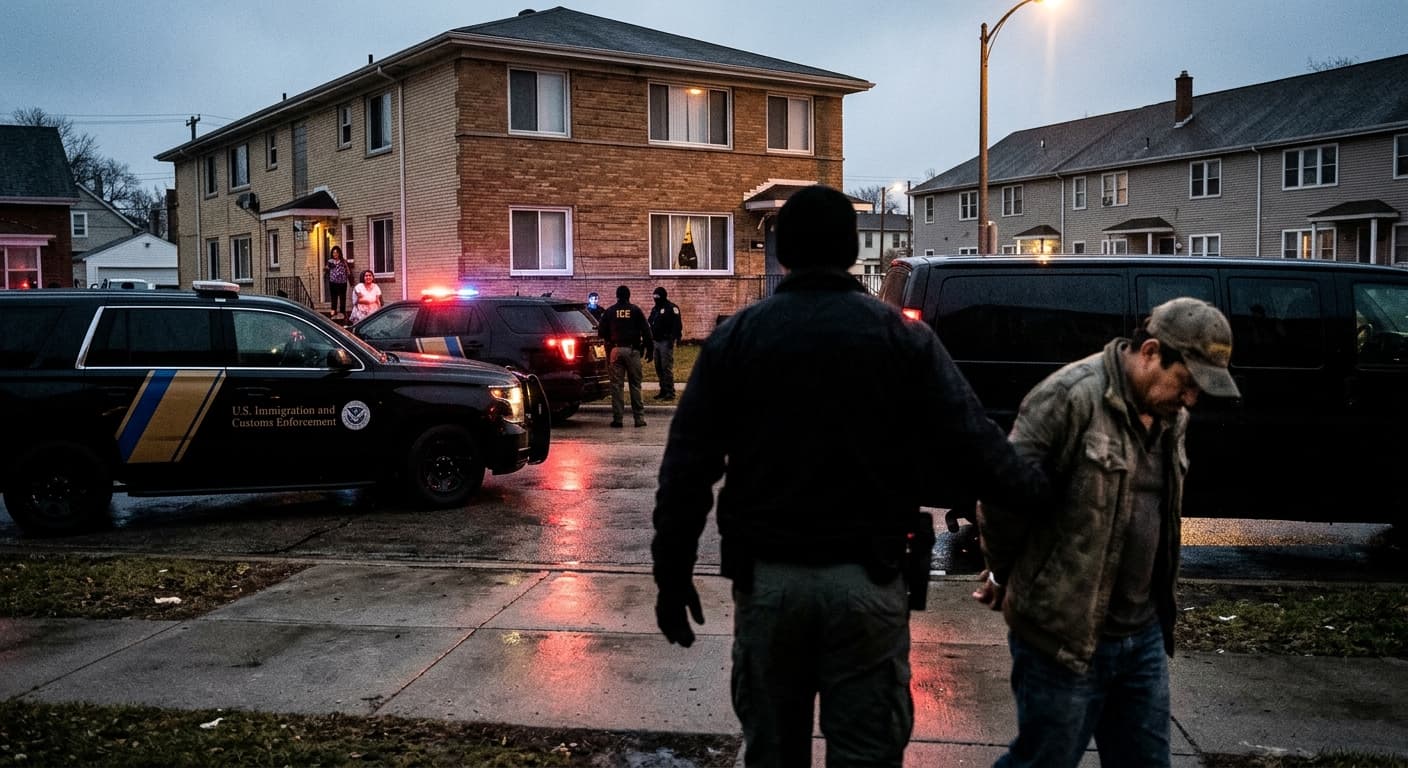
Federal agents arrested 57 people in Wisconsin between June 29 and July 1, 2026 — using the same unmarked-car, family-separation tactics documented in Minnesota's Operation Metro Surge.
Federal immigration agents arrested 57 people across Wisconsin between June 29 and July 1, 2026, according to the Wisconsin Examiner — a three-day operation dwarfed in raw numbers by the crackdowns in Los Angeles, Chicago and the Twin Cities. The significance is not the count. It is that the Wisconsin surge exports the exact tactical package Human Rights Watch called "a manufactured crisis" in Minnesota — masked agents in unmarked vehicles, mothers separated from children and flown to a Texas detention facility, arrests overwhelmingly of people with no criminal history — into a state without the political and legal infrastructure that partially pushed back in Minneapolis. Wisconsin is where the Operation Metro Surge model becomes routine practice, and its 57 arrests matter as a template, not a headline.
What the three days looked like
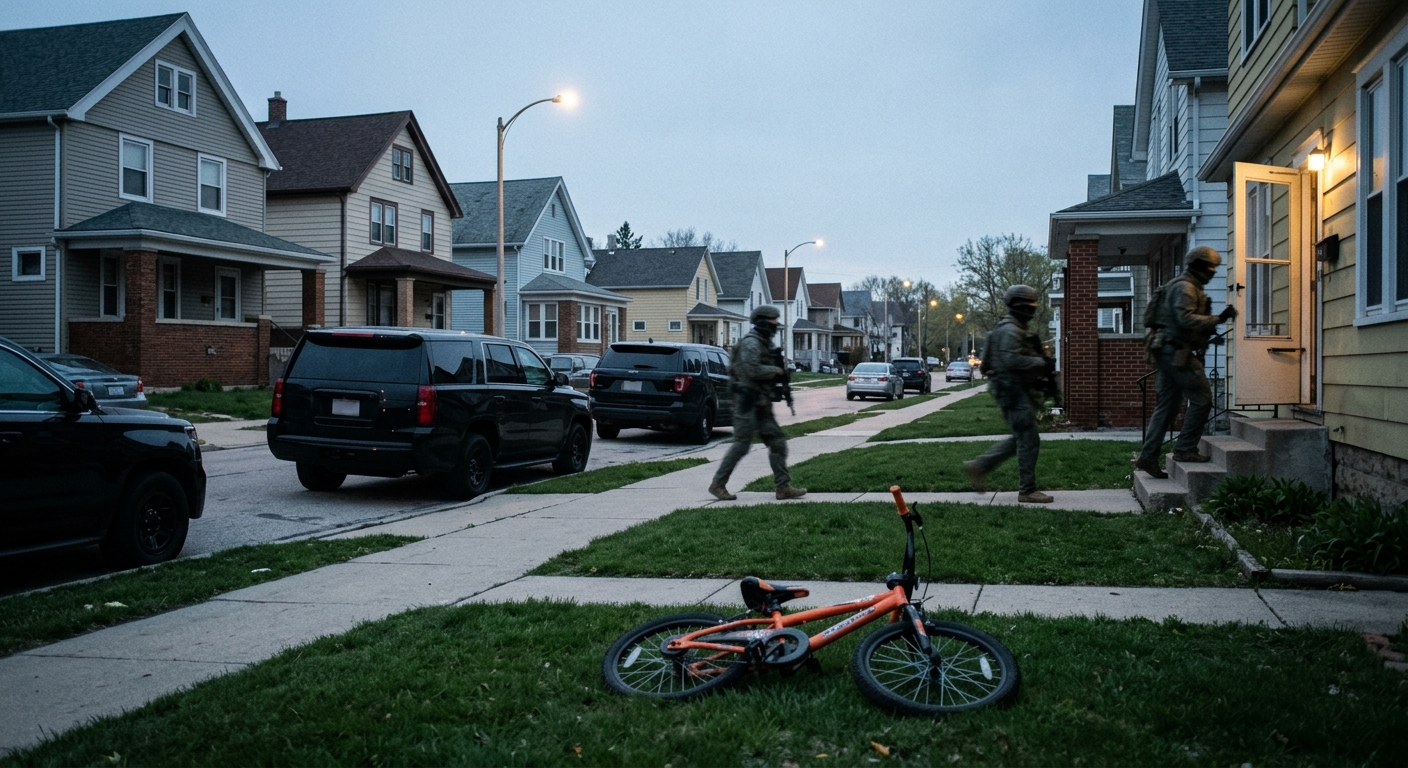
The Department of Homeland Security described the detainees as carrying histories of sexual assault, intoxicated driving, obstruction, drug trafficking, domestic abuse, larceny and fraud. Voces de la Frontera, quoted in the Wisconsin Examiner, said the "vast majority" of those taken had no criminal record.
The reported scenes match, almost line for line, the Minnesota template. Galo Suárez, 25, on a work permit, said masked agents followed him and his fiancée Reyna Elizabeth Garcia from a food market, broke his car windows, repeatedly called them "dogs" in Spanish, and released him with a warning to "run and not look back" while keeping Garcia and her brother. Jacqueline Eckstrom of Greenfield described watching agents smash a car window and detain a woman, leaving her children screaming in the glass-strewn back seat. Diana Socha Torres and her 8-year-old son were taken from their home in the Wisconsin Dells, moved through the Milwaukee ICE office and flown to the South Texas Family Residential Center in Dilley — despite an active asylum case, an ICE-issued ankle monitor, and no charges in Wisconsin.
That routing is the tell. In January 2026, NPR reported that ICE was flying Minnesota families to Dilley "within hours" of arrest, in some cases before lawyers could reach them and in defiance of court orders. Minnesota's federal district was so overwhelmed by habeas petitions it called in four out-of-state judges. U.S. District Judge Patrick Schiltz wrote that "ICE has likely violated more court orders in January 2026 than some federal agencies have violated in their entire existence." The Wisconsin Dells case indicates the Dilley pipeline is now a national default, not a Minnesota anomaly.
The unmarked vehicles and broken windows are also not local improvisation. NPR's investigation of federal fleet practices documented ICE and Border Patrol using vehicles without rear license plates and, in one Illinois video, an agent openly saying his unit "changes the plates out every day." In May 2026, the DOJ
sued Maine, Massachusetts, Oregon and Washington for refusing to issue confidential plates to ICE — a legal fight over whether federal agents may operate, in Massachusetts Governor Maura Healey's words, "in secret, even from our law enforcement."
Why Wisconsin, and why now
Two structural conditions make Wisconsin the natural next stage.
First, the money and the mandate. On June 9, 2026, the White House announced Senate passage of the Secure America Act, roughly $70 billion in multi-year funding for ICE and Customs and Border Protection through fiscal 2029. DHS was already operating under an internal directive to arrest 3,000 people per day, and the composition of detention has decisively shifted. According to ICE data submitted to Congress and
reported by the Guardian, immigrants with no criminal record are now the largest single category in ICE detention: 16,523 people, against 15,725 with convictions and 13,767 with pending charges, of 59,762 total detainees. That is the first time under the second Trump administration that non-criminal detainees have outnumbered convicted ones — a fact directly at odds with the "worst of the worst" framing DHS has used to justify the Wisconsin operation.
An NBER working paper using ICE administrative arrest data obtained by the Deportation Data Project found that average daily ICE arrests in 2025 were higher than at any point in the previous decade, while the share of those arrested with any criminal conviction is at a near-record low, comparable only to the pandemic anomaly. A
Migration Policy Institute analysis of that same data found that roughly 75,000 people arrested by ICE in the first nine months of the second term — more than a third of the total — had no criminal record, and that among those who did, most convictions were traffic violations or lower-level offenses.
Second, the ground game. Wisconsin already has the compliance architecture Minnesota lacked. A Wisconsin Law Review comment documents that most Wisconsin sheriffs comply with ICE detainers and that several counties operate Section 287(g) agreements deputizing local officers as immigration agents — arrangements the author argues are unlawful under state law but which remain operational. Voces de la Frontera has an active federal suit against five county sheriffs — Walworth, Brown, Marathon, Kenosha and Sauk — over that compliance,
docketed as 3:25-cv-01070 in the Western District of Wisconsin, with a remand motion litigated in early 2026.
Wisconsin's Democratic governor, Tony Evers, has no direct authority over federal enforcement. Milwaukee's police, unlike Minneapolis's, sit inside a state where the Republican-controlled legislature is hostile to sanctuary policy, and the Milwaukee Police Department has said it will not enforce the city's mask-ban ordinance against ICE agents, according to TMJ4 as summarized by the UWM Post. The DOJ's April 2025 arrest of Milwaukee County Circuit Judge Hannah Dugan for allegedly directing a defendant out a courthouse back door,
as NPR reported, was in effect an early warning to any Wisconsin official contemplating friction with ICE. Court filings in that case,
available through CourtListener, show that Milwaukee's chief judge had circulated draft policies restricting ICE arrests inside the courthouse — the very policies the federal indictment against Dugan appears designed to punish.
The pattern is the policy
The Wisconsin surge should not be read as a lapse. Three convergent lines of evidence identify it as policy.
The first is scale. Brookings researchers estimate ICE made roughly 380,000 arrests between the January 2025 inauguration and February 2026, and that the enforcement surge cost 668,000 jobs across the 86 cities that experienced the sharpest ICE arrest spikes — with 51,000 to 297,000 of those lost jobs previously held by American-born workers. Each excess ICE arrest is associated with about 13 jobs lost overall. If that ratio holds in Milwaukee and Madison, a 57-person arrest surge is a proxy for a labor shock touching hundreds of workers across dairy, food processing and construction — sectors Wisconsin cannot easily replace.
The second is the escalating human toll. The UN High Commissioner for Human Rights, Volker Türk, warned on June 26, 2026 that 18 people died in ICE custody in the first five months of 2026, with a further death reported that month — against 33 for all of 2025 and 11 in 2024. Türk noted the detained population had risen from roughly 40,000 in early 2025 to over 60,000, with DHS planning to reach 90,000 by year-end. Five of the 2026 deaths were classified as suicides. In March 2026, the UN Committee on the Elimination of Racial Discrimination separately
warned that racial profiling and racist political rhetoric had "heightened human rights violations against migrants and asylum seekers" in the United States.
"I call for prompt, independent, impartial and effective investigations into all deaths in ICE custody. Those responsible for violations of the law must be held to account, and the rights of the victims' families to truth, justice and reparation and guarantees of non-recurrence must be upheld." — Volker Türk, UN High Commissioner for Human Rights,
June 26, 2026
The third is the targeting of refugees and asylum seekers with lawful status. In January 2026, NPR documented more than 100 refugees with no criminal background unlawfully arrested in Minnesota — many flown to Dilley — as part of a DHS push announced January 9 to re-examine thousands of refugee cases for potential fraud. A federal judge ordered their release and paused those detentions. Diana Socha Torres's transfer to Dilley from the Wisconsin Dells, with an active asylum case and no charges, sits squarely inside that pattern. So does the ICE detention this spring of Salah Sarsour, president of the Islamic Society of Milwaukee, who lost more than 30 pounds during nearly three months in an Indiana facility and was ordered released on June 18 by a federal judge who
Al Jazeera reported affirmed his First Amendment rights.
What to watch
- The Voces de la Frontera sheriffs' suit (3:25-cv-01070, W.D. Wis.). A remand ruling in 2026 would determine whether Wisconsin's Section 287(g) agreements survive the state-law challenge outlined in the
Wisconsin Law Review. If the plaintiffs prevail, the compliance infrastructure enabling this surge is legally destabilized.
- The Dugan prosecution. A judicial-obstruction conviction would criminalize the courthouse-access policies that Milwaukee County judges circulated in April 2025, and would deter local judicial pushback nationwide. Acquittal would embolden it. The evidentiary rulings in
the pending motion are the near-term inflection point.
- The DOJ license-plate suits against Maine, Massachusetts, Oregon and Washington. A federal ruling either way settles whether ICE can operate in unmarked vehicles as a matter of federal supremacy — the same tactic used to detain Galo Suárez's fiancée in Milwaukee.
- Detention capacity. If ICE hits its stated 90,000-person target by year-end 2026, the Türk warning on custodial deaths becomes a leading indicator, not a lagging one.
The Bottom Line
The Wisconsin surge is small in numbers and large in meaning: it is the moment the Minnesota playbook — unmarked vehicles, family separation, rapid transfer to Dilley, arrests dominated by people with no criminal record — stops being an exceptional deployment and becomes the operating standard of a $70 billion federal enforcement machine. The decisive fact is not that 57 people were arrested in three days, but that a mother with an ankle monitor and an active asylum case was flown to Texas from the Wisconsin Dells — proving that lawful status, court supervision and clean records no longer function as protection. Wisconsin is the test of whether the model spreads with resistance or without it.
Discover more

US Politics
Next Generation Republicans
A leaked survey shows 39% of Republicans under 30 do not identify as MAGA, revealing a split in the GOP's future leadership.
US Politics
SNAP Food Assistance Faces Legal Challenges
In 2026, SNAP faces stricter eligibility rules and mounting legal challenges, threatening food assistance for the millions of Americans who rely on the program.
US Politics
House Ethics Committee Pushes Sexual Miscond.
The House Ethics Committee has shifted responsibility for sexual harassment settlement records to the Office of Congressional Workplace Rights, complicating disclosure efforts.

Economics
Fed's Amex AML order puts correspondent banking on notice
Federal Reserve's Amex AML order requires board-level controls and a 90-day plan; OCC fined the bank $350 million over enterprise-wide deficiencies.