Why el-Obeid Matters in Sudan's War
El-Obeid's strategic importance in Sudan's ongoing conflict.
Model Diplomat7 min readAfrica
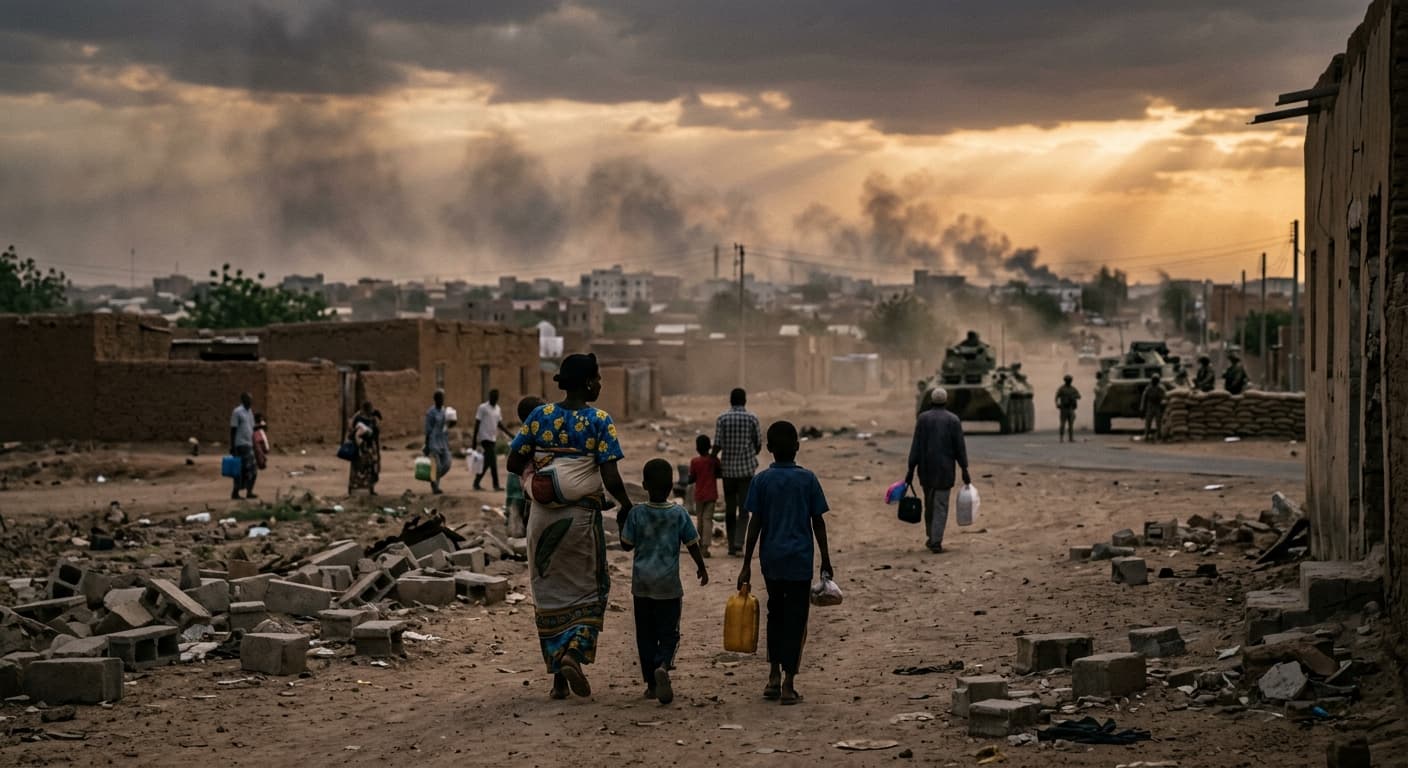
Why el-Obeid Matters as Sudan's War Enters a New Phase
Sudan's war has moved from Khartoum to Kordofan, and 500,000 civilians in el-Obeid are trapped between an RSF advance and a stalled Quad peace process.
The most dangerous city in Sudan on July 7, 2026 is not Khartoum or el-Fasher — it is el-Obeid, the North Kordofan capital where the Rapid Support Forces have massed troops around a garrison town holding roughly 500,000 people, and where UN rights chief Volker Türk warned on July 3 that the world faces "another human rights catastrophe" if it does not act within days. The strategic point is narrower than the humanitarian one: whichever side controls el-Obeid controls the road, rail and pipeline geometry that links Darfur to the Nile valley — which is why the battle for this junction town, more than any move on Khartoum, will decide whether Sudan's war ends in a negotiated split or a full RSF push east.
The junction the war now turns on
El-Obeid sits about 360 km southwest of Khartoum at the intersection of highways connecting central Sudan to Darfur and the southern states, and is the terminus of the country's only functioning rail spur into western Sudan. It has remained under Sudanese Armed Forces (SAF) control throughout the war — the army broke a two-year RSF blockade in February 2025 — making it the SAF's most important position in western Sudan and its logistical backstop for any future attempt to retake Darfur.
The geometry cuts both ways. The RSF holds virtually all of Darfur after seizing el-Fasher on October 26, 2025, and now dominates much of neighbouring Kordofan — a fact the ICG calls the war's single most consequential territorial shift. The
International Crisis Group writes that the main battlefront has shifted to Kordofan, "wedged between the warring parties' strongholds," with the army trying to push the RSF out so it can eventually try to recapture Darfur, and the RSF trying to move eastward to "once again threaten Khartoum and the Nile valley." El-Obeid is the hinge on which that reversal turns.
There is also a pipeline underneath the map. As Belgium's Egmont Institute noted after el-Fasher fell, Kordofan is where "oil pipelines run to South Sudan, where grain silos and fuel depots are located, and where crucial supply routes to Khartoum converge. Whoever controls Kordofan can economically strangle the rest of Sudan." The RSF already holds the Heglig pumping station in South Kordofan and the al-Jaili refinery north of Khartoum, according to an
IFRI paper by Ernst Jan Hogendoorn. South Sudan's 150,000-barrel-per-day export flow through Sudan is already caught between two armed taxmen. Taking el-Obeid would give the RSF the missing overland grip on that corridor.
An imminent atrocity, on the record
The warnings are unusually specific. Türk's High Commissioner's office told the UN Human Rights Council that between June 6 and June 28, at least 45 people were killed and 41 injured in 15 drone attacks in and around el-Obeid, according to Al Jazeera's write-up of his July 3 briefing. Türk framed it as a policy demand, not a lament:
"This is not a drill. It is a red alert that needs to land on the desks of heads of state and government around the world. Their phones should be running hot in the coming days and weeks, with ideas on how to prevent atrocity crimes in el-Obeid and in other places in Kordofan."
Secretary-General António Guterres and Türk had already jointly warned on June 18, in a UN News dispatch, that the RSF build-up around el-Obeid raised the risk of "serious international crimes" and that "we must not allow the horrors of El Fasher to be repeated in El Obeid." UN humanitarian chief Tom Fletcher, in a
June 30 statement, was blunter: "We cannot allow El Obeid to become another El Fasher… Too often in this brutal war, clear warnings have been ignored. Civilians have paid the price."
The el-Fasher benchmark is the reason the warnings are calibrated so sharply. A February 2026 report from the UN Human Rights Office documented more than 6,000 people killed in three days when the RSF overran el-Fasher, including at least 4,400 inside the city and roughly 1,600 more killed as they tried to flee; the
BBC reported 460 people executed at the Saudi Maternity Hospital alone, per WHO director-general Tedros Adhanom Ghebreyesus. Türk explicitly told the Council on June 18 that "we have seen this playbook before" and cannot allow a repeat of "the preventable atrocities we documented in El Fasher and Zamzam." That is the model everyone is now trying to prevent.
The numbers on the ground
The displacement math is moving in the wrong direction fast. The International Organization for Migration reported on July 3 that newly displaced people from Kordofan since October 2025 have surged 65 per cent — from more than 132,000 in February 2026 to over 219,000 by late June, with more than 100 displacement-triggering incidents recorded in under nine months, or one major incident every two to three days. IOM says el-Obeid itself hosts about 500,000 people, including more than 83,000 internally displaced persons.
That is the pool from which any siege casualty count would be drawn. Save the Children told Al Jazeera that more than 11,000 people, including over 5,500 children, had fled fighting around el-Obeid in the two weeks to July 7. The 2026 UN Humanitarian Needs and Response Plan for Sudan is 15 per cent funded, per OCHA, against a caseload of more than 30 million people in need. That funding gap made el-Fasher's siege lethal long before the RSF walked in; it will do the same in el-Obeid.
The weapon of choice is now the armed drone. Türk's office reported on May 11 that drone strikes accounted for at least 880 civilian deaths in the first four months of 2026 — over 80 per cent of all conflict-related civilian deaths — with most of those first-quarter killings recorded in Kordofan, according to a UN in Sudan press release. Recent RSF strikes have hit el-Obeid's main power station and fuel depots, cutting electricity and shutting down water pumps — the same infrastructure-first playbook that preceded ground assaults in Darfur.
Why the peace track cannot save the city
The diplomatic architecture that is supposed to prevent an el-Obeid assault is broken. In September 2025 the "Quad" (the United States, Saudi Arabia, Egypt and the UAE) published a roadmap starting with a three-month humanitarian truce, but SAF chief Abdel Fattah al-Burhan rejected it in November, telling Al Jazeera that the plan "eliminates" the army and "maintains the RSF in its positions."
Chatham House concluded in May that the Quad's roadmap "contained no enforcement mechanism and was rejected by the SAF before it could be tested."
The Quad's internal politics have deteriorated further. ICG notes that Abu Dhabi and Riyadh — the RSF's and army's primary Arab patrons respectively — clashed openly in December 2025 after Saudi Arabia used its military to stop a UAE-backed campaign in Yemen. The US State Department's June 22 statement that RSF is "massing forces" around el-Obeid and that mass atrocities may be "imminent" reads, in that light, less like a warning shot than a public admission that Washington has run out of levers on its own coalition. The
Council on Foreign Relations, in a June 23 commentary titled "Failure to Act in Sudan (Again)," argued that the international community is repeating exactly the pattern it followed before el-Fasher.
That is the second-order story here. If el-Obeid falls, the immediate consequence is a mass-atrocity risk against half a million people. The structural consequence is a de facto partition of Sudan along the Kordofan line, with the RSF administering Darfur and much of the south while sitting on the oil-transit infrastructure that funds both governments. Egmont's assessment — that whoever controls Kordofan can "fasten the administrative split of Sudan" — is the scenario the SAF is trying to prevent by digging into el-Obeid rather than negotiating, and it is why al-Burhan will not sign the Quad text even under humanitarian pressure.
What to watch
- The UN Security Council agenda. Türk explicitly demanded that world leaders' "phones should be running hot" over el-Obeid; the July session is the next scheduled test of whether the Council can produce a binding demand for humanitarian corridors before an assault, rather than after.
- Quad-plus talks. Washington, Riyadh, Cairo and Abu Dhabi have signalled a return to the September 2025 roadmap in July 2026. The specific catalyst to watch is whether the US publicly names UAE arms flows to the RSF;
Chatham House says naming is the enforcement lever that has not yet been pulled.
- The rainy season. Türk warned on May 11 that drone warfare lets both sides fight through the rains that historically paused ground operations. If the RSF launches a ground assault before August, it will confirm his assessment that "hostilities [have expanded] even further to central and eastern states, with lethal consequences for civilians across enormous areas."
- Power and water. Renewed strikes on el-Obeid's transformer and water pumps have preceded every recent escalation; another blackout is the operational tell that an assault is days, not weeks, away.
The Bottom Line
El-Obeid is the pivot of Sudan's war because it is the only place where the SAF still blocks the RSF from converting a Darfur victory into national economic leverage over oil transit, grain corridors and the road to Khartoum. If the city falls, the war stops being about Khartoum's recapture and becomes a negotiation over partition — conducted — if el-Fasher is any guide — over the bodies of civilians the Quad had 10 months to protect and chose not to.
Discover more

US Politics
US Launches $166B Tariff Refund Portal
The US is launching a $166 billion tariff refund portal to aid importers hit by Trump-era tariffs, with major implications for trade and supply costs.
India
Congress Accuses Modi of Stalling Women's Law
Congress accuses Modi of stalling women's reservation law by linking it to delimitation, revealing a deeper electoral strategy.

US Politics
House Ethics Committee Pushes Sexual Miscond.
The House Ethics Committee has shifted responsibility for sexual harassment settlement records to the Office of Congressional Workplace Rights, complicating disclosure efforts.
Conflict & Security
Guatemala: El Niño 2026–27 becomes regional security test
UNICEF: 25.8M children face El Niño risks in Latin America; Guatemala maps 188 municipalities for drought and food insecurity amid regional security test.