Japan's Hormuz Convoy Validates Iran's Role
Tokyo accepts Tehran's terms for oil passage in the Gulf.
Model Diplomat8 min readMiddle East
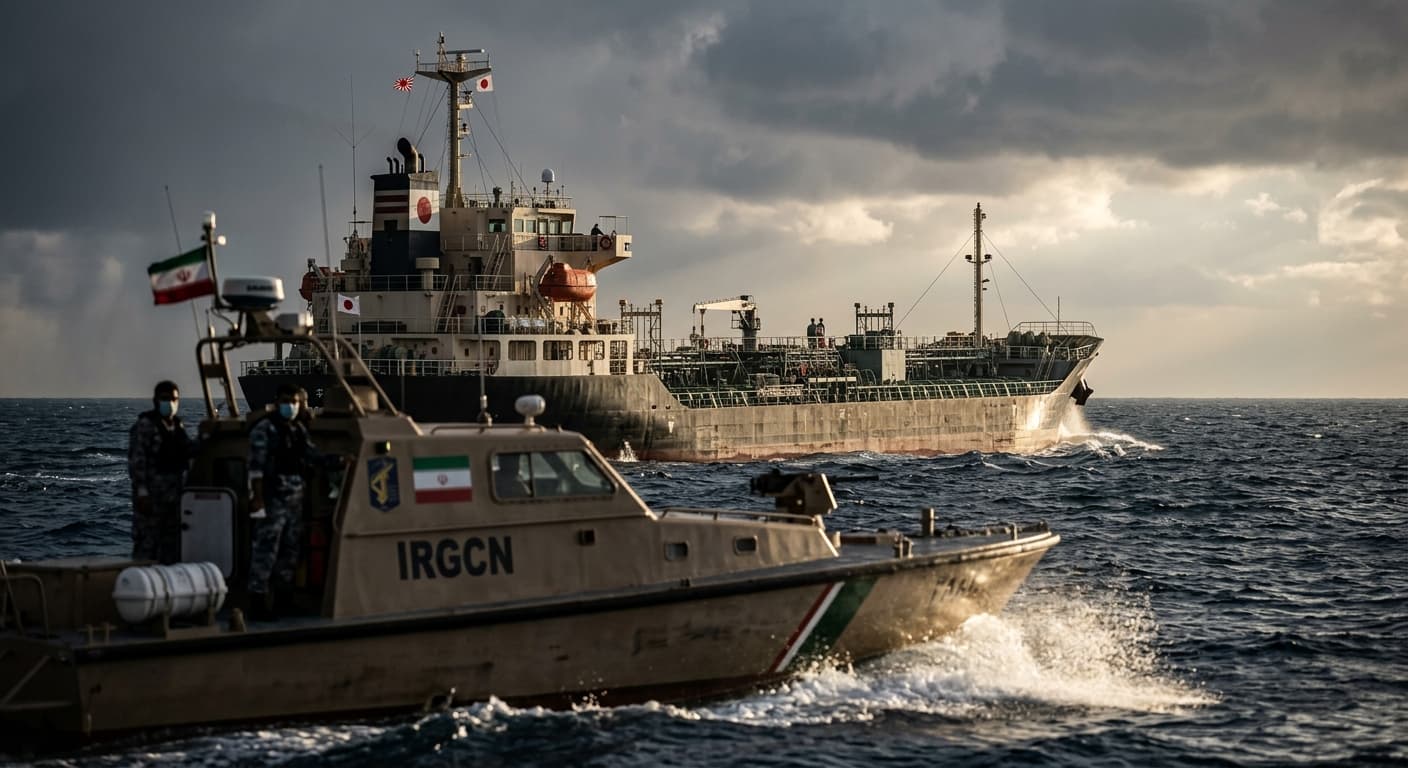
Japan's Hormuz convoy quietly ratifies Iran as the Gulf's gatekeeper
Ten MOL-linked ships exiting the Strait of Hormuz on July 6 via Iran's coast signal that Tokyo — and by extension the global oil market — now accepts Tehran's terms for passage.
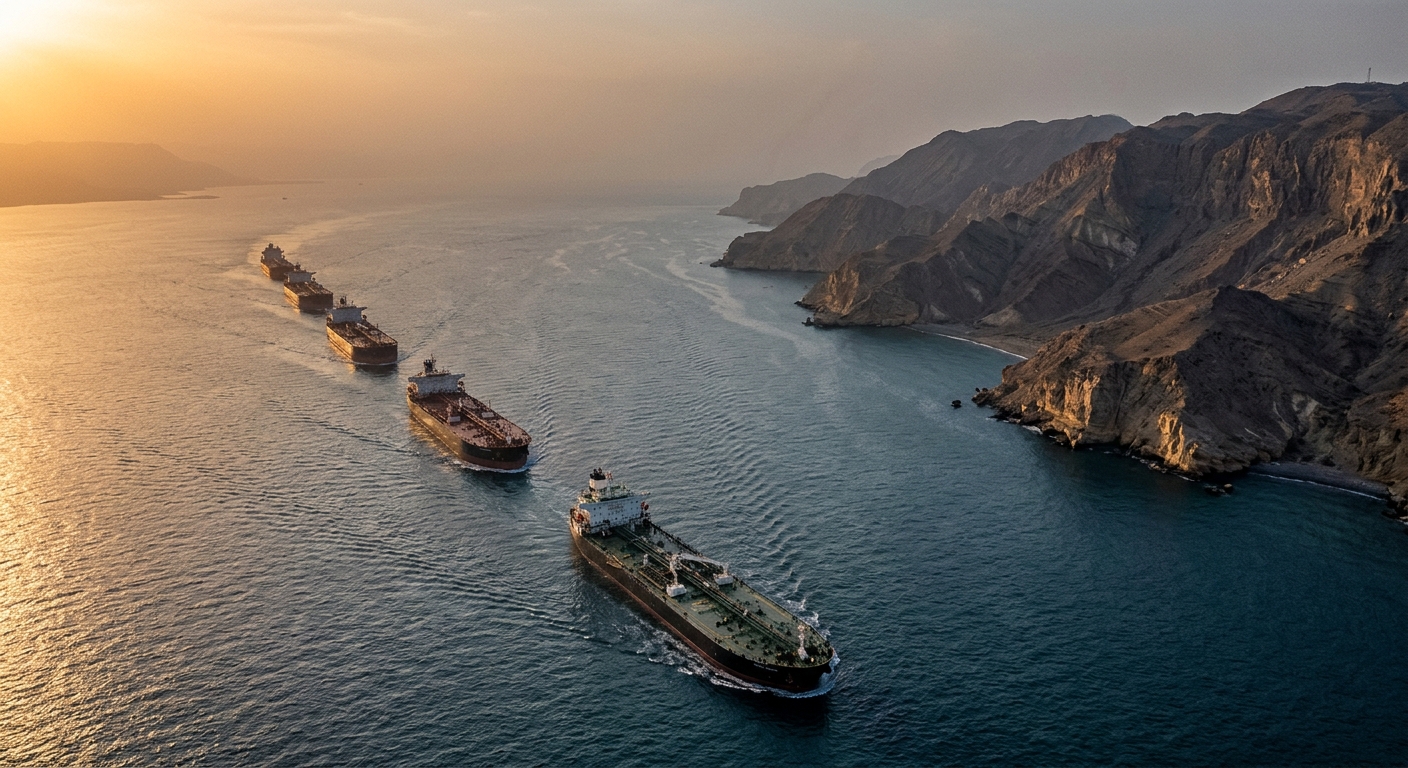
Ten Japan-linked vessels, most of them managed by Mitsui O.S.K. Lines and carrying roughly 12 million barrels of Saudi, Emirati and Qatari crude loaded before the war, sailed out of the Strait of Hormuz on July 6, 2026, hugging the Iranian coastline in convoy rather than the US-recommended Omani channel. According to Reuters shipping data, the fleet includes six very large crude carriers, two chemical tankers, a vehicle carrier and a container ship — the largest single Japanese-linked exit since Iran effectively closed the waterway on February 28. The convoy's route, not its cargo, is the story: Tokyo has quietly validated Iran's self-declared "gatekeeper" regime over the Strait of Hormuz, and it did so 42 days before Tehran's no-fee moratorium expires on August 17.
That validation matters because it undercuts the US, UK and French position — restated in a joint UK–France statement on July 3 — that no coastal state can dictate transit through what Washington still treats as an international waterway. When the world's third-largest oil importer routes its tankers along a corridor set by the Islamic Revolutionary Guard Corps (IRGC) rather than the US-patrolled southern lane, the argument that Iran's control is a temporary anomaly loses much of its remaining force.
What actually happened on the water
The vessels are the survivors of Japan's stranded Gulf fleet. When US and Israeli strikes on Iran began on February 28, Iran's Islamic Revolutionary Guard Corps warned it would set ablaze any ship crossing without permission, and traffic collapsed. According to a March analysis by the Center for Strategic and International Studies, at least 28 Japanese-owned tankers and cargo ships were trapped in or around the Gulf by mid-March, and a Mitsui OSK container ship was struck by an unidentified projectile some 97 kilometres from the strait on March 11.
The July 6 convoy is the payoff of four months of quiet diplomacy. Iranian Foreign Minister Abbas Araghchi told Japan's Kyodo News in March that Japanese ships could transit if Tokyo coordinated with Iranian authorities, framing the strait as "closed only to ships belonging to our enemies," according to Al Jazeera. The first Japan-linked crossing, MOL's LNG carrier Sohar LNG, followed on April 2. Since then MOL has moved cautiously, refusing to say publicly whether it paid any fee and insisting, in its statement to Reuters, that it would prioritise "safety of its seafarers, cargo and vessels."
Prior attempts at group transits ran into Iranian objections. As the Hindustan Times reported at the weekend, at least eight vessels attempting to leave along the Omani coast performed U-turns between Friday and Saturday, then switched to the Iranian side. That reversal — a fleet abandoning the US-preferred lane in real time — is the operational fact underneath Monday's convoy.
Iran's gatekeeper apparatus, formalised
The regime Japan is now working with is not improvised. On June 17, US President Donald Trump and Iran's President Masoud Pezeshkian signed a memorandum of understanding under which Iran committed to use its "best efforts for the safe passage of commercial vessels with no charge for 60 days," according to BBC Verify. Two days later, Iran's Persian Gulf Strait Authority (PGSA) — a body established by the Supreme National Security Council in May — published binding terms. "No vessel is permitted to pass through the Strait of Hormuz without a valid passage permit issued by the PGSA," it declared. The PGSA is itself under US sanctions.
The IRGC's vetting mechanism, described in detail by Lloyd's List, requires shipowners to submit IMO numbers, crew manifests, cargo type and final destination through intermediaries. Cleared vessels receive a code, are challenged by VHF radio on entry, and — for sensitive traffic — escorted by Iranian boats around Larak Island. According to
BBC Verify data, every transit through the strait in the days following the MoU used "the Iranian-approved northern route through Iranian waters, rather than the US-recommended southern route close to the coast of Oman."
Iran's ambassador to China, Abdolreza Rahmani Fazli, told the World Peace Forum in Beijing on Saturday that Tehran would introduce service fees on Hormuz traffic and offer "special treatment" for countries that supported Iran during the conflict, Al Jazeera reported. That is the emerging price of admission.
Why Tokyo had no other option
Japan's constraints are structural. According to the Congressional Research Service report The Strait of Hormuz in Brief, the strait is the only sea route out of the Persian Gulf. The
Japan Institute of International Affairs has documented Iran's legal position — that only "innocent passage," which can be conditioned and suspended, applies in the strait — and notes that neither Iran nor the US has ratified UNCLOS. That legal vacuum has become Iran's operating space.
Japan imports more than 90% of its crude from the Middle East. When the strait closed, Prime Minister Sanae Takaichi announced on March 16 the release of 80 million barrels — 45 days of consumption — from a 470-million-barrel stockpile, as documented in Al Jazeera's coverage of the government gazette notice. Brent hit $126 by late April. On May 4, Takaichi told reporters in Canberra that the closure was inflicting "enormous impact" across the Indo-Pacific; Japan later pledged $10 billion to help ASEAN states weather the disruption,
according to the BBC.
The bind was compounded by Washington. As the American Enterprise Institute's Desmond Lachman wrote in March, Trump asked Takaichi to help escort tankers through Hormuz; Tokyo declined military deployment but had "little room to refuse" other demands. India's Manohar Parrikar Institute described the resulting posture as
constrained alignment — support Washington rhetorically, compensate through economic and diplomatic hedging, and quietly cut its own deal with Tehran. The July 6 convoy is that hedge made visible.
The market has already voted
The clearest sign that Iran's soft control is being priced in as the new baseline is the oil curve itself. Brent September futures settled at $72 on July 6, below the pre-war close of $72.48 recorded on February 27. OPEC+ announced on Sunday that seven members — Saudi Arabia, Russia, Iraq, Kuwait, Kazakhstan, Algeria and Oman — will add 188,000 barrels per day from August, and Saudi Arabia's shipping volumes since June 17 have more than doubled the prior three months combined. The market is treating the Iran-managed corridor as functional, not provisional.
That leaves an awkward gap between physical reality and legal posture. UN Secretary-General António Guterres has called for the strait to reopen with "no tolls and no discrimination." Secretary of State Marco Rubio told reporters in Bahrain that "no country on Earth has the right to charge for the use of international waterways." A Bahrain-drafted UN Security Council resolution to reopen Hormuz "by all necessary means" was vetoed by Russia and China in April, Al Jazeera reported, splitting the P5 on the strait itself. Every US denunciation now runs into the fact that its most important Asian ally is using the very route Washington rejects.
Who wins from the convoy — and who loses
The immediate beneficiaries are Tehran and Beijing. Iran's leverage has been converted from a wartime threat into a going concern with a rulebook, a permit regime, and — soon — an insurance product denominated in cryptocurrency, per Fars reporting via Al Jazeera. China holds diplomatic upside in any "friendly nations" fee tier and, per Lloyd's List, has already brokered yuan-denominated transit payments.
The losers are the coastal states that share the strait but not the leverage. Oman, which co-proposed the 1968 Hormuz Traffic Separation Scheme with Iran at the IMO, has insisted that "future arrangements related to the strait do not involve imposing any transit fees." The UAE's ADNOC chief Sultan al-Jaber has called Iranian interference "economic terrorism." Yet the BBC's Bandar Abbas dispatch found two Panama- and Liberia-flagged container ships — the MSC Francesca and Epaminondas — still detained by the IRGC despite the ceasefire, a reminder that flag-state neutrality is no protection.
For the US, the second-order damage is precedent. If Tokyo can be induced to route around Washington's preferred lane while nominally staying inside the alliance, other Asian capitals — Seoul, Manila, Bangkok — have cover to do the same. S-Oil's VLCC Long Wind, carrying two million barrels of Saudi crude toward Onsan, exited the same weekend under identical conditions.
What to watch next
- August 17, 2026 — the 60-day no-charge window in the US-Iran MoU expires. Iran's ambassador to China has already telegraphed that service fees will follow. Whether MOL and Japan's Foreign Ministry contest the fees or quietly pay them will determine the next equilibrium.
- Multinational Military Mission deployment — the
UK-France July 3 statement commits both governments to "deploy the wider Multinational Military Mission to support freedom of navigation." Rules of engagement, and whether Japan joins even as an observer, will test how far Tokyo will go in reasserting the pre-war regime after taking the Iranian route.
- PGSA sanctions carve-outs — the US Office of Foreign Assets Control has not clarified whether payments to the sanctioned Persian Gulf Strait Authority expose insurers and shipowners to secondary sanctions. Absent guidance, war-risk premiums —
still 1–3% of hull value, versus 0.25% pre-war — will stay elevated and reroute more traffic around the Cape of Good Hope.
Diplomat View
The July 6 convoy is being reported as good news — Japanese ships out, oil prices down, war receding. Read it as the opposite: the moment the pre-war Hormuz regime died quietly, and a permit-based, Tehran-arbitrated one replaced it with the world's third-largest economy as its most important customer. Iran did not need to sink a tanker to win control of the strait; it needed one G7 ally to route ten ships through its corridor, and Japan delivered. The forecast: Iran will introduce formal service fees after August 17 at a level low enough to be tolerable and high enough to establish precedent, most Asian shippers will pay, and Washington will protest without escalating. This call breaks if the Multinational Military Mission deploys with escort authority and Tokyo joins it, or if a second attack in the strait forces MOL back to the Omani lane. Neither is the base case as of July 6.
Read today's full | | Related: Conflict coverage
Discover more
Global Politics
Xi Jinping Calls China-Russia Ties 'Precious'
Xi Jinping's description of China-Russia ties as 'precious' reflects a strategic imbalance, with Beijing dictating terms in the partnership.
US Politics
SNAP Food Assistance Faces Legal Challenges
In 2026, SNAP faces stricter eligibility rules and mounting legal challenges, threatening food assistance for the millions of Americans who rely on the program.
US Politics
U.S. House Passes Alert Act for Aviation
The House passed the ALERT Act 396–10, replacing the ROTOR Act after Pentagon intervention, impacting aviation safety regulations.

Economics
Fed's Amex AML order puts correspondent banking on notice
Federal Reserve's Amex AML order requires board-level controls and a 90-day plan; OCC fined the bank $350 million over enterprise-wide deficiencies.