U.S. House Passes Alert Act for Aviation
House votes on aviation safety bill after ROTOR Act defeat
Model Diplomat7 min readUnited States
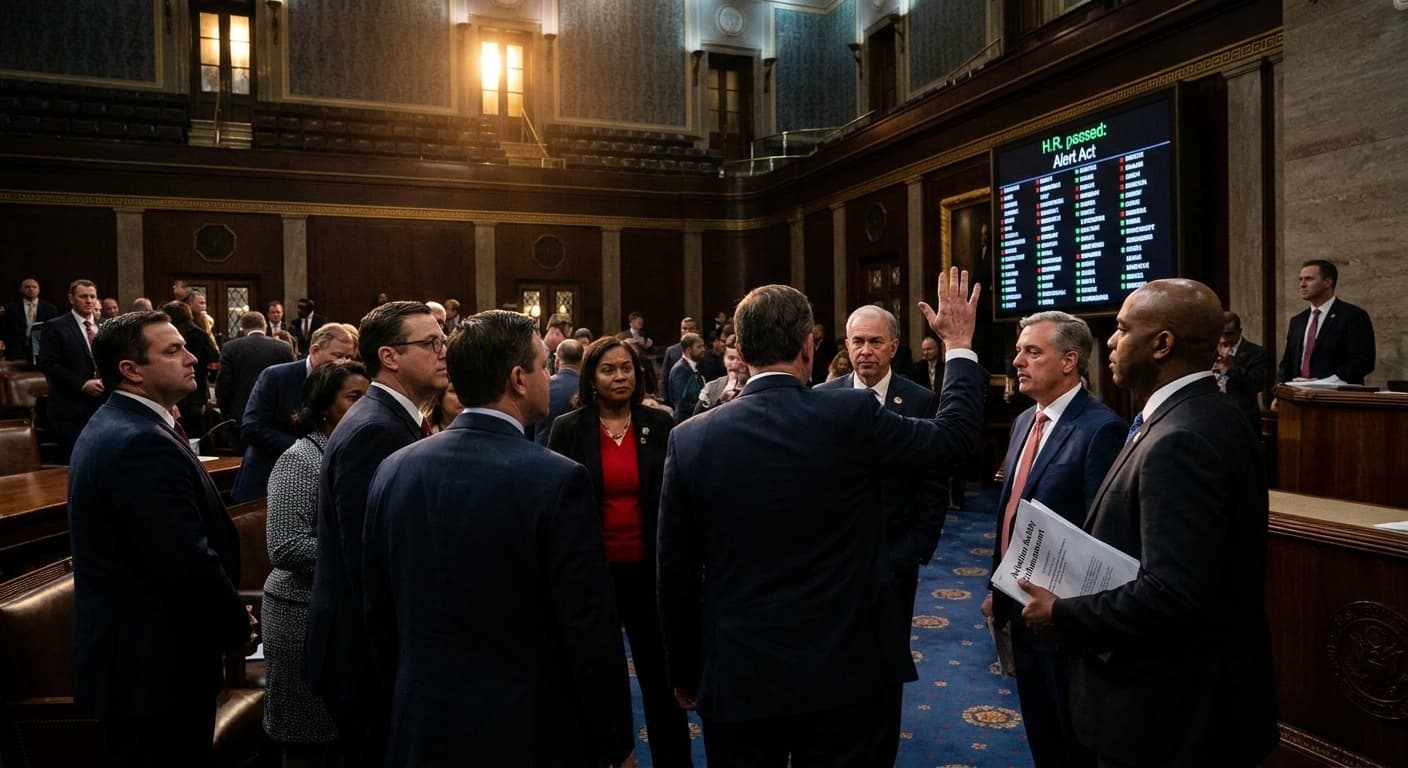
House Passes ALERT Act 396–10 After Pentagon Kills Senate Bill
The U.S. House passed the ALERT Act 396–10 on April 14, 2026, replacing the Senate's ROTOR Act after the Pentagon withdrew support. Here's what changed and what's next.
The House vote that mattered was not the 396–10 tally on the ALERT Act on April 14, 2026 — it was the 264–133 vote that killed the Senate's rival ROTOR Act ten weeks earlier, one vote short of the two-thirds needed under suspension of the rules. That February defeat handed the Pentagon a rewrite of the most consequential aviation safety bill in a decade — narrower military carve-outs preserved, ADS-B In mandates stretched to 2031, and jurisdiction pulled from Senate Commerce to the House Transportation and Infrastructure Committee chaired by Rep. Sam Graves. The families of the 67 people killed at Reagan National are getting a bill. They are not getting the one they helped write.
What the House passed
H.R. 7613, formally the Airspace Location and Enhanced Risk Transparency Act of 2026, cleared the House at 7:58 p.m. on April 14, according to the roll call posted by Congress.gov. The bill runs 130 pages and was drafted, as its sponsors state, to "respond to all of the 50 recommendations" the National Transportation Safety Board issued on January 27, 2026, in report AIR-26-02 on the crash of American Airlines Flight 5342 and Priority Air Transport 25, a U.S. Army UH-60 Black Hawk on a training mission.
The core mandate: by December 31, 2031, virtually every civil aircraft already required to carry ADS-B Out — the transponder that broadcasts position — must also operate ADS-B In, the receiver that lets a cockpit see other traffic on a screen. Department of Defense aircraft, other than certain special-mission platforms, face the same 2031 deadline. The bill also directs the FAA to establish supervisor time-on-position limits, notify parties to near-miss incidents, and re-evaluate the helicopter routes around DCA that the NTSB identified as the probable cause of the collision, per the GovTrack summary of H.R. 7613.
House Transportation and Infrastructure Chair Sam Graves, a working pilot, framed the bill in the committee's April 14 release as a comprehensive answer: "This aviation safety reform bill addresses the probable cause, the contributing factors, and all 50 of the NTSB's safety recommendations." Ranking Member Rick Larsen (D-WA), Armed Services Chair Mike Rogers (R-AL), and Armed Services Ranking Member Adam Smith (D-WA) co-authored the text — a rare four-corners bipartisan product in the 119th Congress.
Why the Pentagon rewrote the bill
The ROTOR Act was the families' bill. Sponsored by Sens. Ted Cruz (R-TX) and Maria Cantwell (D-WA), it passed the Senate by unanimous consent on December 17, 2025, as Congress.gov records. Its central provision repealed a 2025 statute that exempted certain military helicopters in the Washington metropolitan area from ADS-B Out — the same broadcast the Black Hawk was not transmitting on the night of the crash. Cruz, on the Senate floor, put it plainly: "This special carve-out was exactly what caused the January 29 crash that claimed 67 lives,"
as NPR reported in January 2026.
The Pentagon endorsed ROTOR in December. Then, just before the House vote, it reversed. The department warned that enactment "would create significant unresolved budgetary burdens and operational security risks affecting national defense activities," CBS News reported. Graves — who had called ROTOR "emotional legislation" in a January interview with Politico,
per NPR — used the Pentagon reversal to block the bill. On February 24, ROTOR fell 264–133, nine votes shy of the two-thirds threshold under suspension,
Congress.gov roll call 72 shows. Every Democrat but one voted yes. Republicans split 77–132 against.
Rep. Adam Smith, the Armed Services ranking member, telegraphed the reason on the floor on February 23. "Beyond the serious national security impacts of the ROTOR Act, the bill fails to address nearly 90 percent of the recommendations made by the NTSB," Smith said, per the Congressional Record. "The Department of War is requesting these changes be made before the ROTOR Act is signed into law. If we defeat this bill, we can have the ALERT Act on the floor the very next day."
That is not what happened. ALERT was introduced on February 20, 2026 — three days before Smith's floor speech, and four days before the ROTOR Act vote. The alternative was ready. The defeat was choreographed.
The angle: what the families lost
The delta between the two bills is the delta between a mandate and a rulemaking. ROTOR ordered ADS-B In and stripped the military exemption. ALERT orders the FAA to convene aviation rulemaking committees, issue notices of proposed rulemaking, and produce a final rule "not later than 2 years after the date of enactment," with an effective date "not later than December 31, 2031" — five years of process before a single retrofit is legally required. The engrossed text on Congress.gov preserves the Department of Defense special-mission exemption around Washington; it demands only that DoD "coordinate with DOT to conduct a safety risk assessment and implement appropriate mitigations."
The families noticed. In a statement issued the day of the House vote, relatives of Flight 5342 passengers warned that "the collision prevention technologies ALERT relies upon are not market ready and could take years to become widely available," per CBS. "Without installation-ready technology, broad waiver requests from industry will follow, and Congress will face immediate pressure to delay compliance rather than enforce it." Cruz, in his April 14 statement, said Congress "should not advance a bill that neither improves aviation safety nor closes the loopholes that have allowed operators, including the military, to fly blind in congested airspace."
The NTSB, notably, moved closer to the House position after amendments. In February the board said ALERT fell short of its 50 recommendations. After the T&I markup added language on ATC training, near-miss data and route review, the board said the amended bill would require DOT, DoD and the FAA "to take actions that, when completed, would address our recommendations," according to CBS's reporting. "When completed" is doing enormous work in that sentence.
What the NTSB actually found
The systemic case for urgency is on the record. The NTSB's January 27, 2026 finding, quoted verbatim in Section 2 of the bill, is stark: the probable cause was "the FAA's placement of a helicopter route in close proximity to a runway approach path; their failure to regularly review and evaluate helicopter routes and available data, and their failure to act on recommendations to mitigate the risk of a midair collision near DCA."
Contributing factors read as an indictment of every layer of the system: limitations of the collision-alerting systems on both aircraft; "an unsustainable airport arrival rate" at DCA; the Army's "lack of a proper safety management system, which should have identified and addressed hazards associated with altitude exceedances on the Washington, DC, helicopter routes"; and the FAA's "failure across multiple organizations to implement previous NTSB recommendations, including Automatic Dependent Surveillance-Broadcast In." The board has been asking for wider ADS-B In adoption since 2008 — more than a dozen times, NPR reported.
Investigators also documented what the BBC called a "faulty altitude gauge" on the Black Hawk, showing the crew flying 80 to 130 feet lower than actual altitude, per its August 2025 report. The controller in the DCA tower was managing local and helicopter traffic alone on the night of the crash. The Black Hawk crew, wearing night-vision goggles, likely never saw the regional jet before impact. Every one of these threads maps to a specific ALERT provision — but as a study, a rulemaking committee, or a deadline four presidential elections away.
What to watch next
H.R. 7613 was received in the Senate on April 15 and referred to Commerce, Science, and Transportation — Cruz's and Cantwell's committee. As of the Senate's June 29, 2026 legislative status page, the bill remains listed as "Advanced Action" pending in that committee. Cruz has publicly rejected the House product. Cantwell, in December 2025 floor remarks preserved in
the Congressional Record, called the earlier NDAA carve-outs "an unthinkable dismissal" of the 67 families. She is unlikely to rubber-stamp a bill that softens the military language further.
Three catalysts to watch:
- Senate Commerce markup of H.R. 7613 or a substitute — the committee's next open markup window in July 2026 is the earliest realistic vehicle. A Cruz–Cantwell substitute that restores the ADS-B mandate and narrows the DoD exemption would force a conference or ping-pong.
- FAA rulemaking calendar — Section 103 requires the FAA to work with RTCA to publish ACAS Xr minimum operational performance standards by December 31, 2026. Missed deadline, dead bill in practice.
- NDAA FY2027 conference — the House and Senate defense authorizers will again fight over military ADS-B language. Watch whether Section 373's successor in this year's bill preserves or dismantles the exemption ALERT keeps in place.
Diplomat View
The ALERT Act is a Pentagon veto dressed as a compromise. The Department of Defense torpedoed the ROTOR Act after endorsing it, and the House committee chairs — Graves at T&I, Rogers at Armed Services — obliged with a substitute that stretches ADS-B In compliance to 2031, keeps the Washington-area military helicopter exemption on the books, and converts the Senate's mandates into rulemakings. The 396–10 vote is bipartisan cover for a bill that, on its own text, does not force a single aircraft to install collision-avoidance receivers before this administration ends.
The forecast: a Senate substitute in July or September 2026 restores the ADS-B In mandate on a shorter timeline and narrows the military carve-out; the two chambers ping-pong through the fall; and a compromise reaches President Trump's desk before the January 29, 2027 anniversary because no member of Congress wants to face that date empty-handed. What would change this call: a Pentagon-brokered agreement that persuades Cruz to accept the House timeline verbatim, or a second fatal midair before Christmas. The families are betting on neither. They are lobbying for the first — and preparing for the second.
Related reading: U.S. Politics.
Discover more
US Politics
House Passes Short-Term Section 702 Extension
The House approved a short-term extension of Section 702 surveillance despite GOP pushback, exposing deep divisions over privacy and national security.
US Politics
House Passes Bill for Haitian Immigrant Prote
The House advances a bipartisan bill protecting Haitian immigrants under TPS, countering Trump-era policies and addressing the deepening crisis in Haiti.
US Politics
House Bill Extends TPS for Haitians 2023
The U.S. House advanced a bill to extend Temporary Protected Status for Haitians, shielding over 150,000 from deportation amid ongoing instability in Haiti.

Economics
Fed's Amex AML order puts correspondent banking on notice
Federal Reserve's Amex AML order requires board-level controls and a 90-day plan; OCC fined the bank $350 million over enterprise-wide deficiencies.