House Passes Short-Term Section 702 Extension
GOP resistance leads to brief extension of surveillance authority
Model Diplomat3 min readUnited States
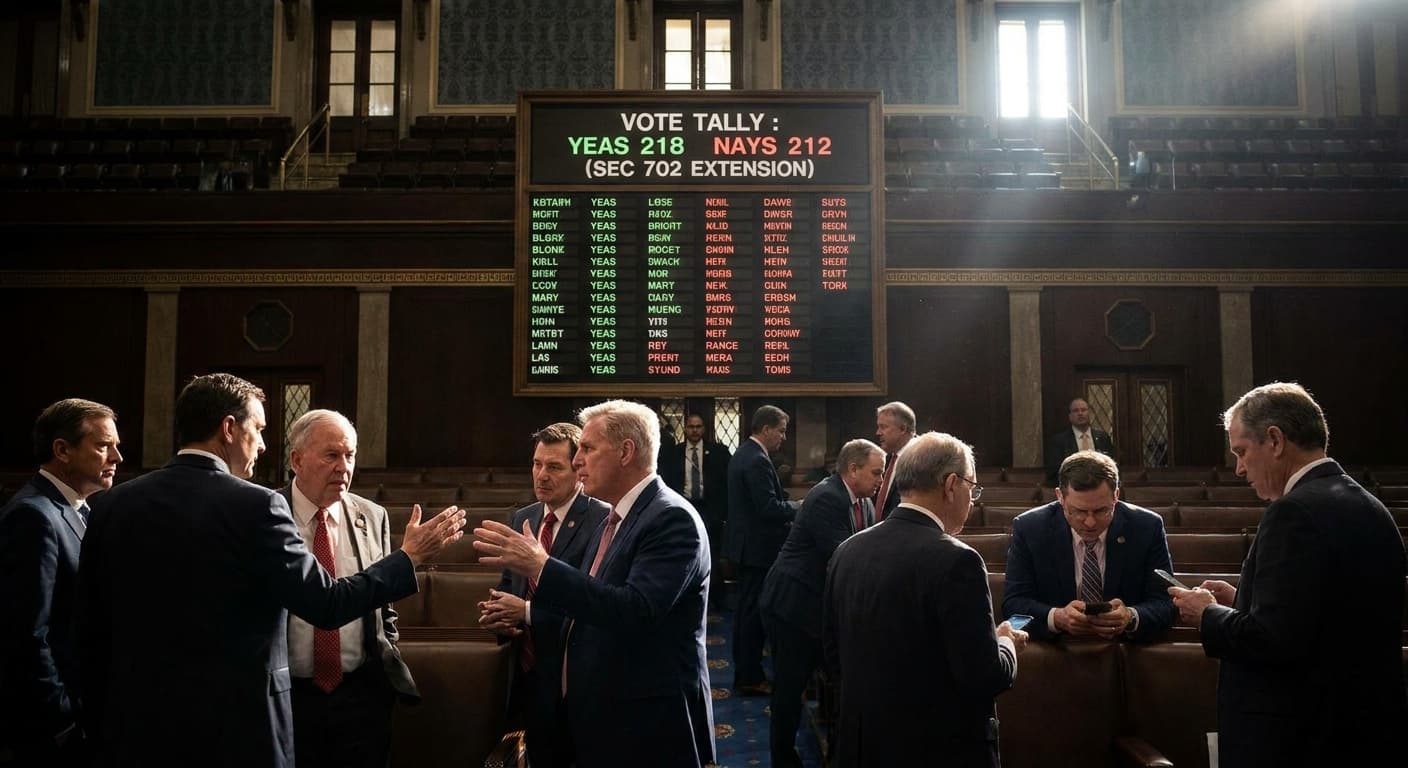
House Approves Short-Term Extension of Section 702 Surveillance After GOP Revolt
Congress passed a brief April 30 extension of Section 702 surveillance after a Republican pushback against longer renewals and Trump-era reform demands.
The House narrowly approved a short-term extension of Section 702 authorities—the legal backbone for U.S. intelligence agencies’ bulk collection of foreign communications—from the Foreign Intelligence Surveillance Act (FISA) on April 17, 2026. This move came amid a fractious debate in Congress and between the legislative branch and the White House, underscoring growing GOP resistance to prolonged or expansive surveillance authorizations.
Why This Matters: A Standoff Over Surveillance’s Future
Section 702, originally enacted in 2008, empowers the NSA and other agencies to intercept communications of foreign targets outside the U.S., with some incidental collection of American citizens’ data. It has been crucial in counterterrorism and espionage efforts but also highly controversial due to privacy concerns. The provision has sparked repeated debates on how much oversight and reform are needed.
This latest extension is a deviation from recent years’ norm of multi-year renewals. Instead, Republicans in the House revolted against not just the length but the overhaul proposals pushed by both the Biden administration and remnants of the Trump-era administration. Trump and some GOP lawmakers have sought more stringent restrictions on data use and retention, reflecting conservative concerns about government overreach, while the Biden administration generally favors a balanced approach with modest reforms aimed at transparency.
The short, roughly two-week extension until April 30 effectively punts a fuller debate into a politically sensitive window. This reflects deep divisions within the GOP ranks: some want to rein in the intelligence community’s reach, while others prioritize unencumbered national security tools. Democrats are meanwhile trying to thread the needle between privacy advocates’ demands and the operational needs of spy agencies.
Historical and Political Context
Section 702 has faced critical moments before, notably in 2017 and 2023, when legislative battles almost allowed it to lapse—once leading to a government shutdown scare. These moments expose the perpetual tension between surveillance for security and civil liberties in U.S. governance.
The GOP revolt echoes past skepticism that surged during and after the Trump administration, which arguably politicized intelligence and surveillance debates. Many conservatives remain wary of expansive electronic surveillance as a potential tool for political targeting or bureaucratic abuse, prompting efforts to impose meaningful reforms or at least delay long-term authority renewals.
This standoff also comes amid increasing public scrutiny of surveillance programs, fueled by whistleblower revelations over the past decade. The intelligence community’s reputation, while still strong in national security circles, is a subject of bipartisan caution in Congress.
What to Watch Next
The immediate near-term question is whether Congress can negotiate a more durable, bipartisan package by April 30. Given the fractured GOP caucus and Democratic pressure, new legislative proposals might include further transparency measures, tighter minimization procedures to protect Americans’ data, or sunset clauses ensuring periodic review.
The White House’s negotiation stance will be crucial—balancing national security demands with political realities on Capitol Hill. Any failure to reach an agreement risks a dangerous legal vacuum that could hamper U.S. intelligence capabilities during a period of intensified geopolitical competition.
For close watchers, this episode signals a broader political dynamic in U.S. surveillance policy: a persistent tug-of-war between liberty and security amplified by intra-party divides, shifting presidential priorities, and evolving public attitudes.
For more on U.S. politics and surveillance policy, see United States and
Global Politics.
House approves short-term extension of surveillance tool after GOP revolt
Discover more

US Politics
House Vote on Trump Iran Strikes Reveals Divs
The House narrowly declined to block Trump from striking Iran, a close vote that laid bare deep partisan divides over war powers and U.S. military action.

US Politics
GOP House Blocks Limits on Trump's Iran War
House Republicans narrowly defeated a resolution to limit Trump's war powers over Iran, intensifying the fight in Congress over presidential military authority.
US Politics
House Rejects Resolution on Trump's Iran Host
The House voted down a resolution to limit Trump's military actions in Iran, laying bare partisan divides and reigniting debate over presidential war powers.

Economics
Fed's Amex AML order puts correspondent banking on notice
Federal Reserve's Amex AML order requires board-level controls and a 90-day plan; OCC fined the bank $350 million over enterprise-wide deficiencies.