India–Australia Summit: Uranium and Defence
Melbourne summit strengthens ties with uranium and defence agreements.
Model Diplomat8 min readAsia-Pacific
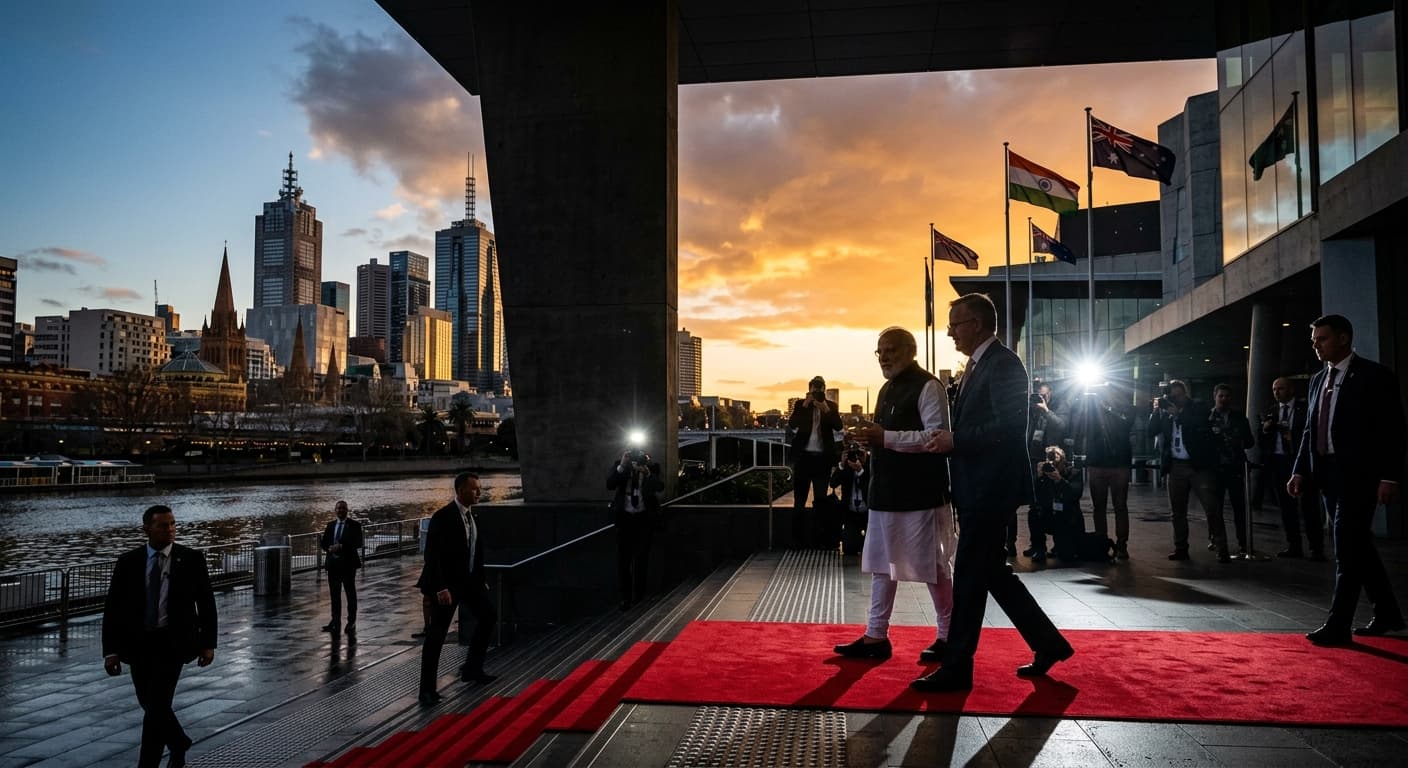
India–Australia Melbourne Summit: Uranium, Defence, Indo-Pacific Reset
The July 9, 2026 Melbourne summit produced a long-term uranium deal, a defence declaration and a Cocos Islands space terminal — a sharper Indo-Pacific alignment aimed squarely at China's chokepoints.
The Third India–Australia Annual Summit in Melbourne on July 9, 2026 did what a decade of communiqués had not: it converted the 2014 civil nuclear agreement into a binding long-term uranium supply, plugged the Indian Coast Guard into Australia's maritime border architecture, and put an Indian space-tracking terminal on the Cocos (Keeling) Islands astride the eastern approaches to the Malacca Strait. Read together, these are not decorative deliverables — they are the operational plumbing of an Indo-Pacific coalition that is now organising itself around Chinese chokepoints in energy, minerals and maritime data. The Melbourne summit's real significance is that it moves India–Australia from declaratory strategic partnership to a hard, dual-use logistics grid — one that Beijing will now have to price into its own calculations.
The uranium deal is the anchor, not the headline
Australia and India signed an "arrangement" permitting long-term Australian uranium exports for "exclusively peaceful purposes" under IAEA safeguards, according to Al Jazeera reporting from Melbourne. That formulation matters. The 2014 Civil Nuclear Cooperation Agreement signed by Modi and Tony Abbott had unlocked the legal possibility of trade, but as the Manohar Parrikar Institute for Defence Studies and Analyses noted at the time, actual flows depended on a still-unwritten "administrative arrangement" covering price, form and duration — see
MP-IDSA's contemporaneous analysis. It is that missing piece Melbourne has now filled.
Australia holds roughly 28% of the world's recoverable uranium — the largest single national reserve base — and Prime Minister Anthony Albanese framed the arrangement as one that "facilitates Australian uranium exports to India to help increase the share of non-fossil-fuel power capacity," per the same Al Jazeera dispatch. For India, the anchor is domestic: the Department of Atomic Energy's April 2026 factsheet published through
India's Press Information Bureau records that India has signed civil nuclear IGAs with 18 countries and is trying to sprint from a small installed base to a 100-gigawatt nuclear ambition by 2047, using Prototype Fast Breeder Reactor technology commissioned at Kalpakkam. Uranium diversification is the enabling variable. Canberra becomes India's fourth major supplier alongside France, Russia and Kazakhstan — and, after the March 2026 Modi–Carney reset,
Canada's Cameco.
The historical parallel worth flagging: Australia's Labor Party had blocked uranium exports to non-NPT states until Julia Gillard's 2011 policy reversal, which — as Al Jazeera's contemporary account records — was opposed at that party conference by one Anthony Albanese, then transport minister. Fifteen years later, the same Albanese has signed the enabling instrument. That is not hypocrisy; it is the measure of how completely China's post-2020 economic coercion of Australia rewrote Canberra's political constraints on India.
Defence: from dialogue to logistics grid
The Joint Declaration on Defence and Security Cooperation released at Melbourne institutionalises what the 2014 Framework for Security Cooperation and the 2020 Mutual Logistics Support Agreement had only sketched. The original architecture — annual defence ministers' meetings, bilateral maritime exercises, cooperation between the Indian Coast Guard and Australian border authorities — was set out in the Framework for Security Cooperation published by India's Press Information Bureau after Modi's 2014 Brisbane visit. What Melbourne adds is a Memorandum of Understanding between Australia's Maritime Border Command and the Indian Coast Guard, an Indian instructor slot at the Australian Defence College by 2028–29, and a Maritime Security Collaboration Roadmap — reported in detail by
Devdiscourse.
The Cocos Islands space-tracking terminal is the most consequential single item. As the Lowy Institute has argued, the Andaman and Nicobar Islands and the Cocos (Keeling) Islands sit north and south of the Sunda, Lombok and Wetar straits — the alternative routes into the Indian Ocean when the Malacca Strait is contested. Chinese research vessels have been mapping precisely this water column. Placing an Indian space-tracking node on Cocos is, in operational terms, an extension of the 2017 ISRO–Geoscience Australia satellite ranging arrangement at Yarragadee — the underlying
MoU is on the Indian MEA's legal treaty portal — but with far greater strategic weight, because Cocos itself is being repositioned as Australia's forward maritime patrol asset in the eastern Indian Ocean.
The Australian Institute of International Affairs' Dalbir Ahlawat and Abhishek Dadhich argued in the run-up to the summit that Australia's National Defence Strategy 2026 and India's Indian Maritime Doctrine 2025 pointed to precisely this "coordinated choke-point strategy of resilience and denial" across the Lombok, Malacca and Sunda straits — see the AIIA analysis. Melbourne appears to have delivered exactly the operational bridge they called for.
Trade: the CECA push and the critical minerals subtext
Bilateral trade tells the harder story about why Canberra needed this weekend. Two-way goods and services trade with India was A$54.4 billion in FY2024–25, and India was Australia's fifth-largest partner, according to Australia's Department of Foreign Affairs and Trade country brief. But the composition of Australian exports is what should focus policymakers: goods exports to China fell 11.2% in FY2024–25 to A$188.7 billion, while exports to the United States surged 44% to A$54.6 billion, per the
Australian Bureau of Statistics International Trade Supplementary release. India inched up 2.1% to A$35 billion. Canberra's China exposure is shrinking; its need for a second, non-Western customer for iron ore, coal, LNG, lithium and rare earths is now structural.
That is why Modi's pitch at the Australia–India CEOs Forum was aimed at closing a Comprehensive Economic Cooperation Agreement (CECA) to succeed the 2022 ECTA. The economic logic — critical minerals upstream in Australia, midstream capital and downstream demand in India — has been argued in detail by the Observer Research Foundation, which notes that ECTA already zero-rated Australian critical minerals into India but that "the partnership has yet to translate into joint processing projects." ORF's parallel
rare earths analysis argued that a genuine mine-to-magnet chain requires Australian upstream expertise plus Indian scale — the precise gap that Melbourne's proposed defence innovation framework and CECA architecture are meant to fill.
The urgency is dated. Beijing's suspension of its April 2025 rare-earth and magnet export controls expires on November 10, 2026, as ISPI's Soumya Bhowmick warned in a piece published this week — and the
United States Studies Centre reports that if controls snap back, Chinese leverage over gallium, rare-earth magnets and battery inputs will tighten sharply. The May 2026 Quad Critical Minerals Framework promised US$20 billion in public and private capital to unlock non-Chinese supply. Melbourne is the bilateral chassis on which that Quad framework gets built.
Who wins, who loses
The clearest winners are Australian uranium and lithium producers — companies like Cameco-linked ventures, Toro Energy, and Pilbara Minerals — that now have a second sovereign-scale buyer at a moment when 95% of Australia's lithium exports still go to China, per the USSC. Indian manufacturers of permanent magnets and EV batteries —
81.3% dependent on Chinese permanent magnets in 2024–25 according to ORF — win a second-source insurance policy. The Nuclear Power Corporation of India Ltd gets long-tenor fuel security for its imported and indigenous reactor fleet.
The losers are less visible but real. Beijing loses optionality: the Cocos terminal narrows the anonymity of Chinese naval and research operations across the Sunda–Lombok arc, and long-term Australian uranium contracts remove one of the last levers by which China's demand dominance shaped commodity pricing power in Canberra. Pakistan loses a plank of its argument at the Nuclear Suppliers Group, where India's growing web of NSG-consistent civil nuclear pacts — now 18 IGAs deep, per India's Department of Atomic Energy — makes Islamabad's case for parallel exemption harder. Domestic Australian anti-nuclear campaigners, whose 2011 defeat the current Prime Minister once championed, lose again.
Washington is a paradoxical case. On paper, the Trump administration's Indo-Pacific team benefits from allies operationalising the Quad Critical Minerals Framework it signed in May 2026 — the India–US bilateral critical minerals framework sits alongside this. In practice, as the
Lowy Institute's Shruti Pandalai argued this week, the more interesting subplot is that "the US is no longer taking on the onus of organising and coordinating cooperation" — India, Australia and Japan are increasingly self-organising a maritime arc that no longer requires American convening power. That is a strategic gain for burden-sharing, and a subtle loss of American centrality.
The historical parallel
The closest precedent is not the 2014 Framework for Security Cooperation but the 2007 Malabar-plus exercise that briefly included Australia before Canberra pulled back under Chinese pressure. Melbourne is the anti-2008 moment: an Australian government publicly compounding — rather than trimming — its Indo-Pacific commitments in the face of Chinese displeasure. The 2020 Comprehensive Strategic Partnership set out the ambition; the Framework for Security Cooperation of 2014 had already anticipated "early operationalization of civil nuclear energy cooperation" and "regular bilateral maritime exercises" between the Indian Coast Guard and Australian border authorities. Twelve years on, those clauses are finally live instruments rather than aspirations.
Diplomat View
The Melbourne summit is best read not as a bilateral upgrade but as the moment India–Australia became the load-bearing spine of the Quad's practical agenda. Our forecast: by end-2027, this bilateral produces the first non-Chinese mine-to-magnet rare-earth line in the Indo-Pacific, and the Cocos terminal is operational as a dual-use maritime-domain-awareness node integrated with India's Information Fusion Centre–Indian Ocean Region. The forecast is falsifiable. It would be revised down if: (a) the CECA slips past mid-2027 without a substantive investment chapter; (b) an incoming Modi-successor government dilutes Indian participation in Quad operational architecture in the name of strategic autonomy; or (c) Beijing offers Canberra a partial rare-earth market détente in exchange for narrowing the Cocos arrangement. The Indian domestic politics of nuclear liability and the Australian domestic politics of foreign investment screening are the two most likely friction points.
The load-bearing claim is simpler: China's leverage in the Indo-Pacific has an off-switch, and Melbourne is where a large piece of it was quietly wired up.
What to watch next
- November 10, 2026 — Expiry of Beijing's suspension of rare-earth and battery-supply export controls; the moment the Melbourne bet gets stress-tested.
- End-2026 — Deadline both sides implied for advancing the Comprehensive Economic Cooperation Agreement; watch the investment and services chapters.
- Q1 2027 — First Annual Defence Ministers' Dialogue under the new Joint Declaration; the operational test of whether the Maritime Security Collaboration Roadmap has teeth.
The Bottom Line
The Melbourne summit converts the India–Australia partnership from strategic vocabulary into strategic infrastructure — uranium under IAEA safeguards, a Cocos Islands space-tracking node, and an Indian Coast Guard–Maritime Border Command MoU that together tighten the eastern Indian Ocean against Chinese coercion. The decisive number is 28% of world uranium reserves now committed to long-term supply for the fastest-growing large nuclear programme on earth. If the CECA closes and the Cocos terminal goes operational, this will be remembered as the summit that made the Quad's practical agenda finally executable — with or without American convening power.
Discover more

US Politics
SNAP Food Assistance Faces Legal Challenges
In 2026, SNAP faces stricter eligibility rules and mounting legal challenges, threatening food assistance for the millions of Americans who rely on the program.
India
Romanian Coalition Party Demands PM Resign
Romania's Social Democrats withdrew from coalition, joining far-right AUR to topple PM Bolojan, risking €10 billion in EU funds by August 2026.

India
CPI MP Accuses PM Modi of MCC Violations
CPI MP P Sandosh Kumar alleges PM Modi breached the Model Code of Conduct in Tamil Nadu, raising election integrity concerns before the 2026 Assembly polls.

Economics
Fed's Amex AML order puts correspondent banking on notice
Federal Reserve's Amex AML order requires board-level controls and a 90-day plan; OCC fined the bank $350 million over enterprise-wide deficiencies.