India, Indonesia Forge Critical Minerals Pact
New agreements aim to reduce reliance on China for resources.
Model Diplomat7 min readAsia
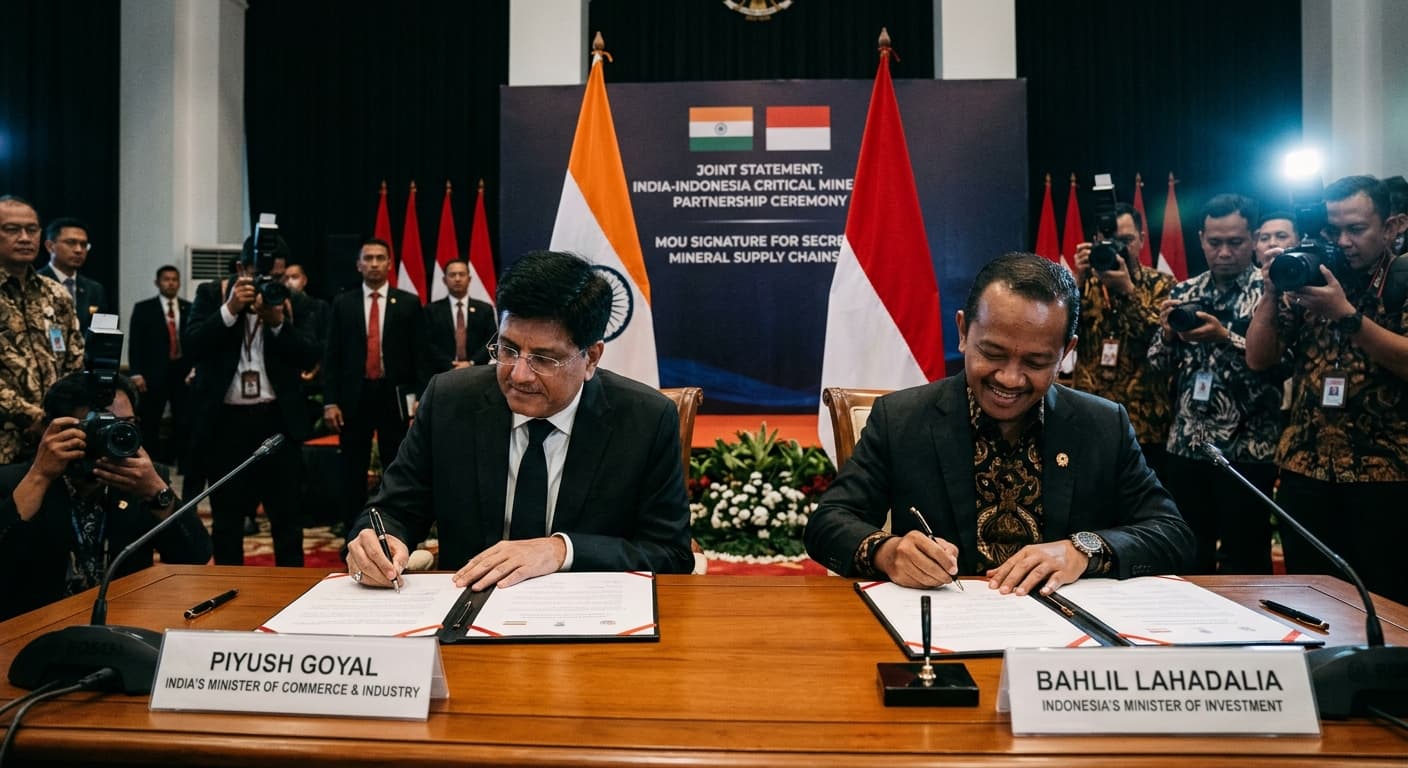
India and Indonesia Bet on Critical Minerals to Break China's Grip
Modi and Prabowo signed roughly a dozen agreements in Jakarta on July 7, 2026, anchoring a South-South critical-minerals axis aimed squarely at Beijing's rare-earth chokehold.
The dozen agreements Prime Minister Narendra Modi and President Prabowo Subianto signed in Jakarta on July 7, 2026 amount to something larger than a bilateral upgrade: they are the first serious attempt by two Global South powers to build a nickel-to-magnet supply chain outside Chinese control — and the reason it is happening now is that Beijing spent 2025 proving it would weaponise both. India, the world's third-largest holder of rare-earth reserves but under 1% of production, needs Indonesia's ore; Indonesia, whose nickel sector is 65–75% owned by Chinese firms, needs a non-Chinese offtaker with scale. Whether the Comprehensive Strategic Partnership can deliver refineries, not just MoUs, will determine whether the electric-vehicle transition tilts back toward diversified supply — or hardens into a single-supplier world.
The Jakarta package, in specifics
Modi's stop in Jakarta — the first leg of a three-nation Indo-Pacific tour that continues to Auckland and Melbourne — produced roughly a dozen agreements spanning critical minerals, defence, health, food security, digital payments, and maritime security, according to Rediff Moneynews and
The Hindu BusinessLine. The load-bearing item is a memorandum between India's Non-Ferrous Materials Technology Development Centre (NFTDC) and Hyderabad-based Midwest Advanced Materials on one side, and Indonesia's state-linked PERMINAS on the other, to develop rare-earth exploration and processing. Defence sits alongside it: New Delhi committed to supply BrahMos supersonic cruise missiles to Indonesia's military, per
OrissaPOST, converting an eighteen-month negotiation into a firm sale.
The critical-minerals piece is not decorative. India's National Critical Mineral Mission, approved by the Union Cabinet on January 29, 2025, put Rs 16,300 crore in direct budget and an additional Rs 18,000 crore from public-sector undertakings behind exploration, overseas asset acquisition, and refining, according to the Press Information Bureau. It explicitly mandates Khanij Bidesh India Ltd. (KABIL) to secure overseas mineral assets — a mandate that has, until now, produced one lithium-block agreement in Argentina's Catamarca province and preliminary due diligence in Australia. Indonesia is by far the largest resource fit KABIL has ever pursued.
Why now: Beijing pulled the trigger, twice
The Jakarta accord was not a scheduled deliverable. It was manufactured by two Chinese decisions.
On April 4, 2025 — two days after President Donald Trump's "Liberation Day" tariff announcement — China's Ministry of Commerce placed export licensing controls on seven medium and heavy rare earths, including samarium, dysprosium, and terbium, according to the Swedish Institute of International Affairs. Rare-earth magnet exports fell 73% in May 2025. Bajaj Auto's flagship Chetak electric scooter output collapsed from 20,384 units to 10,824 units in July 2025,
Al Jazeera reported. Maruti Suzuki flagged production bottlenecks. Chinese customs data show rare-earth magnet exports to India fell 58% between January and August 2025, per the
Vivekananda International Foundation.
Then on October 9, 2025, MOFCOM Notice No. 61 extended the regime extraterritorially: any foreign product containing even 0.1% Chinese-origin rare earths, or made with Chinese processing technology, now requires a Beijing licence. India, which imported roughly 54,000 tonnes of rare-earth magnets in FY 2024–25 with 93% sourced from China, was left staring at a strategic vulnerability its policy establishment had catalogued for a decade and done relatively little about.
The asymmetry that makes this deal work
India brings demand and capital; Indonesia brings the resource base. That is the classic frame — and it undersells what is actually novel here.
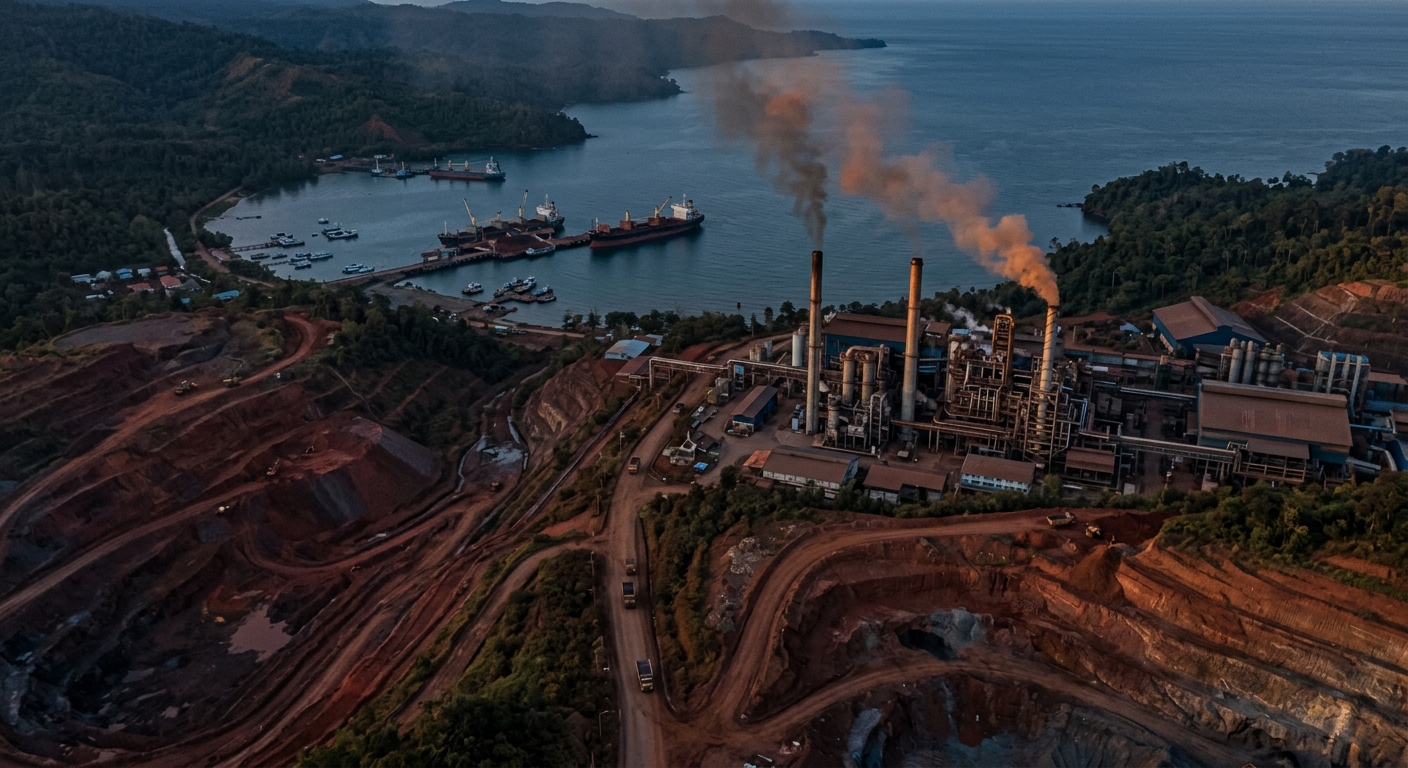
Indonesia produces about 60% of the world's mined nickel and processes close to 45% of primary nickel, per Observer Research Foundation analysis. But Indonesian firms own only around 10% of that refining capacity; Chinese groups, principally Tsingshan and Jiangsu Delong, control the rest. A 2026 SOAS case study puts Indonesia's nickel reserves at 62 million metric tonnes — roughly 44% of the global total — and notes that in
February 2026 Indonesia formalised a critical-minerals trade framework with the United States, part of Jakarta's deliberate move to diversify beyond Beijing.
The India deal is the second leg of that diversification. For Prabowo, adding Indian offtake to a sector convulsed by the 2024 nickel-price crash — Indonesian oversupply cut global average prices 21% and forced BHP to shutter Western Australian mines — provides demand insurance. For Modi, it converts a bilateral relationship long weighted toward Indonesian palm oil and coal (India runs a $17 billion trade deficit with Indonesia) into a structural stake in the battery supply chain. India is subsidising 50 GWh of battery-cell factories under its Production-Linked Incentive scheme, according to Observer Research Foundation, and those cells need nickel.
The rare-earth MoU is the more surprising item. Indonesia is not a top-tier rare-earth producer, but peer-reviewed geochemistry work published in DOAJ documents significant HFSE and REE enrichment in the laterite deposits of West Sulawesi's Mamuju region. The NFTDC–Midwest partnership already produces rare-earth magnets domestically using molten-salt electrolysis technology, per the
Press Information Bureau; linking that capability to Indonesian laterite feedstock is the first move toward an integrated Indo-Pacific magnet chain that does not touch Chinese soil.
Who wins, who loses, and who is quietly nervous
The obvious loser is Beijing's leverage. If India's magnet Production-Linked Incentive scheme — a Rs 73 billion ($800 million) package approved in November 2025 to produce 6,000 tonnes of permanent magnets a year by the early 2030s, per the BBC — lands on Indonesian ore rather than Chinese oxide, one of Beijing's cleanest coercive levers loses its edge over the world's third-largest auto market.
The less obvious loser is Australia. Canberra has spent years positioning itself as India's rare-earths partner of choice through the Economic Cooperation and Trade Agreement and the Minerals Security Partnership. It still holds that position for lithium, cobalt and heavy rare earths. But an India–Indonesia processing corridor built on cheap Indonesian coal power and Chinese-built pyrometallurgy plants will undercut Australian project economics on the light-rare-earths side. Modi's onward stops in Melbourne and Auckland will need to sell the Jakarta package as complementary, not competitive.
The quietly nervous party is Washington. The United States negotiated its own critical-minerals framework with Prabowo in July 2025, part of a tariff-reduction bargain. But Indonesia has since joined BRICS and is now stitching parallel arrangements with India, Britain (via a
UK–Indonesia MoU on nickel, cobalt, lithium, graphite and rare earths), and the European Union under its Critical Raw Materials Act. Prabowo is not choosing sides; he is charging rent to all of them. That is precisely what the
Non-Aligned Movement's founding city — Bandung, 1955 — was built on.
The structural problem no MoU can fix
Two facts constrain the ceiling.
First, India's midstream is thin. As Observer Research Foundation's work on midstream capacity documents, KABIL "lacks independent financing capacity and relies on equity contributions from its parent public sector undertakings, which have limited midstream experience." NITI Aayog's February 2026
Critical Mineral Assessment recommends recapitalising KABIL and building clustered refining hubs — a to-do list, not an accomplishment. Signing an MoU with PERMINAS in Jakarta is easier than commissioning a high-pressure acid leach plant in Sulawesi.
Second, Indonesia's own regulatory pattern is jagged. In 2025 Jakarta proposed raising nickel royalties from a flat 10% to a progressive 14–19%, cut smelter quotas under revised RKAB approvals, and mandated that foreign-exchange earnings from mineral sales stay in Indonesian banks for a year. A SOAS analysis warns that the industry increasingly "resembles the extractive enclaves that resource nationalism originally sought to overcome." Indian firms entering under Prabowo will face the same policy volatility that has already spooked some Chinese and Western investors.
Bilateral trade sits at roughly $30 billion; the leaders' stated ambition, per the NUS Institute of South Asian Studies, is to double it toward $80 billion, with a $100 billion stretch target by 2030. That gap is what the mineral, defence, and UPI-payments agreements are meant to close.
What to watch next
- August 2026: Indonesian defence delegation to India. The BrahMos contract's commercial terms — unit price, technology transfer, indigenous-content quotas — will be inked here. Any slippage signals that the Jakarta package is thinner than announced.
- Late 2026: First KABIL–PERMINAS project selection. Watch for a specific Sulawesi or Halmahera site; anything short of that keeps the rare-earths MoU in signalling territory.
- G20 South Africa summit, November 2026. India and Indonesia are expected to co-sponsor Global South language on critical-minerals traceability and ESG standards — the diplomatic overlay on the commercial architecture.
- India's magnet PLI first-tranche awards, expected Q1 2027. These will show whether NFTDC–Midwest and other bidders can scale to the 6,000-tonne target — the demand signal Indonesian upstream needs.
Diplomat View
The Modi–Prabowo package is a hedge that will only work if it becomes a plant. Rare-earth MoUs signed in state palaces do not separate dysprosium from monazite; hydrometallurgical refineries do, and neither country has built one at commercial scale outside of China's shadow. Our call: the critical-minerals chapter of this partnership will underperform its 2030 targets — expect Indian magnet output near 3,000–4,000 tonnes, not 6,000 — but it will succeed strategically by giving Jakarta a credible non-Chinese offtaker and Delhi a credible non-Chinese feedstock. That is enough to blunt the sharpest edge of Beijing's October 9, 2025 export-control regime, though not enough to escape it. The forecast revises if two conditions change: KABIL is recapitalised as a co-investor with Indian private firms (a NITI Aayog recommendation still awaiting cabinet action), and Prabowo holds royalty and export-proceeds rules steady through 2028. Absent either, the Jakarta accord joins the long list of India-Indonesia joint statements — grand in vocabulary, modest in tonnage.
The bottom line: India and Indonesia are not building an alternative to China's critical-minerals monopoly. They are building the first credible option that lets buyers walk away from it — and that option's value rises every time Beijing tightens a licence.
Related: India.
Discover more
US Politics
House Ethics Committee Pushes Sexual Miscond.
The House Ethics Committee has shifted responsibility for sexual harassment settlement records to the Office of Congressional Workplace Rights, complicating disclosure efforts.

US Politics
SNAP Food Assistance Faces Legal Challenges
In 2026, SNAP faces stricter eligibility rules and mounting legal challenges, threatening food assistance for the millions of Americans who rely on the program.
International Relations
Economist Impact Sustainability Week 2026
Economist Impact Sustainability Week 2026 spotlights the energy transition, AI in clean technology, and supply chain resilience as themes for global leaders.
Conflict & Security
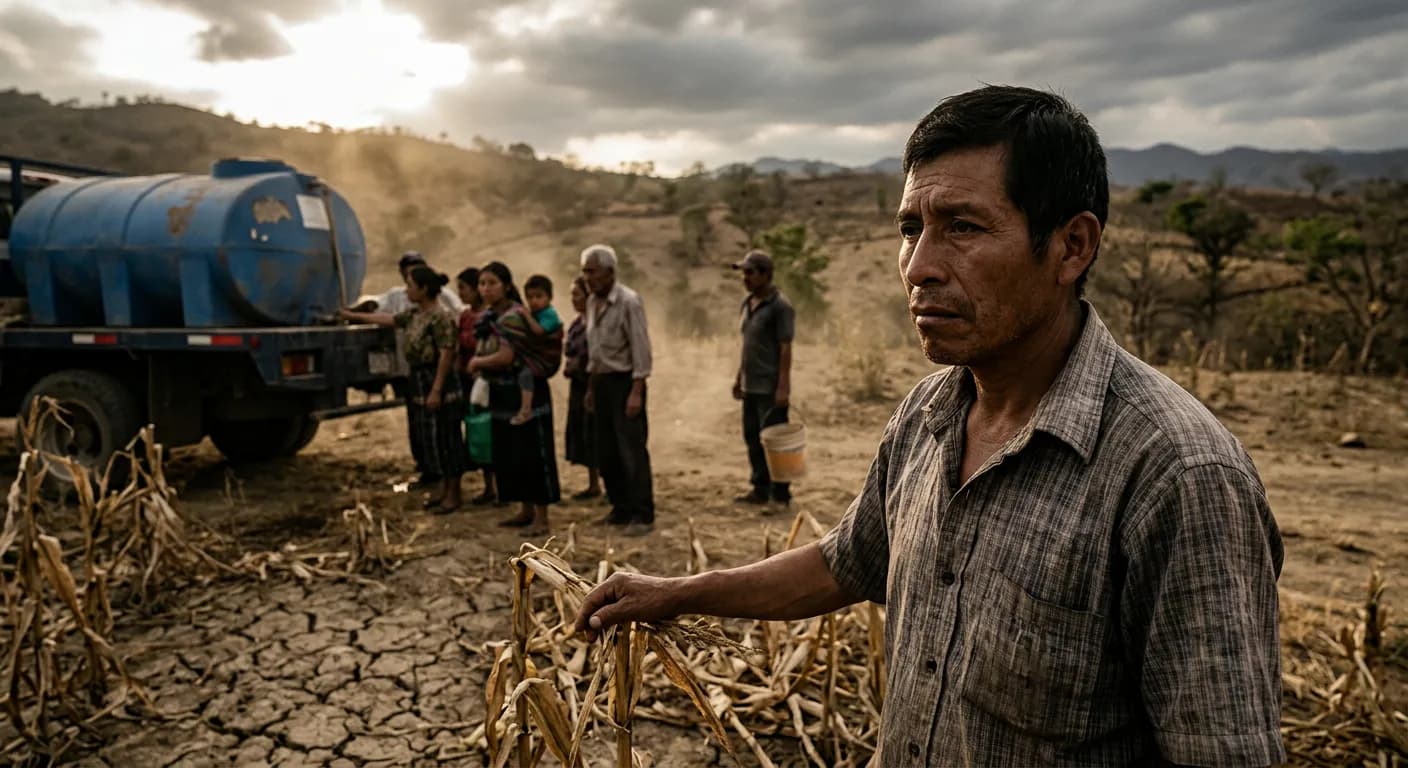
Guatemala: El Niño 2026–27 becomes regional security test
UNICEF: 25.8M children face El Niño risks in Latin America; Guatemala maps 188 municipalities for drought and food insecurity amid regional security test.