Canada-Japan Minerals Pact: $1B Hedge
A strategic deal to secure critical minerals supply chains.
Model Diplomat7 min readAsia-Pacific
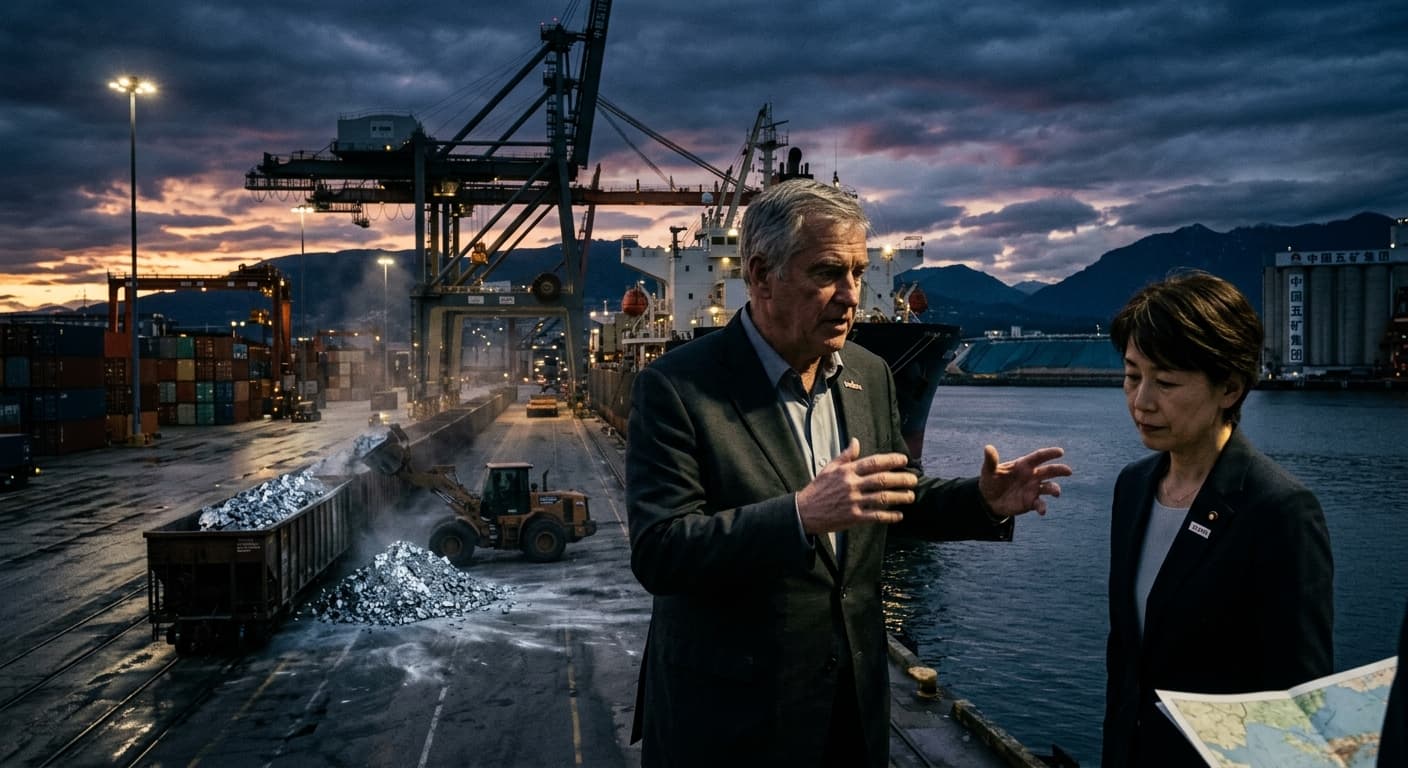
Canada-Japan critical minerals pact: a $1bn hedge against Beijing
Ottawa and Tokyo signed C$1 billion in critical-minerals deals on July 7, 2026, anchoring a de-China supply chain around Canadian gallium, germanium and antimony.
The Canada–Japan critical minerals pact sealed in Tokyo on July 7, 2026, matters less for its C$1-billion sticker price than for what it locks in: a decade-long offtake architecture that turns Trail, British Columbia into the West's designated substitute for the three minerals — gallium, germanium and antimony — that Beijing has already banned from reaching the United States. The pact converts Japan's economic-security doctrine into hard Canadian project finance, and it does so by copying, not opposing, the tools Washington used to squeeze China in the first place.
What was actually signed
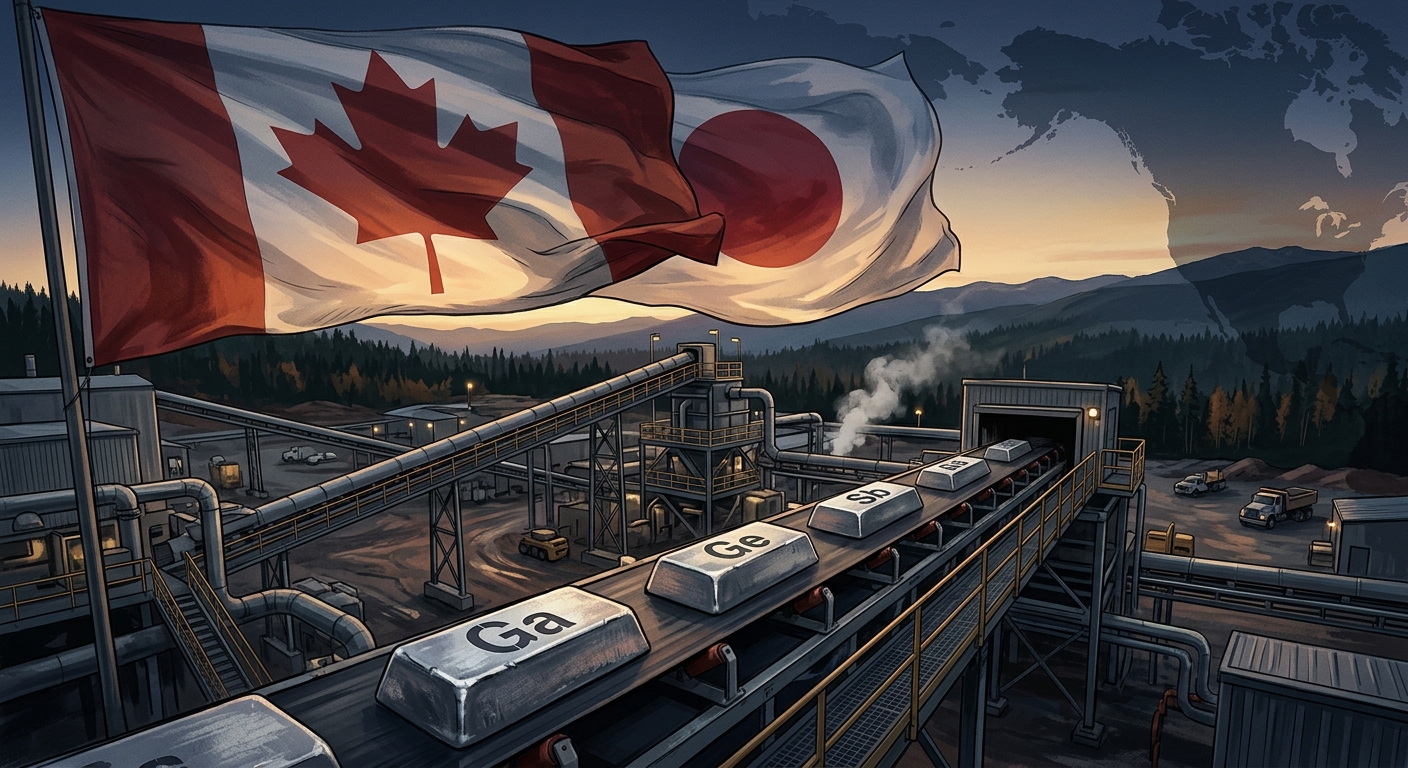
The centrepiece is not the C$1 billion in commercial paper between roughly 180 Japanese and Canadian firms, but a Strategic Investment Agreement signed the day before between the newly created Canada Critical Minerals Accelerator, the Canada Growth Fund and Teck Resources. Ottawa disclosed an equity-like commitment of "up to $400 million directly into the facility" at Teck's Trail Operations in British Columbia, part of an up-to-$850-million total Teck investment that "could double Trail's existing production capacity for germanium and antimony and potentially add new gallium production capacity." Crucially, the same release confirms the government has secured negotiating rights "for a portion of future germanium, antimony and gallium produced by Trail" — an offtake structure that mirrors Japan's own JOGMEC model.
The Team Canada mission, the largest Ottawa has ever sent to the Asia-Pacific, timed the announcement to the trade-mission floor in Tokyo, where the two governments also opened talks on a mutual stockpiling arrangement for gallium and graphite, as reported by AL Circle. That stockpiling language echoes almost verbatim the
US–Japan Framework signed in Tokyo on October 28, 2025, whose Article 8 commits Washington and Tokyo to "consider a mutually complementary stockpiling arrangement" — the same phrase Ottawa is now adopting.
Why Trail, why now
Trail is one of a handful of Western sites that already produces germanium as a zinc-smelting by-product. Under the Government of Canada's own value-chain map, Canada currently produces gallium only through recycling and germanium in small volumes; there are "few entities that specialize in processing these critical minerals to the high-purity levels needed for semiconductor fabrication." Doubling Trail's output and adding primary gallium therefore reshapes the Western supply picture from a rounding error into a strategically meaningful node.
The timing is dictated by Beijing. According to a 2025 report by the Swedish Institute of International Affairs, Chinese exports of unwrought gallium have been near-zero throughout 2025 with European prices up 365 percent; wrought germanium exports fell 60 percent with prices rising 400 percent; antimony prices spiked 437 percent. The
CSIS gallium study documents that on January 2, 2025, Beijing quietly added the ion-exchange and resin technologies used to extract gallium from bauxite to its export-control catalogue, and that exports of the high-performance resin itself "have ceased entirely" — closing off the cheapest route for any newcomer to replicate Chinese processing.
The Japanese calculus
Japan's participation is not opportunistic; it is doctrine. According to the European Parliamentary Research Service, China's October 9, 2025 second wave of rare-earth controls asserted extraterritorial reach for the first time — a 0.1-percent de minimis threshold that would require foreign firms to seek Beijing's approval to export magnets containing even trace Chinese-sourced material. That wave was suspended until November 10, 2026 after the Xi–Trump meeting, but the licensing regime remains, and Beijing has separately targeted Japan directly:
CSIS notes that after Prime Minister Sanae Takaichi's remarks on a Taiwan contingency, China restricted "dual-use" items to Japan on January 6, 2026, forcing Nissan and Suzuki to report supply disruptions and Suzuki to suspend its Swift model.
Tokyo has been reducing its rare-earth dependency on China from roughly 90 percent in 2009 to about 60 percent today — a two-decade project — but as the Brookings Institution argues, further reductions require government purchase guarantees "outside normal market mechanisms," because Chinese suppliers can crush new entrants on price. That is exactly what Ottawa's new offtake rights at Trail deliver: a state-backed anchor buyer that lets Teck raise capital against a floor Japanese and Canadian government demand.
The buyers' club is coming into view
Trail is the pilot for a broader Canadian design that Ottawa officials have called a "buyers' club." According to the Observer Research Foundation, Canada spent its 2025 G7 presidency at Kananaskis pushing "standards-based markets" and by October 2025 had announced 26 partnerships across nine countries. Natural Resources Canada
reported in March 2026 that a second round added 30 more partnerships, together mobilising C$18.5 billion in project capital under a new Critical Minerals Production Alliance.
The Tokyo mission slots Japan into that architecture as the demand anchor. France is the third leg: an Australia–Japan Joint Statement in May 2026 earmarked A$1.67 billion of co-investment for six Australian projects, while Japan and France signed a March 2026 rare-earth roadmap under which Tokyo committed to sourcing "nearly 20 percent" of future heavy rare-earth demand from France-backed refining projects such as Caremag. The middle-power triangle — Canada upstream, Japan as midstream investor and downstream buyer, France as European refiner — is now visible as an operating system, not a slogan.
The unspoken second front: hedging Washington
The Tokyo pact is aimed at China, but its structure reveals a quieter hedge against the United States. In February 2026, Washington proposed a preferential trade arrangement for critical minerals among select partners, and on January 14, 2026 the Trump administration launched Section 232 actions on processed critical minerals — flagged in the same White House framework text as an "adjusting imports" action against processed critical-mineral products. Canada and Japan, as ORF's analysis makes plain, are choosing "parallel mechanisms" that give them "policy flexibility" against both Beijing's coercion and Washington's unpredictability.
That is why Prime Minister Mark Carney's tour that produced the March 6, 2026 Comprehensive Strategic Partnership with Japan was the doctrinal precursor to July's commercial payload. The CSP created an Economic Security Dialogue whose remit — "non-market policies," "harmful overcapacity," export controls — is written in language that could apply as easily to Washington's Section 232 as to Beijing's licensing regime.
Who wins, who loses
The clearest winner is Teck Resources, whose Trail complex vaults from a legacy zinc smelter into the West's designated germanium-antimony-gallium node with a de-risked balance sheet. Japanese trading houses — Mitsui, Sumitomo, Sojitz — win optionality: they gain offtake access to Canadian by-product streams while their existing Australian and Brazilian JOGMEC positions mature. Canadian juniors positioned around gallium and germanium chains — including Rio Tinto Alcan's Vaudreuil recovery project, which received up to C$18.95 million in Global Partnerships Initiative funding to recover gallium from Bayer liquor — now have a demand-side story to sell to lenders.
The losers are more subtle. Chinese processors lose the pricing whip they wielded through 2023–2025: as the Takshashila Institution documents, US industrial consumption of gallium and germanium proved resilient because "the US successfully pivoted to Japanese, German, and Canadian suppliers." US processors, meanwhile, lose their monopoly of the "friend-shored" narrative — the Canada–Japan track is now a parallel option that European and Asian buyers can shop against Section 232 pricing. And Trump's own coalition-building on critical minerals loses leverage: middle powers now have a demonstration that a de-China supply chain can be built without US industrial-policy conditionality.
The historical parallel that matters
The parallel is not the 2010 Senkaku rare-earth shock, though that is the trigger everyone cites. It is Japan's 1970s response to the oil shocks — a two-decade programme of state-brokered offtake contracts with non-OPEC producers that eventually gave Tokyo strategic-petroleum-reserve autonomy without owning the wells. As Brookings' interview with Eiki Tagami argues, rare-earth markets are so thin that "policy designs based on market mechanisms are fundamentally unsuitable" and require "full-volume purchase guarantees" from governments acting jointly. Ottawa is now supplying the guarantee, in Canadian jurisdiction, with Canadian equity — and inviting Japan to fund the demand side. If it works, Trail becomes the germanium equivalent of what Yanbu and Jubail became for Japanese petrochemicals in the 1980s.
What to watch next
- November 10, 2026: China's suspension of the second-wave rare-earth controls expires. If Beijing lets it lapse, the Canada–Japan pact becomes an insurance policy. If it reimposes with tighter extraterritoriality, Trail's economics move from strategic to essential.
- Q4 2026: Final Investment Decision on Teck's full C$850-million Trail expansion. Watch for the specific volume commitments Japan attaches to its share — anything below 5,000 tonnes of gallium-equivalent by 2030 would signal Tokyo is still hedging.
- Spring 2027: Launch of Canada's C$2-billion Critical Minerals Sovereign Fund,
flagged by Natural Resources Canada in March 2026. This is the vehicle that will scale Trail-style deals across cobalt, nickel and heavy rare earths.
Diplomat View
The Canada–Japan pact is the first commercial instrument that operationalises the "buyers' club" concept the G7 endorsed at Kananaskis in 2025. It is defensible as a bet because it does three things at once: it substitutes for Chinese supply where substitution is technically possible (gallium, germanium, antimony), it provides Japan the price-floor guarantee its own analysts have argued is indispensable, and it does so through Canadian jurisdiction — insulating both sides from US Section 232 discretion. The forecast: if Trail's expansion reaches Final Investment Decision by end-2026 with Japanese offtake locked at meaningful volumes, expect Berlin and Seoul to seek similar Canadian anchor deals within eighteen months, and expect Beijing to respond by tightening extraction-technology controls rather than raw-material bans. The forecast would change if either the Canada Growth Fund's C$400-million commitment stalls in due diligence, or if a second Trump critical-minerals action forces Ottawa back into a preferential US arrangement — in which case the middle-power hedge collapses back into a US-led bloc.
The Bottom Line
The bottom line: this deal is not primarily about C$1 billion in mining contracts — it is about Canada and Japan building a policy machine that can guarantee demand for non-Chinese critical minerals at prices Beijing can no longer undercut. If the Trail expansion reaches FID, it will be the first proof that middle powers can de-China a supply chain without waiting for Washington to lead — and the template for every allied minerals deal that follows.
Discover more
Conflict & Security
West Africa Food Crisis: Three Shocks in 2026
Conflict, climate extremes, and the Strait of Hormuz closure drive a severe food crisis in West and Central Africa, with fertilizer prices surging 80% and millions displaced.

Economics
US Tariffs on Brazil: A Political Play
US imposes 25% tariff on Brazil but exempts 66% of exports, targeting manufactured goods ahead of Brazil's October election. Analysis of the political calculus, exemptions, and Brazil's response options.
Tech Policy
US Restarts China Export Controls With 52-Ent
US Commerce Department adds 52 Chinese entities to Entity List and tightens controls on five-axis CNC machine tools, ending eight-month enforcement pause after Trump-Xi Busan truce.

Economics
Trump's 50% Tariff on Canada Ends USMCA's Tar
Trump invokes Section 338 of the Tariff Act of 1930 for the first time, imposing 50% tariffs on $20 billion of Canadian goods and ending the USMCA tariff shield.