

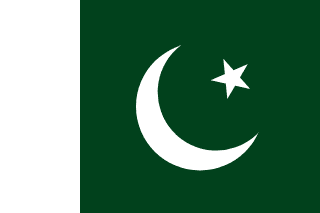
Pakistan.
Islamic Republic of Pakistan
In short
Pakistan is a nuclear-armed state and the world's fifth-most populous country. Its foreign policy has been shaped by the rivalry with India over Kashmir, the alliance with China (the 'all-weather friendship'), and a complex relationship with the United States that has oscillated between close cooperation and deep distrust.
Capital
Islamabad
Government
Federal parliamentary …
Pakistan's government & politics
Leadership, governance, and democratic trajectory.
Pakistan's UN voting record
How Pakistan votes at the UN General Assembly — ideological trajectory, voting partners, topic patterns, and key recent roll calls.
Voting summary
No votes recorded for this period yet.
Bloc alignment
Bloc alignment data not available yet.
Top voting partners
Share of UN GA roll calls voted the same way in 2024.


Topic-level voting
Y / A / N share by Voeten topic flag, 2020–present.
Middle East
Israel/Palestine + regional resolutions
No votes
Nuclear
Nuclear weapons, NPT, IAEA
No votes
Disarmament
Conventional arms control
No votes
Colonialism
Self-determination resolutions
No votes
Human rights
Country-specific HR resolutions
No votes
Economic
Trade, sanctions, development
No votes
Source: Erik Voeten, “United Nations General Assembly Voting Data”, Harvard Dataverse (CC0). Aggregated by Model Diplomat. Last refresh tracked in profile freshness.
Pakistan's foreign policy
Bilateral posture, key relationships, and live diplomatic statements.
Foreign Policy
Pakistan's foreign policy revolves around three axes: the rivalry with India (particularly over Kashmir), the 'all-weather' alliance with China, and relations with the United States. Pakistan has historically served as a bridge between China and the Muslim world.
Pakistan is a leading voice in the OIC on Kashmir, Palestine, and Islamophobia. Relations with Afghanistan have been turbulent, complicated by cross-border militancy and the Taliban's return to power. Pakistan maintains close ties with Saudi Arabia, Turkey, and the Gulf states.
Allies


Rivals

Pakistan's treaties & memberships
UN multilateral treaty positions and IGO memberships.
International Organizations
Society & economy
Macro-economic snapshot and demographic context.
GDP (nominal)
$338.0B
GDP per capita
$1,405
Currency
Pakistani Rupee (PKR)
HDI
0.54
Top trading partners

In the news
Stories surfacing across Pakistan’s authoritative outlets. Grouped by topic, ranked by source coverage.
Frequently asked questions about Pakistan
Quick answers to the most common questions about Pakistan.
What type of government does Pakistan have?
Pakistan is governed as a federal parliamentary republic, with its capital at Islamabad.
What is the population of Pakistan?
Pakistan has a population of approximately 235.8 million people.
What is the economy of Pakistan like?
Pakistan has a nominal GDP of about $338 billion, or roughly $1,405 per capita. Its currency is the Pakistani Rupee (PKR).
What languages are spoken in Pakistan?
The official languages of Pakistan are Urdu and English.
When did Pakistan join the United Nations?
Pakistan has been a member of the United Nations since 1947.
Who are Pakistan's closest allies?
Pakistan's key allies include China, Türkiye, and Saudi Arabia.