Wong and Prabowo's Malacca Strategy
Singapore and Indonesia align to secure the Strait of Malacca.
Model Diplomat8 min readSoutheast Asia
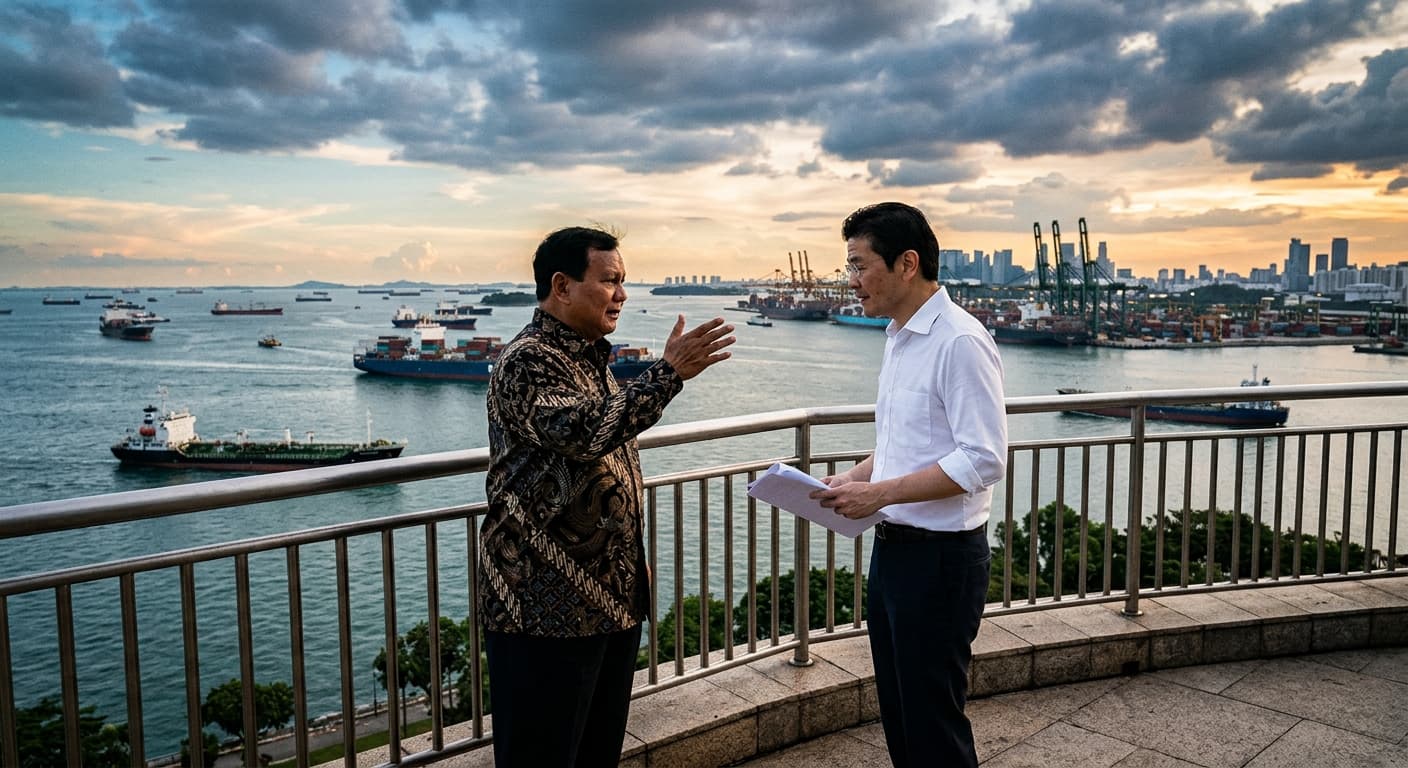
Wong and Prabowo lock in Malacca — and quietly box out Beijing
Singapore and Indonesia declare themselves "strategically aligned" to keep the Strait of Malacca open. The subtext: no tolls, no blockades, no outside navies rewriting the rules.
Prime Minister Lawrence Wong and President Prabowo Subianto used their July 6, 2026 Leaders' Retreat in Jakarta to do something more consequential than the communiqué reads: they pre-empted a live debate inside Prabowo's own cabinet about monetising — or someday leveraging — the world's most important chokepoint. By declaring Singapore and Indonesia "strategically aligned" to keep the strait "safe, open and accessible to all," the two leaders quietly killed the toll idea Indonesian Finance Minister Purbaya Yudhi Sadewa floated in April, and sent a signal to Beijing, Washington and Manila at once: the littoral states, not user powers, will decide how 24% of global seaborne trade moves — and they will not weaponise it. That is the story. The solar farms, the Garuda schools, the cross-border electricity MOUs — all scaffolding.
What the two leaders actually said
Speaking alongside Prabowo at the Merdeka Palace, Wong invoked the Middle East explicitly. "Recent developments in the Middle East have reminded us of the importance of energy security and diversification," he said, per the transcript posted by the Prime Minister's Office. His broader point, carried by
Channel News Asia, was blunter: as coastal states along the Strait of Malacca and Singapore, the two countries are "strategically aligned" and would "do our part to keep the waterway safe, open and accessible to all."
Prabowo went further than diplomatic norm usually allows, telling reporters the two governments had agreed to "resolve differences openly" — a line IDNFinancials read as an implicit reference to the toll flap. The
Business Times noted the pair also extended the "free passage" language to Hormuz — a rare Southeast Asian intervention on a Gulf issue, and one that reads as a hedge against the precedent Iran set this spring.
Why the language matters — and why now
The Strait of Malacca is not the busiest chokepoint by tonnage. It is the least substitutable. Roughly a quarter of global seaborne trade by volume moves through it, along with about 45% of the world's seaborne oil, over 25% of internationally traded cars and 23% of dry bulk, according to a June 2026 Chatham House analysis. Some 82,000 vessels transit annually per
Observer Research Foundation data; the
Council on Foreign Relations puts the figure closer to 90,000. The strait's narrowest point, off Singapore, is 2.8 km wide — there is no serious alternative. Rerouting around Australia adds thousands of nautical miles; Thailand's proposed $36 billion land bridge remains, per an
ISEAS assessment, a decade from viability.
That non-substitutability is precisely why Wong's careful phrasing — "safe, open and accessible to all" — is not boilerplate. Three things have changed the equation in the past 18 months.
First, Iran's April demonstration of leverage at Hormuz reset the mental model of what a littoral state can do with a chokepoint. Within weeks, Indonesian Finance Minister Purbaya Yudhi Sadewa mused publicly about splitting a Malacca toll "three ways" between Indonesia, Malaysia and Singapore, according to CFR's reconstruction of the episode. Foreign Minister Sugiono walked it back within days, but the trial balloon had flown — and, as University of New South Wales legal scholar Dita Liliansa told the New York Times (cited by CFR), insurance and shipping premiums for the strait rose regardless.
Second, the legal architecture that has held Malacca open since 1994 is under strain from within. Article 38 of the United Nations Convention on the Law of the Sea guarantees "unimpeded transit passage" through straits used for international navigation; Article 26 explicitly forbids charges levied on foreign ships "by reason only of their passage." A UN Office of Legal Affairs research paper summarises the point: strait states may bill for pilotage or towage on a non-discriminatory, cost-recovery basis, but a general transit toll is a "disguised toll on passage" and would breach the treaty. That is the legal wall Wong just reinforced on Prabowo's behalf — and the wall Indonesia's own archipelagic claims sit atop. As the
Lowy Institute has argued, if Jakarta undermines UNCLOS's transit-passage regime, it also erodes the legal basis for its 200-nautical-mile EEZ claims against Chinese incursions around the Natuna Islands.
Third, the South China Sea has escalated to the point where "freedom of navigation" is no longer an abstract phrase for Southeast Asians. Since August 2025, Al Jazeera has documented repeated collisions, water-cannon incidents and a Chinese navy helicopter buzzing a Philippine surveillance plane within three metres. On June 11, 2026, Beijing formally sanctioned Philippine Defence Secretary Gilberto Teodoro, barring him and his family from Chinese territory over remarks made at the Shangri-La Dialogue in Singapore, per
Al Jazeera. And in January, a Singapore-flagged bulk carrier — the Devon Bay — sank near Scarborough Shoal, forcing the Chinese coastguard and Philippines coastguard into an uneasy joint rescue that
Al Jazeera framed as a rare de-escalation moment.
The Diplomat View: this is a hedge against three powers, not one
Read carefully, the Jakarta statement is triangulated against three actors simultaneously.
Against Beijing, it forecloses the "Malacca Dilemma" hedges China has been quietly building — the Thai land bridge, the Kyaukpyu port in Myanmar, the Funan Techo Canal in Cambodia — from ever mattering politically. A Journal of Resources Policy modelling study estimates a 20% disruption to Malacca oil flows over 90 days would cost China 62.7 billion yuan. Wong and Prabowo's message is that no littoral state — including Prabowo's more nationalist ministers — will hand Beijing a pretext to internationalise strait security in the name of protecting its oil.
Against Washington, the statement is a polite No to any expanded U.S. naval role in the strait. Chatham House flagged in June that "a more hostile American naval presence in the channel would challenge the authority of regional states such as Singapore and Malaysia" — particularly given U.S. focus on sanctions-evading "dark fleet" ship-to-ship transfers in the Eastern Outer Port Limits anchorage off Malaysia. Prabowo, fresh from signing what the White House branded a "NEW GOLDEN AGE" reciprocal trade agreement with President Trump on February 19, 2026, needs to demonstrate that closer commercial ties do not translate into naval concessions. Wong needs to demonstrate the same thing in reverse — Singapore hosts U.S. logistics at Changi Naval Base, but it will not let the strait become an American condominium.
Against India, the omission speaks. New Delhi has pushed since 2004 to join the Malacca Straits Patrol, the coordinated framework Indonesia, Malaysia, Singapore and Thailand set up in 2006 following the trilateral MALSINDO agreement. According to the Ministry of External Affairs, Singapore in its September 2025 joint statement with Prime Minister Modi "acknowledged with appreciation India's interest in the Malacca Straits Patrol" — a diplomatic acknowledgement, not an invitation.
ISAS reads the acknowledgement as the ceiling, not the floor: Indonesia declared Indian participation "non-feasible" in 2018 and Prabowo has not softened that position. Jakarta and Singapore prefer littoral-state primacy — even from a Quad-aligned partner they otherwise court on defence.
What the piracy numbers reveal
The security case for littoral-state primacy is getting harder to make. RSIS and ReCAAP's Q1 2025 data show piracy and armed robbery incidents in the Singapore Strait surged to 28 in the first quarter of 2025, up from 11 in the same period a year earlier. Chatham House cites an 83% year-on-year rise across Asia in the first half of 2025, mainly targeting bulk carriers. Attackers, historically confined to petty theft with knives, are now boarding high-freeboard vessels while armed with metal rods and improvised weapons.
The Wong-Prabowo statement thus buys the current framework a political extension while its operational credibility erodes. Both leaders committed to expanded defence cooperation, including co-development of training facilities at Batu Raja in West Kalimantan and the Siabu Air Weapons Range — the operational hardware that has to catch up if the diplomatic language is to hold. On the economic side, the two governments signed MOUs binding Danantara, Indonesia's sovereign wealth vehicle, with Keppel Electric, Sembcorp Industries and Singapore Energy Interconnections on cross-border electricity, plus a 1,000-hectare expansion of the Kendal Industrial Park — the "we-are-better-off-cooperating" ballast beneath the strait diplomacy, per the PMO transcript.
Who wins, who loses
The winner is the shipping industry, for now. Ninety-thousand-vessel-a-year traffic runs on the assumption that no littoral state can unilaterally hold it hostage. Jakarta just confirmed that assumption at the highest political level.
The quiet loser is Thailand. Bangkok has been marketing its 90-kilometre land bridge partly on the premise that Malacca risk premiums will keep rising. If Singapore and Indonesia hold the "open and accessible" line credibly for the next 24 months, the geopolitical case for the land bridge — as opposed to the purely commercial one, which is thin — collapses. The ISEAS analysis puts the project's completion at 2039 in a best case, requiring $36 billion in private-plus-Chinese capital.
The most interesting loser is a faction inside Prabowo's own government. Purbaya Yudhi Sadewa's April toll pitch reportedly reflected serious discussions at high levels of the Indonesian government about using the strait to raise budget revenue, according to CFR reporting citing Indonesian political sources. Prabowo has now personally disowned that path in public — an important internal Jakarta signal as the president's coalition manages an ambitious fiscal expansion.
Diplomat View
Wong and Prabowo have bought the Malacca status quo perhaps 24 to 36 months. That is the falsifiable call. The forecast revises if any of three things happens: an Israel-Iran or U.S.-Iran flare-up shuts Hormuz for more than a fortnight, at which point Southeast Asian toll politics returns with force; a Scarborough Shoal incident kills a Filipino sailor and Manila invokes its Mutual Defense Treaty with Washington, forcing littoral states to choose sides; or Beijing formally moves to declare the South China Sea an Air Defense Identification Zone, which would collapse the current "open and accessible to all" fiction. Absent one of those triggers, expect Jakarta to continue publicly defending UNCLOS transit passage while privately extracting user-state contributions to burden-sharing — the "we're not going to impose a toll, but it would be really nice if you helped us financially" position UNSW's Dita Liliansa described. Singapore's role is to keep Indonesia honest to the treaty language. The July 6 communiqué is the ceiling of Singapore's ambition here — and both leaders know it.
What to watch
- August–September 2026: Malacca Straits Patrol 20th-anniversary trilateral (Indonesia, Malaysia, Singapore + Thailand as fourth participant); the test is whether India's request is upgraded from "acknowledged" to observer status.
- September 2026 UNGA: Whether Prabowo repeats the "safe, open and accessible" formulation in his General Debate address, and whether it appears in the ASEAN Chair's statement under Philippines' 2026 chairmanship.
- October 2026 East Asia Summit, Manila: First test of whether Wong-Prabowo language holds under pressure from a Marcos government seeking regional endorsement of the 2016 Permanent Court of Arbitration ruling.
- 2027 60th-anniversary summit: Singapore-Indonesia have flagged a formal upgrade of the bilateral framework; the maritime security annex is where the real commitments will either appear or conspicuously not.
Discover more
India
Women's Reservation Bill 2026: A Political Sh
India's Lok Sabha rejected the Women's Reservation Bill, exposing a political maneuver to redraw electoral maps favoring the north over the south.
Global Politics
US-Iran Tensions Rise
Tensions escalate in the Strait of Hormuz as Iran and the US clash over maritime control, with a ceasefire hinging on a contested MoU paragraph.

US Politics
Virginia GOP Rallies Rural Voters Against Red
Virginia Republicans are mobilizing rural voters against a Democratic-led redistricting referendum, a fight seen as pivotal to control in the 2026 midterms.
Conflict & Security
Guatemala: El Niño 2026–27 becomes regional security test
UNICEF: 25.8M children face El Niño risks in Latin America; Guatemala maps 188 municipalities for drought and food insecurity amid regional security test.