Virginia Joins National Popular Vote Compact
Virginia's entry boosts electoral votes to 222.
Model Diplomat8 min readVirginia
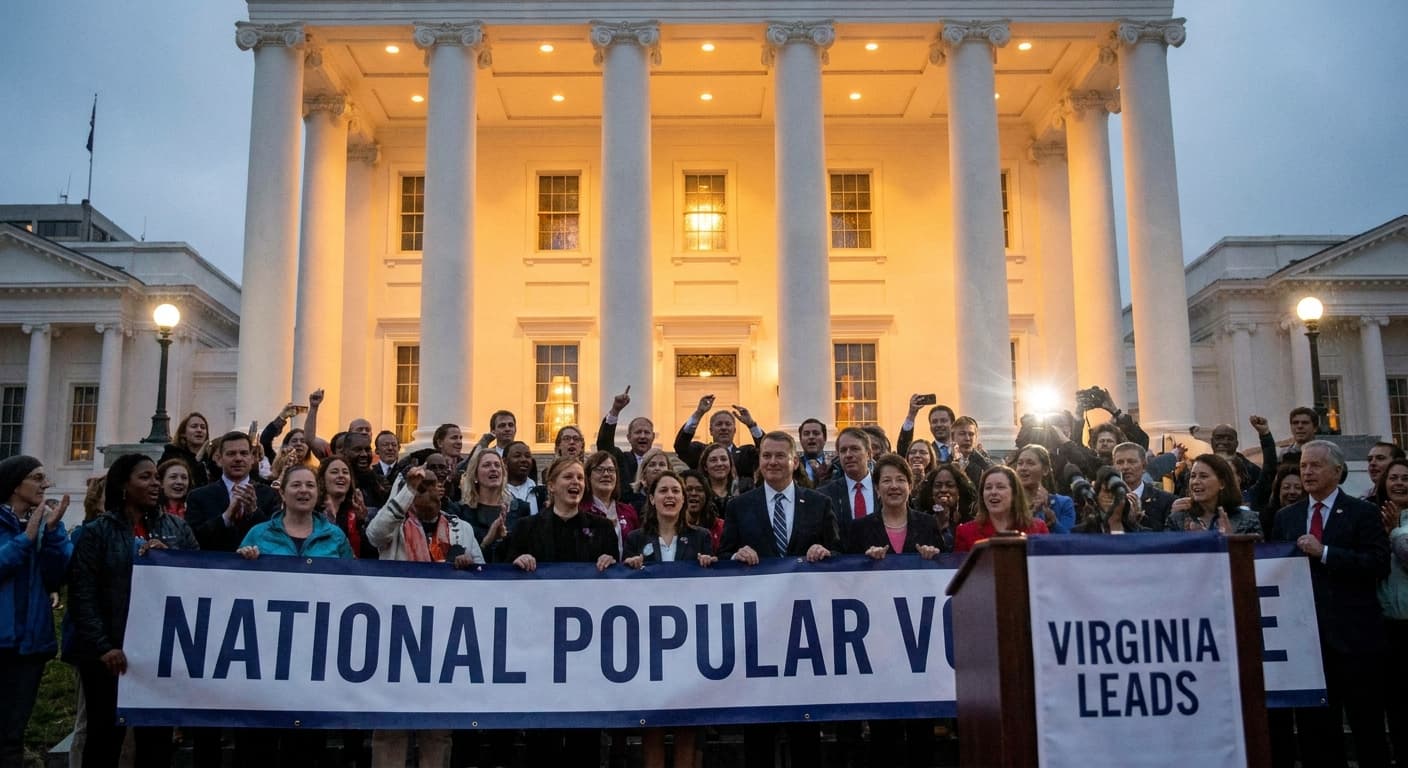
Virginia Joins National Popular Vote Compact, Pushing It to 222
Gov. Abigail Spanberger signed Virginia into the National Popular Vote Compact on April 13, 2026, bringing the pact to 222 of the 270 electoral votes it needs to bind U.S. presidential elections.
Virginia became the 18th jurisdiction to enter the National Popular Vote Interstate Compact when Gov. Abigail Spanberger signed HB 965 and SB 322 into law on April 13, 2026 — adding the commonwealth's 13 electoral votes and lifting the running total to 222 of the 270 needed to trigger the compact, according to National Popular Vote. The load-bearing point is not the milestone. It is the geometry: three of the four remaining paths to 270 run through Republican-trifecta states that will never sign — meaning the compact's fate now depends almost entirely on Democrats holding legislative chambers in Michigan, Pennsylvania, Arizona, Wisconsin and North Carolina in the November 3, 2026 midterms. And on July 7, 2026, the ground under that bet has already shifted: Virginia's own Supreme Court struck down the Democratic-drawn congressional map two months ago, weakening the party heading into a vote that will decide the compact's future.
What HB 965 actually does
The Virginia statute pledges the commonwealth's electors to whichever presidential ticket wins the aggregate national popular vote — but only if and when other states holding a combined majority of the Electoral College have signed identical language. Until then, Virginia's electors continue to go to the statewide winner. NPR reported that the bill "won't take effect unless more states join," a caveat Spanberger emphasized in her signing statement.
The mechanism is constitutionally minimalist by design. It relies on Article II, Section 1, which lets each state legislature "direct" the manner of appointing its electors. A Congressional Research Service report by Thomas Neale and Andrew Nolan describes the compact as an attempt to "achieve direct popular election of the President and Vice President without a constitutional amendment," effective only "if states controlling a majority of electoral votes (270 or more) join." Withdrawal is permitted, but under the compact's own text a state that pulls out within six months of a presidential election is still bound for that election — a firebreak against last-minute defection.
Virginia's accession ends a six-year drought. No state had joined since Colorado, Delaware, New Mexico and Oregon signed on in 2019 — a batch that brought the total to 196 electoral votes, per the same CRS report. The commonwealth had introduced NPV legislation as far back as 2019 without passage. It took Democratic control of both chambers in Richmond plus a Democratic governor — the trifecta Spanberger completed in January 2026 — to move the bill.
Why the last 48 votes are harder than they look
The gap between 222 and 270 is 48 electoral votes. The arithmetic looks trivial. The politics do not.
Every jurisdiction currently in the compact is Democratic-leaning. There is no Republican-led state on the list, and none is realistically coming. The remaining 48 votes must come from states where Democrats can plausibly hold or take unified legislative control: Michigan (15), Pennsylvania (19), Arizona (11), Wisconsin (10), North Carolina (16), Nevada (6), Minnesota (10), Maine (4) and New Hampshire (4). Only Michigan and Arizona have seen the compact clear one chamber, according to the Center for American Progress, which argued Virginia's accession put the finish line "in sight."
The realistic near-term path is Michigan plus one of Arizona, Nevada or Minnesota. Michigan (15) plus Arizona (11) alone closes 26 of the 48. But it presumes Democrats retain the Michigan legislature outright and eventually flip Arizona's — neither guaranteed. Nevada already passed the compact through both chambers in 2019 only to have then-Democratic Gov. Steve Sisolak veto it, warning in the veto message that the compact would "diminish the role of smaller states like Nevada in national electoral contests," as documented by the Heritage Foundation's Hans von Spakovsky. Maine's legislature killed a similar bill the same year after it had cleared the state Senate. That small-state objection cuts across party lines and remains the compact's most durable political obstacle in the states it most needs.
The 2024 inversion no one wants to discuss
If the compact had been in force for the 2024 election, every signatory — California, New York, Illinois, Virginia — would have been required to award its electors to Donald Trump. Trump beat Kamala Harris by roughly 2.3 million votes, taking 49.8% to Harris's 48.3%, per the Council on Foreign Relations' post-election analysis. It was the first Republican popular-vote win since 2004.
That inversion strips the compact of the post-2016 partisan skin most of its opponents attack. It is not a mechanism to elect Democrats. It binds signatories to whichever candidate wins the national plurality — and Republican popular-vote performance has been trending up. Trump took 46% in 2016, just under 47% in 2020, and 49.97% in 2024 before late California counting nudged him below 50%, according to NPR. Compact supporters know this. That they are pushing enactment anyway signals a bet that the structural distortion of the Electoral College — in 2024, roughly 229,726 votes across Michigan, Pennsylvania and Wisconsin would have flipped the outcome, per
CFR — is more corrosive over time than the risk of ratifying a Republican plurality.
The concrete beneficiary of a functioning NPV is not the Democratic Party. It is the campaign consulting economy of California and Texas, which today receive almost no presidential ad spending. The concrete loser is Pennsylvania, whose $270 million in 2024 presidential ad revenue would evaporate. That is the material fight underneath the constitutional one.
The constitutional attack, and why Chiafalo dulled it
Opponents have two constitutional lines of attack. The first is the Compact Clause of Article I, Section 10, which bars states from entering compacts without congressional consent when they "encroach upon or interfere with the just supremacy of the United States" — a standard set in Virginia v. Tennessee (1893) and refined in U.S. Steel v. Multistate Tax Commission (1978). The Cornell Legal Information Institute's ConLaw annotation explains the two-part inquiry: is the arrangement a compact, and if so, does it "affect federal supremacy?" In
U.S. Steel, the Court upheld the Multistate Tax Compact without congressional consent because it did not "enhance state power" against the federal government. The
Heritage Foundation's Thomas Jipping argues NPV fails that test because it "enhances the political power of compacting states at the expense of non-compacting states." Academic critics have piled on: an SSRN essay archived by the
Framers' Inadvertent Gift analysis contends the compact also violates the Equal Protection Clause under Bush v. Gore by aggregating votes cast under 51 different sets of rules.
The second attack is Article II itself — the claim that states cannot outsource their electors to a national tally. That argument was substantially weakened in 2020. In Chiafalo v. Washington, the Supreme Court unanimously upheld state penalties on faithless electors, with Justice Elena Kagan writing that Article II gives states power over electors and "gives electors themselves no rights." A
CRS legal sidebar analyzing Chiafalo concluded the ruling "could be read to suggest the plan, if enacted, would survive constitutional challenge" because it affirmed states may appoint electors "in whatever way it likes."
That is the double edge. The stronger Chiafalo reads on state authority, the weaker the Article II attack on NPV becomes. What remains is the Compact Clause challenge — and even there, an SSRN essay by Vikram Amar and others argues Congress could ratify or fix the compact after triggering, and that "the idea floated by some that only a constitutional amendment can bring about a national popular vote is misguided." A separate 2023 Supreme Court ruling,
New York v. New Jersey, added a further wrinkle: it held that states may unilaterally withdraw from compacts silent on withdrawal — a doctrine the NPV compact preempts with its six-month firebreak, but which lower-court challengers will surely test.
The Virginia complication
Virginia's April 21 redistricting referendum — passed by voters but overturned on May 8, 2026 by the state Supreme Court — matters for the compact more than the Richmond signing ceremony did. NPR reported that the court, splitting 4-3, found the legislature had violated Virginia's constitutional amendment process and ordered the state to use its 2022–2024 congressional map. The
stay application filed with Chief Justice John Roberts on May 11, 2026 was
denied by the U.S. Supreme Court four days later.
The downstream effect: Democrats lost the four congressional seats they had drawn for themselves in Virginia while Republican-led states press ahead with their own mid-decade gerrymanders. That national House math bleeds into state legislative races in the exact states the compact needs. If Democrats underperform in Michigan or Arizona because national headwinds are stronger than expected, the compact's 48-vote gap widens rather than closes.
Diplomat View
The compact is one governor's veto and two state legislative flips away from irrelevance, and one Michigan-plus-Arizona cycle away from rewriting American presidential politics. Our forecast: NPV will not reach 270 before the 2028 election. The binding constraint is not constitutional — Chiafalo effectively answered the Article II question in the compact's favor — but political. The remaining states are either Republican-controlled (Wisconsin, North Carolina, Arizona's legislature) or contain a durable small-state faction that killed the bill in 2019 (Nevada, Maine, New Hampshire).
We would revise this forecast if two conditions hit before June 2027: Democrats retain unified control of the Michigan legislature after November 2026, and Arizona's Senate joins its House in passing the compact bill. Those two events together bring the tally to about 248 and put the compact within one small-state signature of activation. Absent both, NPV remains what it has been for two decades — a movement that keeps adding safe-Democratic states without touching the marginal ones that would actually decide it.
What to watch next
- November 3, 2026 midterms: Legislative control in Michigan, Pennsylvania, Arizona, Wisconsin and North Carolina.
- Early 2027 legislative sessions: Whether Michigan's second chamber schedules a floor vote on NPV, and whether Arizona's Senate follows its House.
- Any federal lawsuit: A pre-enforcement Compact Clause challenge in a Fourth Circuit district court targeting Virginia's HB 965 would preview the constitutional endgame.
The Bottom Line
Virginia's signature moves the National Popular Vote Compact to 222 electoral votes but does not change the arithmetic that matters: the final 48 votes must come from states Democrats do not currently control, in a midterm cycle where their maps have already been struck down. The compact's future is now a bet on Michigan and Arizona in November 2026 — and on whether progressive strategists still want a mechanism that, applied to 2024, would have delivered a second Trump term by consent.
Discover more
US Politics
Trump Ends USMCA, Starts 10-Year Countdown
The Trump administration will not extend the USMCA, initiating a 10-year phase-out of tariff-free trade in North America, impacting Canada and Mexico.

US Politics
Vance Owns the Iran Deal — Trump Ensures It
JD Vance's Iran deal faces scrutiny from GOP hawks as Trump positions him for 2028. The next 55 days will be crucial for Vance's political future.

US Politics
Three Americans Dead in Venezuela Quakes
The US confirms three American casualties in Venezuela's earthquakes, raising domestic accountability for its relief mission amid a humanitarian crisis.

Economics
Fed's Amex AML order puts correspondent banking on notice
Federal Reserve's Amex AML order requires board-level controls and a 90-day plan; OCC fined the bank $350 million over enterprise-wide deficiencies.