Vietnam Expands Spratly Islands Amid Tensions
Hanoi's land reclamation narrows China's influence in the region.
Model Diplomat3 min readAsia
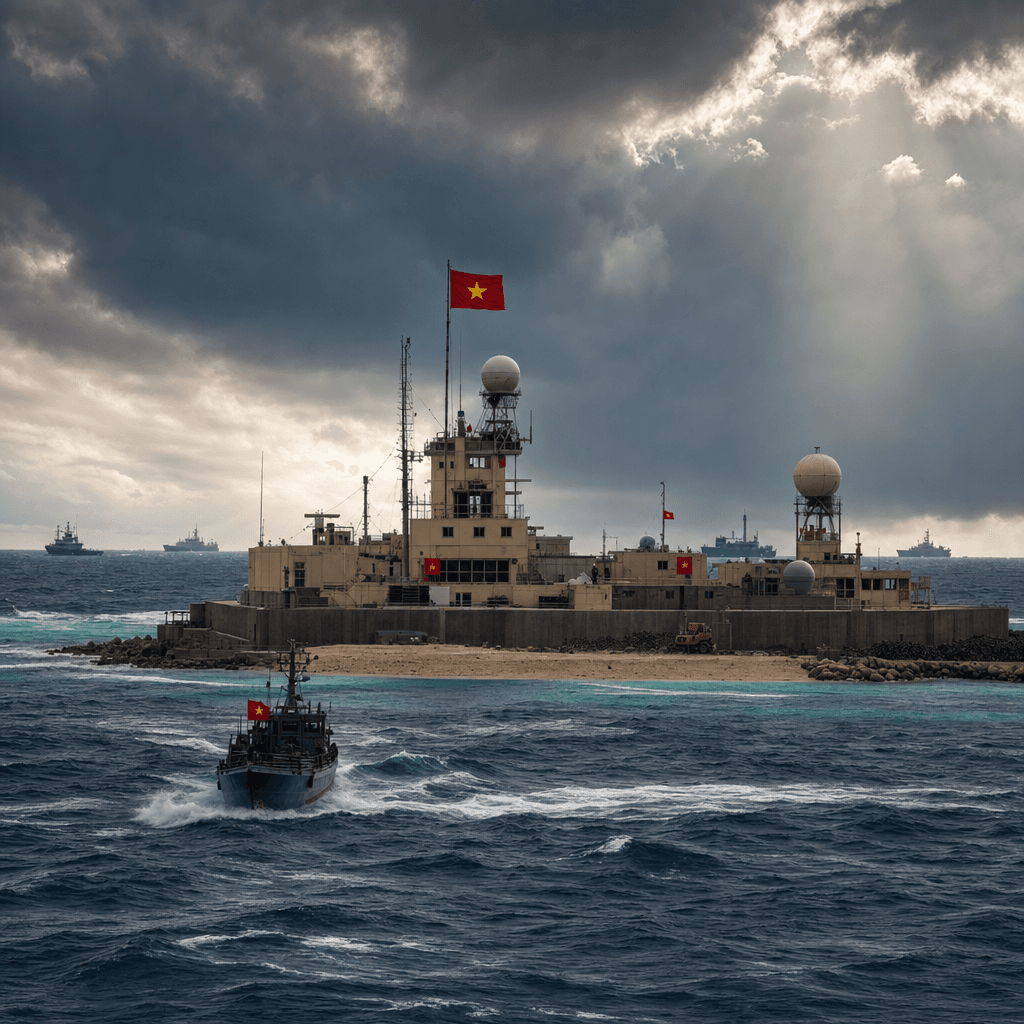
Vietnam is quietly hardening its Spratly outposts
Hanoi has added 216.1 hectares of new land in the Spratlys, turning reclamation into a logistics play that narrows China’s room to coerce but raises the risk of a bigger maritime race.
Vietnam is still expanding its positions in the Spratly Islands, and it is doing so methodically. A new report from the Asia Maritime Transparency Initiative, cited by BBC News Tiếng Việt, says Hanoi added 216.1 hectares of new land over the past year, bringing its total artificial land in the archipelago to about 1,121 hectares.
The Straits Times reports the broader figure as roughly 2,771 acres, with new dredging and landfill work now underway at eight previously untouched features.
Hanoi’s leverage is durability, not parity
The strategic point is not that Vietnam is catching China feature-for-feature. It is that Vietnam is converting disputed reefs into a sustained operating network. The BBC report says the work has shifted from basic reclamation toward larger military and logistics infrastructure, with Barque Canada Reef now Vietnam’s biggest base in the Spratlys. The AMTI-backed reporting in
The Straits Times says Vietnam now has 15 harbors in the archipelago, 11 built since 2021, and that a navigation beacon system on Barque Canada looks designed to support wider air and maritime control.
That matters because Vietnam does not need airstrips everywhere to improve its position. It needs enough ports, storage, and surveillance nodes to keep ships supplied, rotate personnel, and deny China an easy local monopoly. In other words, Hanoi is building resilience, not headline-grabbing showpieces. For policymakers following Global Politics, that is the real shift: the South China Sea contest is moving from symbolic occupation to infrastructure-backed persistence.
China benefits from escalation, but not unchallenged control
Beijing still holds the larger land-reclamation lead, and that remains the decisive fact. The Straits Times says China’s total artificial land in the Spratlys now stands at about 5,460 acres, after new reclamation at Antelope Reef widened the gap again. But China does not get the low-cost advantage it once enjoyed. Every Vietnamese expansion forces Beijing to decide whether to ignore, quietly pressure, or escalate publicly.
So far, Beijing has preferred selective pressure over a direct confrontation with Hanoi. South China Morning Post quoted a Chinese foreign ministry spokesman saying the islands are “China’s inherent territory” and opposing construction on “illegally occupied reefs,” but the tone remains more restrained than China’s treatment of the Philippines. That restraint is strategic. China benefits from keeping Vietnam bilateral and cautious, because a louder fight would push Hanoi closer to Washington and other maritime partners.
What to watch next
The next inflection point is whether Vietnam turns Barque Canada into something closer to a fixed-air operations node. BBC News Tiếng Việt cites experts saying Hanoi has moved from reclamation toward harder infrastructure, but no full runway is reported yet. If satellite imagery later this year shows runway-length work, the balance in the western Spratlys changes again.
Watch also for China’s response pattern. If Beijing keeps its criticism muted while expanding elsewhere, it is signaling that it sees Vietnam as a problem to manage quietly, not a rival to confront head-on. If the rhetoric hardens, the South China Sea contest moves into a more dangerous phase — and the next test will come in the diplomatic calendar, not just on the water.
Discover more

Global Politics
US Seizes Iranian Ship, Tensions Surge
The US seizure of the Iranian ship Touska highlights a shift in control over the Strait of Hormuz, favoring Iran's strategic position.

India
India-South Korea $50B Trade Expansion Plan
India and South Korea target $50 billion in bilateral trade by 2030, focusing on industrial cooperation and strategic alignment amid US pressures.
Conflict & Security
Guatemala: El Niño 2026–27 becomes regional security test
UNICEF: 25.8M children face El Niño risks in Latin America; Guatemala maps 188 municipalities for drought and food insecurity amid regional security test.

Economics
Fed's stress-test overhaul is a capital-smoothing exercise
Federal Reserve finalized stress-test overhaul: two-year averaging for bank capital buffers and public input, expected to halve volatility.