VBSA Bill Pushes Centre-State Fight Into Higher Ed
Tamil Nadu educationists say the Centre’s new regulator would centralise standards, squeeze state autonomy, and leave universities with more control than money.
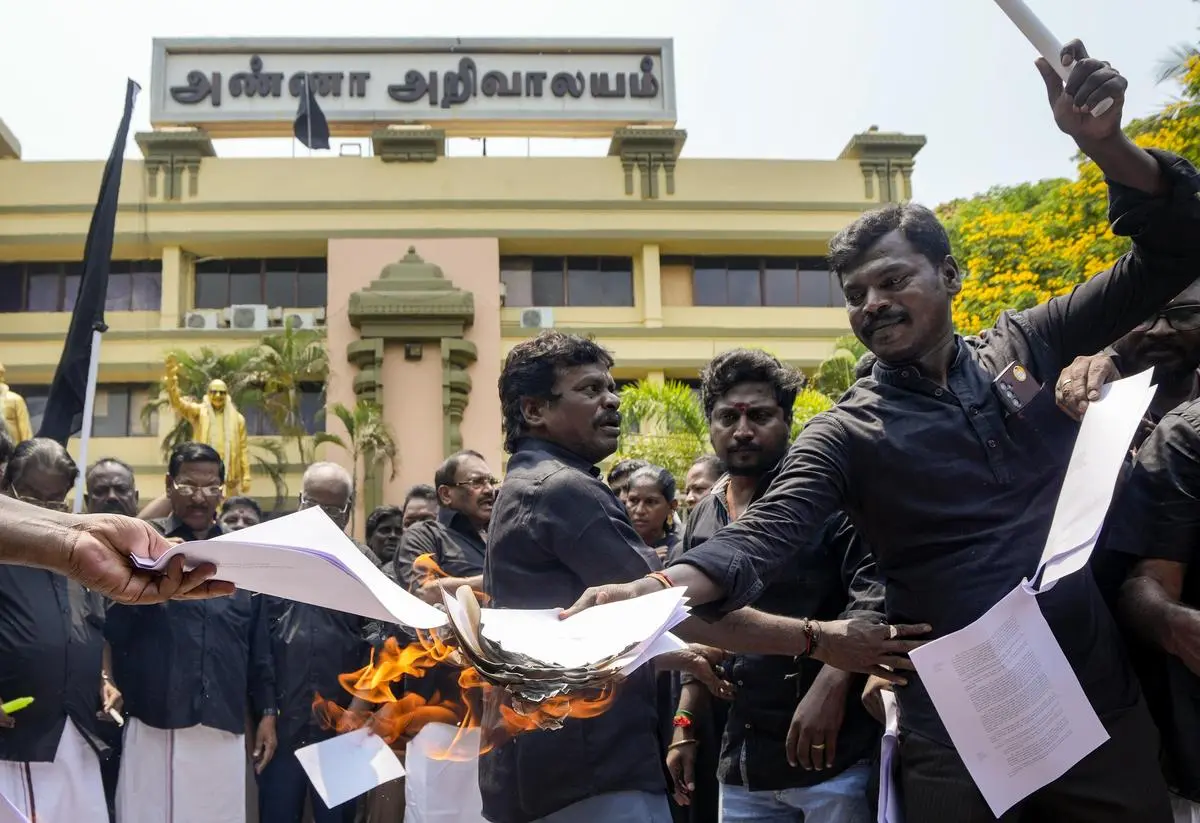
The State Platform for Common School System-Tamil Nadu has told the Joint Parliamentary Committee examining the Viksit Bharat Shiksha Adhishthan (VBSA) Bill, 2025, that the proposal is unconstitutional and should be withdrawn, arguing that it lets the Union government regulate universities far beyond its powers under the Constitution ( The Hindu). The power dynamic is clear: the Centre is trying to pull higher-education leverage upward, while Tamil Nadu’s education lobby is trying to stop a national regulator from overriding state universities.
Why the bill is becoming a federalism fight
The criticism is not just about procedure; it is about who sets the rules of higher education. SPCSS-TN says the bill takes cover under Entry 66 of the Union List, which allows Parliament to coordinate and determine standards, but in practice opens the door to direct regulation and even the winding up of universities (The Hindu;  ETV Bharat). That is why the group calls it a “colourable exercise of power”: if Parliament cannot legislate on the states’ domain, the argument goes, it should not be able to repackage control as “standard-setting” (ETV Bharat).
The bill’s architecture explains the alarm. As reported by both The Hindu and  Telegraph India, VBSA would replace the UGC, AICTE and NCTE with a single 12-member commission and separate councils for regulation, standards and accreditation. SPCSS-TN says that framework would let the Centre dictate what to teach, how to teach, and what research gets rewarded (Telegraph India).
Who gains, who loses
If the bill survives the JPC, the Union government wins the decisive lever: accreditation, curriculum influence and national norms. That would suit New Delhi’s preference for uniformity and easier policy control across a fragmented higher-education sector (Telegraph India). But state universities lose the ability to defend local priorities — especially in Tamil Nadu, where subsidised fees, reservations and women’s education policies have been central to expansion (The Hindu).
The funding question is the sharper second-order risk. Critics say the bill gives the Centre regulatory authority while leaving states with the financial burden, with no clear replacement for existing UGC funding channels (ETV Bharat). That is the recipe for a slow squeeze: states keep paying, but the Centre sets the rules. Over time, weaker state universities could be nudged toward self-financing models, higher fees and greater private competition (ETV Bharat).
What to watch next
The next decision point is the JPC’s response. If it accepts the autonomy critique, the bill may be narrowed or delayed; if not, this turns into a wider Centre-state confrontation over education policy, especially in non-BJP states like Tamil Nadu. Watch for whether the committee revises the bill’s language on regulation versus standards, and whether state governments publicly line up behind SPCSS-TN’s constitutional argument. For the broader policy battle, see  India and Global Politics.