Vance Accuses Israel of Sabotaging Iran Deal
Vance accuses Israel of covert campaign to derail Iran deal
Model Diplomat7 min readMiddle East
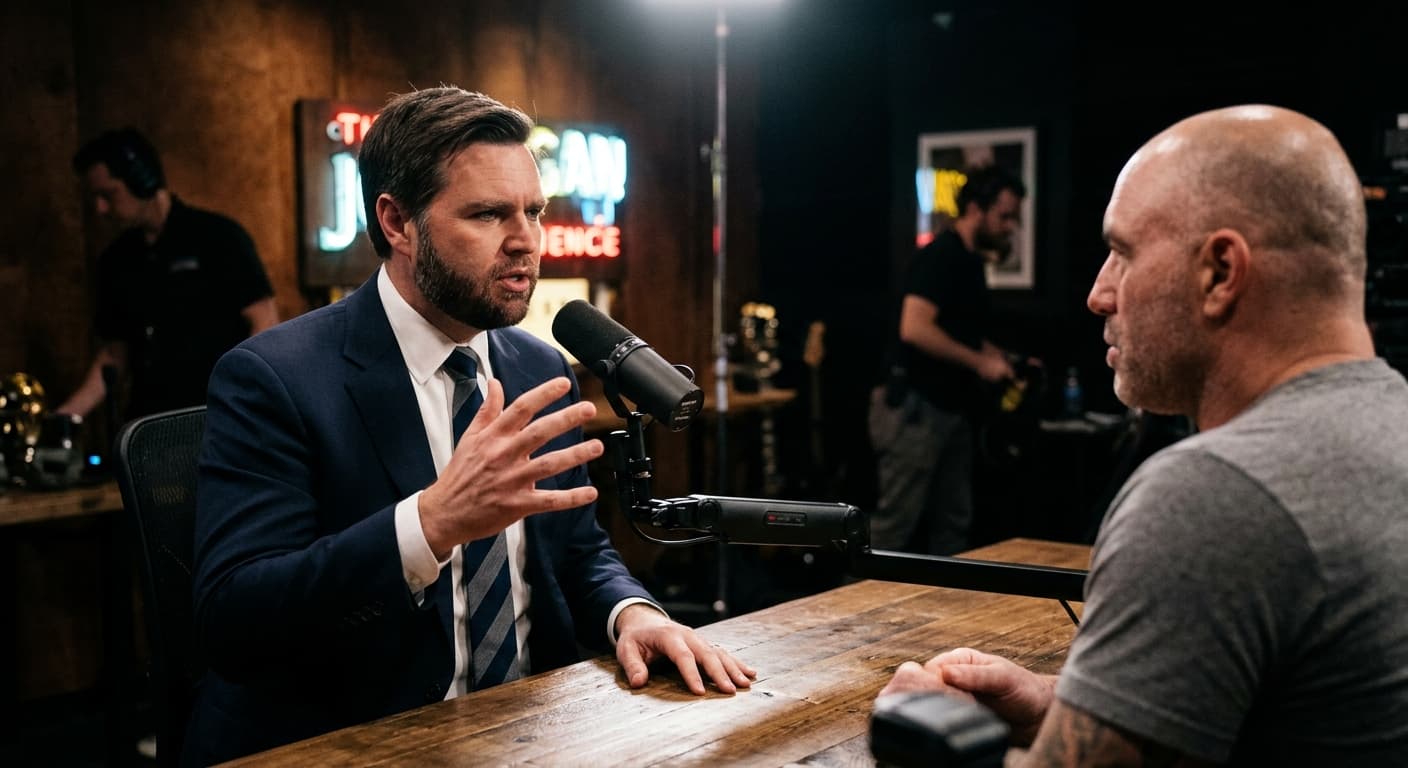
Vance Bets the Iran Deal on a Rogan Pulpit — and Names Israel as the Saboteur
Vice President JD Vance used a Joe Rogan interview to defend diplomacy over endless bombing of Iran — and publicly accused Israeli government figures of running a covert influence campaign to kill the deal he negotiated, a breach with Washington's closest ally that no sitting vice president has made before.
Speaking on The Joe Rogan Experience in an interview that aired July 16, 2026, Vice President JD Vance defended negotiations with Iran and warned that an open-ended bombing campaign would not secure the Strait of Hormuz or produce stability. "The military is one tool, but diplomacy is another tool," Vance said, according to the IANS wire via New Kerala. The headline is not the diplomacy pitch — it is that Vance simultaneously accused elements of the Israeli government of funding a covert campaign to derail his deal, a charge that reframes the US-Iran war as a contest over who controls the exit. Asked whether the US would have entered the war absent Israeli influence, Vance replied: "Yes, yes I do,"
Al Jazeera reported.
A deal Vance owns — and a president who keeps pulling the rug
The object of contention is a 14-point memorandum of understanding signed June 17 by Trump and Iranian President Masoud Pezeshkian, brokered by Pakistan. The full text, read to reporters and published by the BBC and
NPR, commits both sides to an "immediate and permanent termination of military operations on all fronts, including in Lebanon," requires Iran to make "best efforts for the safe passage of commercial vessels with no charge for 60 days," and sets a "maximum 60 days, extendable with mutual consent" window for a final deal to be endorsed by a binding UN Security Council resolution. The US is to lift its naval blockade within 30 days; Iran is to down-blend enriched uranium on site under IAEA auspices.
Vance has become the public face of that agreement. He traveled to Pakistan in April for mediation talks, attended the Switzerland signing framework, and spent the week of July 14 defending the deal at White House briefings, BBC reported. Trump, meanwhile, has openly joked that he might "blame the vice-president if the deal collapses" and questioned whether the MoU was "important enough" for him to sign — before signing a copy on camera at a Versailles dinner with French President Emmanuel Macron.
The contradiction is not incidental. On July 15, as Vance was touting diplomacy on Rogan, Trump was telling Fox News that "next week it gets really bad for them," threatening to "knock out all their power plants" and "all their bridges" unless Iran returns to talks, BBC reported. The same day, US Central Command struck dozens of Iranian military targets near the Strait of Hormuz,
Al Jazeera reported. Iran's lead negotiator, Mohammed Bagher Ghalibaf, declared the MoU voided and Iran in an "existential war with America,"
Al Jazeera reported.
The Israeli influence charge that has no precedent
Vance's sharpest move on Rogan was not the diplomacy argument — it was naming Israel. He said "there have been people within the Israeli government who are trying to, like, actually shift us away from that policy because they want to continue the military campaign," and cited a Time report that a former Trump campaign manager was hired on behalf of Israel to run a digital campaign shaping US views of the war. "There's a literal foreign influence campaign being funded to tank the very deal that I was pursuing," Vance said, Al Jazeera reported.
The accusation drew an immediate verdict from former Israeli consul general Alon Pinkas: "No sitting US vice president has ever accused Israel of openly running a campaign to undermine American policy," he told Al Jazeera. "It is quite shocking."
The backdrop gives the charge weight. In January 2026, an Al Jazeera investigation traced a #FreeThePersianPeople campaign to accounts linked to Israel, promoted by ministers Itamar Ben-Gvir and Naftali Bennett, that steered discourse toward foreign intervention and the return of the monarchy. A 2024
NPR report documented an Israeli firm, STOIC, paid $2 million by Israel's Ministry of Diaspora Affairs to covertly target US lawmakers over Gaza. And in May,
Al Jazeera reported that a former senior official of FDD Action — a pro-Israel advocacy group that spent $150,000 lobbying on Iran sanctions in Q1 2025 — had been appointed to Trump's Iran negotiating team. The network Vance describes is documented; what is new is a sitting vice president saying it out loud, on the largest podcast in the country, and framing it as an impediment to American policy.
The hawks with no endgame
Vance's domestic target is the Republican hawk caucus. Senate Armed Services chairman Roger Wicker called the deal "completely out of step with the president's goals," BBC reported. Vance's counter on Rogan was blunt: "I think that their proposal is to bomb and bomb and bomb. And the honest view, Joe, is that they do not actually have a solution," per the
IANS wire. He ruled out ground troops for regime change and invoked Libya: "We're not gonna send 150,000 ground troops in, in order to accomplish a change in a regime. We're not in that business anymore."
The military brass is not aligned with the diplomatic track. Defense Secretary Pete Hegseth has championed the bombing campaign and launched "Project Freedom" to force-open the strait, Defense.gov reported. Chairman of the Joint Chiefs Gen. Dan Caine said more than 15,000 American service members and over 100 aircraft were deployed to protect shipping, and that Iran had trapped roughly 1,500 vessels and 22,500 mariners in the Persian Gulf. The UN International Maritime Organization reported around 6,000 seafarers still stranded as of July 9, with transit reduced from a pre-war 130 ships per day to a near-standstill,
UN News reported.
Secretary-General António Guterres issued a direct appeal on July 13: "These attacks must all stop," urging both sides to "urgently resume negotiations and to address outstanding issues through diplomacy," according to the UN press release. The UN Department of Political and Peace Affairs separately confirmed that Qatar-hosted indirect talks on MoU implementation began June 30 and remain ongoing,
DPPA reported.
The leverage Vance is actually describing
Strip the rhetoric and Vance's argument is a leverage map. Iran's nuclear facilities, he says, "remained destroyed" — a claim consistent with the MoU's requirement to down-blend enriched uranium on site. The military campaign has degraded Iran's conventional forces. What Iran retains is the Strait of Hormuz: the choke point for roughly one-fifth of global oil and gas, and the one instrument Washington cannot neutralize from the air. "It is, militarily, very difficult to fully neutralise that Iranian capability," analyst Niamh Thafer told Al Jazeera. Iran holds what she called a "snapback capability" to disrupt shipping whenever it chooses.
Vance's "delicate diplomatic dance" — carrots for pragmatists, sticks for hardliners — is an attempt to split the Iranian leadership. The risk is the inverse: that repeated US strikes while negotiations are ongoing consolidate Tehran's hardliners. Iran's Foreign Ministry accused Washington of breaching Articles 1 and 5 of the MoU with its July strikes, calling them "a grave war crime," Al Jazeera reported. Deputy Foreign Minister Kazem Gharibabadi warned that tightening measures will not bring Iran back to negotiations — "it is making a mistake." Both sides, per analyst Thafer, bear responsibility: Iran's attacks on shipping violate the MoU, and the US strikes and reimposed blockade violate it on the other side.
The MoU's terms leave the hardest questions — Iran's ballistic missile programme, its support for proxies, the future administration of the strait — for the 60-day negotiation window. Vance acknowledged on Rogan that Iran's nuclear facilities were degraded but that "negotiations over the longer-term nuclear question were continuing," per the IANS wire. The agreement does not preclude Iran from imposing future tolls on Hormuz; Iran's parliamentary speaker Ghalibaf said the strait "will not return to pre-war conditions,"
Al Jazeera reported. That gap between Vance's diplomacy pitch and Iran's retention of its primary leverage point is the fault line the whole deal runs along.
Diplomat View
Vance's Rogan appearance was a political hedge dressed as a policy case. He is making the bet that the MAGA base — Rogan's audience — will back a negotiated exit from a war that a growing share of Republicans tell pollsters they dislike, and that he can survive being the deal's public face even as Trump keeps the bombing option live. The risk is asymmetric: if the MoU collapses, Trump has already told audiences he will blame Vance; if it holds, Trump signs the trophy at Versailles and Vance gets the negotiating credit but not the headline.
Three things will decide whether Vance's bet pays or implodes:
- The 60-day clock. The MoU window runs to roughly August 17, 2026, extendable by mutual consent. If Iran walks, Vance owns the failure. If both sides extend, the deal is alive but still unsigned in final form.
- Israel's response. Vance has now accused a sitting allied government of running an influence operation against US policy. If Netanyahu's government escalates in Lebanon — the MoU's most fragile front — the ceasefire clause collapses and Vance's diplomacy case loses its evidentiary base.
- Trump's consistency. The president has toggled between threatening to "bomb the hell" out of Iran and saying Tehran "wants to make a deal" inside 48 hours. Every Trump escalation undercuts Vance's pitch; every Trump de-escalation vindicates it. Vance's political survival on Iran depends less on Iran than on which Trump shows up next week.
The bottom line: Vance is not arguing against war — he is arguing for the right to end one on his terms, and he has chosen to make Israel the foil to do it. If the MoU survives August, he will have redefined the vice presidency as a foreign-policy portfolio. If it does not, he will have made the most consequential enemy a sitting vice president has made of an ally in living memory — for nothing.
JD Vance
US Vice President
Republican
In office since January 2025
Public face of US-Iran MoUSince June 2026
MoU negotiation window60 days from June 17, 2026
Rogan interview airedJuly 16, 2026
Positions
Iran diplomacy: Defends negotiations over endless bombing; says military is 'one tool' and diplomacy is 'another.'
Israeli influence: Accuses elements of the Israeli government of funding a covert campaign to derail the deal; says he faces 'vicious' personal attacks for his diplomatic outreach.
Regime change: Rules out 150,000 ground troops for regime change; invokes Libya as a cautionary precedent: 'We're not in that business anymore.'
Hawks' endgame: Says Republican hawks who favor 'bomb and bomb and bomb' have 'no solution' for post-strike stability.
Discover more

US Politics
SNAP Food Assistance Faces Legal Challenges
In 2026, SNAP faces stricter eligibility rules and mounting legal challenges, threatening food assistance for the millions of Americans who rely on the program.
Global Politics
Xi Jinping Calls China-Russia Ties 'Precious'
Xi Jinping's description of China-Russia ties as 'precious' reflects a strategic imbalance, with Beijing dictating terms in the partnership.

India
Yamini Aiyar on Modi's Federalism Shift
Yamini Aiyar critiques Modi's shift from equity-based to performance-based federalism, highlighting implications for India's political landscape.

Conflict & Security
Drone Warfare Killing Aid Workers at Unprec
Over 1,000 humanitarian workers killed in three years as cheap armed drones collapse legal protections. Gaza, Sudan, Ukraine, and DRC see deliberate targeting of aid convoys and hospitals with zero prosecutions.