USMCA Annual Reviews: Investment Uncertainty
Annual reviews keep USMCA rules but deepen investment uncertainty.
Model Diplomat7 min readNorth America
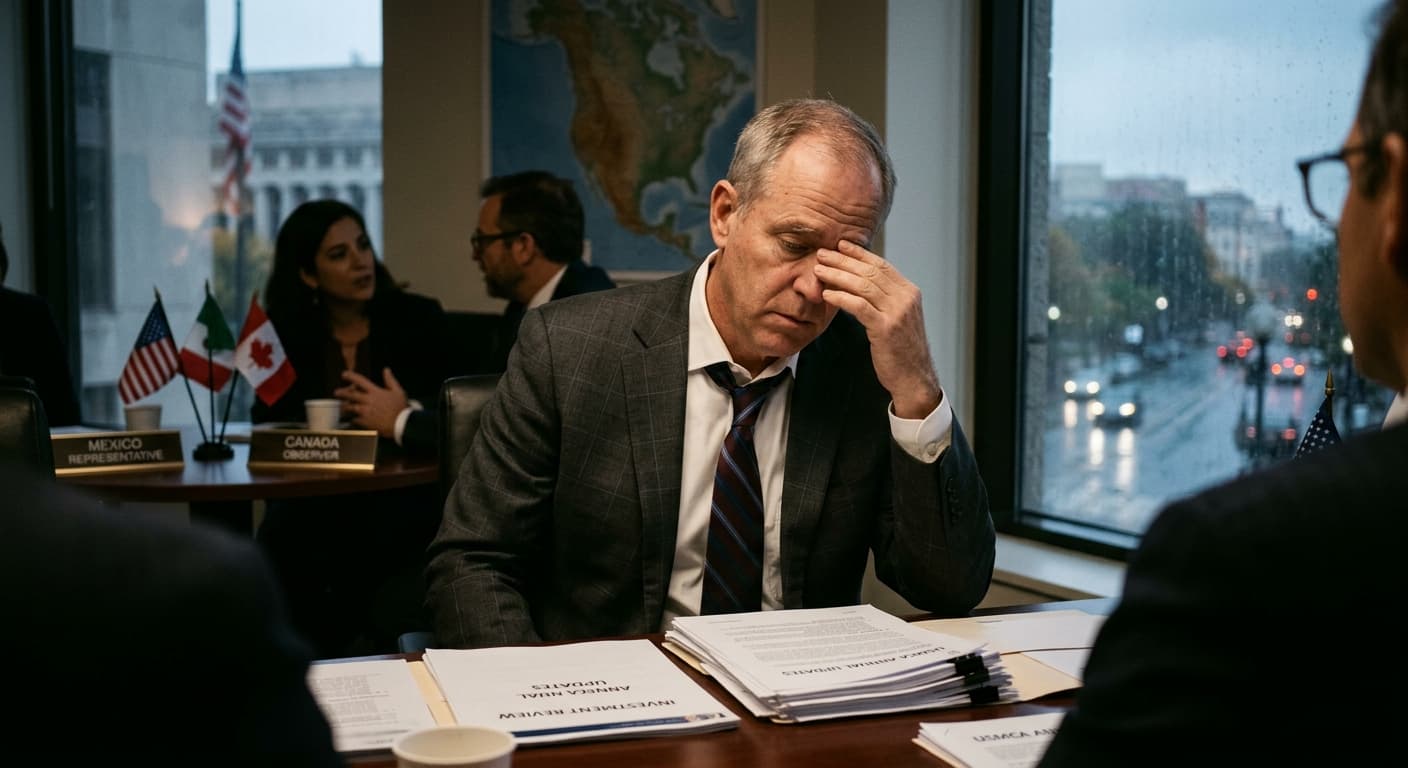
USMCA Shifts to Annual Reviews: Rules Stay, Uncertainty Deepens
Trump's July 1, 2026 decision not to renew the USMCA keeps rules intact but triggers a decade of annual reviews — the tax on North American investment is already visible.
The United States, Mexico and Canada emerged from a virtual meeting on July 1, 2026 without renewing the USMCA — a decision that keeps the pact's rules operational until 2036 but subjects a $2 trillion trade zone to annual re-litigation, converting what firms had treated as a stable regulatory floor into a rolling political variable. The immediate winner is the Trump administration, which preserves tariff leverage without the political cost of withdrawal; the loser is capital allocation across the continent, where Mexican and Canadian investment has already contracted sharply in anticipation. For markets, this is the trade-policy analogue of a central bank that neither hikes nor cuts but signals it may do either every twelve months — the volatility premium sticks.
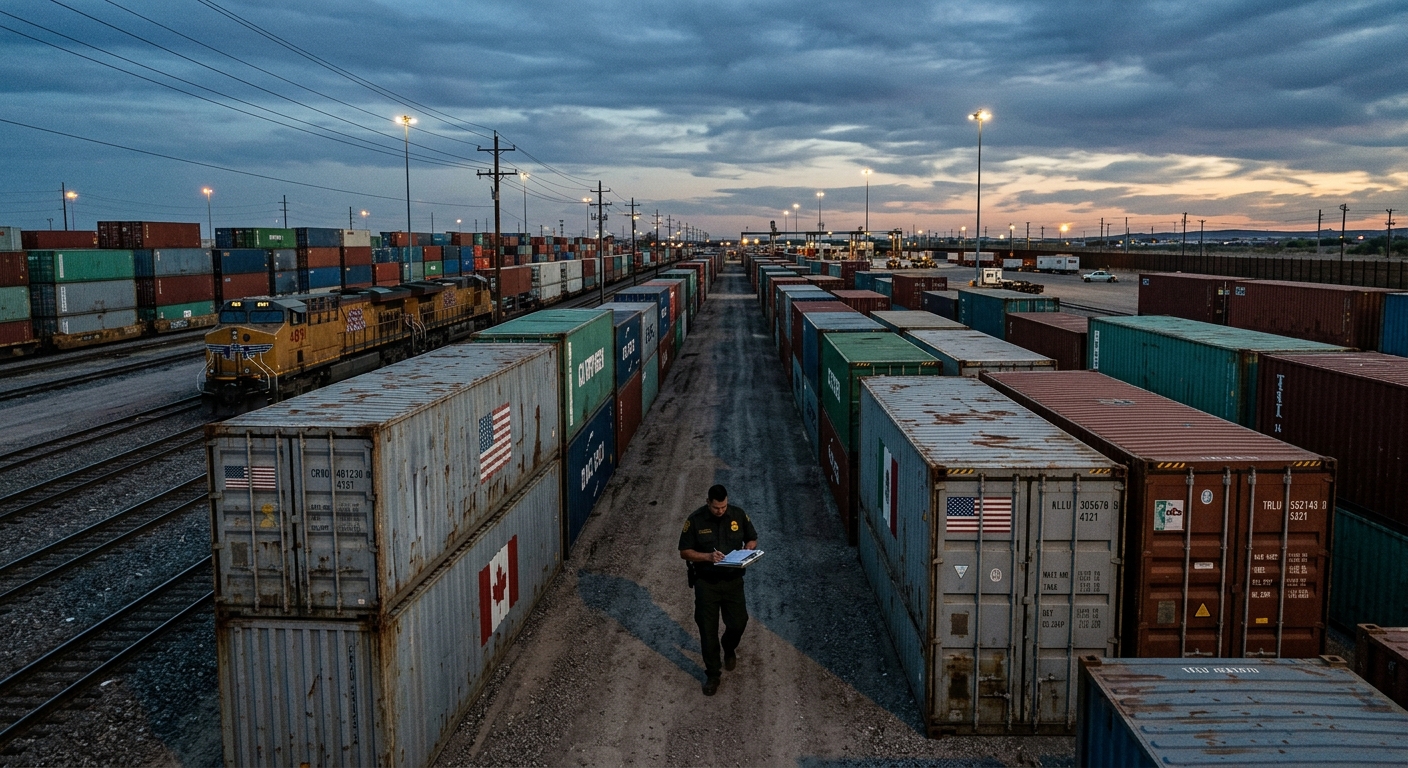
The primary document, in three sentences
The load-bearing text is short. In his official statement, US Trade Representative Jamieson Greer wrote that "the United States did not agree to renew the USMCA in its current form. As a result, the USMCA is not renewed," but added that "the Agreement remains in force pending resolution of these issues or until the Agreement's termination," according to the Office of the US Trade Representative. That is the entire mechanism: the pact does not die, it just never fully re-lives.
Under Article 34.7 of the agreement — the "sunset clause" unique to USMCA — a failure to confirm renewal at the six-year joint review triggers annual joint reviews for a decade, with hard termination on July 1, 2036 if no extension is ever agreed. The Congressional Research Service, in its formal briefing for the 119th Congress, notes that this makes USMCA "the first time such a provision has been included in any U.S. FTA," and that the joint-review track is legally separate from withdrawal, which still requires six months' written notice, according to Congress.gov. Withdrawal, importantly, would need congressional consent — a point the Senate Finance Committee wrote into its implementation report.
That legal architecture is why the market reaction has been muted rather than violent: the rules of origin, the labor Rapid Response Mechanism, and the dispute-settlement framework all remain live law. What has changed is the tenor of every board-room capex conversation in Monterrey, Windsor, and Ciudad Juárez.
The tax you cannot see on a customs form
The clean way to think about annual reviews is as an implicit option cost priced into every long-lived asset. Fitch Ratings, in the note that anchored this week's coverage, warned that maintaining USMCA via annual reviews "preserves the status quo but prolongs policy uncertainty," and singled out Mexico and Canada's 2026 GDP outlook as directly weighed down by the mechanism, according to Fitch. Fitch's judgement is not speculative — it is downstream of measurable damage already recorded in 2025 and early 2026.
CSIS, using the most recent aggregate data, calculates that total investment in Mexico contracted roughly 10% year-on-year in 2025, with public investment down more than 26% and greenfield FDI still running at roughly half the 2015–2022 average. Mexico's auto sector shed about 329,000 jobs in the first half of 2025 — its first contraction since the pandemic — and Canada lost more than 100,000 full-time jobs in the first two months of 2026 alone, according to CSIS. The World Bank, in its June 2026 Global Economic Prospects, attributes Mexico's Q1 2026 contraction to "weaker external demand and elevated trade policy uncertainty," and pencils in only 1.3% growth for 2026,
according to the World Bank.
The IMF, in its 2025 Article IV concluding statement, warned that Mexican inflation would only converge to Banxico's 3% target in the second half of 2026 and flagged trade-policy uncertainty as the dominant downside risk, according to the IMF. That is the transmission channel — annual reviews raise the country risk premium, which forces Banxico to hold rates higher for longer, which compresses growth further. The World Bank's Mexico Monthly Policy Outlook notes bluntly that "USMCA-related uncertainty" is now the pivotal variable for whether inflation eases toward 3.6% by 2028.
The parties are already negotiating around the pact
The July 1 meeting was procedurally trilateral. Substantively, negotiation is bilateral — and asymmetric. USTR has already announced a third round of US–Mexico bilateral talks the week of July 20, focused on Section 232 tariff relief, rules of origin, and Chinese-content limits, per the same Greer statement. Canada, by contrast, has not begun formal negotiating rounds, and Prime Minister Mark Carney told reporters in late June that Ottawa "won't rush to sign a bad agreement," according to the BBC.
The US demands on the table are structural, not marginal. Reuters reported in May that the Trump administration wants regional auto content raised to 82%, with 50% of that value produced in the United States — a sharp break from the current 75% regional / 40% high-wage-jurisdiction floor, according to Al Jazeera's write-up of the Reuters report. For Canada, the shortlist runs to dairy market access, removal of the digital services tax on US streamers, and dilution of Buy-Canadian procurement rules. For both, tighter screening of Chinese inputs — what CFR analyst Shannon O'Neil calls a shift from "rules of origin" to "rules of control" — is the ideological centerpiece,
according to CFR.
The non-obvious point: bilateral negotiation inside a nominally trilateral framework is itself the leverage. Brookings analysts noted that the joint review "could be anything from a meeting to discuss the agreement's operation to a full-fledged renegotiation," and that Washington is deliberately avoiding the latter because a full renegotiation would require congressional approval under expired Trade Promotion Authority, according to Brookings. Annual reviews let the executive branch extract concessions transaction-by-transaction, backed by Section 232 and Section 301 tariff authority that the Supreme Court left standing after its 2026 IEEPA ruling.
Who gains — and the historical parallel that reframes this
The direct beneficiary of annual reviews is US leverage. As CSIS put it, the parties have entered a "Hotel California" review — "you can checkout anytime you like, but you can never leave" — because withdrawal is politically prohibitive but agreement is procedurally elusive, according to CSIS. The Trump administration keeps its tariff cudgel; it also keeps the option to declare an early "win" ahead of the November 2026 midterms, or to escalate demands afterward.
The indirect beneficiary is Asia. Firms that would have expanded in Monterrey are hedging in Vietnam and Malaysia, and Chinese investment into Mexico — $2.9 billion cumulatively from 2017 to 2025 by Mexico's own count, roughly $4.6 billion including Hong Kong — is drawing renewed US scrutiny precisely because it exploits the same rules-of-origin architecture Washington now wants to rewrite, according to Brookings. The paradox: US pressure to close the Chinese backdoor is itself accelerating the near-shoring hesitation that pushes marginal investment back toward Asia.
The historical parallel worth naming is the 1988 Canada–US FTA to NAFTA transition. Between the 1988 signing and NAFTA's 1994 entry into force, Canadian and Mexican capital formation ran below trend as firms waited for rules to settle. USMCA's annual-review era rhymes with that six-year lull — except this time the uncertainty window is ten years, not six, and the sunset is real. That is the structural difference from the NAFTA renegotiation cycle: NAFTA had no self-destruct switch. USMCA does.
Diplomat View
The story markets are pricing wrong is not withdrawal risk — it is duration risk. A negotiated extension before the 2028 US election is the base case, but the terms will be materially worse for Mexico and Canada than a clean 2026 renewal would have been, and the intervening 18–24 months will keep greenfield FDI depressed. The forecast changes if: (1) a Mexico–US deal closes before the November 2026 midterms and Canada is folded in early 2027, which would compress the risk premium fast; (2) a 2028 Democratic administration inherits a partly-renegotiated framework it declines to ratify, extending uncertainty into a second decade; or (3) the Supreme Court further constrains Section 232 authority, gutting Washington's leverage and forcing an accelerated deal. Track the auto rules-of-origin text: if the 82/50 formula survives the July 20 round in anything close to its current form, Canada's leverage collapses, Mexican assembly plants absorb the compliance cost, and the peso carries the adjustment. Fitch's sovereign ratings for Mexico and Canada are the market's cleanest gauge of whether annual reviews are being priced as noise or as regime change — watch for the first downgrade watchlist action.
The bottom line: The USMCA did not die on July 1, 2026 — it was placed on a ten-year life-support drip that keeps the rules alive while draining investment predictability. Washington gets leverage; Ottawa and Mexico City get to keep market access at the price of permanent renegotiation; and the real winner of North America's ambivalence is every Asian supply chain that no longer has to compete with a settled continental production platform.
What to watch
- Week of July 20, 2026 — Third US–Mexico bilateral round. The auto rules-of-origin text is the tell.
- November 3, 2026 — US midterms. If Republicans hold both chambers, expect harder demands in 2027; if not, expect Trump to seek a photo-op deal before year-end.
- Q4 2026 Fitch and Moody's sovereign reviews — First real test of whether ratings agencies price annual reviews as a persistent risk premium or as absorbed noise.
Related: Global Politics
Discover more
Global Politics
Trump's Conflicting Messages on Iran War
Trump's mixed messages on Iran reflect a strategy of audience management, benefiting Tehran amid a complex geopolitical landscape.

India
Delhi CM Rekha Gupta Blasts Opposition's Delm
Delhi CM Rekha Gupta's remarks on women's quota defeat reveal BJP's strategy for the 2029 Lok Sabha elections, focusing on delimitation.

International Relations
Pakistan's Key Role in US-Israel-Iran Meddle
Pakistan is seeking to mediate the US-Israel-Iran conflict, balancing high-stakes diplomacy against severe economic pressures and steep regional challenges.

Economics
Fed's Amex AML order puts correspondent banking on notice
Federal Reserve's Amex AML order requires board-level controls and a 90-day plan; OCC fined the bank $350 million over enterprise-wide deficiencies.