Zimbabwe's Term-Extension Law Redraws SADC's
A new template for term limits in Southern Africa
Model Diplomat7 min readSouthern Africa
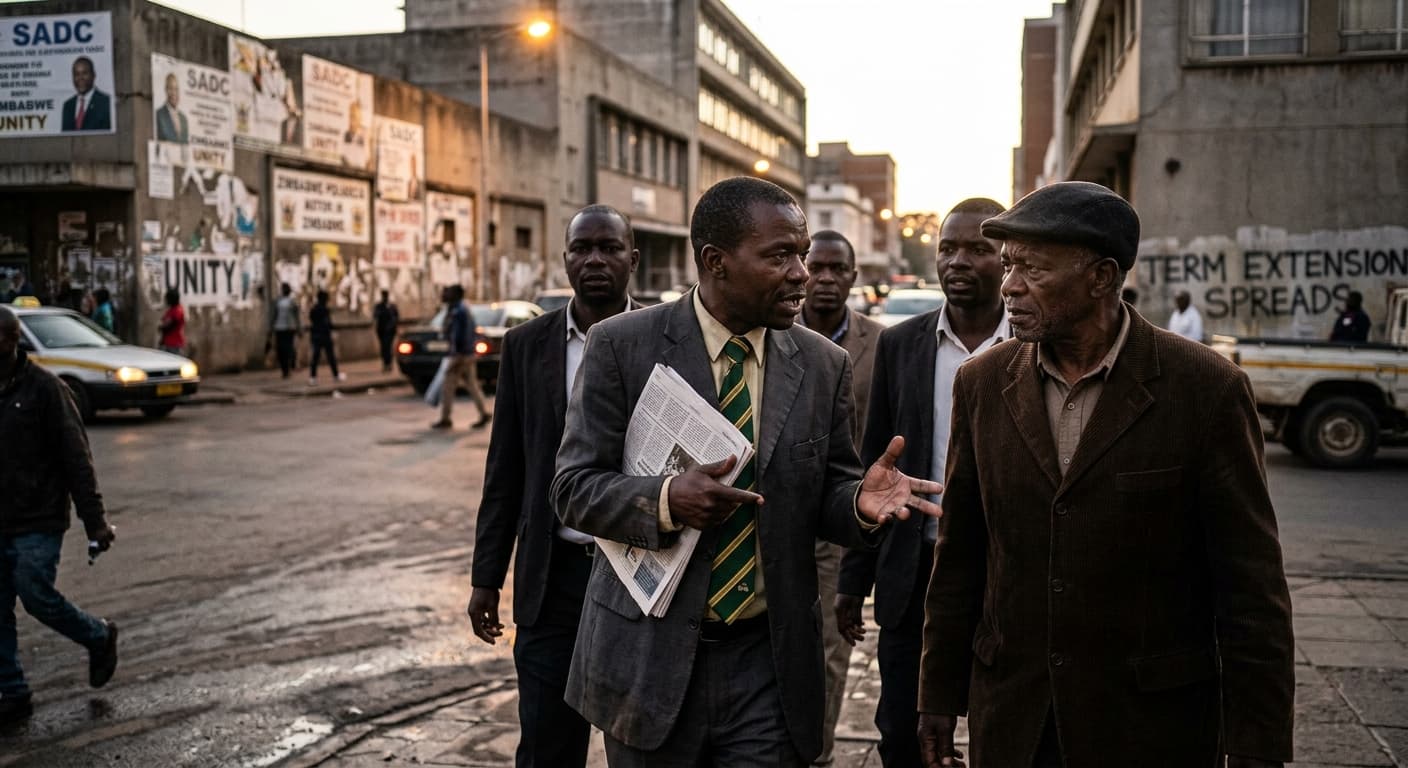
Zimbabwe's Term-Extension Law Redraws SADC's Rules
Mnangagwa signed Constitutional Amendment No. 3 on July 7, 2026, extending his term to 2030 and scrapping direct presidential elections — a template for Southern Africa's next incumbents.
Zimbabwe's Constitutional Amendment No. 3, signed into law by President Emmerson Mnangagwa on July 7, 2026, does more than keep an 83-year-old ruler in office until 2030 — it hands every Southern African incumbent facing an inconvenient term limit a fully worked template for a "constitutional coup" that requires neither soldiers nor a referendum. Passed by 216 votes to 42 in the National Assembly and 75 to 4 in the Senate, extending presidential and parliamentary terms from five to seven years and transferring the choice of president from voters to lawmakers, the law is the clearest signal yet that the ZANU-PF playbook — captured court, disciplined caucus, ambient intimidation — now travels. According to the Institute for Security Studies, 19 of 24 African attempts to amend constitutions to extend executive power since 2002 have succeeded. Zimbabwe just added the 20th.
What the law actually does
The amendment was gazetted on February 16, 2026 and rammed through in under five months. It extends presidential and parliamentary terms from five to seven years, retroactively postpones the 2028 general elections to 2030, and abolishes the direct presidential vote held since 1990 in favour of election by a joint sitting of the two chambers. According to Human Rights Watch, the 2013 Constitution had limited a president to two five-year terms and would have required Mnangagwa to step down in 2028; the new law effectively grants him a further two years and hands his successor's selection to a chamber where ZANU-PF holds a two-thirds majority.
The government's legal cover is a semantic one. Justice Minister Ziyambi Ziyambi told parliament on June 3, 2026 that the bill was "not an abandonment of our constitutional order in any way, shape or form but a continuation of it," a line reported by Al Jazeera. ZANU-PF Treasurer General Patrick Chinamasa framed it as merely "elongating the electoral cycle," not extending a term. But section 328(7) of Zimbabwe's constitution states that any amendment "the effect of which is to extend the length of time that a person may hold or occupy any public office" cannot apply to a sitting incumbent, and that section 328 itself may only be amended by referendum — a threshold the government simply refused to meet.
The gate that was supposed to hold — the Constitutional Court — did not. In May 2026 the bench reserved judgement on multiple challenges. On June 17, one day before the National Assembly vote, it dismissed a case brought by Lovemore Madhuku of the National Constitutional Assembly on procedural grounds, according to Human Rights Watch. Earlier war-veteran-led challenges had been struck off the court roll for technical reasons, as
Al Jazeera reported. The Brookings Institution notes that ZANU-PF only regained its two-thirds majority through serial recalls of opposition MPs after the 2023 election, then swept the subsequent by-elections — a slow-motion capture of parliament described by scholars
Chipo Dendere and Miles Tendi as the enabling condition of everything that followed.
The regional template — and who benefits
The load-bearing claim of this story is not about Zimbabwe. It is that Harare has just packaged the two most durable term-extension tricks into a single, off-the-shelf mechanism: switch to indirect election, then re-baseline the calendar. Togo did the first in April 2024; Chad did the second in October 2025; Zimbabwe has now fused them.
Togo's 2024 reform, approved 87-0 on second reading, moved the country from a presidential to a parliamentary system and stripped voters of a direct choice, as Al Jazeera documented. Opposition and Togolese Catholic bishops called it a "constitutional coup d'état"; the
Institute for Security Studies noted the amendment was rushed through by a parliament whose mandate had expired the previous December. Faure Gnassingbé, whose family has ruled since 1967, now sits as President of the Council of Ministers — the real executive — for a renewable six-year term. The Zimbabwean amendment's replacement of direct election with a joint sitting of parliament is functionally the same move.
Chad went the other way. On October 3, 2025, Mahamat Idriss Déby finalised amendments that abolished term limits and lengthened each term from five to seven years, as Human Rights Watch reported. Zimbabwe copied the seven-year clause verbatim in intent, if not in text.
The Democratic Republic of the Congo is next. On June 15, 2026 — a week before Zimbabwe's Senate vote — the DRC Senate adopted a constitutional revision bill that would allow a referendum on a new constitution under which Félix Tshisekedi's previous terms would not count, according to the Institute for Security Studies. Tshisekedi told a Kinshasa press conference on May 6 that he would accept a third term "if the people want it,"
BBC News reported. The Zimbabwean precedent — court-blessed, parliamentarily laundered, regionally unpunished — arrives just in time to inform his 2028 calendar.
SADC's silence is the story
The African Union has a rule against exactly this. Article 23(5) of the African Charter on Democracy, Elections and Governance treats "any amendment or revision of the constitution or legal instruments" that infringes on democratic change of government as an "illegal means of accessing or maintaining power" warranting sanctions, as the ISS Peace and Security Council Report sets out. In practice the AU has invoked it only against Burundi's Pierre Nkurunziza in 2015–16. The Southern African Development Community's own
Principles and Guidelines Governing Democratic Elections require "full participation of the citizens in the political process" — a standard the shift to parliamentary election of a head of state visibly does not meet.
Yet no SADC head of state has publicly opposed the amendment. That silence is not surprising: as ISS analyst Zenge Simakoloyi has noted, "lawfare" tactics have already been rolled out in Zambia, Tanzania, the DRC and Togo, cited in the same ISS Africa analysis that first called Mnangagwa's manoeuvre a constitutional coup. The Bertelsmann Stiftung's 2026
Regional Report on Southern and Eastern Africa flagged Zimbabwe as a "hard autocracy" showing "virtually no signs of political opening" and warned that "strong presidencies, personalistic rule and disputes over extended terms" now pose the region's dominant autocratisation risk.
Even the European Union declined to condemn. EU Ambassador Katrin Hagemann told Harare's Herald that constitutional amendments were a "sovereign prerogative" — a formulation ISS Africa's David Coltart notes cannot be tested because no referendum was held. The African Development Bank-led debt restructuring process, worth billions to a Treasury under sanctions, gives external creditors a reason to look away.
The opposition's argument, laid out by former finance minister Tendai Biti and Bulawayo mayor Coltart, is that the anti-third-term architecture of the 2013 constitution has just been demolished in plain sight. As Coltart put it in an ISS Africa commentary:
"There is layer upon layer of constitutional safeguards to protect [term limits] … If the effect of any constitutional amendment were to extend a term limit, then you need a referendum. It doesn't matter how you couch it, what language you use."
What to watch
- October 2026 ZANU-PF conference. The party resolution that started this — the 2024 Bulawayo decree that Mnangagwa's term must run to 2030 — will meet its successor. Watch for a resolution reopening the two-term ceiling entirely, or naming a family-line successor. Vice-President Constantino Chiwenga's faction, whom Mnangagwa is reported by
ISS Africa to have quietly stripped of military allies, is the internal veto point.
- DRC referendum bill. The revision bill adopted by the Congolese Senate on June 15, 2026 still requires a Tshisekedi decree to trigger a referendum. A move before the 2028 election calendar collapses — a scenario Tshisekedi has already floated in public — would confirm the Zimbabwean template is being copied in real time.
- SADC Summit, August 2026. Zimbabwe hosts the rotating chair. Any communiqué language on "constitutional governance" or Article 23 of the AU Charter — or the absence of it — will tell debt creditors, election observers and would-be imitators whether the bloc has quietly retired term limits as a regional norm.
- Constitutional Court, pending challenges. Youngerson Matete's High Court petition to void enactment without a referendum, and follow-on cases from the Constitutional Defenders Forum and Amalgamated Rural Teachers' Union, remain live. A single successful ruling on section 328(7) — unlikely, but not impossible — would reopen the file.
The Bottom Line
Zimbabwe's Constitutional Amendment No. 3 is not a domestic story about one 83-year-old president buying two more years. It is Southern Africa's first fully documented, court-blessed, referendum-free playbook for turning term limits into an internal party matter — and it lands on the desks of Kinshasa, Kampala and Kigali at exactly the moment their own calendars turn. If SADC's August summit produces no rebuke and the DRC follows in 2027, the working assumption of every incumbent in the region will shift: term limits are now negotiable in parliament, not enforceable at the ballot box.
Discover more
US Politics
Congress Targets AI Chatbot Access for Terror
The House passed the Generative AI Terrorism Risk Assessment Act, focusing on AI's role in terrorism and potential surveillance implications.

US Politics
White House Pressures Congress for Crypto Leg
The Trump administration's push for the CLARITY Act aims to reshape crypto regulation, impacting trillions in market value and the Trump family's wealth.

US Politics
SNAP Food Assistance Faces Legal Challenges
In 2026, SNAP faces stricter eligibility rules and mounting legal challenges, threatening food assistance for the millions of Americans who rely on the program.

Economics
Fed's Amex AML order puts correspondent banking on notice
Federal Reserve's Amex AML order requires board-level controls and a 90-day plan; OCC fined the bank $350 million over enterprise-wide deficiencies.