US Withdraws from South China Sea Talks
Washington's retreat leaves ASEAN to negotiate with China
Model Diplomat7 min readSoutheast Asia
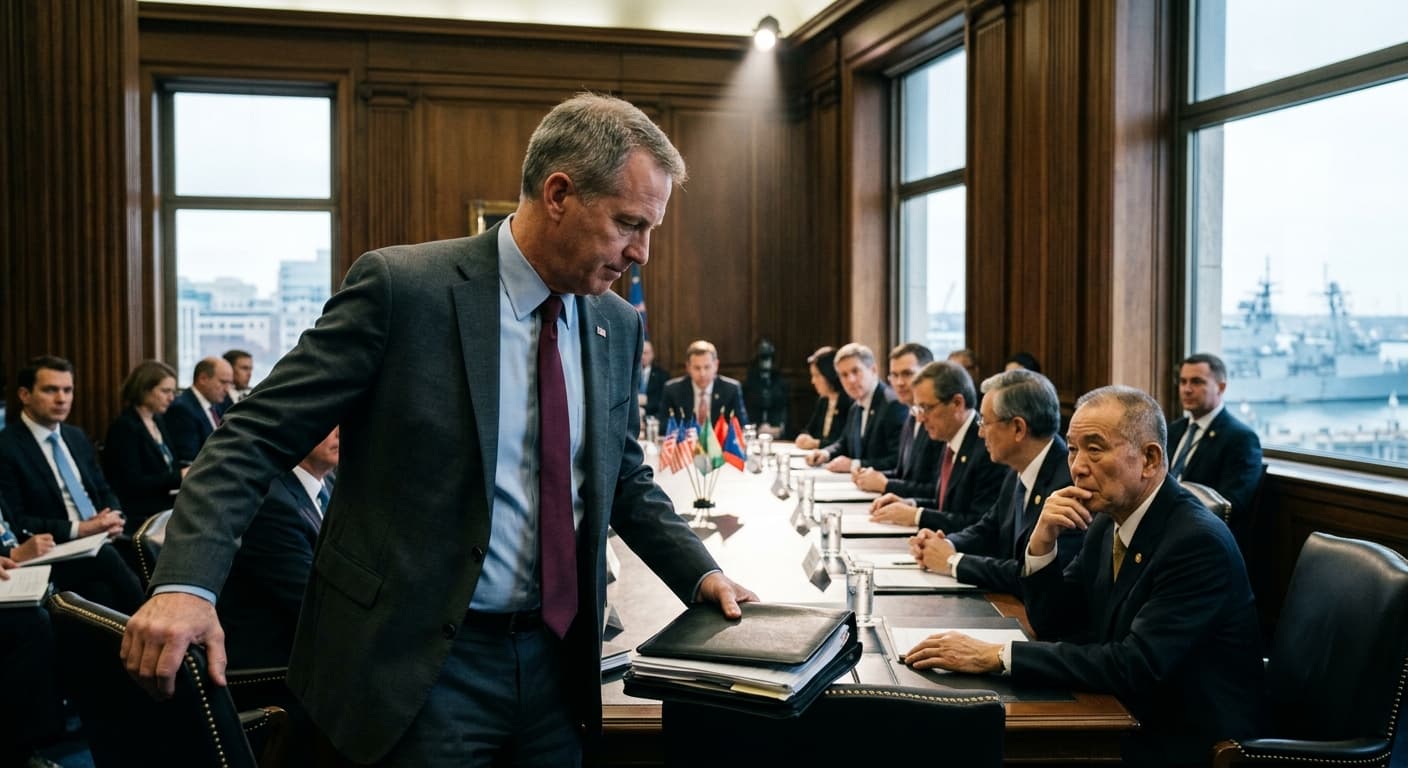
US Steps Back from South China Sea Code of Conduct Talks
Washington's new ASEAN ambassador tells Jakarta the Code of Conduct is "fundamentally" for ASEAN and China — leaving Manila to lead a bloc split down the middle as Beijing consolidates gains at Scarborough.
The United States has pulled its diplomatic weight off the scales of the South China Sea Code of Conduct negotiations at the precise moment the Philippines, as 2026 ASEAN chair, is trying to force a deal — a withdrawal that hands Beijing the outcome it has spent 24 years engineering and puts the burden of confrontation squarely on Manila and Hanoi. Speaking in Jakarta on July 7, US Ambassador to ASEAN Yeouk "Kevin" Kim told reporters the COC is "fundamentally … a discussion and negotiations between ASEAN and China," a formulation reported by The Jakarta Post that reverses a decade of active US pressure for a binding, UNCLOS-anchored text.
The subtext is not neutrality. It is triage. The Trump administration's State Department, having laid off roughly 1,300 staff last July — including the Office of Multilateral Affairs that ran Washington's ASEAN and South China Sea files — has neither the bandwidth nor the political appetite to police Southeast Asia's maritime commons. According to CSIS's Southeast Asia program, that reduction-in-force gutted the very team that had organised Secretary Marco Rubio's Kuala Lumpur trip a year earlier. Kim's Jakarta remarks were the doctrine that follows the layoffs.
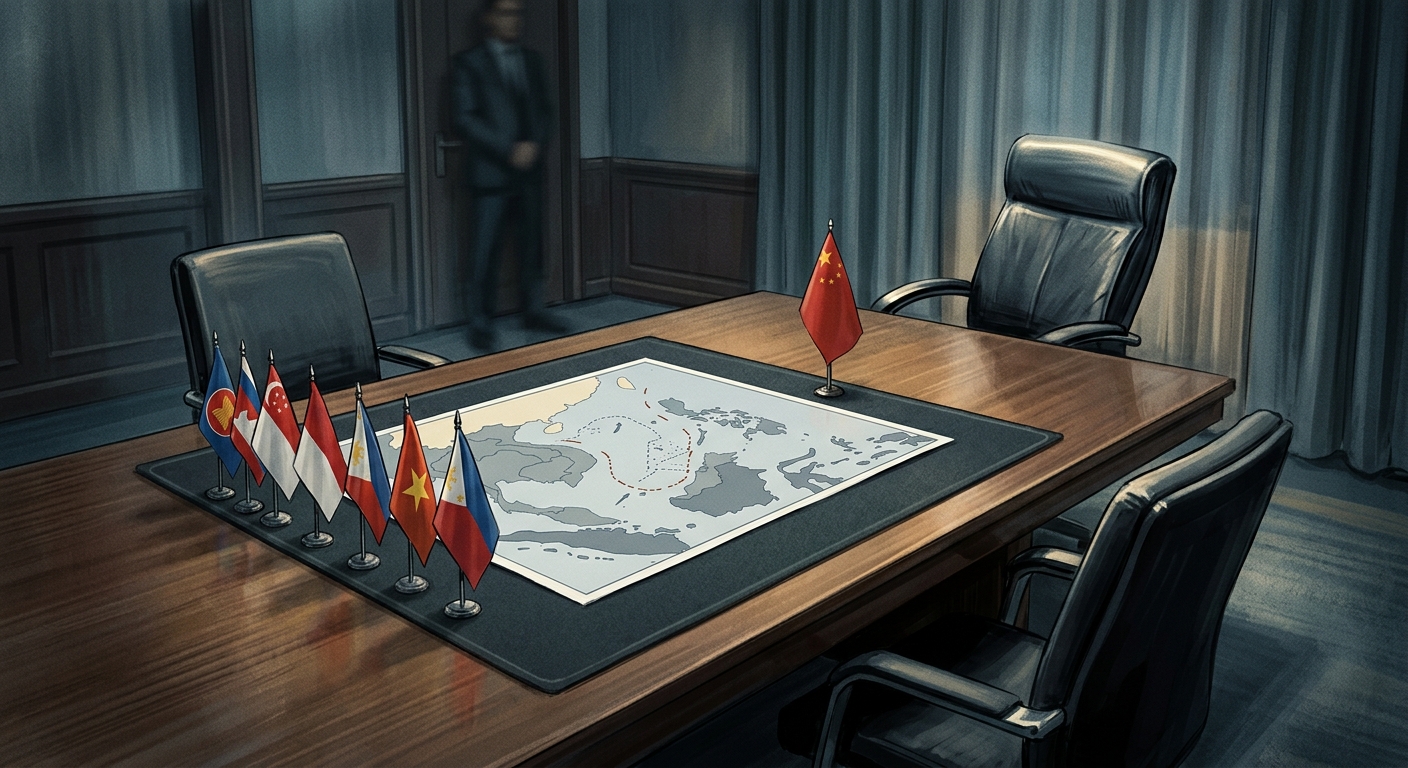
What Kim actually said — and what it means
Kim, confirmed by the Senate 46–43 on May 18, 2026 after the post sat vacant for more than a year, chose his first major media engagement to draw a line. Washington, he said, "will always engage with ASEAN and its member states to ensure that the United States' interests are protected," but the COC itself belongs to the ten member states and China. The Senate floor record confirms the vote and Kim's title as Representative to ASEAN with the rank of Ambassador.
The phrasing matters. Under Barack Obama and Joe Biden, US officials publicly demanded a "substantive" COC "in accordance with UNCLOS" — language that functioned as diplomatic cover for Vietnam, the Philippines and Indonesia against Chinese pressure. In 2020, then–Secretary of State Mike Pompeo declared Beijing's expansive claims "completely unlawful," a statement Brookings analyst Ryan Hass noted was designed to give Southeast Asian claimants legal air cover in exactly these talks. Kim's Jakarta remarks retire that cover.
The bloc is not ready to carry the weight alone. Philippine Foreign Secretary Ma. Theresa Lazaro told a Washington audience at CSIS in June that ASEAN and China are still stuck on four "milestone" issues — scope, legal bindingness, the COC's relationship to the 2002 Declaration, and even the definition of "self-restraint." "Almost 10 years now they haven't defined self-restraint," she conceded. The self-imposed July 2026 deadline set by ASEAN ministers in 2023 has now passed without a text.
The winner is Beijing, and it isn't close
Chinese Foreign Minister Wang Yi has spent 2025–26 promising to "complete consultations this year" — a formulation that rewards China regardless of outcome. If a deal lands, it will be the thin, non-binding text Beijing prefers, dressed up as a diplomatic breakthrough. If it doesn't, China blames "outside interference" and pockets another year of on-the-ground consolidation. Gregory Poling of CSIS's Asia Maritime Transparency Initiative warned nearly a decade ago in "This Isn't the COC You're Looking For" that the framework was "a delaying tactic and a public relations coup for Beijing" — a diagnosis the intervening years have vindicated.
The consolidation is measurable. On September 10, 2025, China declared a "nature reserve" at Scarborough Shoal, an 8,700-acre zone that AMTI documented as a legal pretext to restrict Philippine fishing rights that the 2016 arbitral tribunal expressly protected. Since then, the China Coast Guard has surged its presence at the shoal to levels
AMTI describes as "beyond any previously observed CCG activity in the South China Sea since AMTI began regular AIS tracking in 2019." A 6-by-6-metre "temporary research structure" appeared inside the lagoon on May 25, 2026. On June 11, Beijing sanctioned Philippine Defence Secretary Gilberto Teodoro, barring him and his family from entering China, a step
Al Jazeera reported as an escalation without recent precedent.
Every one of those moves happened while COC talks continued. That is the point. The negotiation is not a brake on Chinese behaviour — it is the ambient noise that lets the behaviour continue.
ASEAN's arithmetic problem
The bloc cannot generate the consensus a strong COC would require. Cambodia and Laos, on the receiving end of substantial Chinese lending and infrastructure, have repeatedly blocked collective statements that name Beijing. Malaysia and Thailand prefer quiet diplomacy. Only the Philippines, Vietnam and — on the Natuna question — Indonesia are pushing for binding language. The Congressional Research Service estimates roughly $3.4 trillion in trade transits the sea annually, about 21% of global commerce; 64% of China's maritime trade moves through the waterway, versus just 14% of America's. That asymmetry — China's dependence is four times Washington's — is why Beijing will keep grinding, and why the US may have decided the marginal return on active mediation no longer justifies the diplomatic capital.
Chatham House's Ben Bland put it plainly in December 2025: with Philippine-China tensions "high with frequent confrontations at sea, it is very unlikely that CoC negotiations will reach a successful conclusion with the Philippines at the helm." His analysis urged Manila to pivot toward confidence-building measures — hotlines, drill notifications, joint search-and-rescue — rather than chase a text that will either fail or be worthless.
Manila is already hedging. At the ASEAN Defence Ministers' Meeting Plus last November, US Defense Secretary Pete Hegseth and Secretary Teodoro jointly launched Task Force Philippines, a US Indo-Pacific Command unit of roughly 60 permanent personnel focused on allied response to South China Sea contingencies. CSIS analysts Andreyka Natalegawa and Japhet Quitzon call this the "rhetoric versus reality" of ASEAN chairmanship: Manila will preach centrality in the COC room and build minilateral deterrence outside it. The Philippines has, in effect, decided the code of conduct is a diplomatic ritual, not a security instrument.
Why Washington's step-back is not the same as abandonment
Read narrowly, Kim's statement is uncontroversial. The United States is not a claimant. It never had a seat at the COC table. Every previous administration nominally deferred to "ASEAN centrality." What has changed is the tone of ambient pressure. Rubio's meeting with Wang Yi on the sidelines of the July 2025 Kuala Lumpur summit was described as "positive and constructive," and Trump was invited to Beijing — a diplomatic register that Southeast Asian foreign ministries read as declining willingness to spend US leverage on maritime disputes that primarily benefit smaller partners.
The Task Force Philippines announcement, the ongoing Enhanced Defence Cooperation Agreement base expansions, and the Atlantic Council's dispatch from Manila documenting the "one theater" approach with Japan, Australia and Taiwan tell a different story: Washington is shifting from multilateral rules-writing to bilateral hardware and posture. It is a bet that deterrence over Scarborough and Second Thomas Shoal is bought with radars and marines, not with treaty text.
The bet may be correct. It is not without cost. Vietnam, Indonesia and Malaysia — states that will not sign onto a US-led military coalition — lose their most useful diplomatic backstop when Washington disengages from the COC. Hanoi in particular has quietly relied on US legal and rhetorical support to hold its line on the Vanguard Bank and other blocks. Kim's Jakarta framing tells those capitals they are on their own.
Diplomat View
The US step-back is a rational triage move, but it accelerates the outcome it purports to be neutral about. With Washington off the field, the COC will either be finalised as a thin, non-binding document that legitimises Chinese activity — Beijing's optimum — or it will collapse quietly, leaving the 2002 DOC as the only text in place while China builds facts at Scarborough and the Spratlys. Either way, the pressure moves onto bilateral US-Philippines deterrence and on Vietnam's quiet lawfare. The forecast changes if two things happen: if the Philippine Senate ratifies expanded US basing under EDCA and Vietnam publicly joins a coordinated legal push on the 2016 award's tenth anniversary this month, ASEAN's claimant caucus effectively forms without needing bloc consensus. If instead Manila settles for the watered-down text CSIS's Manila Strategy Forum warned about — trading legal force for a signed piece of paper before its chairmanship ends — the code of conduct becomes the funeral notice for UNCLOS in Southeast Asia, not its ratification.
What to watch
- July 12, 2026 — Tenth anniversary of the arbitral tribunal award. Watch whether Manila, Hanoi and Jakarta issue coordinated statements, and whether Kim's mission publishes one at all.
- ASEAN Foreign Ministers' Meeting, Manila (late July 2026) — The COC text, or absence of one, and the communiqué language on Scarborough. A vague reference to "self-restraint" without naming China is Beijing's win.
- ASEAN Summit and East Asia Summit, Manila (November 2026) — Marcos's last chance as chair to deliver either a binding COC or a face-saving political declaration. The Chatham House base case says neither lands.
- US Senate FY27 State Department appropriations markup — Whether Congress restores the Office of Multilateral Affairs positions cut in July 2025 is the leading indicator of whether Kim's step-back is doctrine or drift.
The Bottom Line
The bottom line: Washington's withdrawal from the Code of Conduct table is not neutrality — it is a decision to stop subsidising a negotiation that was going to end on Beijing's terms anyway, and to redirect its leverage into bilateral deterrence with Manila. The Philippines now chairs a bloc it cannot unify, negotiates a text it cannot make binding, and confronts a China that has spent twenty-four years learning exactly how long ASEAN will wait. Whatever emerges from Manila this year will be signed by ten flags and written by one.
Discover more

India
Women's Reservation Bill 2026: A Political Sh
India's Lok Sabha rejected the Women's Reservation Bill, exposing a political maneuver to redraw electoral maps favoring the north over the south.
US Politics
SNAP Food Assistance Faces Legal Challenges
In 2026, SNAP faces stricter eligibility rules and mounting legal challenges, threatening food assistance for the millions of Americans who rely on the program.
US Politics
U.S. House Passes Alert Act for Aviation
The House passed the ALERT Act 396–10, replacing the ROTOR Act after Pentagon intervention, impacting aviation safety regulations.

Economics
Fed's Amex AML order puts correspondent banking on notice
Federal Reserve's Amex AML order requires board-level controls and a 90-day plan; OCC fined the bank $350 million over enterprise-wide deficiencies.